


California’s Central Coast can feel like a single dreamlike shoreline when you are driving Highway 1, but choosing where to sleep along it has real consequences for your budget, driving time and the kind of trip you will remember. From wave-lashed Big Sur cliffs to vineyard-dotted Paso Robles and the Spanish architecture of Santa Barbara, each town offers a different mix of scenery, walkability, dining and price. This guide compares the key Central Coast bases so you can decide where to book for aquarium days, Big Sur views, wine tasting weekends, beach holidays, romantic escapes or affordable family trips.
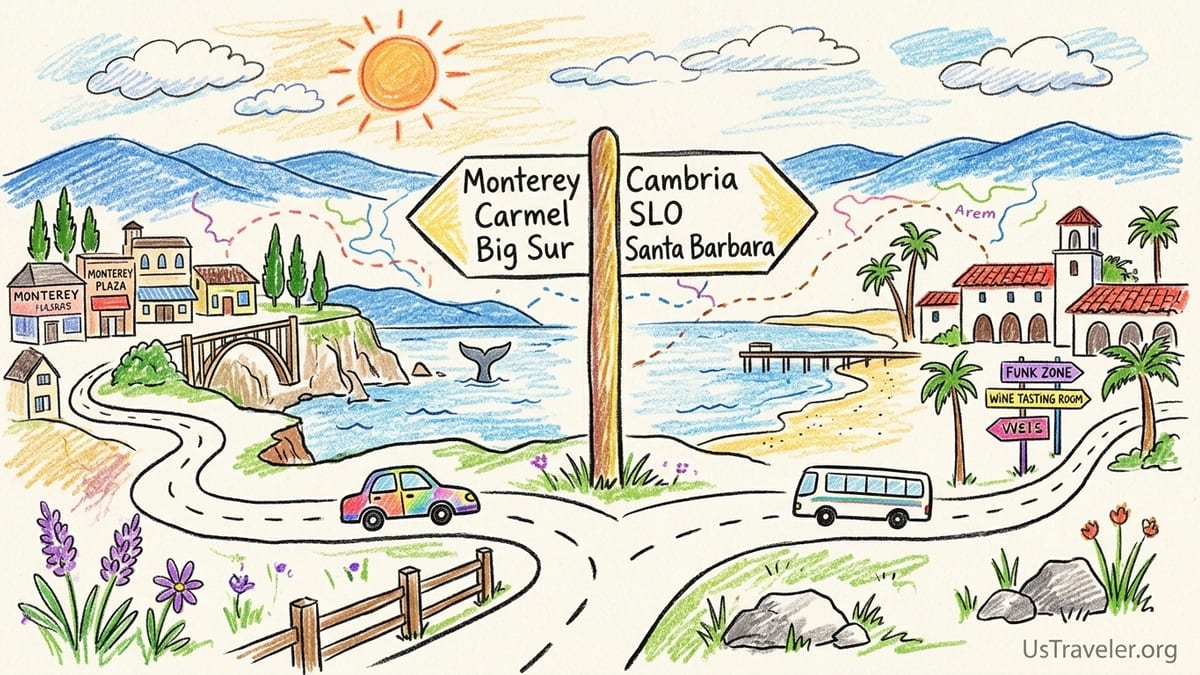
How to Choose Your Central Coast Base
The stretch of coast between roughly Santa Cruz and Ventura includes a dense cluster of small destinations that look close together on a map but feel very different on the ground. Monterey, Carmel-by-the-Sea, Pacific Grove and nearby Big Sur form the northern gateway to the region, while Cambria, San Simeon, Morro Bay, San Luis Obispo, Pismo Beach, Avila Beach, Paso Robles, Santa Barbara and Ventura shape the center and south. Distances are short in miles but slow in minutes because much of Highway 1 is winding two-lane road, especially around Big Sur. That means your hotel location can easily add an extra hour or more to every day of sightseeing if you choose poorly for your priorities.
Before you book, decide what matters most. If you want easy access to the Monterey Bay Aquarium and whale watching, Monterey or Cannery Row make sense. If iconic Big Sur scenery is the priority, consider a splurge night at Ventana Big Sur or Post Ranch Inn or plan day trips from more affordable bases like Carmel or Cambria. For wine trips, Paso Robles and Carmel Valley Ranch place you near vineyards, while Santa Barbara has an urban tasting room scene and nearby Santa Ynez Valley wineries. Families looking for a relaxed beach holiday may prefer Pismo Beach, Avila Beach or Ventura. Couples on a romantic escape often gravitate to Carmel-by-the-Sea, Cambria’s Moonstone Beach, or upscale Santa Barbara properties such as Hotel Californian.
The other key factor is price. Central Coast lodging has risen in cost in recent years, especially in peak summer, over holiday weekends and during major events such as Monterey Car Week in August or university graduation weekends in San Luis Obispo and Santa Barbara. In many towns a simple roadside motel can reach or exceed 250 to 300 dollars per night during these periods, while premium oceanfront hotels and Big Sur resorts can climb well above 1,000 dollars per night. Parking fees, resort charges, taxes and breakfast policies vary significantly between properties and can add a substantial amount to your nightly cost.
To help you compare, this guide uses example midweek dates in the same shoulder season period, outside major holidays or event weeks, when checking publicly available flexible, free-cancellation rates on hotel booking engines or official hotel sites. Prices and policies change frequently, but using identical dates for checks makes it possible to compare the relative cost and value of different areas in a realistic way.
Big Sur Scenery and Why Lodging Costs So Much
Big Sur is the visual star of the Central Coast. Towering cliffs, cypress trees, and the Bixby Creek Bridge are what travelers picture when they dream of driving Highway 1. Yet relatively few travelers actually sleep in Big Sur. The reason is simple: supply. The stretch between roughly Carmel Highlands and Ragged Point has a strict combination of protected land, rugged topography and limited development, so there are only a handful of lodges, campgrounds and small inns. High demand plus low room count means prices stay elevated for much of the year.
Flagship properties such as Ventana Big Sur and Post Ranch Inn illustrate this reality. Even on non-holiday weekdays in shoulder seasons, publicly available flexible rates for standard rooms often fall into the four-figure range per night for two adults, before tax and fees, with minimum-night stays during peak periods. These rates typically include more than just a bed. Ventana Big Sur, for example, sells itself as an adults-focused, all-inclusive style resort experience with meals and some activities included in many packages. Post Ranch Inn emphasizes privacy, architecture and fine dining, with ocean or mountain-view standalone units. Parking is usually included, but resort fees and service charges may apply, and advance deposits and stricter cancellation terms are common compared with mid-market coastal hotels.
Other Big Sur options, such as rustic cabins or glamping tents near the Big Sur River, tend to be less expensive in absolute terms but still command a premium relative to inland motels. On the identical sample dates, a basic cabin or tented site with shared facilities can price comparably to a comfortable standard hotel room in Monterey or Pismo Beach. That is the Big Sur premium at work. Limited supply and extraordinary scenery let even simple accommodation charge more than you might expect in another rural area.
Because of this pricing pattern, many travelers treat Big Sur lodging as a special splurge for one or two nights rather than a full-week base. A common strategy is to stay primarily in Monterey, Carmel or Cambria, then book a single memorable night at Ventana Big Sur or a similar lodge, using the more affordable bases for the rest of the trip. The trade-off is additional driving time into and out of the Big Sur section, but for many budgets this is the only way to experience a Big Sur sunrise or sunset without paying top-tier luxury prices for an entire week.
Monterey, Cannery Row and Pacific Grove vs Carmel and Big Sur
Monterey, Carmel-by-the-Sea and Pacific Grove wrap around the southern edge of Monterey Bay. The Monterey Bay Aquarium sits at the heart of Cannery Row, which is fronted by waterfront hotels that appeal strongly to families and first-time visitors. The Monterey Plaza Hotel & Spa and InterContinental The Clement Monterey are the flagship properties here. On common midweek shoulder-season dates, typical flexible rates for a standard room for two often land somewhere in the 350 to 600 dollar range per night before tax, depending on view category and demand. Parking can add an additional nightly cost, often in the 30 to 50 dollar range for valet or garage parking. Resort-style fees are sometimes charged on top, which may include amenities like Wi-Fi, spa access or bicycle use, so it is important to check the fee breakdown during booking. Breakfast is usually not included in the base rate but can be added as a dining package or paid for a la carte.
Pacific Grove, directly west of Cannery Row, offers a quieter residential feel with classic motels, small inns and a scenic, rocky waterfront. On the same dates, many Pacific Grove properties list standard rooms in roughly the 180 to 320 dollar range before tax. Parking is often included or modestly priced, and resort fees are less common. Walking access to tide pools and coastal trails is excellent, but you will likely drive five to ten minutes to reach the aquarium or Old Fisherman’s Wharf for whale watching departures.
Carmel-by-the-Sea, a 10- to 15-minute drive south of Monterey, feels like a European village with storybook architecture, art galleries and a sheltered beach. Lodging here is dominated by small inns, boutique hotels and bed-and-breakfast properties. For the same sample dates, Carmel inn rates often begin around 250 to 350 dollars per night for smaller rooms and climb to 600 dollars and beyond for larger suites, ocean views or luxury brands. Many Carmel inns include complimentary breakfast, afternoon wine receptions or on-site parking in the room rate, though some charge a nightly parking fee due to tight street space. Carmel Valley Ranch, a more resort-like property inland in Carmel Valley, combines villa-style accommodations with golf, pools and on-site vineyards. It frequently commands nightly rates that compete with higher-end Carmel-by-the-Sea properties while offering more resort features but requiring a 15- to 25-minute drive to the coast.
Compared with these, Big Sur resort rates are markedly higher for equivalent dates and more restrictive on cancellation and deposits. For travelers whose priorities are aquarium access, whale watching and day trips into Big Sur, it often makes sense to base in Monterey, Carmel or Pacific Grove and treat Big Sur as a drive rather than a nightly destination. Typical driving times from central Monterey to Bixby Creek Bridge are about 30 to 40 minutes in light traffic, while reaching popular stops near Pfeiffer Big Sur State Park can take 60 to 75 minutes. From Carmel-by-the-Sea the times are slightly shorter. Parking at major roadside viewpoints is usually free but limited, so leaving earlier helps avoid congestion.
Cambria, San Simeon and Moonstone Beach vs Morro Bay and San Luis Obispo
Further south, Cambria and San Simeon are the northern gateway to the Hearst Castle area. Cambria, set among pines, has two distinct lodging zones: the village and Moonstone Beach. Cambria’s Moonstone Beach row consists mainly of low-rise inns and motels directly across from a wooden boardwalk and rocky beachfront. On shared midweek dates outside peak holidays, sample rates for oceanfront or partial-ocean rooms at places such as Cambria Beach Lodge often fall roughly between 250 and 450 dollars per night before tax, sometimes including simple breakfast and parking. Rooms across the street from the water but without direct views may be somewhat lower. There are no large high-rise hotels here, which preserves the low-key atmosphere but limits inventory.
San Simeon, a short drive north of Cambria and closest to Hearst Castle’s visitor center, lines Highway 1 with classic motor inns and midscale hotels. These properties are typically more affordable than Moonstone Beach on the same dates, with many standard rooms pricing into the 140 to 220 dollar range before tax. At this level you often get free self-parking and sometimes basic breakfast, but interiors may be older and most rooms are set back from the water, with partial views at best. San Simeon can be a budget-friendly sleeping spot for travelers focused on touring Hearst Castle and seeing the nearby elephant seal rookery rather than spending long days on the beach.
Morro Bay and San Luis Obispo offer a different type of stay. Morro Bay sits around a scenic harbor dominated by Morro Rock, with basic motels and small inns within walking distance of Embarcadero seafood restaurants. On identical shoulder-season dates, many Morro Bay rooms cluster around 150 to 260 dollars per night before tax, though water-view rooms and renovated boutiques may run higher. Parking is typically free. The beach at Morro Strand State Beach is wide, backed by dunes, and more about walking and kite flying than sunbathing. San Luis Obispo, 15 to 20 minutes inland, functions as a small college city centered on California Polytechnic State University. Its hotels include both chain brands and one-of-a-kind properties such as the Madonna Inn, known for its themed rooms decorated in bright, often whimsical styles. Sample flexible midweek rates for standard Madonna Inn rooms often fall in the 250 to 350 dollar range, plus tax, with free parking and on-site dining. Event and graduation weekends tied to the university can push citywide rates up significantly, so it pays to check the campus calendar before committing.
Travelers choosing between Cambria’s Moonstone Beach and San Simeon’s cheaper motels should consider how much time they truly plan to spend near the water. Moonstone Beach inns place you directly opposite a scenic, walkable shoreline and within a short drive of Cambria’s restaurants and wine-tasting rooms, ideal for a romantic or relaxing stay. San Simeon minimizes cost and road time to Hearst Castle but lacks Cambria’s charm. Compared with both, Morro Bay and San Luis Obispo provide easier access to Highway 101 and inland routes, which makes them convenient bases for road trips that focus less on Big Sur and more on San Luis Obispo County’s wineries and small towns.
Pismo Beach and Avila Beach vs Inland San Luis Obispo and Paso Robles
Pismo Beach is one of the Central Coast’s classic sandy beach towns. Many hotels sit on bluffs or directly above the sand near the pier, and the Inn at the Pier Pismo Beach is a prominent example of the newer, resort-style builds. On common shoulder-season midweek dates, flexible rates for standard rooms here often range roughly from 250 to 400 dollars per night before tax, with additional nightly charges for parking and, in some cases, resort fees that cover rooftop pool access, Wi-Fi and similar amenities. Many rooms include partial or full ocean views, especially at the higher price points, and you can walk from your hotel to the pier, restaurants and casual bars in minutes.
Avila Beach, tucked in a small south-facing cove a short drive from Pismo, feels more compact and somewhat more upscale. The waterfront is lined with low-rise inns and condos. On matching dates, room rates in Avila are usually comparable to or slightly above Pismo Beach for ocean-view options, often starting around the high 200-dollar range and climbing from there, while hillside or inland-facing units may cost less. Parking charges, where present, are often somewhat lower than in big-city beachfronts but still noticeable on a multi-night stay. Families with younger children often appreciate Avila’s calm bay waters and smaller size, while couples may enjoy the evening atmosphere and short drives to nearby tasting rooms and hot springs.
Inland San Luis Obispo, as noted earlier, offers better value if beach access is less critical. Chain hotels along the 101 corridor and downtown boutiques frequently list weekday flexible rates under the 250-dollar mark on the same shoulder-season dates, even lower when booked well in advance or midweek in quieter months. Parking is often free at properties outside the core downtown area, and resort fees are uncommon. The trade-off is a 10- to 15-minute drive to reach Pismo, Avila or Morro Bay beaches.
Paso Robles, about 30 to 45 minutes north of San Luis Obispo by car, is the inland wine hub. It has evolved into a destination in its own right, with tasting rooms surrounding a central square and hundreds of wineries scattered through the surrounding hills. Accommodation ranges from highway motels, where sample flexible rates can sometimes fall under 200 dollars per night outside of peak event weekends, to luxury vineyard resorts that rival coastal prices. Wine festival weekends, popular concert series at the local amphitheater, and holiday periods can push nightly rates up steeply throughout the town. For travelers whose top priority is wine tasting rather than ocean views, Paso Robles or similar inland bases can deliver a full schedule without the higher premium that comes with being directly on the water.
Santa Barbara vs Ventura for Beach, Dining and Value
At the southern end of the Central Coast, Santa Barbara offers a polished mix of Spanish-style architecture, a compact waterfront and a well-developed food and wine scene. The Funk Zone neighborhood packs tasting rooms and casual eateries into a walkable grid close to the beach, while State Street provides a longer corridor of shops and restaurants. Beachfront hotels and those near the Funk Zone usually command some of the area’s highest prices. Hotel Californian, a luxury property framed by tile work and whitewashed walls near the waterfront, often lists flexible standard-room rates in the 500 to 900 dollar range per night on shoulder-season dates, with suites rising higher. Nightly valet parking charges and service fees usually apply, and breakfast is not typically included in base rates. Other waterfront or near-waterfront properties in Santa Barbara follow a similar pattern, with many comfortable but non-luxury hotels still surpassing 350 to 450 dollars per night in high demand periods.
Ventura, about 30 to 40 minutes down the coast, generally comes in as the better value beach town while still offering a classic pier, broad sandy shore and a compact, historic downtown. Beachfront hotels in Ventura include a mix of well-known chain brands and independent properties. On the same midweek dates used elsewhere in this guide, many Ventura beachfront or near-beach rooms price in the 200 to 320 dollar range before tax, although newly renovated or higher-category rooms can go higher. Parking is often either included or modestly priced compared with Santa Barbara, and resort fees are less common. Inland, a short walk or drive from the beach, rates drop further, making it feasible to find a clean, comfortable room under 200 dollars per night outside of peak summer weekends.
The trade-off is atmosphere and dining depth. Santa Barbara’s restaurant scene is broader, with more fine-dining options, wine bars and high-end shopping, while Ventura feels more laid-back and residential. Travelers planning Channel Islands National Park excursions sometimes choose Ventura because boat departures often leave from its harbor and because pre- and post-trip stays are more affordable. For a week-long Central Coast trip, pairing a few nights in or near Santa Barbara with nights in Ventura can balance budget and access, using Ventura for more casual beach days and Santa Barbara for special dinners and walks along the waterfront.
When comparing Santa Barbara and Ventura hotels, pay close attention to parking charges, local occupancy taxes and any added urban or resort fees. Between the two cities, combined tax and assessment rates on hotel stays commonly fall into the mid-teens as a percentage of the room rate, and increases have occurred in several California municipalities in recent years. Over three or seven nights, those percentages add up. A flexible, free-cancellation rate that looks marginally more expensive at a property that includes parking and breakfast can work out cheaper than a lower headline rate that layers on multiple fees and paid breakfast.
Comparing Atmosphere, Hotel Style and Practicalities by Priority
Different travelers come to the Central Coast for different reasons, so it helps to group destinations by priority rather than strictly by geography. For Big Sur scenery and road trips focused on the famous cliffside drive, the best bases are Carmel-by-the-Sea, Carmel Valley, Monterey and, for a splurge, Big Sur itself in a property such as Ventana Big Sur or Post Ranch Inn. These locations provide reasonable access to the northern Big Sur segments, with driving times from Carmel to many overlooks in the 30- to 60-minute range depending on traffic and stops. Hotels in these areas lean toward romantic inns, full-service resorts and, in Monterey, larger waterfront properties. Walkability is excellent in Monterey’s Cannery Row, downtown Carmel and parts of Pacific Grove, with many restaurants clustered together. Parking can be tight, and nightly charges for garage or valet service are standard at upscale hotels.
For aquarium access and whale watching, Monterey stands at the top of the list. Cannery Row hotels like Monterey Plaza Hotel & Spa and InterContinental The Clement are within walking distance of both the Monterey Bay Aquarium and many boat departure points. Families who want to minimize car time often pay a premium here in exchange for the convenience. Pacific Grove offers quieter streets and lower prices but requires a short drive and parking near attractions. For those focused on whale watching, it is worth checking seasonal migration calendars for gray, humpback and blue whales, as trips run year-round but sightings and trip types change by season.
Beach holidays are best served by Pismo Beach, Avila Beach, Ventura and Santa Barbara, with honorable mentions for portions of Morro Bay and Moonstone Beach that appeal more to walkers than swimmers. Pismo’s Inn at the Pier and similar clifftop properties provide direct, stair-accessible sand, a classic pier and sunsets over the water. Avila’s small, sheltered bay is ideal for families, while Ventura’s broader beaches offer room to spread out and relatively easy parking compared with more urban Southern California beaches. Santa Barbara delivers a more polished, resort-style beachfront with palm-lined paths and a stronger emphasis on dining and nightlife.
For wine tasting, Paso Robles and Carmel Valley Ranch stand out. Base in Paso for a dense matrix of wineries reachable on short rural drives and a lively downtown tasting room scene that allows for car-free evenings. Carmel Valley Ranch and surrounding valley lodgings combine sunshine and vines within a short reach of both tasting and coastal scenery. Santa Barbara adds an urban winery district in the Funk Zone, with the nearby Santa Ynez Valley providing a deeper vineyard experience a drive away. Across all these areas, booking transportation or designating a sober driver is essential, as country roads are dark at night and law enforcement in California patrols for impaired driving.
For romantic trips, Carmel-by-the-Sea, Cambria’s Moonstone Beach, Big Sur resorts and Santa Barbara’s higher-end waterfront hotels all provide atmosphere in different styles. Carmel’s lanes and oceanfront at sunset, Moonstone Beach’s wave-splashed boardwalk, and the dramatic clifftop decks at Big Sur lodges are all strong settings for special occasions. For affordable family stays, San Simeon, Morro Bay, inland San Luis Obispo, Paso Robles motels, and Ventura’s value beachfront and near-beach hotels can stretch a budget further while still delivering access to beaches, castles and wildlife. These areas often offer free or cheap parking, basic breakfast options and fewer mandatory fees.
Typical Price Bands, Driving Times and Event Impacts
While exact prices change frequently, certain patterns hold across the region when looking at similar dates and flexible cancellation policies. On shoulder-season midweek dates checked for this guide, many standard rooms in San Simeon, Morro Bay, inland San Luis Obispo and Ventura could be found in the broad 150 to 260 dollar per night range before tax, depending on specific property and demand. Pismo Beach, Avila Beach, Pacific Grove and lower-priced Carmel or Cambria inns commonly landed in the 220 to 350 dollar band. Monterey waterfront, Moonstone Beach oceanfront, Paso Robles higher-end wine resorts, and Santa Barbara mid-range beachfront hotels often ranged from roughly 300 to 600 dollars and above, while Big Sur luxury properties and top-tier Santa Barbara or Carmel resorts reached into or beyond the 800 to 1,200 dollar per night range for standard rooms or suites.
Realistic driving times between major hubs are important when planning a multi-stop trip. In light to moderate traffic, Monterey to Carmel takes about 10 to 15 minutes by car. Carmel to Cambria, using the scenic Highway 1 route through Big Sur, can take roughly 3 hours or more when accounting for slower speeds, construction zones, photo stops and potential one-lane controls. Cambria to Morro Bay runs about 35 to 45 minutes, while Morro Bay to Pismo Beach is about 30 to 40 minutes, depending on chosen route. From Pismo Beach to Santa Barbara, plan on approximately 90 minutes, and another 30 to 40 minutes from Santa Barbara to Ventura. These estimates lengthen significantly on summer weekends, during road work in the Big Sur corridor, or when traffic incidents occur on the 101 freeway.
Event-driven demand swings are a defining feature of Central Coast pricing. Monterey Car Week, typically held in August, pulls luxury travelers from around the world, and many Monterey, Carmel and Pacific Grove hotels either sell out or quote nightly rates at multiples of their usual shoulder-season prices. Minimum-night stays are common, and cancellation policies often tighten. Wine events in Paso Robles and Santa Barbara County, such as harvest celebrations in fall or spring release weekends, create similar surges inland. In San Luis Obispo, major university events at California Polytechnic State University, including move-in weekends, open house and graduations, quickly fill hotels across the city and spill demand into nearby Pismo and Morro Bay. Santa Barbara sees similar effects from University of California Santa Barbara events and major festivals.
Across the region, summer weekends, long holiday weekends and school vacation periods drive base rates up and reduce the availability of discounted or points-based bookings. Taxes, often in the mid-teens once transient occupancy taxes and local assessments are combined, are charged on top of the full nightly room rate and sometimes on resort fees as well. Parking charges at higher-end properties, which can range from around 20 to 50 dollars per night, further increase the effective nightly cost. When comparing hotels, travelers should always look at the estimated total with taxes and fees rather than the base nightly rate alone.
Sample Three-Night and Seven-Night Budgets and Route Ideas
Given the wide range of prices, it is useful to sketch example budgets using realistic current patterns rather than fixed numbers. For a three-night trip focused on aquarium visits, a taste of Big Sur and a bit of wine, one plan would be to spend two nights in Monterey or Pacific Grove and one night in Carmel or Big Sur. For a mid-range budget, you might allocate around 250 to 350 dollars per night before tax for Pacific Grove, then 350 to 500 dollars for a special final night in Carmel, knowing that equivalent dates in Big Sur resorts could be much higher. With parking fees and taxes included, the total accommodation budget for three nights might reasonably fall somewhere in the high 1,000 to 2,000 dollar range for a couple seeking comfortable but not ultra-luxury rooms during a shoulder season.
A seven-night northbound road trip starting from Los Angeles could look like this: two nights in Ventura for value-conscious beach time and possible Channel Islands excursions, two nights in Pismo Beach or Avila Beach for relaxed sand and short drives into San Luis Obispo, two nights in Cambria or San Simeon for Hearst Castle and central coast views, and one final night in Monterey or Carmel to experience the aquarium and a Big Sur sunrise drive. At moderate price points, with sample nightly bands in the 180 to 350 dollar range for most stops and a possible 400- to 500-dollar night in Monterey or Carmel, the total pre-tax room cost might land somewhere in the 2,000 to 3,000 dollar area for the week for two adults, not counting holidays or festival periods.
For a seven-night southbound trip starting in the Bay Area, a balanced itinerary might include two or three nights in Monterey or Pacific Grove, one or two nights in Cambria or Morro Bay, one night in inland Paso Robles for wine tasting, and two nights in Santa Barbara or Ventura. Travelers with a higher budget could substitute one Monterey-area night with a Big Sur resort night or choose Santa Barbara’s Hotel Californian or a similar high-end property for their final nights. In that scenario, including at least one luxury night where rates run in the upper hundreds or higher, the total accommodation cost for seven nights could move into the 3,000 to 5,000 dollar range or above, depending on dates.
Budget-focused families willing to stay slightly inland and travel outside peak holidays can assemble much cheaper combinations. Three nights in Ventura, two nights in inland San Luis Obispo and two nights in San Simeon or Morro Bay, choosing simpler motels in the lower half of the price bands described earlier, could bring pre-tax lodging costs closer to the low or mid four-figure range for a week, assuming flexible midweek stays and early booking. In all cases, mixing one or two premium nights at a dream property with several nights in simpler, well-located motels is a powerful way to experience the best of the Central Coast without committing to luxury rates every night.
The Takeaway
California’s Central Coast is not a single destination, but a string of distinct towns wrapped around the same dramatic shoreline. Where you stay shapes not only what you see but how much time you spend driving, how much you pay in parking and resort fees and what kind of evenings you enjoy after sunset. Monterey, Carmel, Pacific Grove and Big Sur deliver classic coastal drama and world-class marine life access, while Cambria, San Simeon, Morro Bay and San Luis Obispo offer a quieter, often more affordable blend of beaches, castles and small-city charm. Pismo Beach, Avila Beach and Paso Robles tilt toward sand or wine respectively, and Santa Barbara and Ventura provide two very different flavors of the southern gateway to the region.
Prices vary widely by town, by property and by season, but certain patterns repeat. Staying directly on iconic stretches such as Big Sur or Santa Barbara’s waterfront carries a significant premium, especially around signature events and summer weekends. Stepping slightly inland to Ventura, inland San Luis Obispo or highway-side Paso Robles properties can cut nightly costs substantially without sacrificing the essence of the trip. For many travelers, the most satisfying Central Coast itineraries blend these approaches, pairing one or two splurge nights at places like Ventana Big Sur, Carmel Valley Ranch or Hotel Californian with longer stays at simpler inns in more modestly priced towns.
Whether you are planning a three-night long weekend or a seven-night road trip, start with your priorities. If Big Sur scenery and the aquarium top the list, cluster nights near Monterey and Carmel. If wine is the focus, emphasize Paso Robles and the valleys around Santa Barbara. For child-friendly sand and boardwalks, aim at Pismo, Avila or Ventura. Once you settle on a route, run sample searches for your exact dates and compare not only room rates but also taxes, resort and parking fees, and breakfast policies. With thoughtful planning and a willingness to mix destinations and hotel styles, you can build a Central Coast stay that fits your budget and matches the California coast you have imagined.
FAQ
Q1. Which Central Coast town is best if I want to see Big Sur but keep hotel costs under control?
For most travelers, basing in Carmel-by-the-Sea, Pacific Grove or Monterey works best. These towns offer a wide spread of prices and easy day-trip access to Big Sur, with drives from Carmel to many famous viewpoints taking about 30 to 60 minutes in normal conditions.
Q2. How far in advance should I book hotels for Monterey Car Week or major wine events?
For Monterey Car Week in August, it is sensible to start looking many months in advance, as waterfront and Carmel hotels can sell out quickly and rates rise steeply. For Paso Robles or Santa Barbara wine events, booking several months out is also wise, especially if you want walkable downtown locations.
Q3. Is it worth paying extra for a Cannery Row hotel near the Monterey Bay Aquarium?
For families with children or travelers who value walking more than driving, yes, paying more for Cannery Row hotels like Monterey Plaza Hotel & Spa or InterContinental The Clement can be worthwhile. You can walk to the aquarium and many restaurants, saving parking costs and time, although you will pay higher nightly rates and parking fees than in nearby Pacific Grove.
Q4. What is the main difference between staying on Cambria’s Moonstone Beach and in San Simeon?
Moonstone Beach places you across from a scenic boardwalk and rocky shoreline with a more romantic and village-like feel, but it usually costs more. San Simeon’s highway motels are cheaper and close to Hearst Castle, though they lack the same atmosphere and many rooms sit farther from the water.
Q5. Should I stay in Pismo Beach or inland San Luis Obispo if I want both beach time and nightlife?
Pismo Beach is better if you prioritize waking up near the sand and enjoying sunset walks without driving. Inland San Luis Obispo offers livelier nightlife, more varied dining and often lower hotel prices, but you will drive 10 to 20 minutes each way to the beach.
Q6. Is Santa Barbara worth the higher price compared with Ventura?
Santa Barbara offers a more polished waterfront, broader dining and shopping, and a strong urban wine scene, which many travelers feel justifies the premium for a few nights. Ventura delivers good beaches and a pleasant downtown at generally lower prices, so combining the two can balance budget and experience.
Q7. Where should I stay for Central Coast wine tasting without doing much driving each day?
Paso Robles and downtown Santa Barbara are both good choices. In Paso Robles you can book a hotel near the main square and join guided wine tours or use car services to reach vineyards. In Santa Barbara, you can taste at multiple Funk Zone wineries on foot and book separate transport for trips into the Santa Ynez Valley.
Q8. Are Big Sur resorts like Ventana Big Sur or Post Ranch Inn suitable for families?
Many of the highest-end Big Sur properties are oriented more toward couples and adult travelers, with some focusing specifically on adults-only stays or quiet, spa-like atmospheres. Families may find more space, services and kid-friendly pools at larger resorts closer to Monterey, Carmel or Pismo Beach.
Q9. How do parking and resort fees affect my overall Central Coast hotel budget?
In popular towns such as Monterey, Santa Barbara and Pismo Beach, nightly parking charges of roughly 20 to 50 dollars are common at upscale properties, and some add daily resort or amenity fees as well. Over several nights this can equal or exceed the cost difference between two hotels, so always check the full estimated total, not just the base room rate.
Q10. Is it realistic to stay in one town and day-trip to all the others along the Central Coast?
Trying to see the entire Central Coast from a single base usually means many hours in the car, especially when Big Sur or Paso Robles are involved. For trips longer than a couple of nights, most travelers are happier dividing their stay between at least two or three towns so that no single day’s driving dominates the experience.