

I drove up the Central Coast expecting two very different kinds of California spectacle on the same day: the theatrical glamour of Hearst Castle on its hill above San Simeon, and the rough, noisy wildness of the elephant seal rookery at Piedras Blancas. By the time I wound back to Cambria in the fading light, I had a much clearer sense of what felt worth paying for, what I would do differently next time, and why this particular combination makes for a memorable, if slightly exhausting, San Simeon day trip.
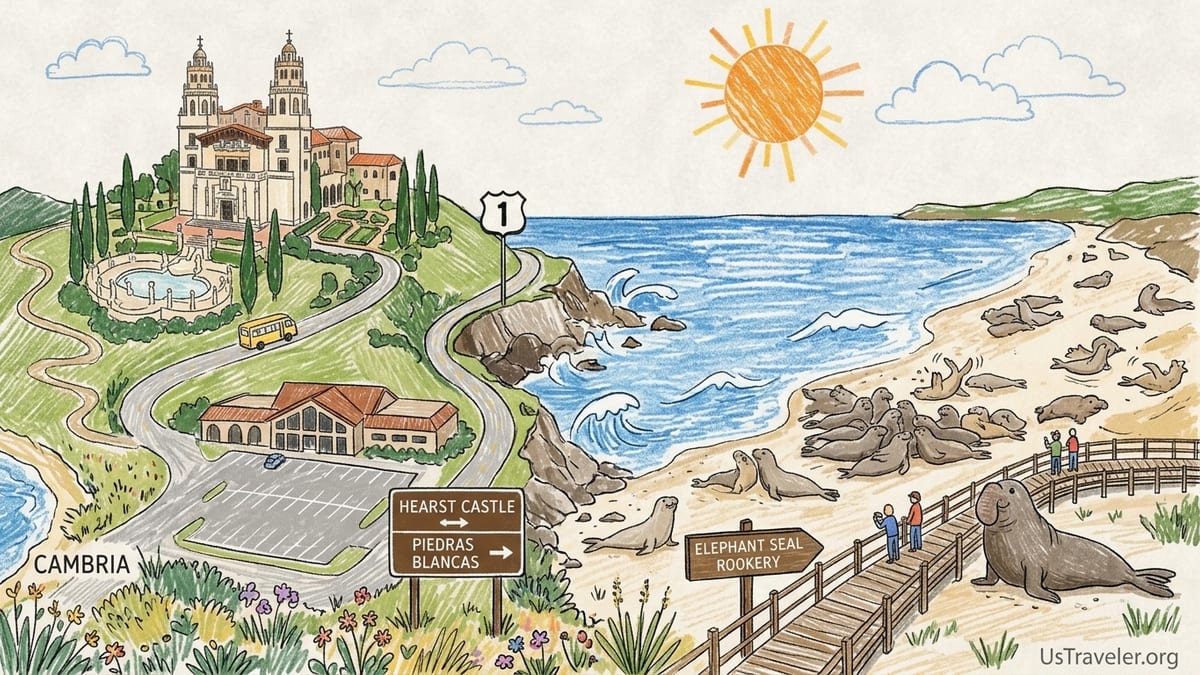
Rolling Out of Cambria: Expectations on Highway 1
I based myself in Cambria for this trip, which already sets the mood very differently from a quick freeway stop. Early in the morning, I pulled out of the pine-shaded streets near Moonstone Beach and merged onto Highway 1, heading north toward San Simeon. The drive between Cambria and Hearst Castle is short, roughly 10 to 15 minutes, but it feels like crossing a threshold: the town drops away, cattle graze on rolling green-brown hills, and the Pacific flashes in and out of view on the left. I remember thinking that it was a fitting approach to something as mythologized as William Randolph Hearst’s hilltop estate.
Going into the day, I had two very different expectations. For Hearst Castle, I imagined polished storytelling, carefully curated rooms, and a tightly controlled visitor experience with a premium price tag to match. For the Piedras Blancas elephant seal rookery a little farther up Highway 1, I pictured raw nature: wind, surf, and animals doing whatever they pleased, with none of the polish or structure of a guided tour. I wanted to see whether pairing a paid, highly produced attraction with a free wildlife stop on the same stretch of coastline would feel balanced or lopsided.
Weather plays a big part in how this day unfolds, so it is worth noting the conditions I actually encountered. My visit fell in late winter, with a classic Central Coast mix of low morning clouds, soft light, and temperatures in the 50s Fahrenheit that warmed slightly as the sun burned through. On foggier days, you could easily arrive at both the castle and the rookery under a cool gray lid, and that would change the atmosphere. On my day, visibility was good, the roads were dry, and traffic light once I got past Cambria’s last stoplight.
Compared to big-name California attractions in larger cities, parking and crowd levels here felt almost relaxed. Even so, I had booked my Hearst Castle ticket in advance and planned my timing carefully, knowing that tours sell out on busy weekends and holidays. The elephant seals, by contrast, did not care what my schedule looked like. They would be there on their own clock, and my plan was simply to show up after the castle and spend as much or as little time as felt right.
Arriving at Hearst Castle: Visitor Center, Tickets and Shuttle Logistics
Hearst Castle is not a place where you simply drive to the front door and wander in. All visits start at the Hearst Castle Visitor Center at the bottom of the hill, off Highway 1. I pulled into the large paved lot mid-morning and found plenty of free parking, though the rows closest to the entrance were already filling with rental cars and tour buses. Inside the visitor center, you find the ticket counters, restrooms, café, gift shop and the theater where the “Building the Dream” film plays.
I had pre-purchased a standard Grand Rooms Tour ticket online, which is one of the core daytime tours currently listed at about 35 dollars for adults, with lower prices for children. At the ticket counter, staff were confirming reservations, printing tickets, and emphasizing that each ticket is specific to a particular tour and time. This is important. The Grand Rooms, Upstairs Suites, Cottages & Kitchen, Designing the Dream and more specialized tours are separate products. Buying one does not automatically grant access to all areas of the estate. If you want to see both the main social rooms and the upstairs suites, you buy two different tours and plan the timing accordingly.
Tickets are released up to roughly 60 days in advance, and I noticed several signs recommending advance reservations, especially for busy seasons. My midweek winter visit still had day-of availability for some time slots, but popular slots and certain specialty tours had already filled. The staff recommended arriving at least 25 minutes before your scheduled departure to allow time for check-in, boarding the shuttle, and a brief introduction. Given the remote location and occasional construction or closures along Highway 1, that buffer seems wise.
The shuttle system is the gatekeeper between everyday reality and Hearst’s so-called “Enchanted Hill.” After a short wait at the boarding area just outside the visitor center, I climbed onto a comfortable bus with large windows. The ride up takes around 15 minutes, switchbacking through ranchland and brush with increasingly dramatic views of the coastline below. There is an audio narration that introduces William Randolph Hearst, the estate’s history, and a bit about architect Julia Morgan’s role. It already felt like a curated experience before we even saw the house itself come into view.
Inside the Grand Rooms: A Highly Produced Glimpse of Hearst’s World
At the top, we stepped off the shuttle into another world. The first impression is often the outdoor setting rather than the architecture: carefully terraced gardens, Mediterranean cypresses, and the iconic outdoor Neptune Pool stretching away with its pale stone and reflections. From there, our guide gathered us at the base of Casa Grande, the main house, where the Grand Rooms Tour officially begins.
The Grand Rooms Tour is marketed as best for first-time visitors, and that matched my experience. Over the next hour or so, our group moved through a sequence of showpiece spaces on the ground floor of Casa Grande: the Assembly Room, the enormous Refectory dining hall, the Billiard Room and the theater. Our guide blended art history, gossip, and logistics, pointing out European ceilings salvaged from monasteries, ancient tapestries, and the ways Hearst hosted Hollywood guests here in the 1920s and 1930s. The tone was enthusiastic but not overly worshipful, focusing as much on the logistics of running such a place as on the glamour.
What struck me most was the density of detail. In the Assembly Room, for example, nearly every surface is busy: carved wood, intricate ceilings, heraldic banners, old masters or their companions in gilded frames. It felt more like walking through a private European museum than an American home. The Refectory continued this impression with long tables, high-backed chairs, massive chandeliers and those famous ketchup and mustard bottles that are often mentioned as evidence of Hearst’s casual tastes layered onto old-world grandeur.
The tour is tightly controlled in terms of path and timing. We were not free to step off the prescribed route or linger indefinitely in a favorite corner. Photography is allowed, but the pace keeps you moving. At the end of the indoor section, we exited to spend a short time on the terraces and by the Neptune Pool before returning to the bus. This constrained access is deliberate. If you want a deeper or different slice of the estate, you need to choose a different tour, and that is where understanding the ticket structure really matters.
What Each Tour Actually Buys You: Grand Rooms vs. Upstairs and Cottages
One of the most common misconceptions among first-time visitors is that a Hearst Castle ticket is a complete, all-areas pass. It is not. On the day of my visit, the standard daytime tours like Grand Rooms, Upstairs Suites and Cottages & Kitchen were priced in the same ballpark, around the mid-30-dollar range for adults, but each tour is a separate purchase covering different spaces and stories. If you want to see everything, you would be booking multiple tours and spending a full day or more.
The Grand Rooms Tour, which I took, focuses on the main social rooms on the ground floor of Casa Grande. The Upstairs Suites Tour climbs into the upper stories to show guest suites and more intimate living spaces. The Cottages & Kitchen Tour heads to the smaller guest houses near the main pool area and behind-the-scenes service areas like the industrial kitchen. “Designing the Dream” and similarly named offerings tend to emphasize architecture, construction history and Julia Morgan’s design choices, sometimes including spaces or perspectives that the standard tours do not cover.
There are also smaller-group specialty tours, such as a Julia Morgan-focused tour that a fellow traveler on my shuttle mentioned booking at a much higher price point. Those tours, according to current staff, come with a per-person cost significantly above the standard 35 dollar level and usually last longer, with fewer participants. They are aimed at repeat visitors or serious architecture enthusiasts who want to engage more deeply with Morgan’s work, the engineering challenges of building on the hilltop, and the tension between Hearst’s changing ideas and Morgan’s discipline.
My own visit stayed within the standard price bracket. For roughly 35 dollars, I received a shuttle ride up and back, an hour-long guided walk through some of the most spectacular rooms, and a short window to wander the accessible terraces by myself before returning to the bus. That felt fair, but it is important for travelers to understand that you do not get the upstairs areas, guest cottages or detailed design discussion on that single ticket. If you imagine an all-encompassing “castle pass,” you will be disappointed. If you view each tour as a separate experience, choosing the one that best fits your interests and time, the pricing structure makes more sense.
Julia Morgan’s Hand and Hearst’s Story Behind the Facade
Standing on the terrace, I kept coming back to the notion that this place did not spring fully formed from Hearst’s imagination. It was the result of a long collaboration between a powerful client and a highly skilled architect, Julia Morgan. Interpretation materials and the shuttle narration emphasize that Morgan was not simply executing drawings. Starting in 1919, she took responsibility for the design of all the hilltop buildings and for translating Hearst’s shifting ideas into something structurally and aesthetically coherent.
Morgan brought a rare combination of training and practicality. She was one of the first prominent female architects in the United States, with formal education at the prestigious École des Beaux-Arts in Paris and significant early experience in California. At San Simeon, she acted as both architect and project manager, overseeing roadways, pools, gardens and the integration of an enormous collection of European art and architectural fragments. Some state park materials describe her role in modern terms as similar to “design-build,” handling not just drawings but coordination with artisans, suppliers and on-site crews.
William Randolph Hearst, for his part, was both wealthy newspaper magnate and passionate collector. He inherited the San Simeon ranch from his father, who had first purchased land there in the 19th century, and he initially imagined a relatively modest hilltop retreat. Over nearly three decades, from about 1919 until the mid-1940s, that simple idea grew into a sprawling estate of main house, cottages, terraces and pools that he called La Cuesta Encantada, the Enchanted Hill. During the 1920s and 1930s, he entertained Hollywood actors, politicians and other elites here, using the property as both private residence and stage for his own influence.
Knowing this context while walking through the Grand Rooms changes how the spaces feel. It is easy to see Hearst Castle simply as an extravagant monument to one man’s ego, and many visitors still react that way. But it is also a remarkable record of Julia Morgan’s ability to meld disparate stylistic elements into something that, for all its excess, functions as a coherent environment. That duality is part of what made the paid visit feel worthwhile to me. I was not just buying access to pretty rooms. I was buying a lens on California’s cultural, economic and gender history in the early 20th century, all distilled into stone, tile and concrete on a hill above the Pacific.
From Hilltop Grandeur to Wind and Sand: Driving to Piedras Blancas
After my tour, I took a later shuttle down, spent a few minutes in the visitor center, and then walked back to the car with sand-colored dust on my shoes and a head full of ceilings and tapestries. The transition from that world back to Highway 1 is abrupt. One moment you are among marble statues and manicured hedges, the next you are in a parking lot beneath the same coastal sky shared by ranches, gas stations and cheap motels.
From the Hearst Castle Visitor Center, the drive to the Piedras Blancas elephant seal rookery is short. You get back onto Highway 1 northbound and follow the coast for roughly 10 to 15 minutes. The signage is straightforward: there are clear highway signs for the rookery viewing area, and the turnoff leads to an elongated dirt and gravel parking area running parallel to the ocean. Parking here is free, and on my visit cars ranged from rental sedans to camper vans and a few tour buses.
The first thing I noticed stepping out of the car was the change in texture. At Hearst Castle, surfaces are smooth and curated. Here, the ground was uneven, the wind picked up loose sand, and the soundtrack shifted from polite conversation and guide patter to surf and the low, almost comic growls of elephant seals. The viewing area is set up with wooden boardwalks and railings that keep people above and back from the beach. Volunteers and signs remind visitors that this is a protected rookery in a state marine reserve, and that there is no beach access or direct contact with the animals.
Because I was visiting in late winter, the breeding season for northern elephant seals was still active in the broader regional calendar. However, what mattered for my experience was the behavior actually on display during that particular afternoon. There were plenty of animals, but the explosive mating battles and brand-new pups that sometimes dominate photographs were not front and center during my time at the railing. That in itself was an important lesson in managing expectations about wildlife.
What I Actually Saw: Real Elephant Seal Behavior and Seasonal Patterns
Looking down from the boardwalk, the beach was densely mottled with bodies. Most of the seals I could see were sprawled on the sand in loose clusters, ranging in color from light gray to a mottled brown that nearly matched the beach. A few were much larger, with that distinctive, arching nose that marks adult males, while many were smaller juveniles or females. Movement was sporadic. One seal would suddenly flip sand onto its back with a surprisingly graceful arc of its flippers, while others in the same cluster barely twitched for several minutes.
Occasionally, a larger seal would lift its head and upper body, issuing a deep, resonant call that carried up to the viewing platform. Nearby seals might respond or shuffle slightly, but full-on confrontations were rare while I was watching. The overall mood, if one can use that word for wild animals, was lazy but alert. They seemed to be resting and conserving energy between demanding phases of their life cycle, rather than engaged in dramatic action.
Interpretive panels along the boardwalk, along with information from local conservation groups, outline the seasonal rhythm of this rookery. Late December through March is generally described as the peak breeding and pupping season, when adults return to give birth, nurse, mate and then depart again. Later in spring and through summer, different age and sex groups come back to molt, shedding their fur and top layer of skin while fasting on shore. In fall, there is yet another wave of returns as juveniles and sub-adults haul out to rest. The point is that there are almost always elephant seals present, but their numbers, size mix and behavior change over the year.
On my specific visit, I did not witness births, newly born pups still wet from the ocean, or extended mating fights. I saw resting animals, some vocal displays, sand-flipping to regulate body temperature, and occasional short-distance shuffles as individuals repositioned themselves relative to neighbors. The rookery was still impressive precisely because it was real. This was not an edited highlight reel; it was one random afternoon in the life of a wild colony on the Central Coast. For travelers, it is crucial not to promise children or companions that they will see particular behaviors on a given day. The seasonal windows increase the likelihood of breeding or molting activity, but there are no guarantees.
Comparing Value: Paid Hilltop Tour vs Free Coastal Wildlife
By the time I left the rookery and pointed my car back toward Cambria, I had spent about half a day on this combined outing. The comparison between Hearst Castle and the elephant seals is tempting, but they are very different kinds of value. At Hearst Castle, I traded money for access to a curated historical environment. For around 35 dollars, I received a structured tour, expert commentary, transportation up and down the hill, and maintenance of a fragile cultural resource. Every minute and every viewpoint had been carefully designed by humans, both in Hearst’s time and in the way the state park now runs tours.
At Piedras Blancas, I paid nothing at the gate. There were no tickets or reservations. The cost was my time, the gas in my tank, and my willingness to stand in the wind with hair in my face, breathing in a mix of salt, kelp and a faint animal smell rising from the beach. Infrastructure exists in the form of parking, boardwalks, signage and volunteer docents, but the main show is not under anyone’s control. The seals do not perform on demand. From a strictly financial standpoint, the rookery provides extraordinary value, offering a world-class wildlife encounter without an entrance fee.
Emotionally, the contrast is just as sharp. Inside Hearst Castle, I felt mostly curiosity and a bit of awe at the sheer scale of ambition and resources. There is also an undercurrent of discomfort, knowing this opulence was funded by media power and economic inequality. Admiration for Julia Morgan’s skill sat alongside questions about how we memorialize wealthy figures. At the rookery, my reaction was simpler and more visceral. Watching hundreds of large marine mammals haul out on a California beach, knowing their species was once hunted almost to extinction and has now rebounded here, felt unexpectedly moving.
If I had to choose only one, it would depend on my mood and interests that day. Travelers who love architecture, social history and interior detail will find Hearst Castle well worth the ticket price. Nature-focused visitors or families on tighter budgets might derive more lasting memories from the free wildlife stop. Taken together in a single day, though, the two experiences amplify each other. Seeing raw coastal nature right after a tour of constructed grandeur is a reminder of how different forms of “spectacle” coexist along the same few miles of Highway 1.
Practicalities: Parking, Weather, Food and Where to Stay
On a practical level, this day trip is straightforward if you plan a few basics. Parking at both Hearst Castle’s visitor center and the elephant seal rookery is free, though the castle lot is paved and more structured, while the rookery parking is unpaved and can be crowded in peak times. I did not struggle to find a space at either site during my late winter weekday visit, but on holiday weekends you may want to allow extra time for both parking and shuttle boarding.
Weather on the Central Coast can fool people who look only at temperature. Even when the thermometer hovers in the 60s Fahrenheit, the combination of coastal wind and damp air can feel chilly, especially on the exposed boardwalks at Piedras Blancas. At Hearst Castle, much of the Grand Rooms Tour is indoors, but you will be outside on terraces and walking between buildings, and the shuttle waiting area is open to the air. I was glad I brought a light jacket and comfortable walking shoes, both for the stairs at the castle and the uneven ground near the rookery parking.
Food choices cluster mostly around Cambria and San Simeon. Before my tour, I grabbed a simple breakfast in Cambria, then relied on the café at the Hearst Castle Visitor Center for a late snack and coffee. The offerings are typical of a state-managed attraction: sandwiches, pastries, packaged snacks, and hot and cold drinks. Back down on Highway 1, San Simeon has a small cluster of restaurants attached to motels, serving burgers, seafood, and casual American and Mexican fare. Cambria, by contrast, offers a wider range, from wine bar small plates to hearty breakfasts and bakery counters. If you prefer more character and variety, Cambria is the better base for meals.
Accommodation follows the same pattern. In San Simeon, most lodging options are highway-side motels and budget to midrange hotels, convenient for a quick overnight stop before a morning tour. In Cambria, you find more atmospheric choices: inns along Moonstone Beach Drive with ocean views, B&Bs tucked into pine forest neighborhoods, and small lodges within walking distance of the village’s shops and restaurants. For this trip, staying in Cambria made it easy to drive a short way north to Hearst Castle in the morning, continue to the elephant seals afterward, and still be back in town for dinner without feeling rushed.
The Takeaway: Would I Combine Hearst Castle and Elephant Seals Again?
By the end of the day, I felt a pleasant kind of fatigue that comes from absorbing a lot of different impressions. The timing worked well: a late-morning Grand Rooms Tour, some time on the hilltop terraces, a break at the visitor center, then a short drive to the rookery for an unstructured hour or so with the elephant seals. I was back in Cambria by late afternoon, in time to walk along Moonstone Beach before sunset and think about what I would repeat or change.
If I returned with first-time visitors, I would choose the Grand Rooms Tour again as my Hearst Castle anchor. It provides a strong introduction to the estate at a clear price point, and it suits a wide range of fitness levels, with fewer stairs than the Upstairs Suites or some specialty options. On a subsequent trip focused more on architecture, I would seriously consider the Cottages & Kitchen tour or one of the Julia Morgan oriented small-group tours, accepting the higher price as the cost of deeper access. But for a single combined day with the elephant seals, one standard tour feels like the right balance.
As for the rookery, I would absolutely include it again, regardless of season. Even when the beach activity is less dramatic, there is something grounding about stepping away from curated human spaces into a landscape where no one controls the main attraction. It also rounds out the narrative of the day. Hearst’s estate represents a period when individual wealth shaped the coast in highly visible ways. The elephant seals represent both the damage humans once did to marine life and the capacity for ecosystems to rebound under protection.
So, was this San Simeon day trip worth it? For me, yes. The combination of a paid, meticulously interpreted historic site and a free, raw wildlife experience along the same stretch of highway created a fuller picture of California’s Central Coast than either stop could on its own. If you plan ahead for reservations, weather and timing, and accept that elephant seals will follow their own seasonal script, driving from Cambria through San Simeon to Hearst Castle and Piedras Blancas in one day is a rewarding way to spend your time and money.
FAQ
Q1. How much does a Hearst Castle tour cost for adults?
The standard daytime tours such as the Grand Rooms, Upstairs Suites or Cottages & Kitchen are currently priced in the mid-30-dollar range for adults, around 35 dollars before any processing fees or taxes. Specialty small-group tours cost more and should be checked directly with the official ticketing system for the latest prices.
Q2. Do I need reservations for Hearst Castle, or can I just show up?
You are not required to have reservations, but they are strongly recommended, especially on weekends, holidays and during school breaks. Tickets can be reserved roughly 60 days in advance, and popular time slots and specialty tours often sell out. If you prefer to buy on the day, arrive early and be flexible with tour times.
Q3. Is one ticket enough to see all of Hearst Castle?
No. Each tour ticket covers only specific areas of the estate. The Grand Rooms Tour focuses on the main social rooms of Casa Grande, while the Upstairs Suites, Cottages & Kitchen and architecture focused tours access different spaces. If you want to see multiple areas, you must purchase separate tickets and plan enough time between tours.
Q4. How long should I plan for a Hearst Castle visit including the shuttle?
Plan about two to two and a half hours for a single daytime tour. That includes arriving at the visitor center 25 to 30 minutes early, the 15-minute shuttle ride up, roughly an hour for the guided tour itself, some free time on the terraces if allowed, and the shuttle ride back down.
Q5. Is the Piedras Blancas elephant seal rookery really free to visit?
Yes. There is no entrance fee or ticket required for the rookery viewing area along Highway 1. Parking in the adjacent lot is also free. Costs are limited to your transportation, any donations you choose to make, and whatever food or lodging you arrange elsewhere.
Q6. When is the best time of year to see elephant seals at Piedras Blancas?
Elephant seals are present year-round, but different seasons highlight different behaviors. Late December through March is generally the main breeding and pupping period, spring and summer bring molting, and fall sees haul-outs of juveniles and sub-adults. You may see resting animals at any time, but specific behaviors like birthing or fighting are never guaranteed on a particular day.
Q7. How much walking is involved at Hearst Castle and the rookery?
At Hearst Castle, standard tours involve walking, standing and stairs, although some accessible tours are designed for visitors with mobility challenges. At the elephant seal rookery, walking is mostly along flat wooden boardwalks and dirt paths near the parking area. Comfortable shoes are recommended for both locations.
Q8. Can I visit Hearst Castle and the elephant seal rookery in a single day?
Yes. The Hearst Castle visitor center and the Piedras Blancas elephant seal rookery are only a short drive apart along Highway 1. Many travelers take a morning or midday castle tour, then continue north to the rookery in the afternoon before returning to Cambria or San Simeon for the evening.
Q9. Is it better to stay in Cambria or San Simeon for this day trip?
Both work, but they offer different experiences. San Simeon has convenient highway-side motels close to Hearst Castle and the rookery. Cambria, slightly farther south, has more characterful inns, B&Bs and restaurants, especially near Moonstone Beach and the village center. For atmosphere and dining choices, I found Cambria the better base.
Q10. Which Hearst Castle tour would you choose if you can only do one?
For a first visit, I would choose the Grand Rooms Tour again. It offers a strong overview of the main house’s social spaces, includes the shuttle and hilltop access, and works for a wide range of visitors. If I returned specifically for architecture and behind-the-scenes detail, I would consider adding the Cottages & Kitchen or a Julia Morgan focused small-group tour.