


I stood in the soft sand at Pier Avenue in Oceano with a rental waiver in one hand and a helmet in the other, watching a line of ATVs buzz toward the horizon. The scene should have felt like classic California fun: Pacific breeze, big blue sky, mountains of golden sand. Instead, even before I turned the key on my own quad, I found myself counting ambulances, fence lines, dust plumes and the number of people who clearly had no idea how dangerous this playground could be. Riding the Oceano Dunes at Pismo Beach is marketed as a must-do thrill. After experiencing it up close, I think the safety risks, costs and environmental damage deserve much tougher scrutiny.
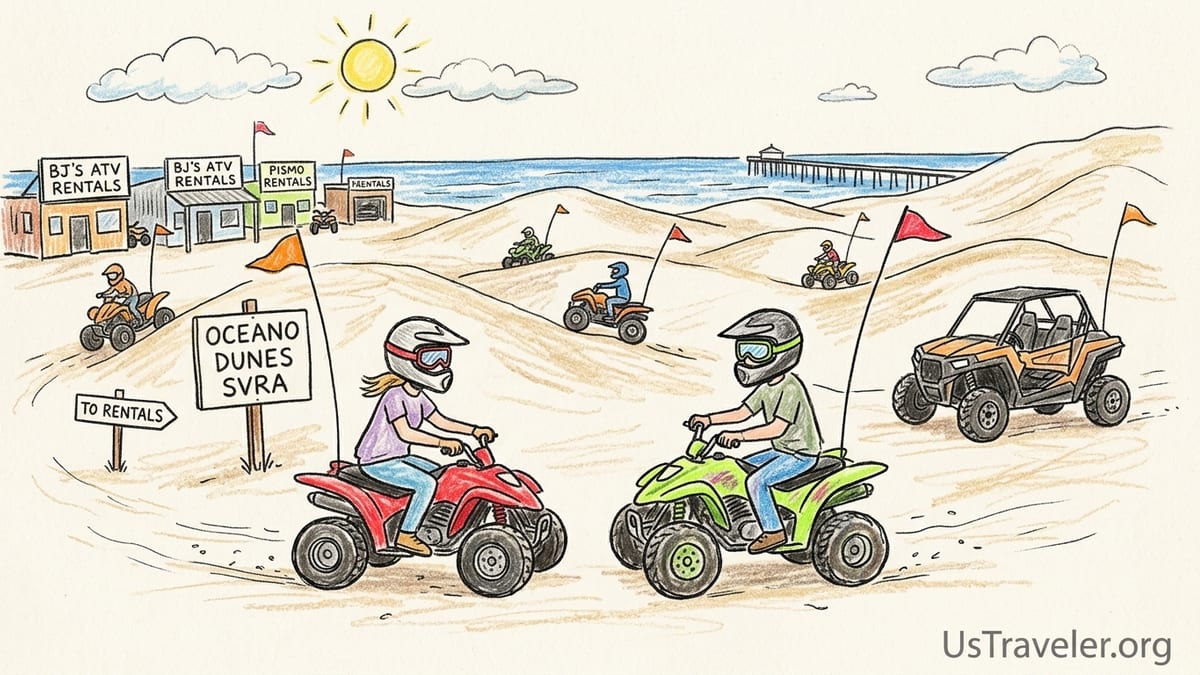
Stepping Into the Scene: Renting an ATV at Pismo Beach
The gateway to Oceano Dunes State Vehicular Recreation Area sits just behind the little strip of rental shops clustered along Pier Avenue in Oceano. Names like BJ’s ATV Rentals and Arnie’s ATV Rentals are on sandwich boards out front, and their trailers are lined with bright plastic quads and side-by-sides ready to be towed onto the sand. I signed my paperwork at one of these operators, joining a queue of mostly first-time riders who looked more like people on a wine-country weekend than off-road veterans.
The rental process is slick and efficient. A one-hour ATV rental for an adult single-seat quad was posted at around 80 to 100 dollars before taxes and fees, with two-hour options climbing into the 130 to 150 dollar range for more powerful machines, based on current online listings and booking platforms. A separate state vehicle day-use fee of 5 dollars is charged at the Oceano Dunes entrance booth per street-legal vehicle entering the riding area, a charge that is completely distinct from whatever you pay the private rental company. That separation matters: the state is essentially subsidizing motorized recreation on public sand, while the operators run profitable businesses inside that framework.
Before I was handed keys, the rental staff processed a damage deposit. For many operators, this is placed as a credit card hold and can easily run 100 dollars or more for a basic ATV, and several hundred dollars for high-powered sport quads or UTVs. One popular Pismo-area experience advertising a two-hour free-roaming rental at Oceano Dunes lists deposits in the range of 100 dollars per basic quad and up to well over 400 dollars for larger performance machines, with side-by-sides at four-figure holds. These are real stakes for anyone who tips a vehicle or snaps plastic bodywork.
Helmets are mandatory under California law, and the shop provided a Department of Transportation compliant full-face helmet included in the base price. Goggles were available but not always included; some riders brought their own, while others paid a small extra fee for eye protection and basic gloves. The safety briefing was brisk: how to start and stop, how to shift the automatic transmission, where not to ride near the shoreline, and a reminder to watch out for other vehicles. It took under ten minutes. Considering we were about to pilot heavy machines into shifting terrain with blind drop-offs, it felt more like a rental car counter speech than a serious safety orientation.
On the Sand: Noise, Speed and Limited Visibility
Driving from the Pier Avenue ramp onto the wet sand, the surface feels almost civilized. Vehicles spread out along the hard-pack zone by the shore, sharing space with families hauling coolers, toddlers digging in the sand and shorebirds probing for food. California State Parks posts a 15 mile-per-hour speed limit on the beach and near campsites, but the difference between 15 on slippery sand and 15 on asphalt is stark. Even at legal speeds, braking distances feel long and steering input is vague. Add in a mix of lifted trucks, rental quads and dune buggies weaving along the same corridor and the margin for error feels thin.
Once you leave the hard sand and climb east into the dunes, the sensory experience changes completely. The wind carries the high-pitched whine of two-stroke engines and the deeper growl of big side-by-sides. Fine sand becomes airborne under every throttle blip, hanging in the air like fog. The dunes look smooth from a distance but at ground level they are chaotic: tire ruts cut across slopes at odd angles, small bowls hide just over crests and soft pockets grab at your front wheels when you least expect it.
Visibility is the first and most visceral problem. California State Parks requires every vehicle in the dune riding area to run a tall whip and bright flag, at least eight feet high with a red or orange pennant near the top. The idea is simple: if you cannot see the machine itself as it approaches a ridge, you can at least spot the flag as it crests. In practice, in a busy section of Oceano Dunes on a weekend, the flags form a constantly moving forest of orange and red, and your brain struggles to track which ones are heading toward you and which are moving away.
At one point I eased my ATV up toward what looked like a modest ridge. I could hear another engine somewhere on the far side but could not see the rider. The State Parks guidance urges riders to “scout your route,” approach dune crests at an angle, and never assume the other side is safe. Obeying that advice, I stopped short, swung wide and inched up the slope at a diagonal. As I did, a side-by-side appeared from the opposite direction, its front wheels already airborne as the driver tried to get playful at the top of the hill. Had I ridden straight up at speed, our paths would have crossed in exactly the wrong place.
Rollover and Collision Hazards: What the Official Guidance Actually Says
It is tempting to chalk up most dune accidents to “user error,” but that framing ignores how inherently unstable this environment can be. California State Parks’ own safety information for Oceano Dunes makes several points that should give any traveler pause. First, it emphasizes that riders must always maintain a speed that allows them to control, turn or stop their vehicle if conditions change. In the dunes, conditions change constantly: sand shifts with every gust of wind, sun angle erases shadows at midday and other riders carve new ruts into what looked like clean slopes only minutes earlier.
Park guidance explains how dune faces differ. The ocean-facing, windward side of a dune tends to be more gradual, while the inland, leeward side can form a steep slipface. From the approach side, that steep drop is almost invisible until you are literally at the crest. That is why State Parks urges riders to approach ridges slowly, use spotters when jumping and avoid charging up blind hills. The physics are ruthless: once an ATV’s front wheels cross an unsupported slipface at speed, weight transfers forward and downward, and the slightest loss of balance can trigger a nose-over rollover.
Collision risk is just as real. The same safety guidance that talks about scouting routes also warns riders to keep their ears open, avoid earbuds or loud music, and never operate vehicles under the influence of alcohol or drugs. On a busy weekend, that ideal is not always met. I watched one group of friends line up their quads for an impromptu drag race along a ridge that overlooked a popular family camping area. Flags or not, their focus was on each other, not the minivans and kids playing in the trough below.
Children on oversized machines are another recurring concern called out in State Parks messaging. Regulations require that riders be able to reach and safely operate all controls, yet on the sand it is common to see kids whose feet barely touch the footrests, bouncing across ruts on full-size quads while a parent follows on a rental side-by-side. The law makes adults responsible for placing minors on machines that are too large, but enforcement resources are finite. The result is a visible gap between the letter of the safety rules and what actually happens on a crowded dune face.
The True Price of a Few Hours of Engine Noise
The headline rental rate is only the starting point for the cost of a Pismo ATV adventure. On the day I rode, menu boards and online listings from several Oceano-area companies showed single-rider ATV prices roughly in the 80 to 120 dollar range for an hour, and 130 to 200 dollars for two hours, depending on engine size and model. Two-seat and four-seat dune buggies or UTVs, which many families favor, were often priced closer to 200 to 350 dollars for a similar block of time. Some operators charge a concession fee or add-on surcharges on top of the base price.
Damage deposits, held against your credit card, sit in the background while you ride. A modest tip-over that breaks a mirror, plastic fender or handlebar can quickly turn into a multi-hundred-dollar bill. Several rental outfits specify in their terms that renters are fully responsible for all damage, and that any insurance offered by third-party booking sites may not apply to intentional stunts or off-limits areas. Many shops do not bundle dedicated damage waivers the way car rental companies do, so the risk exposure is real and personal.
Riding with passengers adds its own upcharges. An extra rider fee per machine is common, often adding 15 to 30 dollars or more per person on top of the base vehicle price. For a family of four seeking a two-hour ride in a four-seat UTV, the total at the counter can quickly cross 400 dollars before taxes, and that still does not include the separate 5 dollar vehicle day-use fee paid to California State Parks at the Oceano Dunes gate.
When you factor in optional gear rentals, gas surcharges and parking or campsite costs if you are staying on the beach, that Instagram-ready hour on the dunes becomes one of the most expensive short activities on California’s Central Coast. In my case, including fees and taxes, the actual cost of around ninety minutes of riding plus the park day-use charge worked out to well over 150 dollars for a single rider, and that was with a mid-range ATV, not a premium side-by-side.
Environmental Controversy: Dust, Habitat and Conflicting Uses
Long after the roar of engines fades at sunset, Oceano Dunes keeps making noise in hearing rooms and environmental reports. The California Coastal Commission, which oversees coastal development and public access, has repeatedly found that off-highway vehicle use at Oceano Dunes has degraded dune habitats, harmed native species, worsened air quality and created conflicts with people who simply want to walk or swim without dodging traffic. Its staff reports describe how vehicle traffic compacts sand, crushes vegetation and disturbs wildlife that depend on open, undisturbed dune systems.
The dust issue is particularly contentious. The Oceano Dunes are part of the larger Guadalupe Nipomo Dunes complex, and downwind communities have grappled with elevated airborne particulate levels for decades. Research cited by regional air quality regulators indicates that while there is a natural dust component, off-highway vehicle activity aggravates the problem by destabilizing surfaces and lofting more fine particles into the air. Anyone who has stood in the vehicle staging area on a busy afternoon and watched tan haze drift inland has seen the visual side of that problem for themselves.
Even within the park, competing uses are obvious. On one side of the fenced line, trucks and quads race each other up the faces of big dunes. On the other, kite flyers, picnickers and people simply walking their dogs along the tideline try to pretend the din is far away. State Parks has created separate non-vehicle zones, such as the Oso Flaco Lake area at the southern end, precisely because the off-road presence made it difficult for more traditional beachgoers to enjoy the same landscape in peace.
Over the years, there have been high-profile proposals to phase out or significantly reduce off-roading at Oceano Dunes. Environmental advocates have called for full conversion to passive recreation, while off-road enthusiasts and some local businesses push back, citing heritage and tourism revenue. As of October 2026, however, California State Parks still officially allows designated off-highway vehicle recreation within specific boundaries of Oceano Dunes SVRA. Riding is not banned, and the dunes remain the only state park unit in California where the public can legally drive and camp directly on the beach. That policy choice carries consequences that are visible in every torn-up patch of foredune and each dust advisory issued on windy days.
Western Snowy Plover: A Tiny Bird With Outsized Stakes
Among the species caught in this tug-of-war is the Western Snowy Plover, a small, pale shorebird that nests on open sandy beaches. The plover has been listed as a threatened species under federal law, and Oceano Dunes has long been both a refuge and a danger zone for it. The birds lay their speckled eggs directly on the sand, often in shallow scrapes that are nearly invisible to the untrained eye. To a rider scanning for a fun slope rather than a tiny bird, a nesting site simply looks like more beige ground.
To protect the plovers, California State Parks and cooperating agencies fence off significant stretches of dune and beach each breeding season, and in recent years have expanded some closures permanently to safeguard nesting habitat. Signs warn visitors not to enter, and law enforcement rangers can cite or remove people who ignore those boundaries. The logic is not abstract. A single careless footstep, not to mention a spinning tire, can crush eggs or chicks instantly. The fences are not an inconvenience; they are the only barrier between a threatened species and the weight of thousands of recreational vehicles.
From an experiential standpoint, the plover protection zones drive home how incompatible certain types of recreation are with wildlife needs. On my ride, more than once I found myself idling next to a fence, listening to engines rev just outside and watching shorebirds work the damp sand inside the closure. It felt jarring, like two values pressed up against each other: adrenaline tourism on one side and fragile life hanging on by a string of orange plastic posts on the other.
For travelers who care even slightly about conservation, respecting these fenced areas is non-negotiable. That means not ducking under ropes for a better photo, not hiking into signed closures and certainly not riding any motorized vehicle beyond the authorized OHV boundaries. Given the cumulative stress that off-roading already places on this ecosystem, honoring the few remaining quiet zones is the bare minimum.
Guided Trips vs Independent Rentals, and Quieter Alternatives
Most rentals at Oceano Dunes are “free roam” experiences. The company delivers your ATV or buggy to the edge of the riding area, gives you a map and a verbal safety rundown, and then you are on your own for the next hour or two. That independence is a selling point for many riders, but it also means that brand-new operators are unleashed into complex terrain with only the most basic coaching. The learning curve unfolds in real time, in traffic.
Some operators and tour companies offer more structured options, pairing riders with guides who lead small groups along preset routes and moderate speeds. These guided trips may cost more per person but can significantly reduce confusion and risky behavior, especially for families or nervous first-timers. A guide can physically demonstrate safe ways to approach a crest, identify soft sand traps to avoid, and set clear expectations about speed and spacing within the group. After watching several unguided renters get stuck on steep slipfaces or panic on sidehills, I came to appreciate how valuable that human factor can be.
It is worth asking hard questions at the counter or before booking online. Does the operator offer any form of hands-on training beyond a few minutes in the staging area. Will staff ride with you to a beginner-friendly zone and stay nearby, or do they simply point at the horizon and wave goodbye. Do they mention State Parks safety guidance about scouting dunes and using spotters, or do they focus on how much “air” you can catch. The answers reveal whether a company is truly invested in safer recreation or simply in high turnover.
If you are drawn to the beauty of the dunes more than the engine noise, Oceano and its surroundings offer lower-impact alternatives. Sandboard and sand-sled rentals are available from some local shops, letting you hike and slide on smaller slopes without machines. The Oso Flaco Lake area provides a one-mile boardwalk through wetlands and inland dunes to a vehicle-free section of beach, with the soundtrack of shorebirds and surf instead of mufflers. Nearby Pismo State Beach, including stretches near the pier and further north, delivers classic Central Coast sand and waves without the chaos of the OHV zone. After riding, I spent a quiet evening walk on that non-motorized shoreline and felt like I had finally met the coast itself instead of its mechanized overlay.
The Takeaway
Looking back on my time riding ATVs at Oceano Dunes, I am struck by how little the thrill justified the trade-offs. Yes, there were fleeting moments of fun: the rush of cresting a tall dune with the Pacific glittering in the distance, the feeling of floating over rippled sand at just the right speed and angle. But those highs sat alongside constant vigilance, worry about collisions and rollovers, and a nagging awareness of how much noise and dust we were pumping into a fragile landscape.
Financially, the experience felt out of balance. For well over 150 dollars in combined rental charges, fees and the state day-use cost, I bought ninety minutes of concentration and occasional anxiety. Knowing that a simple misjudgment could have added hundreds of dollars in damage on top of that did not help me relax. For a solo traveler or a family watching their budget, there are many other ways to spend that money along the Central Coast that deliver deeper connection and far less risk.
Ethically and environmentally, the dissonance is even sharper. California’s own Coastal Commission has documented the harm that off-highway vehicles do to Oceano Dunes’ habitats and air quality, and agencies expend huge effort fencing off plover nesting areas and managing dust. To show up as a temporary thrill-seeker and contribute to that burden, even for a short ride, now feels at odds with how I want to travel. There is a difference between accessing nature and consuming it.
If your primary goal is adrenaline and you are willing to accept both serious safety risks and the environmental footprint, then a carefully chosen, well-guided ride at Oceano Dunes might still make sense, especially if you are honest about the hazards and stay scrupulously within the rules. For many travelers, though, I believe non-motorized exploration is the better choice. Walking the beach, hiking the inland dunes near Oso Flaco Lake, or simply sitting on the sand listening to waves and shorebirds offers a quieter, more sustainable version of this coastline. Having done the ATV circuit once, my own verdict is clear: the price and risk were not worth it, and next time I will leave the engines behind.
FAQ
Q1. Is ATV riding currently allowed at Oceano Dunes near Pismo Beach?
As of October 2026, designated off-highway vehicle use is still allowed within specific areas of Oceano Dunes State Vehicular Recreation Area, subject to park rules and seasonal restrictions.
Q2. How much does it cost to rent an ATV at Pismo Beach?
Recent online listings show roughly 80 to 120 dollars for a one-hour single-rider ATV, with two-hour and multi-seat vehicles costing significantly more, plus deposits and taxes.
Q3. What additional fees should I expect beyond the rental price?
Expect a credit card damage deposit, possible concession or fuel surcharges, extra rider fees and a separate 5 dollar vehicle day-use fee paid to California State Parks at the entrance.
Q4. How dangerous is ATV riding at Oceano Dunes?
Riding involves real risks of rollover, collisions and getting stuck on unstable slopes. California State Parks emphasizes scouting dunes, moderating speed and never exceeding your skill level.
Q5. Do I need prior off-road experience to ride the dunes?
Most rental companies allow complete beginners, but the terrain is complex and busy. Lack of experience increases your risk, especially without a guide or thorough training.
Q6. What protective gear is required or recommended?
Helmets are legally required. State Parks also recommends goggles, gloves, long sleeves, long pants and sturdy over-the-ankle boots to reduce injury in a crash or rollover.
Q7. Why are parts of the dunes fenced off?
Fenced zones protect sensitive habitat, including Western Snowy Plover nesting areas and restored vegetation. Entering or riding in these closures can harm wildlife and may lead to citations.
Q8. Are there guided ATV tours, or is it all unguided rental?
Many rentals are free-roaming, but some operators or tour companies offer guided rides where a leader sets the route and pace, which can improve safety for nervous or first-time riders.
Q9. What non-motorized alternatives are available near Oceano Dunes?
You can walk or relax on nearby Pismo State Beach, hike the Oso Flaco Lake boardwalk to a vehicle-free shoreline, or try sandboarding or simple dune hiking in permitted areas.
Q10. Is riding ATVs at Oceano Dunes a good choice for families?
Families often enjoy the novelty, but the combination of real safety risks, high costs and environmental concerns means it is worth considering quieter, lower-impact activities instead.