


On a sunny Saturday in early October 2026, I walked into Monterey Bay Aquarium with mixed feelings and a lighter wallet. I had prebooked tickets for two adults and one child, which came to $180 before fees: 65 dollars each for the adults, 50 dollars for our elementary-schooler, with our toddler free. I had not been in several years, and with prices now at 65 dollars for adults aged 18 to 69 and 50 dollars for ages 5 to 17, I wanted to see honestly whether this world-famous aquarium still justified its cost, especially during a short visit to Monterey or Carmel. By the end of the day, after queuing, weaving through crowds, and spending just under four hours inside, I found myself questioning whether the experience truly matched the price.
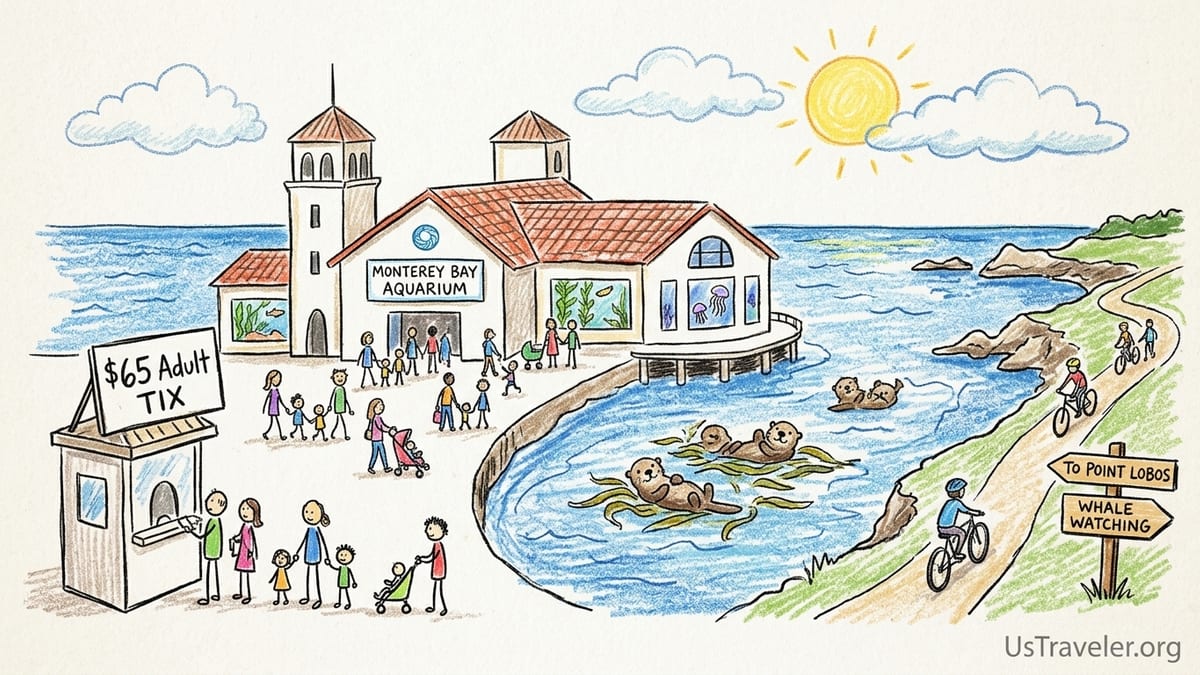
Setting the Scene: Date, Tickets, Group and First Impressions
We visited on Saturday, October 5, 2026, with a timed morning entry. Our total ticket spend was clear in my mind: 65 dollars each for two adults, 50 dollars for our seven-year-old, and zero for our three-year-old. For a typical family of four with two paying kids, you are looking at 230 dollars just to walk in the door. That figure does not include parking, food, or the small but very real cost of snacks, coffee, or a souvenir plush otter that your kids will almost certainly notice on the way out.
Monterey Bay Aquarium still uses timed ticketing, which theoretically controls the flow of visitors. In practice, 15 minutes before our slot, a long but orderly line had already formed along Cannery Row. The queue moved reasonably quickly once our window opened, but we still spent about 20 minutes between arrival and actually stepping into the exhibits. There was a brief bottleneck just inside the entrance where staff gave a welcome talk and reminded people about same-day re-entry with a hand stamp. It was friendly and efficient, but it also meant entire waves of people entered the galleries at once.
Inside the lobby, the first thing that struck me was how crowded it felt for an off-season weekend. This was not a peak summer or holiday date, yet stroller traffic was heavy and almost every vantage point around the first big tanks was lined two or three people deep. My expectations were high because of the price and the aquarium’s global reputation. I wanted to be wowed by the exhibits, of course, but also to feel that I had room and time to enjoy them without constantly jockeying for a spot at the glass.
We spent three hours and forty minutes in the aquarium itself, not counting a break for lunch outside. Based on conversations with staff and locals, most visitors spend between two and four hours on a typical visit, which matched what I saw: families with younger kids often started to fade around the three-hour mark, while dedicated enthusiasts with cameras and field guides could easily have stayed longer.
Crowds, Queues and How They Shape the Experience
The single biggest factor that colored my visit was crowd density. By 11 a.m., many of the signature exhibits had a constant ring of people around them. For the Open Sea tank in particular, it often felt like a concert crowd waiting for a headliner to take the stage. If you arrived a few minutes before a scheduled feeding or presentation, you might find three or four rows of people already in place, with shorter visitors and children essentially limited to glimpses between shoulders.
At the sea otter exhibit, which is understandably one of the major draws, the situation was even more intense. We approached twice in the late morning and once in mid-afternoon. The first time, we were three rows back from the glass with our child standing on tiptoe and seeing mostly reflections and the backs of other visitors. The otters themselves were active and playful, but our experience of them was mostly through raised phones as people in front of us recorded video. It took patience and some strategic hovering to finally get our seven-year-old close enough for a clear, satisfying view.
Even the quieter-feeling areas had pinch points. The narrow walkways around some of the smaller tanks and touch pools turned into slow-moving corridors where stopping to read an interpretive sign or help a child reach the glass could trigger minor traffic jams. It was not chaotic or unsafe, more like being in a very popular art museum on a free day instead of a calm, contemplative space that invites you to linger and observe.
To the aquarium’s credit, there are staff and volunteers stationed throughout the building who help manage flow and answer questions. Several times I saw them gently remind people to move away from the glass after taking photos so others could step forward. That helped, but it did not change the fundamental reality: when the building is close to capacity, your ability to appreciate even the best-designed exhibit is at least partly determined by how many people are already standing in front of it.
Walking the Layout: From Kelp Forest to Jellyfish
The Monterey Bay Aquarium layout still reflects its Cannery Row roots, with galleries unfolding across multiple levels and a mix of large headline tanks and smaller, habitat-focused spaces. For a first-time visitor, the rough flow is fairly intuitive: you start near the Kelp Forest, loop through rocky shore exhibits and touch pools, then work your way toward the Open Sea wing and upstairs to sea otters and more kid-friendly areas. Clear signage and maps make it reasonably easy to orient yourself, although with a stroller you will need to pay attention to elevator locations.
We intentionally followed the recommended route to see how the experience felt for someone who did not want to strategize every move. That decision made our morning feel more crowded than it needed to be, because we arrived at each “highlight” exhibit at roughly the same time as everyone else with our time slot. By the time we reached the Open Sea gallery, there was already a thick semicircle of visitors gathered, and we had to ease our way in along the sides rather than step back and take in the full panorama directly from the center benches.
In calmer moments, the layout works beautifully. Standing at the base of the Kelp Forest tank and looking up through swaying fronds as leopard sharks and schooling fish glide past remains one of the most transporting experiences you can have in any aquarium. Strategically placed benches invite you to sit and watch, and when we returned late in the afternoon, we finally found the breathing room to do exactly that for almost 15 minutes. The difference in atmosphere between mid-morning and late-day here was striking: the same space felt alternatively like a crowded subway platform and then like a quiet underwater cathedral.
The upper-level touch pools and children’s areas were logically grouped, with plenty of railings and step stools. However, the combination of narrow aisles, wet floors and excited kids made those spaces particularly congested just after lunch. If you are visiting with small children and want them to actually interact with the touch pools rather than be overwhelmed by the noise and elbows, arriving in the first hour after opening or circling back in the late afternoon will give you a noticeably better experience.
Exhibit by Exhibit: What Truly Stood Out and What Fell Short
The Open Sea exhibit is intended to be the emotional center of the aquarium, and on a good day it earns that status. The giant window, the deep blue water, the schooling sardines and larger open-ocean species combine into a mesmerizing scene that you simply cannot recreate at home. When we temporarily found space along the rail, it was easy to lose track of time watching the slow ballet of rays and fish. In terms of pure spectacle, this is where much of your 65 dollars feels most tangibly spent.
Yet that same exhibit is one of the hardest to enjoy fully when the aquarium is busy. On our visit, we never once saw the Open Sea room less than half full, and during feeding times it was shoulder to shoulder. The best views were dominated by people seated on the floor staking out spots well ahead of schedule, and it was not realistic to expect a young child to stay put that long. If you cannot tolerate standing for extended periods or you are sensitive to noise, you may find that the theoretical magic of this space is blunted in practice.
The Kelp Forest, on the other hand, managed to feel special even when crowded. Its vertical orientation, with multiple viewing angles on different levels, offers more ways to step aside and still feel immersed. We found good vantage points both at the base and from the side upper windows. The constantly shifting light filtering down through real, living kelp helps keep the tank absorbing even if you only manage a partial view from the edge of the crowd.
The jellyfish galleries were, for us, the most consistently enjoyable part of the aquarium. They are slightly tucked away compared with the otters and Open Sea, and as a result they drew smaller, slower-moving crowds. Here, the design choices were more apparent: thoughtful lighting, darkened rooms that minimized glare on the glass, and a series of modestly sized tanks that encouraged close viewing without creating a single bottleneck. Our kids were entranced, and so were most adults around us. If you are inclined toward photography, this is also the section where you are most likely to get clear, reflection-free shots without constantly jostling.
By contrast, the sea otter exhibit, although home to beloved rehabilitation animals and supported by serious conservation work, was largely diminished by view-blocking crowds. The animals were charismatic and clearly well-cared-for, but it was difficult to connect with them when every sightline involved someone’s arm held high for a photo. The touch pools offered brief moments of delight for our children, but only after several false starts where we could not get close enough to the edge for them to actually touch anything. For a family weighing whether the cost is justified, these chokepoint experiences matter more than glossy marketing photos might suggest.
Tickets, Family Costs and Parking: The Real Price Tag
As of October 2026, Monterey Bay Aquarium lists standard admission at 65 dollars for adults aged 18 to 69 and 50 dollars for youth aged 5 to 17, with children four and under free. Seniors and students may find slightly reduced pricing through specific programs or members-only promotions, but for most visiting families, those are the numbers that matter. That means a family of four with two paying kids will spend 230 dollars simply to enter. For a solo traveler, 65 dollars is a sizable but potentially manageable splurge. For a multigenerational group or extended family, the total can climb past 300 or even 400 dollars very quickly.
Parking near the aquarium adds another meaningful layer. The main Cannery Row Parking Garage on Foam Street and nearby city lots typically charge about 1.50 to 2.00 dollars per hour on weekdays, with daily maximums in the 15 to 20 dollar range depending on the specific facility and date. On busier weekends and during special events, flat daily rates closer to the upper end of that range are increasingly common. In practice, for a three to five hour aquarium visit, you should budget roughly 15 to 20 dollars to park within a short walk, more if you arrive early and linger for meals and shopping afterward.
Food costs inside and around the aquarium can easily rival parking. The on-site cafe and restaurant focus on sustainably sourced seafood and family-friendly options, which is commendable, but prices align with what you would expect at a major California attraction: think low to mid-teens for kids’ meals and well over 15 dollars for adult entrees, before drinks or dessert. If you choose instead to eat along Cannery Row, many casual restaurants charge similar or slightly higher prices, especially for waterfront views. For our family, a basic lunch and coffee run after the visit added another 70 dollars to the day.
When you tally tickets, parking, and a single meal, a realistic total for a family of four can easily land in the 320 to 350 dollar range for a half-day centered on the aquarium. That kind of outlay might be acceptable for a once-in-a-decade visit or a bucket-list trip, but it becomes harder to rationalize if you are in the area only briefly and considering other ways to experience Monterey Bay’s marine life.
Same-Day Re-entry and How to Stretch the Value
One important policy, though not always fully leveraged by visitors, is same-day re-entry. On our visit, staff offered hand stamps at the exits so that guests could leave for lunch or a break and return later the same day without buying another ticket. For families with young children or anyone sensitive to crowds and sensory overload, this re-entry option is crucial to unlocking more value from the high ticket price.
We tested this by leaving just after noon, grabbing a simple sandwich lunch away from the densest part of Cannery Row, and returning around 2:30 p.m. The difference inside the aquarium was noticeable. While still busy, the late-afternoon crowd had thinned slightly. Some families had already headed back to their hotels or on to the next stop, and the atmosphere felt less frenetic. This second session is when we truly enjoyed the Kelp Forest and jellyfish galleries in a calmer state.
Plan your day around at least two separate blocks of time if you want to maximize what you get for 65 dollars. One effective strategy is to enter soon after opening, focus on the exhibits most likely to be swamped later such as sea otters and touch pools, then step out for lunch and a walk along the Coastal Recreation Trail. Return mid to late afternoon for slower, more contemplative time at the larger tanks and jelly galleries. Spreading three to five hours across the day, instead of cramming everything into one stretch, helps soften both crowd stress and the feeling that you paid a premium for a rushed experience.
However, this approach only makes sense if you are staying relatively close or dedicating an entire day to the Cannery Row area. If you are trying to combine the aquarium with a half-day at Point Lobos, an extended walk around Pacific Grove’s shoreline, or a whale-watching trip, same-day re-entry can be harder to capitalize on. You may find yourself paying full price for an attraction that, in practical terms, you only manage to enjoy for two hurried hours.
Competing Experiences: Aquarium vs Trail, Shoreline, Point Lobos and Whale-Watching
Monterey and Carmel offer a rare concentration of world-class coastal experiences, most of which either cost far less than the aquarium or provide a very different type of encounter with the bay. The Coastal Recreation Trail, for example, runs right past the aquarium and along the shoreline through Pacific Grove. Renting bikes or simply walking sections of the trail lets you watch harbor seals, sea otters and seabirds in their actual habitat for the cost of parking and perhaps a bike rental. On our visit, we saw sea otters floating just offshore from the trail within 15 minutes of leaving the aquarium, and those unscripted moments felt surprisingly powerful after watching their captive counterparts behind glass.
Pacific Grove’s rocky shoreline, reachable in a short drive or even a longer walk from Cannery Row, offers tide pools, crashing waves and varied coastal views with no admission fee. You may pay for street parking or a small lot, but the overall cost is minimal compared with aquarium tickets. For travelers who appreciate photography or slow, unstructured wandering, the simple act of sitting on a bench above the surf and watching pelicans skim the water can easily fill an afternoon at essentially no extra cost.
Point Lobos State Natural Reserve, a 15 to 20 minute drive south along Highway 1, charges roughly 10 dollars per car for entry, covering everyone inside the vehicle. Parking inside the reserve is limited and fills early, but even if you end up parking along the highway and walking in, your monetary cost remains modest. Once inside, you gain access to miles of trails, dramatic headlands, sheltered coves and some of the most accessible wild marine scenery in California. On a clear day, watching sea lions on offshore rocks or spotting harbor seals in a cove at Point Lobos can rival or exceed any single moment inside the aquarium, and you can stay until closing without watching the clock in the same anxious way.
Whale-watching is in a different price bracket, closer to the aquarium than to a simple hike, with many tours from Monterey’s Fisherman’s Wharf charging in the range of 70 to 100 dollars per adult depending on season and operator. Yet for that price you are often on the water for three to four hours, with a real chance of seeing humpback whales, dolphins or even orcas. It is not guaranteed, and seasickness is a real risk, but the potential payoff feels more proportionate to the cost for many ocean-focused travelers. Crucially, while the aquarium delivers controlled, guaranteed viewing of captive and display animals, a good whale-watching trip gives you an unfiltered window into the living bay that the aquarium exists to interpret.
These experiences are not interchangeable. The aquarium excels at bringing you extremely close to creatures you might never see in the wild and at presenting complex ecological stories in a digestible way. The trail, shoreline, Point Lobos and whale-watching place you inside those ecosystems with less structure but more raw immediacy. When time and budget are limited, you have to be honest about what kind of encounter matters most to you and your companions.
Education, Conservation and the Question of Value
It would be unfair to judge Monterey Bay Aquarium purely as an entertainment product. The institution has a strong record in marine research, animal rehabilitation and public education, including work with sea otters and broader conservation advocacy. Interpretive signs throughout the building are well-written and regularly updated, and during our visit we encountered multiple live presentations that tackled topics from sustainable seafood to plastic pollution in approachable, age-appropriate language.
There is also a less visible layer of value in the ticket price. Maintaining massive living exhibits with real seawater pumped in from the bay, caring for animals that cannot simply be replaced from a supplier, and funding behind-the-scenes science and policy efforts all cost money. When you pay 65 dollars, a portion supports those missions. For some visitors, particularly those with a strong environmental ethic or an interest in ocean science, that alone helps justify the price, even if the front-of-house experience feels crowded or rushed.
Yet as a traveler making tough choices with finite vacation funds, it is just as fair to ask whether a daytime visit at full price delivers enough direct, enjoyable experience to match the cost. On my October 2026 visit, my honest impression was that the aquarium’s educational and conservation merits sometimes had to work hard to compensate for the practical frustrations of crowding. I found myself thinking that the same money could have funded multiple Point Lobos visits, a solid whale-watching tour, or a mix of low-cost shoreline walks and a more moderately priced attraction elsewhere on the Central Coast.
Ultimately, value is subjective. If you have never been to Monterey Bay Aquarium and you or your children are deeply fascinated by marine life, the chance to stand a few feet from a living kelp forest or watch open-ocean animals in the Open Sea tank will likely feel worth a splurge once. If aquariums are only a mild interest and your travel style leans toward quiet nature, slow drives and unscheduled time, you may find that 65 dollars per person feels out of proportion to what you personally gain.
The Takeaway
After a full day structured around a visit on October 5, 2026, I came away impressed by the quality of Monterey Bay Aquarium’s exhibits and staff but unconvinced that a 65 dollar adult ticket offers consistently good value, especially during busier periods. The standout experiences in the Kelp Forest, jellyfish galleries and Open Sea tank are genuinely world-class when you can access them with clear sightlines and a bit of space. However, persistent crowds, tight viewing areas at headline exhibits like the sea otters and touch pools, and the cumulative cost of tickets, parking and food leave the overall package feeling financially heavy for many travelers.
Would I personally pay again? For myself as a frequent visitor to the Central Coast, probably not at full price in the near future. If friends or extended family who had never been were visiting and badly wanted to go, I might join them once more, but I would strongly encourage an off-peak weekday, a careful plan to use same-day re-entry, and realistic expectations about crowding. If the aquarium offered a substantially lower-priced late-afternoon ticket that aligned with its quieter hours, I would be far more inclined to return just to sit in front of the Kelp Forest and jellyfish exhibits.
Who should prioritize it? First-time visitors to Monterey or Carmel with a strong interest in marine life, families whose kids genuinely light up at the idea of aquariums, and travelers who see part of their ticket price as a direct donation to ocean conservation will likely find enough magic to justify a one-time visit. For them, the aquarium can serve as an anchor day in a longer trip that also includes Point Lobos, the Pacific Grove shoreline, and time on the Coastal Recreation Trail.
Who might skip it or downgrade it from “must do” to “maybe”? Budget-conscious families, travelers with only a day or two in the area, and those who prize open, uncrowded natural settings over indoor attractions may find better value in lower-cost alternatives like hiking at Point Lobos, walking Pacific Grove’s waterfront, or investing in a whale-watching trip. For these visitors, the bay itself offers such rich, accessible marine life that paying 65 dollars per adult to see curated slices behind glass may not feel essential.
FAQ
Q1. How much does it really cost for a family to visit Monterey Bay Aquarium?
For a typical family of four with two paying children, tickets alone are about 230 dollars at current rates, and a realistic total including nearby parking and a basic meal often lands in the 320 to 350 dollar range.
Q2. How crowded is the aquarium on weekends or during school breaks?
On my early October Saturday visit, major exhibits were often two to four people deep at the glass, and signature areas like the sea otters and Open Sea tank were consistently crowded, especially around scheduled feedings and presentations.
Q3. How much time should I plan to spend inside the aquarium?
Most visitors seem to spend between two and four hours inside. We stayed just under four hours total, split into a morning session and a shorter late-afternoon return, which felt sufficient but not leisurely.
Q4. Is same-day re-entry really useful in practice?
Yes, if you are staying nearby. Getting a hand stamp and leaving for lunch or a walk before returning later in the afternoon noticeably reduced crowd stress and helped us enjoy the exhibits more fully.
Q5. How do aquarium costs compare with visiting Point Lobos State Natural Reserve?
Point Lobos charges around 10 dollars per vehicle for entry, covering everyone in your car, so a family can spend a full day hiking and watching marine life there for far less than a single aquarium ticket.
Q6. Is whale-watching a better value than the aquarium?
Whale-watching tours from Monterey often cost a bit more than an aquarium ticket per adult, but they usually last three to four hours on the water and can deliver powerful encounters with wild whales and dolphins if conditions cooperate.
Q7. What are the parking options near Monterey Bay Aquarium?
Most visitors use the Cannery Row Parking Garage or nearby city lots, where weekday rates are typically around 1.50 to 2.00 dollars per hour with daily maximums in the 15 to 20 dollar range, higher during busy periods or special events.
Q8. When is the best time of day to visit to avoid the worst crowds?
Based on my visit and local advice, the first hour after opening and the last couple of hours before closing are usually calmer, while late morning through early afternoon tend to be the busiest, especially at marquee exhibits.
Q9. Is Monterey Bay Aquarium still worth it if I only have one full day in Monterey or Carmel?
If you are passionate about aquariums, you can make it worthwhile by dedicating several hours and using same-day re-entry. If you prefer varied outdoor experiences, you may find more satisfaction dividing that day among the shoreline, Point Lobos and the Coastal Recreation Trail instead.
Q10. Who should skip the aquarium or consider it a lower priority?
Travelers on tight budgets, those who dislike crowds or indoor attractions, and visitors who are primarily interested in quiet hikes and wild coastal scenery may be happier focusing on free or low-cost outdoor options and possibly a whale-watching trip instead of paying full price for aquarium admission.