


Monterey Bay is one of the few places in the world where you can realistically plan a dedicated whale watching trip at almost any time of year. Deep nutrient-rich waters, a submarine canyon that plunges close to shore and federal protection as a national marine sanctuary combine to bring gray, humpback, blue, fin and even killer whales within reach of a half-day boat tour. This guide focuses on practical booking decisions: when to come, which harbor to sail from, how tours differ, what they cost, and how to choose the right experience for your group and your target species.
Why Monterey Bay Is a Whale Watching Hotspot
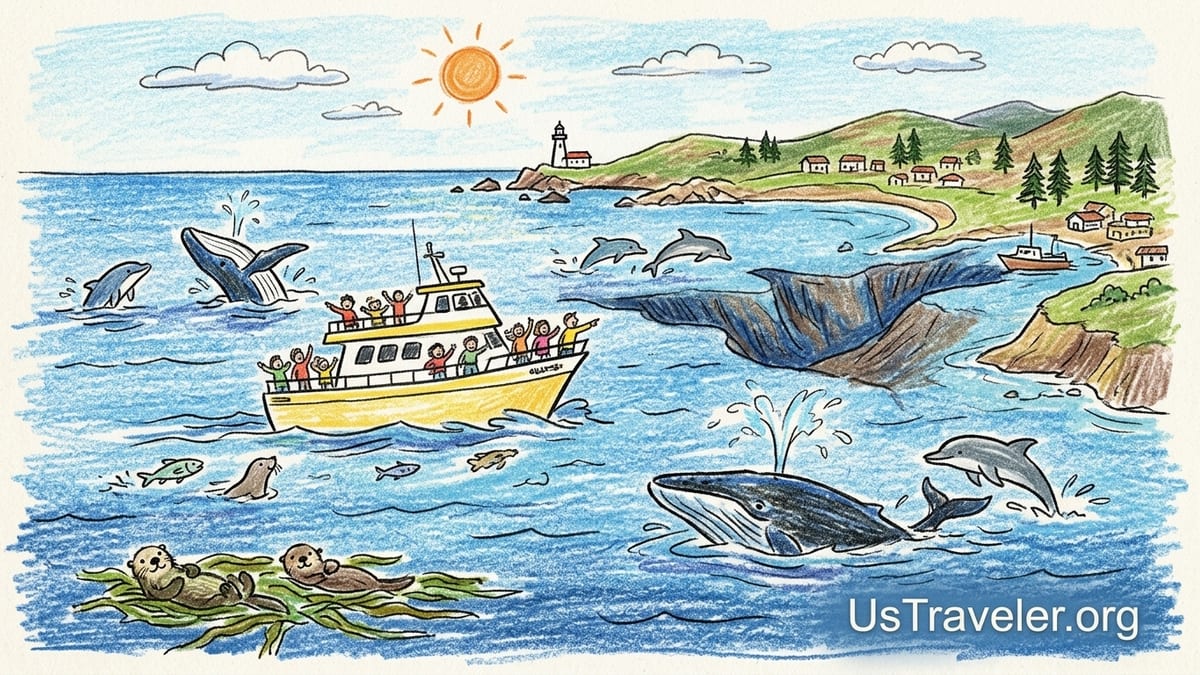
Monterey Bay sits within the Monterey Bay National Marine Sanctuary, a protected stretch of central California coast that supports at least several dozen marine mammal species. The key feature for whale watchers is the Monterey Submarine Canyon, a deep underwater trench that cuts into the bay and brings cold, nutrient-rich water close to shore. When winds and currents mix this water toward the surface, it fuels plankton blooms, which feed krill and small schooling fish such as anchovies and sardines. These, in turn, attract baleen whales and dolphins in feeding aggregations that can be reached in a few hours by small boats.
The canyon comes especially close to land off Moss Landing, roughly at the midpoint of the bay, which is why many operators emphasize how quickly they can reach deep water from that harbor. From Monterey and Santa Cruz, boats travel a bit farther to reach these same productive zones, but still remain within a half-day cruising radius. For visitors, this geography means you do not have to commit to a full expedition-style trip to see large whales: three- to four-hour excursions can reliably encounter feeding humpbacks in summer and migrating gray whales in winter when conditions are suitable.
Because the area is managed as a national marine sanctuary under the National Oceanic and Atmospheric Administration, commercial whale watching here operates within a framework of federal marine mammal protection laws and sanctuary guidelines. Reputable companies coordinate with each other by radio to reduce unnecessary searching and often share information about wildlife locations, which helps keep viewing focused and allows captains to respect distance guidelines while still providing close but lawful looks at whales and dolphins.
This combination of deep offshore habitat, proximity to harbors and regulatory oversight is why Monterey Bay is often described by marine biologists and local guides as one of North America’s premier year-round whale watching destinations. For travelers, it translates directly into higher odds of sightings, shorter travel times from the dock to prime habitat and a choice of different styles of tour.
Whale Species and Seasonal Patterns
Several species of large whales use Monterey Bay either as a migration corridor or as a seasonal feeding ground. The most commonly seen are gray whales in winter and early spring, humpback whales from spring through fall, and blue whales in some summers. Fin whales, killer whales and various dolphin species also occur, but are less predictable. Understanding how these patterns work will help you align your trip timing with your target species.
Gray whales pass through the sanctuary area in two main pulses linked to their coastal migration between Arctic feeding grounds and Baja California breeding lagoons. Southbound adults begin to appear around December and can be seen offshore into February. In spring, from roughly March through May, the northbound migration brings cow and calf pairs close to shore, sometimes inside the main shipping lanes. Winter trips often focus on spotting the characteristic blows and flukes of migrating grays, sometimes accompanied by views of other coastal wildlife such as sea lions and harbor porpoises.
Humpback whales are the signature summer and fall species in Monterey Bay. Sanctuary wildlife calendars and local operators describe humpbacks arriving in increasing numbers from about March, staying through summer and often into November as long as anchovy and krill concentrations remain strong. These whales are feeding, not simply passing through, so encounters can include breaching, tail slapping and coordinated lunge-feeding at the surface. For many visitors, this is the most dramatic style of whale watching the bay offers and is a primary reason travelers target late spring to early fall.
Blue and fin whales are also drawn to offshore krill swarms in some summers. Blue whale sightings in particular tend to peak in mid to late summer during years with strong upwelling. However, they are less predictable than humpbacks and usually farther offshore. Killer whales, or orcas, are present in the region year-round but move widely along the coast. Local reports describe brief periods, often in spring, when transient killer whales hunt sea lions or gray whale calves near the bay. These encounters are memorable but cannot be guaranteed on any given date.
Month-by-Month Wildlife Calendar
The Monterey Bay National Marine Sanctuary publishes seasonal guidance on when different species are typically present within the sanctuary. Combined with long-term experience from local operators, this allows you to build a realistic month-by-month expectation curve, though wildlife can never be guaranteed and exact timing shifts slightly from year to year with ocean conditions.
From January through March, the emphasis is on gray whales. January often represents peak southbound traffic, with multiple gray whale sightings common on a single tour. February sees both late southbound and early northbound whales, while March focuses increasingly on northbound cow and calf pairs that tend to travel a bit closer to shore. Humpback whales begin to arrive during March in some years, but reliable feeding groups usually appear later in spring. Winter and early spring can also bring calmer seas on some mornings, although large Pacific swell events do occur.
April and May are transition months when humpback numbers build and gray whale calves continue north. Sanctuary guidance references humpbacks arriving from March onward and remaining into November, which aligns with what many captains report. By late May, humpbacks are often the primary whale seen on regular trips, sometimes accompanied by Pacific white-sided dolphins or common dolphins. Sea lion and sea otter viewing is strong year-round, so even slower whale days still usually offer varied marine life.
June through September is the core humpback whale season. Multiple operators report daily humpback sightings on the majority of trips during these months, often just a short run from the harbor. Blue and fin whales may appear offshore in some summers, especially July and August, when upwelling-driven productivity peaks. September and October continue to offer good humpback encounters, with some years seeing strong feeding right through early November. By late November and into December, attention shifts back to gray whales as the first southbound migrants begin to pass through again, while some late-season humpbacks may linger if prey remains abundant.
Throughout the year, smaller cetaceans such as dolphins and porpoises, plus sea otters, harbor seals and California sea lions, are regularly encountered. Birdlife also tracks the seasons, with winter bringing high numbers of migratory seabirds and spring and summer featuring breeding cormorants and murres on coastal cliffs. For trip planning, it is helpful to decide whether your primary goal is migration-style gray whale viewing in winter and early spring, or feeding humpback and potential blue whale encounters from late spring through fall.
Choosing Your Departure Harbor: Monterey, Moss Landing or Santa Cruz
Most dedicated whale watching tours on Monterey Bay leave from one of three harbors: Monterey, Moss Landing or Santa Cruz. All offer access to the same general whale-rich waters, but each has its own trade-offs in terms of boat ride length, sea conditions, nearby services and overall convenience for different itineraries.
Monterey is the most common starting point for visitors who are already planning to see the Monterey Bay Aquarium or stay near Cannery Row. Several operators, including Monterey Bay Whale Watch, Princess Monterey Whale Watching and Discovery Whale Watch, run multiple daily trips from Fisherman’s Wharf or adjacent piers. From here, boats may take 30 to 60 minutes to reach the most productive sections of the submarine canyon, depending on where whales are feeding that day. The advantage is a wide choice of departure times, walking-distance hotels and restaurants, and large parking areas near the wharf.
Moss Landing sits roughly mid-bay and very close to where the Monterey Submarine Canyon rises toward the surface. This means some trips can encounter whales within a relatively short time of leaving the harbor when animals are feeding near canyon edges. Operators such as Sea Goddess Whale Watching emphasize this proximity in their marketing and local accounts often mention seeing whales within minutes of departure on good days. The harbor area itself is quieter than Monterey or Santa Cruz, with a smaller cluster of restaurants and lodgings, so it can suit travelers who prioritize time near whales over nightlife or extensive dining options.
Santa Cruz, at the northern end of the bay, is convenient for travelers coming from the San Francisco Bay Area who want to combine whale watching with surf-town beaches or visits to the Santa Cruz Beach Boardwalk. Santa Cruz tours often require a longer transit to reach central canyon feeding zones compared with Moss Landing, and operators there sometimes emphasize coastal scenery as part of the experience. Hotels and vacation rentals are plentiful, and some visitors choose Santa Cruz chiefly for its broader leisure atmosphere, accepting a slightly longer boat ride in exchange.
Sea conditions can differ subtly among these harbors as well. Because Moss Landing is closest to deep water, boats may encounter ocean swell earlier in the trip, while Monterey and Santa Cruz routes may have a longer period of more sheltered coastal waters before reaching open bay chop. For those prone to seasickness, it can be useful to discuss typical conditions and vessel size with your chosen operator and consider morning departures, which more often benefit from lighter winds.
Comparing Major Whale Watching Operators and Prices
Several well-established companies operate from Monterey and Moss Landing, each with slightly different vessels, price structures and trip durations. Prices change periodically, but recent listings and booking platforms provide a reasonable guide. Because the market is competitive and fuel costs fluctuate, travelers should confirm exact fares directly with the operator close to their travel dates.
Discovery Whale Watch, departing from Monterey’s Fisherman’s Wharf, advertises daily tours throughout the year. Their standard three-and-a-half to four-hour morning whale watch is typically listed in the mid to upper double digits per adult before taxes and fees, with slightly lower prices for shorter afternoon trips of about two-and-a-half to three hours. Recent online booking portals show adult fares around the mid 70 to mid 80 dollar range for some tours, with child and occasional promotional rates somewhat lower. Discovery operates medium-size vessels equipped with indoor seating and outdoor viewing decks, and trips are described as being led by experienced captains and naturalist guides.
Monterey Bay Whale Watch, also based at Fisherman’s Wharf, is associated with research-focused marine biologists and runs a mix of standard three- to four-hour trips and longer eight- or even twelve-hour expeditions on selected dates. Frequently asked questions from the company describe boats such as the Blackfin, a roughly 65-foot double-wide catamaran that can carry around 120 passengers, and smaller single-deck vessels with capacities between about 35 and 65 guests. This operator tends to emphasize naturalist commentary and scientific interpretation, which may appeal to travelers particularly interested in behavior, ecology and photography.
Princess Monterey Whale Watching offers trips from a bright yellow building on Fisherman’s Wharf and typically runs multiple departures per day in peak season. While their FAQ directs visitors to check current pricing online or by phone, third-party ticketing outlets for comparable large-vessel cruises in Monterey Bay often show adult prices in the broad range from the upper 50s to around 80 dollars depending on day, time and demand. Princess focuses on larger, more stable boats with plenty of seating, indoor cabins and snack bars, which can be more comfortable for guests concerned about motion or for families with younger children who meet age requirements.
Sea Goddess Whale Watching, operating from Moss Landing, markets itself around quick access to the canyon and relatively small group sizes compared with the largest Monterey boats. Public information and traveler reports indicate that Sea Goddess runs three- to four-hour trips in roughly the same price band as Monterey operators, generally within the 70 to 100 dollar range per adult depending on season and timing. Capacity is lower than the biggest catamarans out of Monterey, which some travelers feel allows more room at the rail and a more intimate feel, though subject to more noticeable motion in rougher seas.
Across all operators, child fares are commonly discounted relative to adults, sometimes by 20 to 30 percent or more, and some companies offer periodic specials for early morning trips or off-peak days. Because contracts with booking partners and changing fuel prices can affect rates, it is wise to treat any quoted range as indicative rather than fixed, and always review current pricing, included amenities, and any taxes or port fees before purchasing.
Boats, Comfort and Seasickness: Finding the Right Fit
Choosing the style of vessel can matter as much as choosing the operator. Monterey Bay fleets range from large catamarans that hold over one hundred passengers to smaller monohull boats that carry a few dozen at most. Each type has implications for comfort, seasickness risk and how easily you can move around for photography and wildlife viewing.
Larger, wider boats such as the Blackfin or comparable vessels used by Princess Monterey tend to feel more stable, especially in moderate swell. They usually offer both indoor and outdoor seating, restrooms and snack service. For travelers worried about seasickness, a big, slow-moving boat with high railings and sheltered indoor spaces can be reassuring. Families with school-aged children, older relatives or anyone who prefers not to stand in the wind for long periods often do well on these cruises. The trade-off is that rail space can be busier and movement across the deck may be more limited when popular animals surface on one side.
Smaller boats, such as some of the single-deck vessels used by Monterey Bay Whale Watch or the mid-size boats out of Moss Landing, provide a more intimate experience. It is easier to change sides quickly when whales surface, and guides can sometimes interact more personally with guests. Photographers often appreciate the lower angle to the water and fewer obstructions between lens and subject. On the other hand, smaller boats generally pitch and roll more in swell and chop, which can increase the likelihood of seasickness for travelers who are sensitive to motion. These operators usually recommend that guests prone to nausea take preventive measures, such as anti-motion medication taken in advance and avoiding heavy meals before boarding.
Regardless of vessel size, most companies operate within similar safety frameworks. Life jackets are required for children of certain ages and weights, and crews give safety briefings before departure. If mobility or accessibility is a concern, it is important to contact the operator in advance. Some larger boats can more easily accommodate guests who use canes or have limited mobility, provided they can navigate a few steps onto the vessel, while smaller boats with narrow gangways may be more challenging.
If seasickness is a major worry, consider booking a morning trip on a larger catamaran during late spring through early fall, when conditions often combine relatively gentle seas with abundant feeding whales. Discuss your concerns with the company at the time of booking and ask about the most stable vessels in their fleet and typical conditions for your chosen month.
Timing Your Trip: Morning vs Afternoon and What to Bring
Most Monterey Bay whale watching companies schedule at least two departures a day during much of the year, often around mid-morning and early afternoon, with additional sailings in peak season. The choice between morning and afternoon can affect your experience almost as much as the date and operator you choose.
Morning trips more often benefit from calmer winds and flatter seas, especially in summer when afternoon sea breezes are common. Cooler air and low sun angles can make for softer lighting and more comfortable conditions for photography. Many captains and local guides informally recommend morning departures for guests who prioritize comfort or are nervous about seasickness. However, early departures require prompt arrival and check-in, and coastal fog can be more prevalent in the first hours after sunrise, occasionally softening visibility.
Afternoon trips can feel warmer once marine layer clouds burn off, and they may fit better with a relaxed vacation schedule that includes a leisurely breakfast or morning visit to the Monterey Bay Aquarium. Wildlife patterns are not strictly tied to time of day, and hungry whales continue to feed whenever prey is available, but choppier surface conditions and stronger winds are more likely later in the day during many months. If you choose an afternoon departure, consider selecting a larger vessel and be prepared for potentially more motion.
Regardless of departure time, dress in more layers than you think you will need. Even on sunny days, air temperatures at sea are significantly cooler than on land, and wind chill while cruising can be considerable. Operators commonly suggest long pants, a warm base layer, a windproof and waterproof outer jacket, a beanie or warm cap and closed-toe shoes with good grip. Sunglasses, sunscreen and lip balm are important, as UV exposure can actually be strong over reflective water even when skies are hazy.
Practical extras include binoculars for picking out distant blows, a camera with a moderate telephoto lens if you are interested in photography, and a small waterproof bag or case to protect electronics from spray. Compact snacks and water are usually allowed, though some boats sell drinks and simple food. Since trips can last up to four hours, particularly if whales are abundant, a small daypack with essentials will help keep you comfortable without cluttering the deck.
Booking Policies, Guarantees and Responsible Whale Watching
Before confirming a reservation, take time to read each operator’s booking and cancellation policies carefully. Weather and sea conditions sometimes require trips to be cancelled or rescheduled at short notice, especially during winter storms or strong wind events. In such cases, reputable companies typically offer guests a choice between rebooking on another day or receiving a refund. However, terms vary, and some reduced-price or third-party tickets may be subject to different rules than direct bookings.
It is also important to distinguish between weather-related cancellations and no-whale days. Many Monterey Bay operators maintain very high sighting success rates, especially during peak seasons, but no company can promise whales on every single departure. Some businesses advertise “sighting guarantees,” which may offer a complimentary repeat trip if no whales are seen. Travelers should understand that a repeat-trip guarantee usually means an opportunity to join another cruise at no additional ticket cost, not a cash refund. If your schedule is tight or you are visiting only for a single day, a complimentary future trip may have limited practical value, so weigh that against ticket price and timing.
Responsible whale watching is central to the long-term health of Monterey Bay’s marine mammals. Federal laws such as the Marine Mammal Protection Act, along with sanctuary-specific guidelines, limit how closely boats can approach whales and dolphins and how long they can remain near individual animals. Companies that follow NOAA’s best practices will avoid chasing whales at high speed, intersecting their path directly or surrounding them with multiple vessels. Instead, they typically position at a respectful distance and allow animals to approach if they choose.
When researching operators, consider asking whether they adhere to official viewing guidelines and whether their captains participate in local training or educational programs linked to the sanctuary. On board, guests can support ethical practices by following crew instructions, keeping noise levels moderate when close to animals and not pressuring staff to move illegally closer for photographs. Strong binoculars and a good zoom lens are better tools for close views than pushing the boat too near.
Weather-related safety decisions occasionally disappoint travelers who had hoped for a specific departure, but a company that cancels in marginal conditions is showing a commitment to guest safety and comfort. Keeping this in mind when you book can help set realistic expectations and reduce frustration if a schedule change becomes necessary. Trip insurance or flexible travel plans can also protect against the small but real risk of storm-related cancellations during winter months.
Boat Trips vs Shore Watching
For travelers who are unsure about boat travel, Monterey Bay’s coastal viewpoints offer the possibility of seeing whales from land during migration seasons. The sanctuary’s headlands, especially elevated points near the mouth of the bay and along the Big Sur coast, provide wide views over open water where gray whales and, less commonly, humpbacks may be visible as distant blows and flukes. In winter and spring, local volunteers sometimes staff interpretation stations at popular lookout spots to help visitors scan for migrating whales.
However, it is important not to assume that shore-based viewing will deliver the same experience as a dedicated boat tour. Even in peak migration weeks, whales may travel farther offshore than is easily visible from land, and fog or glare can limit what you can see. When whales are sighted from cliffs or beaches, they often appear as small puffs of spray and brief glimpses of back or tail rather than the close-up views and varied behaviors possible from a boat positioned near feeding groups.
For visitors who absolutely cannot or do not wish to go on the water, planning a winter or early spring coastal road trip that includes several hours at well-known lookout points can still provide a chance, though never a promise, of seeing gray whales. Combining this with stops at the Monterey Bay Aquarium, the sanctuary visitor center in Santa Cruz, or local nature reserves ensures the trip remains rewarding regardless of sightings.
By contrast, travelers who are primarily motivated by the desire to see large whales at relatively close range are generally better served by a reputable boat tour during a period of strong humpback or gray whale presence. The ability of captains to communicate by radio, adjust course and spend time with active groups is what makes boat-based whale watching significantly more reliable than passive observation from shore.
Cost Scenarios and Recommendations by Traveler Type
Whale watching on Monterey Bay represents a moderate additional cost on top of accommodation and transport, but for many visitors it is a central highlight of the trip. While exact ticket prices shift over time and by operator, season and departure, recent ranges allow for planning-level estimates and comparisons among different traveler profiles.
For a solo adult booking a standard three- to four-hour trip with a major operator from Monterey or Moss Landing, an approximate budget in the region of 75 to 90 dollars before taxes and fees is a reasonable planning figure, depending on day of week and how far in advance you book. Adding parking near Fisherman’s Wharf or at Moss Landing, plus a simple meal or coffee before or after the cruise, might bring the all-in cost closer to 100 to 120 dollars for the day. Solo travelers often appreciate smaller or more naturalist-led boats, where it can be easier to interact with guides and fellow passengers.
A couple planning to go out together can expect to spend roughly 150 to 180 dollars on tickets at recent rates, with total day costs perhaps in the 180 to 220 dollar range once parking, snacks and incidental expenses are included. For couples on a romantic getaway or honeymoon, booking an early morning summer humpback trip followed by lunch at a harbor restaurant is a common pattern. Those particularly interested in photography or in-depth commentary might lean toward operators known for scientific guiding, while those who prioritize comfort may prefer the larger, more stable vessels even at slightly higher prices or with more passengers aboard.
For a family of four with two school-aged children, costs scale accordingly. Using indicative adult fares in the 75 to 90 dollar band and child fares discounted into perhaps the 50 to 70 dollar range, a family could reasonably plan on 250 to 320 dollars for tickets alone, with a total outing cost in the range of 300 to 380 dollars including parking, simple snacks and a modest meal. Some operators restrict very young children for safety reasons, so families should check minimum age rules carefully. Booking a morning trip in relatively calm weather, choosing a larger boat and preparing children with warm clothing and a briefing about safety can make the experience more enjoyable.
When aligning species goals with traveler type, consider the following broad tendencies. Winter and early spring gray whale trips can suit visitors who enjoy migration narratives and do not mind cooler conditions and the possibility of larger swell. Families visiting over school breaks in March or April often pair gray whale watching with aquarium visits. Late spring through early fall humpback seasons are ideal for those seeking dramatic feeding and breaching behaviors and for photographers aiming for action shots in more stable weather. Travelers intent on maximizing their chances of seeing blue or fin whales should target mid to late summer and be prepared for longer runs offshore and the possibility of coming away with excellent humpback encounters even if rarer species do not appear.
Ultimately, the best choice is the one that matches your tolerance for motion, your budget, your schedule and your wildlife priorities. Taking time to choose an operator whose vessels, commentary style and policies fit your needs will go a long way toward turning Monterey Bay’s remarkable natural wealth into a highlight of your trip rather than a gamble.
FAQ
Q1. When is the best time of year to see whales in Monterey Bay?
The bay offers whale watching opportunities year-round, but winter and early spring are best for migrating gray whales, while late spring through fall is prime time for feeding humpbacks and, in some summers, blue and fin whales offshore.
Q2. Which harbor is better for whale watching: Monterey or Moss Landing?
Monterey offers more operators, departure times and nearby hotels and restaurants, while Moss Landing is closer to the deep submarine canyon, so boats there may reach productive feeding areas more quickly. Both can deliver excellent sightings in season.
Q3. How much should I budget for a whale watching trip?
Recent prices for a three- to four-hour tour typically fall in the mid 70 to 90 dollar range per adult, with discounted child fares. A couple can expect around 150 to 180 dollars for tickets, and a family of four roughly 250 to 320 dollars before incidentals.
Q4. Are larger boats or smaller boats better for avoiding seasickness?
Larger, wider boats tend to feel more stable in swell and often have indoor cabins where you can sit near the center of motion, which helps many guests prone to seasickness. Smaller boats can roll more but offer a more intimate experience and easier movement for viewing.
Q5. Is a “sighting guarantee” the same as a refund if no whales are seen?
No. A sighting guarantee usually means you are offered a complimentary repeat trip if no whales are seen, not a cash refund. If you cannot return on another day, the guarantee may have limited value, so read policies carefully before booking.
Q6. What should I wear and bring on a Monterey Bay whale watching tour?
Dress in warm layers with a windproof outer jacket, long pants, closed-toe shoes, a hat and gloves in cooler months. Bring sunglasses, sunscreen, lip balm, a camera with some zoom, and binoculars if you have them, plus any motion sickness remedies you plan to use.
Q7. Are whale watching tours suitable for young children?
Many operators welcome school-aged children but restrict toddlers or infants for safety reasons. Check minimum age rules for your chosen company and consider a larger, more stable boat and a shorter trip length if your children are new to boating.
Q8. How close do the boats get to the whales?
Responsible operators follow federal and sanctuary guidelines that limit how closely boats can approach whales. Captains usually position at a respectful distance and allow whales to choose whether to come closer, which protects the animals while still allowing good viewing.
Q9. Can I see whales from shore instead of taking a boat?
It is sometimes possible, especially in winter and spring when gray whales migrate close to shore, but visibility is unpredictable and views are usually distant. A dedicated boat tour offers far more reliable and closer encounters than shore-based watching.
Q10. What happens if my whale watching trip is cancelled due to weather?
If a departure is cancelled for safety, most companies will offer to rebook you on another trip or provide a refund according to their stated policy. This is separate from sighting guarantees and is one reason to read booking terms before you purchase.