


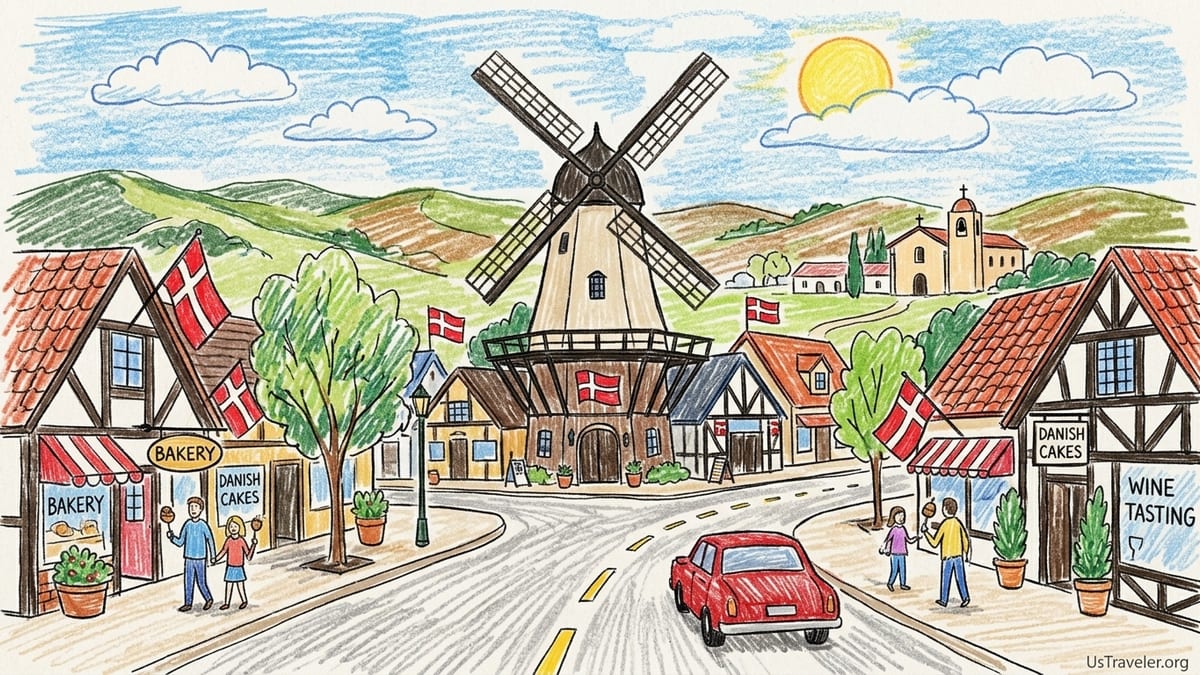
I arrived in Solvang with a head full of Danish clichés and tourism-board imagery. The approach off Highway 246 revealed windmills spinning lazily above half-timber facades, Danish flags fluttering from gabled rooftops, and bakery windows crowded with kringle and butter cookies. I had seen the photos and the promotional language about "California’s Danish village" so often that I expected at least some measure of lived Danish-American culture underneath the decoration. What I found instead was a place where genuine heritage exists, but it is buried under layers of staging, souvenir density, wine-tasting rooms, and crowd choreography that make Solvang feel more like a themed retail district than a small immigrant town.
Arriving in California’s Danish Village
Driving from Santa Barbara to Solvang takes around 40 to 50 minutes by car, depending on whether you take Highway 101 through Buellton or the more scenic but curvier Highway 154 over San Marcos Pass. It is a short enough drive that a day trip feels effortless. That convenience shapes the village before you even park: Solvang is built for easy bus drop-offs, quick family visits, and tour groups who will spend more on pastries and wine than on museums.
My first impression came as I turned onto Mission Drive, one of the town’s main thoroughfares. The speed limit dropped, the traffic slowed to a crawl, and the faux-Danish scenery switched on like a movie set. Wood-framed shop fronts with decorative half-timbering lined the road, lined with red-and-white Danish flags. One of several windmills rose up behind a cluster of shops with signs promising Danish pancakes, aebleskiver, and year-round Christmas ornaments. It was picturesque in the way of a theme park street, tightly composed for photos and quick consumption.
Parking was free in the central lots off Mission Drive and Copenhagen Drive, something the city actively promotes. That alone hints at the town’s priorities: removing friction for shoppers, not necessarily for those seeking slower cultural exploration. When I stepped out of the car, I found myself immediately funnelled toward Copenhagen Drive, where most visitors seem to begin their loop past bakeries, souvenir stores, and wine-tasting rooms.
There is an undeniable initial charm. The compact streets, the scent of sugar and coffee, and the novelty of Danish-style architecture in coastal California make for a strong first impression. But within a few blocks the repetition becomes impossible to ignore: yet another shop with butter cookies in blue tins, yet another patio offering flight tastings, yet another storefront selling Scandinavian-themed knickknacks that have little to do with Danish-American history in this valley.
Walking Copenhagen Drive, Mission Drive and Alisal Road
Copenhagen Drive is Solvang’s staged main street. Walking its length takes only minutes, but it can easily consume hours if you stop in every boutique. On a weekend, crowds move in slow clumps from bakery to bakery, phones raised for photos under the wooden arches and in front of the windmills. Many storefronts here lean heavily into a playful, almost caricatured version of Denmark: Viking helmets on plastic mannequins, gnome figurines, and racks of novelty T-shirts printed with puns about pastries and wine.
Mission Drive, which runs parallel and carries through-traffic, offers a slightly different cross-section. It is where many of the older bakeries, casual restaurants, and budget motels sit. Yet even here, the Danish facade is carefully maintained. Signs are written in curly fonts evoking old-world script, and buildings wear decorative wood beams regardless of what they house inside. It is easy to forget that this is a town founded in 1911 by Danish immigrants who initially created a fairly typical California farming community. Most of the overtly “Danish” storefront architecture came later, particularly after mid-century tourism boomed.
Alisal Road, which runs down toward the Santa Ynez River and one of the larger resort properties, mixes some of the densest tourist retail with small pockets of quieter residential life just a few blocks off the main grid. I found the cognitive dissonance strongest here: wooden clogs hung above doorways, while golf carts zipped in and out of resort driveways. It felt less like a village shaped organically over time and more like a wine-country commercial plan overlaid with Danish decor.
Step onto some of the side streets near Copenhagen Drive, and the spell breaks further. The Danish trim falls away, revealing ordinary ranch-style houses and unadorned commercial buildings. There is nothing wrong with that, of course, but it underlines how narrowly the themed core has been drawn for visitors. The central shopping streets are not the sum of Solvang; they are the carefully curated part of it, built to harvest tourist attention in a concentrated strip.
Souvenir Density, Tourist Restaurants and Tasting Rooms
After an hour or two on Copenhagen and Mission Drives, the pattern becomes predictable. Souvenir shop, jewelry store, Christmas store, Danish pastry counter, tasting room, repeat. There are variations in quality, but the overall effect is that of a downtown where nearly every square foot must justify itself in immediate sales to out-of-town visitors. It is difficult to find businesses that feel primarily oriented toward local life rather than the next arriving tour bus.
Souvenir shops dominate prime corners. Inside, you find the same spectrum of products that appear in many tourist towns: branded mugs, magnets, shot glasses, and imported chocolates. The Scandinavian twist gives it some novelty. There are Danish flags on everything from keychains to aprons, and shelves of mass-produced Viking figurines alongside nicer ceramics and textiles. I did see a few shelves of books on Danish history and design, but these were often swamped by novelty items designed for quick, forgettable purchases.
Restaurants in the core lean hard into the Danish angle, sometimes at the expense of depth. Several menus feature aebleskiver, frikadeller, and open-faced sandwiches alongside burgers, nachos, and California wines. Prices reflect the captive-audience setting: it is common to see breakfast plates pushing into the mid to high teens and basic lunch entrees hovering around 20 to 25 dollars, tax and tip not included. That is not extreme for coastal California, but it does sting more when the food feels designed to match an image rather than to showcase real culinary traditions with care.
Wine and beer tasting rooms are everywhere. Solvang is in the heart of the Santa Ynez Valley, so it makes economic sense to bring the tasting to where the people already are. But this concentration further dilutes the Danish narrative. At times I felt like I had wandered into a generic wine village that happened to have windmills, rather than a Danish-American community that happens to sit in wine country. A tasting flight will often run around 20 to 30 dollars, with discounts if you buy bottles, which can quickly add up if you are sampling in multiple rooms during a short visit.
Heritage vs. Theme: How Solvang Became This Way
To understand why Solvang feels so heavily themed, it helps to remember its history. Danish educators and community leaders founded the town in 1911, buying thousands of acres in the Santa Ynez Valley to create a new Danish colony in California. Early photographs and city records show a settlement that looked much like other small California farming towns of the era, with modest wooden and stucco buildings, a hotel, a church, and school facilities, but without the overt half-timber fantasy you see today.
The turning point came after World War II, when national media attention began to frame Solvang as “Little Denmark.” A high-profile Saturday Evening Post feature in the late 1940s attracted visitors who expected a quaint European village on the Pacific Coast. In response, local leaders increasingly reshaped the commercial core to match that outside image, selectively demolishing earlier utilitarian structures and replacing them with Danish-style storefronts. In subsequent decades, particularly the 1960s and 1970s, windmills, gables, and decorative facades spread along Copenhagen Drive, Mission Drive, and Alisal Road as tourism and retail became the town’s economic backbone.
The result is a paradoxical streetscape. The most obviously Danish-looking buildings are often the least historically Danish in terms of when and why they were constructed. A half-timbered shop selling souvenir T-shirts might have far fewer tangible links to the first immigrant families than a plain-looking church hall or ranch house outside the central district. The visible Danish vocabulary is real enough in an aesthetic sense, but it is layered on later as a commercial strategy rather than preserved from the colony’s earliest years.
That strategy has succeeded in turning Solvang into a year-round tourist magnet, but it also means that meaningful heritage is easy to miss if you only follow the signage for pastries and windmills. The town’s own planning documents acknowledge how much of the Danish village character was consciously developed along a few key streets, which now form what is essentially a themed village-design district packaged for visitors. As a traveler, you are always walking the line between appreciating the charm and recognizing its constructed nature.
Bakeries, Pastries and the Question of Authentic Taste
No visit to Solvang seems complete without at least one stop in a Danish bakery, and here the picture is more nuanced. The village is home to several long-running, family-connected bakeries that anchor the culinary side of its identity. Places like Birkholm’s Bakery, Mortensen’s Danish Bakery, and Olsen’s Danish Village Bakery have been part of the town’s fabric for decades, and many still emphasize recipes and techniques that draw from Danish traditions.
Prices, however, remind you that this is very much a tourist destination. At one well-known bakery, a slice of apple strudel runs a little over 6 dollars, while a whole strudel pushes past 20. Kringle loaves, almond rings, and specialty breads cluster around the high-teens price point per piece, and simple Danish raisin breads sit in the 6 to 8 dollar range. Individual pastries like waffles, almond tarts, and fruit-filled danishes hover around 5 to 7 dollars. It is easy for a family of four to spend 30 to 40 dollars on a couple of coffees and a small selection of pastries if everyone wants to sample something different.
The quality varies from bakery to bakery and even from day to day. At one of the busiest spots on Copenhagen Drive, the pastry case looked stunning but the reality held less flavor than I hoped. A raspberry pastry leaned too sweet and a bit dry, as though it had been sitting for a while, sacrificed to the demands of volume. In contrast, at a slightly quieter bakery a couple of blocks off the main tourist flow, the kringle had more nuance, with flaky layers, a restrained sweetness, and a pronounced almond aroma that felt closer to what I have encountered in bakeries in Copenhagen.
What complicates the picture further is that some of the most authentic-tasting items are not necessarily the ones most aggressively promoted. A tray of simple cinnamon crisps or dark limpa bread might deliver more genuine satisfaction than the showier cakes and decorated cookies that dominate the display. But these subtler pleasures can be easy to miss if you are moving with the crowds, checking boxes rather than seeking depth.
Deeper Cultural Stops: Museums and the Mission
If you are willing to step away from the commercial core, Solvang does offer a few places where heritage feels less staged and more reflective. Elverhøj Museum of History and Art is one of these. Located in a former residence designed in a Danish-style idiom, it focuses on the history of Solvang and the Danish-American community in the Santa Ynez Valley. Admission for adults and older children is about 5 dollars, with reduced pricing for seniors and free entry for young children and some pass holders. The experience here is quieter than on Copenhagen Drive: exhibits on immigration, family life, and local crafts give context that is mostly absent from the storefront theatrics.
Inside Elverhøj, I found displays of old photographs, household items, and narratives about the town’s founders that helped me connect the dots between 1911 and the present. There were also rotating art exhibitions that highlight local artists. It is not a large museum, and you can see it in under an hour, but the tone is earnest rather than promotional. It felt like a place where the community speaks to itself and to attentive visitors, not a photo backdrop designed to keep you shopping.
The Hans Christian Andersen Museum, located above a bookstore in the center of town, is more idiosyncratic. It is a small, somewhat eccentric collection of displays related to the famous Danish author, with translations of his works, artwork, and biographical information. The space feels a little dated and a bit cluttered, yet there is charm in its refusal to become a slick attraction. It is less about staged immersion and more about one enthusiastic layer of Danish cultural memory curated in a very local way.
Old Mission Santa Inés, sitting just east of the main commercial grid, supplies another form of depth. The mission predates the Danish settlement by more than a century and connects visitors to the broader layers of California history in this valley, from Native Chumash communities to Spanish colonial and Mexican periods. The grounds and small museum ask for a modest admission or donation, and they offer a welcome counterpoint to the wooden clogs and Christmas ornaments downtown. Standing in the mission courtyard, with its adobe arches and views of rolling hills, I was reminded that Solvang is an overlay on a much older landscape whose stories are largely absent from the themed shopping streets.
Comparing Solvang to Los Olivos, Santa Ynez and Los Alamos
Part of assessing whether Solvang is worth your time is seeing it in the context of its neighbors. The Santa Ynez Valley includes several small communities within a short drive: Los Olivos, Santa Ynez, Buellton, Ballard, and Los Alamos among them. Each offers its own version of wine-country charm, and some present it with far less overt theming than Solvang.
Los Olivos, about 10 to 15 minutes by car from Solvang, is essentially a cluster of tasting rooms, galleries, and a few restaurants tucked into a walkable grid of streets. The architecture leans more toward rustic Californian and Victorian-era homes than any imported national style. Here the focus is squarely on wine and food. Tasting fees are often similar to those in Solvang, but the experience feels less theatrical. Sitting under an oak tree with a flight of Rhône-style blends or local pinot noir, you are more aware of the valley’s vineyards and less of souvenir displays.
Santa Ynez, just down Highway 246, has a low-key main street with Western false-front buildings, feed stores, and taverns alongside newer restaurants and cafes. It feels more like a living small town that happens to have tasting rooms, not a place that has reoriented its entire identity around day-trippers. Los Alamos, a bit farther north along Highway 101, brings its own quirky mix of wine bars, antique shops, and a handful of serious restaurants inside old Western storefronts and former motels. None of these towns is free of tourism, but the relationship between visitor and resident life feels more balanced than in Solvang’s core.
In that comparison, Solvang stands out as the most intensely staged and curated stop in the valley. That can be a plus if you want a compact, walkable hit of pastries, wine and photo-friendly architecture in a couple of hours. But if your goal is to feel embedded in a broader wine-country landscape, with more time in vineyards and along rural roads, neighboring towns may offer a more satisfying base or at least a necessary complement to Solvang’s high-concept theme.
Day Trip vs. Overnight: How Much Time Does Solvang Merit?
Because the drive from Santa Barbara is well under an hour, the natural question is whether Solvang deserves more than a quick road-trip stop. Having done both a two-hour pass and a longer stay in the valley, my view is that Solvang works best as a focused half-day excursion or brief pause within a broader Santa Ynez itinerary, rather than as the sole centerpiece of an overnight trip.
In roughly two hours, you can park, walk the length of Copenhagen Drive and Mission Drive in the core, stop at one bakery for coffee and pastries, browse a couple of shops, and drop into either Elverhøj Museum or the mission for a dose of history. Add another hour or two if you want a sit-down lunch and a single tasting-room visit. Beyond that, additional time risks feeling repetitive unless you have a strong interest in visiting multiple museums or are using Solvang as a home base for exploring the rest of the valley by car.
An overnight stay makes more sense if you treat Solvang as one node in a network of nearby experiences. You can spend the late afternoon in the village, enjoy dinner at a restaurant that takes wine and ingredients seriously, then head out the next day for vineyard tastings near Santa Ynez or Los Olivos, a drive along rural roads, or a stop in Los Alamos. In this scenario, Solvang provides lodging, breakfast pastries, and a walkable evening, but the heart of your trip lies in the surrounding countryside.
What I would not advise is designing a multi-day itinerary that expects Solvang alone to yield new discoveries each day. The themed core is simply too small and too repetitive for that. After you have made one pass through the bakeries, shops, and windmills, the marginal returns on additional time shrink quickly. Better to acknowledge its strengths as a compact, photogenic, consumption-oriented village and to balance it with quieter, less curated corners of the valley.
The Takeaway
Is Solvang worth visiting? I would say yes, but with clear expectations. If you arrive imagining a living Danish town transplanted intact from Jutland to California, you will likely be disappointed. The reality is a small American wine-country community that has wrapped its commercial center in Danish costume, then doubled down on that identity to keep tourist dollars flowing. Genuine heritage is present, but it is interwoven with and often overshadowed by calculated theming, souvenir retail, and high-footfall food and wine businesses.
What worked best for me was approaching Solvang as a short, curated experience rather than as a deep dive into Danish-American culture. I appreciated the chance to sample pastries at a long-running bakery, to step inside Elverhøj Museum and the Hans Christian Andersen Museum, and to pause in the courtyard of Old Mission Santa Inés. I also appreciated being able to see, in a few hours, how mid-century tourism reshaped a farming settlement into a stage set that millions now treat as a slice of Denmark on the Central Coast.
On a return visit, I would repeat a stop at one or two bakeries that prioritize craft over spectacle, revisit Elverhøj for its grounded storytelling, and spend the rest of my time in nearby Los Olivos or Santa Ynez, where the wine-country atmosphere feels less choreographed. I would skip most of the souvenir shops and the more aggressively themed restaurants whose menus feel designed more for Instagram than for honest cooking.
Solvang, in the end, is not a destination I would build an entire trip around, but it can be a memorable chapter in a broader Santa Barbara or Santa Ynez Valley itinerary. Treat it like a vivid, somewhat kitschy interlude on the drive from the coast to the vineyards, and you are more likely to leave satisfied rather than puzzled by how a place founded with real immigrant intentions now feels, in its heart, like an elaborate set built to sell pastries, wine tastings, and the idea of Denmark to passing cars.
FAQ
Q1. How long do I really need to see Solvang?
Most visitors can experience the core of Solvang in about two to three hours, including a bakery stop, a short walk along Copenhagen and Mission Drives, and a quick visit to one museum or the mission. More time only adds value if you plan additional wine tastings or want to explore the broader Santa Ynez Valley.
Q2. Is Solvang an authentic Danish town?
Solvang was founded by Danish immigrants in 1911, but much of the overtly Danish-looking architecture in the commercial core was added later to appeal to tourists. There is real heritage here, yet the central streets function more as a themed district than as an organically preserved Danish town.
Q3. Is Solvang worth a dedicated overnight stay?
An overnight can make sense if you use Solvang as a base for exploring nearby destinations like Los Olivos, Santa Ynez, and Los Alamos. On its own, the village does not offer enough variety to justify multiple full days for most travelers.
Q4. How expensive are pastries and food in Solvang?
Expect individual pastries to cost around 5 to 7 dollars, with larger items like kringle or strudel in the high teens or low twenties. Sit-down meals on the main streets commonly reach the mid-teens for breakfast and 20 to 25 dollars or more for lunch and dinner entrees, before tax and tip.
Q5. Are the museums in Solvang worth visiting?
Yes, if you are interested in context beyond the shopfronts. Elverhøj Museum offers solid background on Solvang’s history and Danish-American culture, while the Hans Christian Andersen Museum provides a quirky look at the author’s legacy. Old Mission Santa Inés adds a deeper layer of regional history.
Q6. How does Solvang compare with Los Olivos or Santa Ynez?
Solvang is the most intensely themed, with Danish-style facades and dense retail. Los Olivos and Santa Ynez feel more like relaxed wine-country towns, with less overt staging and a stronger connection to surrounding vineyards and ranchlands.
Q7. Is Solvang family-friendly?
Yes. The compact, walkable core, windmills, sweet shops, and casual restaurants make it easy for families with children. Just be prepared for crowds on weekends and the temptation of many small purchases, from pastries to souvenirs.
Q8. What is the best way to get to Solvang from Santa Barbara?
Driving is the most straightforward option. The trip typically takes 40 to 50 minutes by car, either via Highway 101 through Buellton or the more scenic Highway 154 over the mountains. There are also bus connections tied to Amtrak services for travelers without a car.
Q9. Is Solvang a good wine-tasting base?
Solvang has many tasting rooms within walking distance, which is convenient if you want to sample without driving between stops. For vineyard settings and a less commercial feel, many travelers prefer to stay or spend more time in Los Olivos, Santa Ynez, or along rural roads outside town.
Q10. What should I skip if I am short on time?
If your schedule is tight, skip most of the generic souvenir and gift shops and focus on one quality bakery, a brief historical stop such as Elverhøj or the mission, and a short stroll through the core. That combination gives you a clear sense of Solvang without getting stuck in repetitive retail.