


The stretch of California coast between Monterey and Santa Barbara compresses an astonishing amount of wine diversity into a few hundred miles. Paso Robles, the Santa Ynez Valley and Edna Valley each offer distinct landscapes, climates and wine styles, along with very different ways to taste: hilltop estates, laid‑back country wineries, compact tasting towns and urban waterfront districts. Choosing among them is less about better or worse and more about which region fits your palate, budget and travel style.
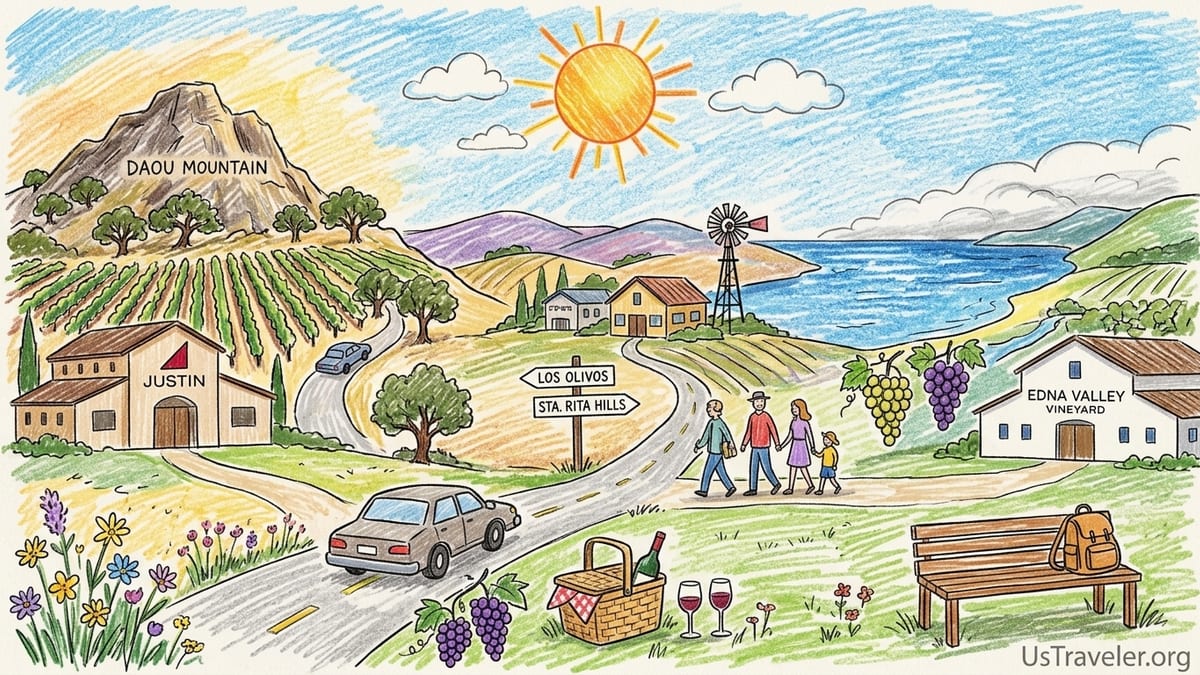
Three Regions, Three Different Central Coast Worlds
Although Paso Robles, the Santa Ynez Valley and Edna Valley all sit within California’s broader Central Coast, they feel like three separate wine worlds. Paso Robles anchors the north, a sprawling inland area defined by rolling oak‑studded hills and warm summer days. Santa Ynez Valley lies farther south in Santa Barbara County, a transverse valley that funnels cool Pacific air inland and splinters into subregions like Los Olivos, Ballard Canyon and Sta. Rita Hills. Between them, just outside the city of San Luis Obispo, Edna Valley forms a small, low‑lying pocket only a few miles from the ocean, with a notably long, cool growing season.
For travelers, the geography immediately shapes logistics. Paso Robles is car‑centric: many of its best‑known wineries sit 10 to 25 minutes from town along winding country roads, chiefly in the western Adelaida and Willow Creek districts. Estate tastings often involve driving up vineyard lanes to hilltop properties like DAOU and Adelaida, or out to rural wineries like Justin and Tablas Creek. In contrast, Santa Ynez Valley dining, lodging and tasting are scattered among several small towns, but Los Olivos in particular concentrates more than twenty tasting rooms into a few walkable blocks around Grand Avenue and Alamo Pintado Avenue, while large estates like Fess Parker and Gainey sit a short drive away. Edna Valley is the most compact of all: vineyards such as Edna Valley Vineyard and Center of Effort cluster just southeast of San Luis Obispo, with the city’s hotels and restaurants ten to fifteen minutes away by car.
Climate drives the most fundamental differences in wine style. Paso Robles, especially inland districts, is one of California’s warmest quality wine regions, with hot afternoons tempered by dramatic nighttime cooling. That diurnal swing favors thick‑skinned Cabernet Sauvignon and Mediterranean Rhône varieties like Syrah, Grenache and Mourvèdre. The Santa Ynez Valley runs from very cool at its western mouth near Sta. Rita Hills to warm in the far‑eastern Happy Canyon, so Chardonnay and Pinot Noir dominate nearer the ocean while Syrah, Grenache and Bordeaux varieties appear further inland. Edna Valley, only about five miles from the Pacific with heavy marine influence, registers among the coolest and longest growing seasons on the Central Coast, which is reflected in its focus on Chardonnay and Pinot Noir with high natural acidity and restrained alcohol.
Terroir and Wine Styles: Paso Robles
Paso Robles covers more than 600,000 acres and multiple American Viticultural Areas (AVAs), with the highest elevations and steepest slopes concentrated in the western Adelaida and Willow Creek districts. Limestone‑rich and calcareous soils appear in pockets throughout this western side, particularly on DAOU Mountain in the Adelaida District, where DAOU Family Estates farms Cabernet Sauvignon and Bordeaux varieties on steep, rocky hillsides with sweeping views over Paso Robles. The combination of hot summer afternoons, altitude and nighttime cooling makes Paso a stronghold for ripe yet structured reds, especially Cabernet Sauvignon and Rhône blends.
Cabernet fans will find multiple styles within a short drive. Justin Vineyards, west of Paso among forested hills, built its reputation on Bordeaux‑inspired blends and Cabernet Sauvignon. Its estate tastings typically focus on structured, ageworthy reds, often alongside culinary options at the onsite restaurant. DAOU emphasizes plush, polished Cabernet and Bordeaux blends, with several seated tasting formats that may include food pairings on the winery’s terraces. In a different stylistic register, Tablas Creek, in the Adelaida District, concentrates on estate Rhône varieties. Its classic flight highlights blends based on Grenache, Mourvèdre, Syrah and Roussanne, while a higher‑end Legacy Tasting, currently listed at about 75 dollars per person, focuses on library and limited bottlings and appeals to collectors and wine professionals.
Not all Paso experiences are high‑priced. Eberle Winery, one of the region’s pioneers with extensive underground caves, has long been known for accessible tastings and educational cave tours that introduce visitors to Paso history along with Cabernet Sauvignon, Zinfandel and Rhône varieties. While its more elaborate VIP cave experiences command higher fees, its standard tastings remain relatively modest compared with upscale hilltop estates. Adelaida Vineyards & Winery, another Adelaida District producer, offers seated tastings at the winery and occasionally separate hilltop experiences with panoramic views. Its portfolio spans Cabernet, Rhône varieties and Pinot Noir from cooler pockets, showcasing the stylistic range Paso can deliver when altitude and exposure vary.
In the glass, Paso Robles wines generally skew toward ripe fruit, generous texture and noticeable oak on premium reds, particularly at estates focusing on Cabernet and flagship blends. Rhône specialists such as Tablas Creek and other west‑side producers often aim for a fresher, more savory profile, especially in Syrah and Grenache, with notable minerality in sites rich in limestone. For visitors who enjoy full‑bodied reds, Paso is an obvious fit; white‑wine choice tilts toward Rhône whites like Viognier and Roussanne, along with richer styles of Chardonnay.
Santa Ynez Valley and Los Olivos: A Patchwork of Microclimates
South of Paso Robles, Santa Ynez Valley stretches inland from the Pacific in a rare transverse orientation, which allows ocean fog and wind to penetrate deeply before being gradually blocked by inland hills. The result is a gradient from very cool in the Sta. Rita Hills near Lompoc to significantly warmer climates near Santa Ynez town and Happy Canyon. Within this broader AVA, more tightly defined appellations such as Sta. Rita Hills, Ballard Canyon and Los Olivos District highlight specific soil and climate combinations. Ballard Canyon, for example, sits in the heart of the valley and combines cool nights with short periods of daytime heat, producing Syrah with both ripe fruit and peppery freshness. The Los Olivos District, which surrounds the village of Los Olivos, consists largely of well‑drained sandy and clay loams formed from alluvium, favoring Rhône and Bordeaux varieties with balanced acidity.
Wine styles reflect this diversity. In Sta. Rita Hills on the western end, Pinot Noir and Chardonnay dominate, marked by bright acidity, moderate alcohol and savory or saline notes from strong maritime influence. Producers pouring these wines in downtown Los Olivos or at estate properties in the hills often differentiate cuvées by vineyard, with single‑vineyard bottlings from windy sites delivering taut, ageworthy Pinot Noir. Move east toward Los Olivos and Santa Ynez and the mix shifts to more Syrah, Grenache and Cabernet Franc alongside Chardonnay, often with slightly riper fruit and softer tannins than their counterparts farther west. In Ballard Canyon, Syrah takes center stage, mixing dark fruit with herbal and floral notes that speak to its mixed climate of warm days and notably cool nights.
From a visitor’s perspective, Santa Ynez Valley offers three main tasting modes. Estate wineries like Gainey Vineyard and Fess Parker sit along country routes such as the Foxen Canyon Wine Trail. Gainey’s home ranch tasting room is surrounded by estate vineyards and focuses on estate‑grown wines, while Fess Parker Winery’s expansive tasting room and lawns make it a popular stop for groups and families, with areas where children can play under supervision while adults taste. Closer to town, Sunstone Winery near Santa Ynez offers outdoor tastings in a Provençal‑style courtyard built from reclaimed French stone, with reservations especially recommended on weekends and for larger groups.
Meanwhile, the town of Los Olivos functions almost like a wine village. Current guides list more than twenty tasting rooms clustered within a few compact blocks, including producers like Carhartt Family Wines, which pours a broad range of Rhône and Bordeaux‑influenced wines at its Carhartt Cabin, and Tercero Wines, where tastings focus on small‑lot Rhône and aromatic whites. Many Los Olivos tasting rooms offer tastings in the 20 to 30 dollar range per person, often with the fee credited toward bottle purchases. Operating hours vary, but a common pattern is late morning opening around 11 a.m. and last pours by 5 or 6 p.m., with some venues extending to early evening on weekends.
The region’s mix of climates makes Santa Ynez Valley especially attractive to mixed‑palate groups. One day might include a Sta. Rita Hills Pinot Noir flight in a Los Olivos tasting room, a Syrah‑driven lineup from Ballard Canyon and a Bordeaux blend from Happy Canyon, all within short drives of each other. Compared to Paso Robles, the red wines often show slightly lower alcohol and more pronounced acidity, while the best Chardonnays and Pinot Noirs from the cooler western zones can rival better‑known coastal regions in complexity.
Edna Valley: Cool‑Climate Chardonnay and Pinot Near the Coast
Edna Valley sits just southeast of the city of San Luis Obispo and is among California’s closest inland valleys to the Pacific. The valley floor lies only a handful of miles from the ocean, and gaps in the coastal hills funnel cool marine air and fog inland. Historical petitions for the Edna Valley AVA emphasize its long, cool growing season, frequent ocean fogs and moderate summer temperatures compared with hotter inland areas. Kill‑frost events are relatively rare, which, combined with the valley’s extended hang time, allows grapes to ripen slowly while retaining high acidity.
These conditions favor Chardonnay and Pinot Noir above all. Estate producers such as Edna Valley Vineyard and Center of Effort focus on these varieties, with additional plantings of Rhône grapes in slightly warmer pockets. Edna Valley Vineyard highlights multiple tiers of Chardonnay, from brighter stainless‑influenced bottlings to richer reserve cuvées, along with Pinot Noir that balances red fruit, spice and fresh acidity. The winery’s Private Reserve Experience currently lists at around 40 dollars per person for a guided tasting of limited‑release reserve wines. Center of Effort hosts seated, appointment‑based tastings of estate Chardonnay and Pinot Noir, often in modern indoor spaces that open to views of surrounding vineyards and the volcanic Morros that punctuate the valley.
Compared with Paso Robles and much of Santa Ynez Valley, Edna’s wines present as cooler, more linear and lower in alcohol. Chardonnay tends toward citrus, green apple and stone fruit notes with well‑defined acidity, while Pinot Noir offers red cherry, cranberry and baking spice with fine tannins and moderate weight. For travelers used to richer styles, these wines can feel taut and refreshing, especially with local seafood in nearby Pismo Beach, Avila Beach or Morro Bay. Because the valley is part of the broader San Luis Obispo Coast AVA, many producers emphasize sustainable and coastal farming credentials, which appeals to visitors keen on environmentally mindful wine tourism.
Edna Valley’s compact geography makes logistics straightforward. Most tasting rooms sit within a ten to fifteen minute drive of central San Luis Obispo, where visitors find the majority of lodging, restaurants and non‑wine activities. That proximity allows travelers to combine a morning hike or beach visit with an afternoon of one or two focused tastings without long drives. It also enables safe transport options, such as short taxi or rideshare trips back to town, which are easier and typically less expensive to arrange than in more rural Paso Robles.
Tasting Formats: Estates, Downtown Rooms and the Funk Zone
The three regions differ as much in tasting format as in terroir. Estate wineries dominate the classic image of Paso Robles. DAOU’s reservations‑required, seated tastings on DAOU Mountain may include food pairings from an onsite culinary team, combining multiple Cabernet‑focused flights with shared plates. Justin’s estate experiences west of Paso, bookable by reservation, include guided tastings that run roughly 90 minutes and may be paired with à la carte lunch offerings from the onsite restaurant at the main property. Tablas Creek’s estate tasting room sits amid its vineyards in the Adelaida District, a fifteen minute drive from Paso along Adelaida Road, with options ranging from core lineups to the more in‑depth Legacy Tasting. Eberle and Adelaida Vineyards also operate estate rooms where visitors taste steps from production facilities and, in Eberle’s case, underground caves.
Downtown tasting rooms offer an alternative for those who prefer to park once and walk. Paso Robles’ compact town center surrounds a central park and hosts multiple winery outposts and wine bars, though the heaviest concentration of estate names still lies in the hills to the west. Santa Ynez Valley excels in walkable tasting: Los Olivos compresses more than twenty tasting rooms into a grid of low‑slung buildings and historic storefronts, enabling visitors to sample different producers without driving. That density supports a slower, more flexible day, where travelers can drop into a room like Carhartt, Brewer‑Clifton or Tercero for a one hour tasting and then decide on the next stop based on energy and interest.
For guests who prefer not to drive at all between vineyards, Santa Barbara’s Funk Zone and the surrounding urban core provide perhaps the most practical model on the Central Coast. Wedged between downtown Santa Barbara and the waterfront, the Funk Zone’s former warehouses now house art studios, breweries, restaurants and more than a dozen tasting rooms that form a key segment of the Santa Barbara Urban Wine Trail. Visitors can move on foot between spaces such as Santa Barbara Wine Collective, Pali Wine Co.’s Funk Zone tasting room and various small producer outlets, often within a few minutes of each other. Many open around midday and pour until early evening, making it easy to build a gentler tasting schedule interspersed with food and time by the beach.
Edna Valley occupies a middle ground. Most tastings still take place at estate or near‑estate properties along rural roads, but short drives from San Luis Obispo mean visitors can rely on local taxis or rideshare services and still return quickly to town. Some San Luis Obispo wine bars and downtown tasting rooms pour Edna Valley producers, providing an urban option similar, albeit on a smaller scale, to Santa Barbara’s Funk Zone.
Practical Details: Costs, Reservations, Policies and Logistics
Tasting fees and policies evolve frequently, so travelers should always confirm directly with wineries shortly before visiting. As of late 2026, a baseline pattern has emerged. In Paso Robles, tasting flights at larger, view‑driven estates such as DAOU, Justin and Adelaida generally range from roughly 40 to 75 dollars per person for standard experiences, with fees sometimes waived or partially credited with qualifying wine purchases or club signups. Tablas Creek’s more advanced Legacy Tasting sits at the upper end of that spectrum at around 75 dollars, while its core flights are lower. Eberle keeps its basic tasting and cave tour relatively affordable compared with many Napa and Sonoma benchmarks, which appeals to value‑conscious visitors.
In Santa Ynez Valley, most downtown Los Olivos tasting rooms charge in the 20 to 35 dollar range per person, again often applying fees toward purchases. Premium estate tastings at properties like Fess Parker, Gainey or Sunstone typically fall between 30 and 60 dollars per person, with specialized private or library experiences costing more. Sunstone notes that reservations are optional but strongly recommended on weekends, especially for larger parties. Fess Parker allows small groups to reserve online for flights, glasses or bottles, and its grounds are frequently cited as family‑friendly, with outdoor space that accommodates children under adult supervision.
Edna Valley pricing is broadly similar to Santa Ynez rather than Paso’s priciest estates. Edna Valley Vineyard’s Private Reserve Experience is currently listed at 40 dollars per person for a guided tasting of four reserve wines, with the option to waive one tasting fee with a qualifying wine purchase. Other Edna Valley producers sit in a comparable band, particularly for standard seated tastings of Chardonnay and Pinot Noir. Because the region’s tasting scene is smaller, reservations are often required or strongly suggested, especially on peak weekends during late summer and harvest.
Policies around food, pets and children vary. Many Paso Robles estates, including Justin, restrict outside food at their main tasting areas but offer onsite culinary options, from cheese boards to full restaurant menus. DAOU provides its own small‑plate and pairing menu and generally does not permit outside picnics in core tasting zones, though policies can evolve. Santa Ynez Valley estates more commonly allow picnics in designated areas, provided guests purchase wine onsite; some, like Fess Parker, are known for lawns where families lay out blankets. Downtown tasting rooms in Los Olivos and the Funk Zone vary: a number are dog‑friendly on patios, while others are strictly 21 and over indoors. Travelers planning to bring pets or children should verify in advance and aim for weekday visits, when rooms are less crowded.
Transport also differs markedly among the three regions. In Paso Robles, public transport to wineries is virtually nonexistent, and distances between estates make walking impractical. Visitors either drive themselves, hire a local driver service or join prearranged wine tours. Santa Ynez Valley offers more choices, from full‑day guided tours departing Santa Barbara or Solvang to private drivers who build custom itineraries among vineyards and Los Olivos tasting rooms. Edna Valley’s short distances from San Luis Obispo allow travelers to rely on local taxis or rideshare services for half‑day tastings at one or two wineries without committing to a full tour. Santa Barbara’s Funk Zone requires no vehicle at all once visitors reach the neighborhood, reducing the need for designated drivers.
Comparison Table: Costs, Concentration and Stay Length
The following high‑level comparison summarizes how the three regions stack up for most visitors. Specific prices and offerings change regularly, so treat these as approximate ranges and cross‑check before booking.
Paso Robles generally commands the highest tasting fees, especially at marquee estates, but offers dramatic vineyard scenery and some of the Central Coast’s most ambitious Cabernet and Rhône programs. Wineries are spread across a broad area, particularly west of town, which argues for at least two full days if you want to combine a few hilltop estates with more modest, educational stops like Eberle or Tablas Creek. Lodging options range from roadside motels to vineyard inns and high‑end resorts; rates climb during summer weekends and the late August to October harvest window.
Santa Ynez Valley sits in the middle on cost but scores highly on convenience. With more than twenty tasting rooms in Los Olivos alone and larger estates dotted within a fifteen to twenty minute drive, visitors can structure days that mix walkable tastings with one or two scenic vineyard visits. Accommodation spreads among Solvang, Santa Ynez and Los Olivos, from inns like Fess Parker’s Wine Country Inn in Los Olivos to chain hotels near the main highways. A two‑night stay suits most first‑time visitors, though serious Pinot Noir and Chardonnay fans who want deeper exploration of Sta. Rita Hills may justify an extra day.
Edna Valley typically feels slightly more affordable in terms of both lodging and tasting fees, especially when paired with San Luis Obispo’s broader tourism market and off‑season university calendar. Because the region is compact, a focused enthusiast could sample two or three key producers in a single day, but a weekend stay allows time for coastal excursions to Avila or Pismo Beach, meals in downtown San Luis Obispo and perhaps a side trip to Paso Robles or Santa Maria. For travelers who value walkable evening dining, SLO’s downtown provides more options than any individual town in Santa Ynez Valley or Paso Robles proper.
Sample Itineraries and Budget Considerations
Responsible wine travel means capping the number of tastings and building in food, water and downtime. For most people, two, at most three, full tastings per day is the upper limit before palate fatigue and alcohol add up. The following sample plans assume shared tastings where appropriate and the presence of a sober driver or use of a guided tour or rideshare whenever winery‑to‑winery driving is involved.
A one‑day Paso Robles visit might focus on the western hills. Start with a late morning estate tasting at Tablas Creek to explore Rhône varieties in a more vineyard‑driven style. Break for a long lunch in downtown Paso or at a winery with a restaurant. In the afternoon, schedule a single seated tasting at DAOU or Justin, ideally with food pairings to slow the pace. Skip a third winery in favor of downtown strolling or an early dinner near the central park. For a weekend, expand to include a day in the Adelaida District, with a morning at Adelaida Vineyards followed by Eberle’s cave tour and tasting, and perhaps a lower‑alcohol white‑wine or rosé flight to finish.
In Santa Ynez Valley, a car‑free or low‑driving day can center on Los Olivos. Stay in or near the village, have a leisurely breakfast, then walk to a late‑morning tasting at a producer such as Tercero or Carhartt. Break for lunch at a local café, then choose one or two more tasting rooms in the afternoon, ideally mixing styles, such as a Sta. Rita Hills focused lineup at a producer specializing in Pinot Noir and Chardonnay followed by a Rhône blend specialist. On a second day, consider a guided small‑group tour out of Santa Barbara or Solvang that visits two or three estates like Gainey, Sunstone and Fess Parker, with transport included.
An Edna Valley day trip from San Luis Obispo could start with brunch in downtown SLO, followed by an early afternoon seated tasting at Edna Valley Vineyard. After a break or short walk at a nearby trailhead, head to a second appointment at Center of Effort or another estate for Chardonnay and Pinot Noir. Return to town by late afternoon and leave the car parked for the evening. A weekend in the area can expand to include a Saturday in Edna Valley and a Sunday coastal loop to Avila or Pismo, with perhaps a single additional tasting at a coastal outpost pouring SLO Coast wines.
Budget expectations for a couple vary with travel style. As a late‑2026 baseline, a two‑day Paso Robles visit might involve four tastings total at an average of about 50 dollars per person per tasting at larger estates, for roughly 400 dollars in tasting fees, plus a bottle or two purchased at 40 to 80 dollars each. Lodging can range from roughly 200 dollars per night for midrange motels to notably higher for vineyard hotels in peak harvest months. A similar Santa Ynez Valley weekend built mostly around Los Olivos tasting rooms might see three or four tastings at 25 to 35 dollars per person, totaling in the neighborhood of 220 to 280 dollars in fees for a couple, with slightly lower lodging costs in Solvang or Santa Ynez outside peak holidays. An Edna Valley and San Luis Obispo weekend, assuming two to three tastings at 30 to 40 dollars per person and moderate coastal or downtown lodging, can come in somewhat below Santa Ynez overall, especially outside major event weekends.
Guided Tours, Designated Drivers and Independent Visits
Choosing between guided tours, designated drivers and independent visits hinges on budget, group size and comfort with navigation. In Paso Robles, distances between wineries and limited rideshare coverage in the hills push many visitors toward hiring a private driver or joining a small‑group tour. Private drivers typically charge a daily rate plus gratuity but allow personalized itineraries, which is valuable if you want to combine sought‑after estates with smaller appointments at producers off the main routes. Group tours cost less per person but follow preset winery combinations selected by the operator. For serious collectors targeting specific tasting rooms like DAOU, Justin and Tablas Creek on the same day, a private driver often makes the most logistical sense.
Santa Ynez Valley presents more nuance. Travelers based in Santa Barbara can book full‑day van or mini‑bus tours that depart from city hotels and cover three or so wineries in the valley, sometimes including lunch. Current price surveys show per‑person rates that, for a couple, often land between the cost of two or three separate Uber or taxi rides plus tasting fees and the cost of hiring a bespoke private driver. Couples who prioritize flexibility frequently opt to self‑drive one day spent mostly in Los Olivos, where car‑to‑glass time is minimal, and then reserve a group or private tour on another day for farther‑flung estates. Families with children may prefer to drive themselves so that they can leave more easily if kids tire of tasting room patios.
In Edna Valley and around San Luis Obispo, independent visits are easiest. Short distances between SLO lodging and valley wineries, coupled with more reliable rideshare availability than in outer Paso Robles, make it feasible to schedule two tastings and rely on a taxi or rideshare for one or both winery legs. Some visitors still hire private drivers for half‑day custom tours, but the economics lean more toward independent travel, especially for small groups. Santa Barbara’s Funk Zone and downtown Santa Barbara represent the safest option of all: once checked into a nearby hotel, guests can walk between tasting rooms and restaurants, so the main discipline required is spacing out tastings and alternating with food and water.
For all three regions, seasoned visitors emphasize the importance of reservations. Many marquee Paso and Santa Ynez estates operate primarily or entirely by advance booking, especially for weekend time slots between late spring and harvest. Downtown tasting rooms in Los Olivos and the Funk Zone can often accommodate walk‑ins during weekdays and shoulder seasons, but fill up quickly on Saturdays. Booking specific time windows also helps control pacing: an 11 a.m. reservation, a long lunch and a 3 p.m. tasting leave little room to add impulsive extra flights that can tip a day from enjoyable to exhausting.
The Takeaway
Matching region to traveler type can simplify Central Coast trip planning. Paso Robles suits serious red‑wine drinkers and collectors who are especially interested in Cabernet Sauvignon and Rhône blends and who value immersive estate settings. The region rewards multi‑day stays, both for the breadth of wineries and the need for safe, planned transport. Couples comfortable with higher tasting fees in exchange for dramatic views, culinary programs and polished hospitality will likely consider Paso their first stop.
Santa Ynez Valley and Los Olivos appeal strongly to couples and groups with mixed palates and experience levels. The ability to sample Sta. Rita Hills Pinot Noir, Ballard Canyon Syrah and Los Olivos District Rhône or Bordeaux blends within a short radius, all while staying in a relaxed countryside setting, makes the area ideal for both beginners and enthusiasts. Los Olivos’ walkable grid of tasting rooms works well for travelers who prefer to leave the car parked for most of the day, while larger estates like Fess Parker and Sunstone provide the classic vineyard backdrop many visitors imagine when they picture wine country.
Edna Valley and nearby San Luis Obispo best serve travelers who prioritize cool‑climate Chardonnay and Pinot Noir and who want to combine wine with coastal activities. Beginners often appreciate the lighter textures and higher acidity of Edna wines, which match easily with seafood and casual local cuisine. Lodging in SLO offers the most urban evening environment of the three regions, with a university‑town energy that contrasts with Paso’s quieter downtown and Santa Ynez’s small‑village feel. Budget‑conscious couples may find that a long weekend based in SLO with a single dedicated Edna Valley tasting day delivers strong value.
For casual visitors and those who want walkable tasting rooms more than vineyard vistas, downtown Los Olivos and Santa Barbara’s Funk Zone are the most practical options. Travelers can arrive by car, ride the train to Santa Barbara or connect via regional flights and then explore on foot. In both places, it is realistic and responsible to limit the day to two or three tastings, interleaved with meals and time at the beach or in local shops. Whichever region you choose, planning around a modest number of focused tastings, confirmed reservations and a clear transport strategy will keep the emphasis on discovery rather than logistics and ensure that the Central Coast’s diversity of terroir and style comes through in the glass.
FAQ
Q1. How many wineries can I realistically and safely visit in one day?
Most visitors find that two, at most three, full tastings per day are plenty. Limiting stops allows time for food, water and breaks between pours and reduces both palate fatigue and alcohol intake, especially when tastings involve five or more wines each.
Q2. Do I need reservations for Paso Robles, Santa Ynez Valley and Edna Valley wineries?
Reservations are strongly recommended in all three regions, particularly on weekends, during summer and in harvest season from roughly late August through October. Many marquee Paso Robles and Santa Ynez estates operate primarily by reservation, while smaller tasting rooms in Los Olivos, San Luis Obispo and the Funk Zone may accept walk‑ins on quieter weekdays.
Q3. Which region is best for Cabernet Sauvignon lovers?
Paso Robles is the strongest fit for Cabernet enthusiasts, especially in its western districts. Estates such as DAOU, Justin, Adelaida and Eberle all feature Cabernet Sauvignon and Bordeaux‑inspired blends prominently, often alongside Rhône varieties, in settings that range from hilltop terraces to cave tours.
Q4. Where should I go if I am more interested in Chardonnay and Pinot Noir?
Seek out Edna Valley and the cooler parts of Santa Ynez Valley, particularly Sta. Rita Hills. Edna Valley producers like Edna Valley Vineyard and Center of Effort focus heavily on Chardonnay and Pinot Noir, while many Santa Ynez and Los Olivos tasting rooms pour Sta. Rita Hills bottlings that emphasize bright acidity and coastal freshness.
Q5. Is there a good option if I do not want to drive between tasting rooms?
Yes. Santa Barbara’s Funk Zone offers a dense cluster of tasting rooms within easy walking distance of downtown hotels and the waterfront, and Los Olivos in Santa Ynez Valley concentrates more than twenty tasting rooms into a few compact streets. In both places you can park once or arrive by rideshare and explore on foot.
Q6. Are the wine regions child and pet friendly?
Policies vary by winery, but many Santa Ynez Valley estates, including larger properties with outdoor lawns, accommodate families with children as long as minors are supervised. Some Paso Robles and Santa Ynez tasting rooms allow dogs on patios. Urban tasting rooms in the Funk Zone and downtown SLO often restrict indoor spaces to guests 21 and over. Always check each winery’s current guidelines before visiting with children or pets.
Q7. How does harvest season affect pricing and crowd levels?
Harvest season from late August through October brings busy weekends, special events and higher demand across Paso Robles, Santa Ynez Valley and Edna Valley. Tasting rooms are more crowded, reservations book out earlier and lodging prices typically rise compared with winter or early spring. Travelers seeking quieter experiences and lower accommodation costs often choose shoulder seasons like late winter or early May.
Q8. What is the typical cost of a wine tasting in these regions?
As of late 2026, standard tastings in Los Olivos and Edna Valley often run between about 20 and 40 dollars per person, while larger estate experiences in Paso Robles and parts of Santa Ynez Valley commonly fall in the 40 to 75 dollar range. Private or library tastings, food pairings and hilltop experiences may cost more. Many wineries credit a portion of the fee toward bottle purchases or waive fees for club members.
Q9. Should I book a guided wine tour or explore independently?
Guided tours and private drivers are useful in Paso Robles and Santa Ynez Valley, where distances between wineries are longer and rideshares less reliable, particularly in rural areas. Independent visits work well in Edna Valley, Los Olivos and the Funk Zone, where wineries lie closer to town centers and taxi or rideshare access is better. Your choice should balance budget, desired flexibility and comfort with driving.
Q10. Which region is best for beginners versus serious collectors?
Beginners often gravitate toward Santa Ynez Valley and Edna Valley, where walkable tasting towns and slightly gentler wine styles make exploration less intimidating. Serious collectors typically favor Paso Robles for its ambitious Cabernet and Rhône programs, along with focused tastings at estates such as DAOU, Justin and Tablas Creek. Couples and casual visitors who want a mix of wine, dining and non‑wine activities often find that splitting time between two regions, such as Santa Ynez and Edna or Paso and SLO Coast, delivers the best overall experience.