


I knew I wanted the Atlantic, but not the roar of Daytona or the boardwalk thrum of Cocoa Beach. That is how I ended up inching my rental car across the Merrill P. Barber Bridge into Vero Beach on a warm Friday afternoon, windows cracked, the air starting to smell faintly of salt and hibiscus. The skyline never really appeared. Instead of high-rise condos, the barrier island rose as a low, green strip, palms and live oaks hiding most buildings from view. It felt like the volume on Florida’s east coast had just been quietly turned down.
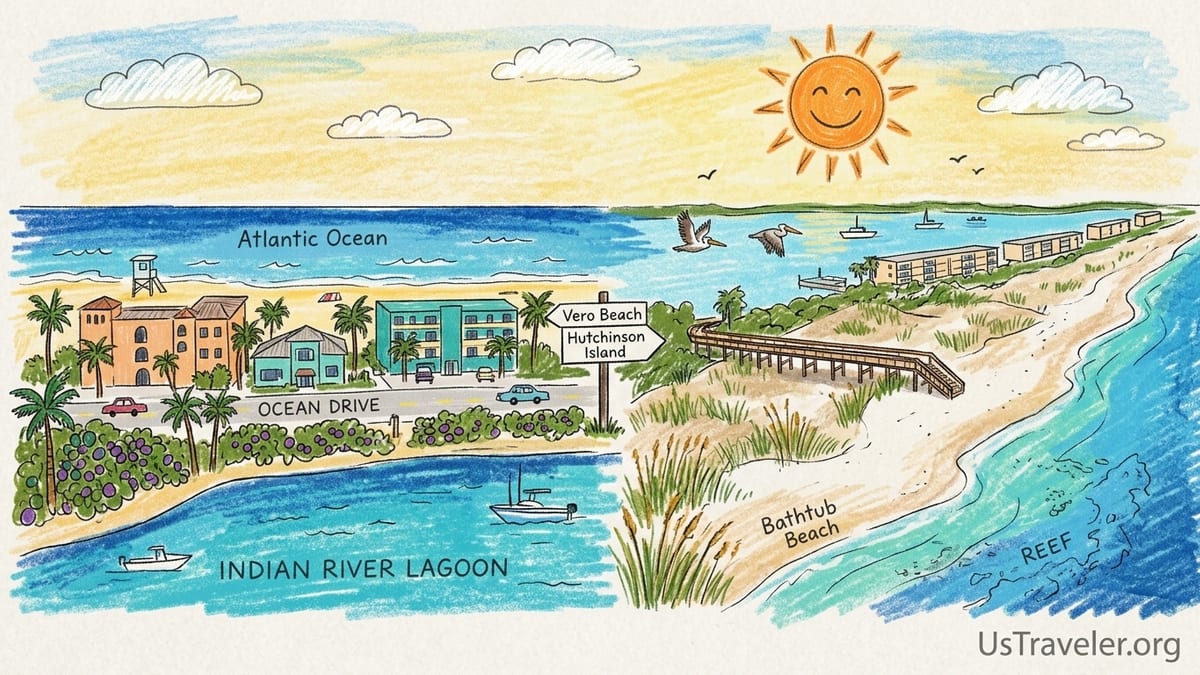
Arriving in Vero Beach: First Impressions of a Low-Rise Coast
Crossing into Vero Beach’s barrier island, what struck me first was what I did not see. There were no rows of twenty-story condos casting late-afternoon shadows over the sand, no neon beach clubs announcing themselves from blocks away. Ocean Drive, the main oceanside street, felt almost like a village road that happened to end at the Atlantic. Buildings mostly hovered in the two to five story range, and many of them were set back behind sea grapes and palms, so the ocean kept slipping in and out of view instead of being walled off.
I stayed just off Ocean Drive in a small independently run hotel, a low stucco building with exterior corridors and a tiny pool tucked behind a hedge. My room was clean if slightly dated, with cool tile floors, a basic but comfortable bed, and a balcony that looked over a quiet residential street rather than the water. The tradeoff was price and access. On September weekday dates, that room ran just under 200 dollars per night including taxes, with no added resort fee, and I was still only about a five-minute walk from Humiston Beach Park and its Atlantic horizon.
Coming from places like Daytona, where many oceanfront hotels now lean into resort fees and paid parking, Vero immediately felt less transactional. I parked my car free of charge behind the hotel, and within an hour of arriving I was walking east toward the beach past single-story homes and flowering shrubs. There were no barkers, no souvenir megastores, just people walking dogs or heading home from work. The sense that this was first a hometown and second a resort colored the whole stay.
My expectations were simple. I wanted a calm beach break with good swimming, easy parking and enough restaurants and coffee to feel looked after without the nightlife that keeps you awake when you would rather hear the surf. In Vero Beach, that combination turned out to be surprisingly easy to find, especially if you are willing to be a short stroll or a very short drive from the water instead of directly on it.
Exploring Ocean Drive and Beach Parks: Humiston, South Beach and Wabasso
Ocean Drive is where Vero Beach’s barrier island gathers itself. Early the next morning I started at Humiston Beach Park, which sits right in the middle of this small commercial strip. The park is compact but carefully kept, with a neat lawn, a playground, shaded benches and a short path over the dunes to the sand. On a late summer Saturday around 9 a.m., the parking lot had open spaces, including standard and a few accessible spots, and nearby street parking still felt relaxed. There were lifeguards on duty, showers that actually worked and clean restrooms, all within a couple of minutes’ walk to independent cafes and boutiques when you stepped back onto Ocean Drive.
The shopping and dining just off Humiston added a layer of convenience I rarely find on quieter beaches. Along Ocean Drive and the side streets you find small galleries, clothing boutiques, a surf shop with an espresso bar, and cafes doing proper espresso drinks and fresh pastry. On one morning, I grabbed a latte from a tiny counter set inside a surf shop, then walked the half-block to the dunes and watched pelicans skim the water while I drank it. There is a farmers market set up at Humiston on Saturday mornings, where local produce and baked goods add a small-town, weekend feel to the neighborhood.
South Beach Park, a short drive down A1A from Ocean Drive, felt different again. The approach is through a residential pocket with no storefronts, and the parking lot here is larger but also fills a bit earlier when conditions are good. I found a spot mid-morning and walked over the short dune crossover to a broad stretch of sand that felt less built-up than many Florida beaches. There were lifeguard stands, shelters and showers, but no commercial development directly behind the beach, which meant you needed to bring your drinks and snacks with you. In exchange, I got longer, quieter shoreline walks. I walked south until the crowds thinned to scattered couples and shell hunters, with mostly low houses hiding behind the dunes.
Later, I drove north to Wabasso Beach Park. The route up A1A passed pockets of condos and Disney’s Vero Beach Resort, but the general impression stayed low-rise and green. Wabasso’s parking is somewhat more limited than South Beach, so I had to circle for a few minutes around midday, but once on the sand I found a pleasant middle ground between the more urban feel of Humiston and the residential quiet of South Beach. Surf conditions along this stretch can vary day to day, but on my visit the water was a manageable mix of rolling Atlantic waves and clear shallows near the shoreline, comfortable for confident swimmers and older kids but less of a gentle pool than the Gulf coast.
Dining, Independent Shops and Staying Off the Sand in Vero Beach
For me, Vero Beach’s great surprise was how easy it was to enjoy the coast without paying for an oceanfront tower. My off-beach hotel left me within walking distance of Ocean Drive’s independent cafes, restaurants and shops. I ate breakfast at a small bakery near Humiston one morning, where the line was mainly locals in flip-flops, then wandered through a home and lifestyle store filled with coastal linens, books and glassware that felt curated for actual homes, not souvenir shelves.
Dinners leaned toward casual but competent. One night I sat at the bar of a long-established oceanfront restaurant on stilts, listening to stories about hurricanes from a bartender who had clearly been there through several. Another evening I chose a second-floor dining room above Humiston Park, where glass walls looked out over the palms to the ocean. Prices, as of late 2026, generally ran in the mid-teens for sandwiches and casual lunches along Ocean Drive and 25 to 40 dollars for mains at more polished dinner spots, which felt in line with other coastal towns that cater to a mix of locals and visitors.
Because public beach access in Vero is genuinely good, I never felt penalized for staying off the sand. Both Humiston and South Beach offer free parking, lifeguards and facilities, and even smaller access points north and south were straightforward to find. For travelers doing a three-night stay, the cost difference can be noticeable. On my sample dates in shoulder season, a midrange independent hotel one block off Ocean Drive priced around 600 to 650 dollars total for three nights including taxes and minimal fees, while comparable oceanfront rooms with direct views and on-site bars pushed closer to 1,000 to 1,200 dollars and sometimes added nightly resort fees.
There are tradeoffs. Nightlife in Vero Beach is limited, especially on the barrier island. By 9:30 or 10 p.m. on weeknights, Ocean Drive was quiet enough that I could hear sprinklers and palm fronds more than music. If you want live bands and late-night bars, you would be driving across the bridge into mainland Vero, and even there the scale is small. But for a trip where mornings start with coffee and a beach walk, and evenings end with a glass of wine on a quiet balcony, that felt like a feature more than a flaw.
Side Trips from Vero: Gardens, Art and a Very Local Downtown
During this stay I focused mostly on the beaches, but I did set aside time on a previous visit to dip into Vero’s cultural side. A short drive down US 1 from the beach, McKee Botanical Garden lies tucked among old-growth trees and waterlily ponds. The garden’s restored 18-acre site preserves part of a 20th-century tourist garden, with winding paths, tropical plantings and small water features. Admission in late 2026 for adults was listed in the low- to mid-twenties, with slightly reduced prices for children and local members, and the garden operates daily except major holidays. It is not a full-day excursion, but for a morning away from the sand, especially in the cooler months, it offered a calm, shaded contrast to the Atlantic glare.
Near the barrier island’s western side, the Vero Beach Museum of Art anchors Riverside Park. This regional museum holds rotating exhibitions, a sculpture garden and a permanent collection that leans into American art and contemporary works. Standard adult admission as of 2026 was posted in the mid-teens, with discounts for seniors, students and children, and free days tied to specific museum programs. The building is compact but well laid out, and the downtown-feeling galleries and small cafe are a nice reminder that Vero is more than just its beach.
Downtown Vero Beach itself, on the mainland, is worth a quick wander, though it remains modest in scale. Along 14th Avenue and the surrounding streets you will find local coffee shops, a handful of restaurants, murals and a low-key evening scene on weekends. It does not compete with bigger Florida downtowns for nightlife, but it is the place to go if you need a break from beach restaurants, want a good espresso, or feel like browsing record stores and antique shops for an hour or two.
These attractions are not essential if your goal is a purely quiet beach holiday, but they add rainy-day options and variety for longer stays. Importantly, they are all car dependent. Public transport is limited, so you should plan on budgeting time for short drives and parking, which is generally free or low-cost around these sites but still requires a car and a bit of navigation.
Shifting South to Hutchinson Island: First Glimpse of Jensen Beach and Stuart
From Vero Beach, Hutchinson Island starts as a long, low ribbon of sand stretching south through Indian River and Martin counties. I drove down A1A, watching the addresses tick from Wabasso Beach toward Jensen Beach, and noticed the spaces between clusters of development growing wider. Whereas Vero Beach’s oceanside has a defined village center at Ocean Drive, Hutchinson Island feels more strung out, with pockets of condos, resorts and public accesses separated by stretches of dune and mangrove.
For my Hutchinson Island stay, I booked a midrange hotel on the river side, near Jensen Beach, rather than directly on the ocean. The property sat on the Indian River Lagoon with a small marina, an outdoor pool and a low-rise layout that felt more like an older motel updated in stages than a modern resort. My room had laminate floors, a comfortable king bed, and a tiny balcony overlooking the lagoon. The walk to Jensen Beach Park on the ocean side was not practical, so I drove, but my nightly rate in shoulder season hovered around 180 to 220 dollars including taxes. There was, however, a daily resort fee of about 25 dollars that covered parking, Wi-Fi and use of kayaks and bikes, a common feature at larger properties in this area.
Arriving at Jensen Beach Park late afternoon, I found a sweeping, mostly natural shoreline. The park sits on the eastern side of the island with a long boardwalk over the dunes, a decent-sized parking lot, restrooms and outdoor showers. Parking was free during my visit, although this can change during special events or future seasons, so it is wise to check current county guidance when planning. Compared with Vero, the feel here was slightly wilder, with higher dunes and a more open sweep of ocean, but still far quieter than the major tourist beaches to the north.
Driving further south another day, I reached Stuart Beach, which feels like the island’s main family beach. Here, the parking lot is larger again, and the amenities expand to include a snack shack, volleyball courts and direct proximity to the Florida Oceanographic Coastal Center, an educational facility set behind the dunes. The skyline remained low, but the number of families hauling umbrellas and coolers was higher, especially on a sunny weekend morning. Even so, I found a parking space without circling, and once I walked a few hundred yards up the beach, the density of people thinned significantly.
Bathtub Beach, Lagoon Walks and Nature on Hutchinson Island
Bathtub Beach, at the southern end of Hutchinson Island near Stuart, is one of the most talked-about spots in Martin County. Named for the shallow, protected pool that forms behind its offshore reef at lower tides, it has long been a favorite for families with small children and for those who prefer calmer water. On my visit, access was open but closely monitored because this stretch has been affected by erosion in recent years. The beach is narrower than in Vero, and parking is limited to a stretch along SE MacArthur Boulevard and a small lot, so arriving early in the day mattered. Once on the sand, though, the reef-created shallows lived up to their reputation when the tide and conditions lined up, offering very gentle, warm water perfect for wading.
One of the differences I noticed about Hutchinson Island compared with Vero Beach was the closeness of the Indian River Lagoon. Where Vero’s lagoon-side parks are mostly a short drive inland, on Hutchinson Island I could step out the back of my hotel onto a dock where mullet flicked in the water and dolphins sometimes cruised past at first light. Short walks at places like the Jensen Beach Causeway Park and small nature preserves along the lagoon side offered a different kind of quiet coastal experience: boardwalks through mangroves, views of sailboats at anchor, and sheltered waters with far less wind than the Atlantic side.
The Florida Oceanographic Coastal Center, just across from Stuart Beach, is a key attraction here, though my visit was limited to its surroundings. The center offers aquariums, a lagoon with rays and educational programs about sea turtles and coastal ecosystems. Family travelers I chatted with praised it as a half-day outing that combined well with time on the sand at Stuart Beach, especially when midday sun made swimming less appealing. Admission, according to posted late-2026 information, sits in the moderate range for a nonprofit attraction, with adult tickets in the twenties and children discounted, so a family of four could expect to spend around 70 to 90 dollars for entry depending on ages and memberships.
Quiet walks here tended to be either very early or around sunset. By 8 a.m., Jensen Beach’s sand still carried only footprints from the dawn walkers, and at dusk the lagoon side glowed amber around small docks and spoil islands. Unlike more urbanized coasts, boardwalks were generally short and practical rather than designed as nightlife promenades. The mood was residential and nature-focused rather than festive.
Swimming, Crowds, Cleanliness and the Cost of Three Nights
Comparing the two areas directly, the differences in swimming and crowds became clear over a few days. In Vero Beach, the beaches at Humiston, South Beach and Wabasso generally offered straightforward Atlantic swimming during standard conditions, with moderate waves and clear-enough water where you could see your feet in the shallows on calmer days. Lifeguards at the guarded parks monitored rip current risks and posted flags, which felt reassuring if you are used to busier beaches with more chaotic surf. Crowds were present but never overwhelming on my visits. Even on a reasonably busy Saturday, I could walk in either direction from a main access and find ample personal space.
On Hutchinson Island, the variety was greater but so were the constraints. Jensen Beach and Stuart Beach could feel busier at peak times, with more families and day-trippers from inland cities driving in, yet the greater length of unobstructed shoreline again meant solitude was available with a short walk. Bathtub Beach’s unique reef pool created the calmest water of either area when conditions allowed, but its narrow sand and ongoing erosion issues made it the most fragile and at times crowded spot. In exchange, it provided the kind of child-friendly wading conditions that are hard to find on the open Atlantic.
In terms of cleanliness, both regions impressed me. Trash cans were frequent and generally used, restrooms were in acceptable shape, and local counties clearly invest in their waterfronts. I noticed slightly more seaweed and natural debris near Stuart and Bathtub at certain times of year, which locals attributed to sargassum patterns and recent storms, while Vero’s sand felt a bit more consistently clean underfoot during my stays. Neither place had the cigarette-heavy, bottle-cap-littered feel that can mar some popular beaches closer to theme-park corridors.
To understand the cost side, I priced sample three-night stays for the same midweek dates in shoulder season, using publicly available rates for similar midscale accommodations. In Vero Beach, an off-beach independent hotel one block from Ocean Drive with a pool and free parking came out around 600 to 700 dollars total for three nights including taxes, with no resort fee and a walking-distance beach approach. An oceanfront boutique hotel with direct beach access and on-site bar and restaurant typically landed between 1,000 and 1,300 dollars total for three nights once taxes and nightly resort fees in the 30 to 40 dollar range were included.
On Hutchinson Island in the Jensen Beach and Stuart area, a lagoon-side midrange hotel across from the causeway, not directly on the ocean but with water views and pool, showed three-night totals around 650 to 750 dollars including taxes, plus a daily resort fee of roughly 20 to 35 dollars that added around 60 to 100 dollars to the bill. An oceanfront condo-style resort on the Atlantic side usually started around 1,100 to 1,400 dollars for the same three-night window, with cleaning fees or resort charges bringing the effective nightly cost a bit above Vero’s equivalent properties. Overall, if you are comfortable staying slightly off the beach, the two destinations can be comparable in total spend, but true oceanfront is rarely a bargain in either place.
Dining, Nightlife and Getting Around: Quiet Evenings on Both Shores
Restaurant culture differs subtly between the two coasts. Vero Beach’s Ocean Drive delivers a compact cluster of independent options in an easily walkable strip. You can stroll in flip-flops from a sunset drink at a beachfront bar to a more polished dining room above the park, then wander past shop windows on the way back to your hotel. Reservation demand exists during peak season and weekends, but because the area is walkable, you can also simply drift until you find a place with space at the bar or on the patio.
On Hutchinson Island around Jensen Beach and Stuart, dining is more spread out. There are beloved waterfront restaurants on both the ocean and lagoon side, and Jensen’s mainland downtown offers a genuine cluster of bars and eateries, but most visits require a drive. I found myself planning dinners more intentionally, checking driving times across causeways and considering bridge traffic at sunset. Once seated, though, the vibe was similar to Vero: seafood-heavy menus, casual dress, and conversations pitched at a low hum rather than over loud music.
Nightlife in both destinations is limited, and that is a major difference from Daytona or Cocoa Beach. In Vero, most island restaurants and bars wind down by around 10 p.m., with only a few spots staying open later, mostly on weekends. Mainland Vero offers a slightly livelier scene, but it is still modest. In Jensen Beach and Stuart, the main cluster of evening activity is downtown Stuart, where a few bars and live-music venues keep going a bit later, especially on Friday and Saturday nights. However, this requires a drive from island accommodations, and ride shares may not be as plentiful as in larger cities, which is a consideration if you plan to drink.
Car dependence is a shared reality across both areas. While you can craft a nearly car-free trip by staying on Ocean Drive in Vero and doing everything on foot within that bubble, most visitors will still drive to other beaches, attractions or mainland restaurants at least some of the time. On Hutchinson Island, a car is more clearly essential. Public transit is sparse, sidewalks can be intermittent along stretches of A1A, and distances between beaches, restaurants and hotels are greater. For travelers used to parking once and walking for days in more urban coastal destinations, this is an adjustment worth planning around.
The Takeaway
After splitting time between Vero Beach and the Hutchinson Island stretch around Jensen Beach and Stuart, I came away feeling that both are excellent options for travelers who want the Atlantic without the intensity of Daytona or Cocoa Beach. The choice comes down to your preferred rhythm and what you value most in a quiet coastal break.
For couples, I lean toward Vero Beach, especially if you can base yourselves within walking distance of Ocean Drive. The combination of walkable cafes, independent shops, a couple of genuinely good date-night restaurants and easy-access beaches at Humiston and South Beach makes it easy to spend three or four days mostly on foot, punctuating beach time with coffee runs and gallery browses. Nights are quiet, but in a way that supports slow dinners, early walks and unhurried mornings.
Families might tilt slightly toward Hutchinson Island, particularly if shallow water and hands-on learning matter. The combination of Stuart Beach, Bathtub Beach’s reef-protected shallows when conditions allow, and nearby institutions like the Florida Oceanographic Coastal Center gives parents more structured options alongside regular beach play. Parking is generally manageable, and the extra space on the sand during shoulder seasons can be a real gift with energetic kids.
For travelers who prioritize peace over nightlife and do not mind driving, either location can deliver a restorative escape. If walkability and a defined village feel are high on your list, Vero Beach has the edge. If you prefer a slightly wilder coastline, more obvious contrasts between ocean and lagoon, and a sense of being at the farther edge of development, Hutchinson Island may speak to you more strongly. In both places, the surf sounds louder than the nightlife, the buildings stay mostly below the treeline, and sunrise on the water feels like the main event. That, for me, is exactly the kind of Florida beach holiday I was looking for.
FAQ
Q1. Which is quieter overall, Vero Beach or Hutchinson Island?
In my experience, both are significantly quieter than Daytona or Cocoa Beach, but Vero Beach around Ocean Drive feels more like a low-key village, while Hutchinson Island feels like a string of quiet pockets separated by undeveloped stretches. If you want an evening stroll with a small-town atmosphere, Vero has the edge.
Q2. Is it worth paying for an oceanfront room in these areas?
Oceanfront rooms in both destinations are noticeably more expensive than off-beach options, often adding several hundred dollars over a three-night stay once taxes and resort fees are included. Because public access and parking are good, especially in Vero, I found better value staying just off the sand and walking or driving a few minutes to the beach.
Q3. How family-friendly are the beaches for young children?
Both areas have lifeguarded beaches and family facilities, but Hutchinson Island’s Bathtub Beach stands out when its reef pool creates very shallow, calm water that is ideal for small children. Vero’s beaches are family-friendly too, with playgrounds at Humiston and broad sand at South Beach, but the surf usually feels more like typical Atlantic conditions.
Q4. Do I need a car, or can I get by without one?
You can manage a mostly car-free stay in Vero Beach if you stay near Ocean Drive and plan to spend nearly all your time on that stretch. On Hutchinson Island, a car is much more important because beaches, restaurants and attractions are widely spaced and public transport is minimal.
Q5. How does parking compare between the two areas?
In Vero Beach, I consistently found free parking at main beach parks like Humiston and South Beach, especially if I arrived before late morning. On Hutchinson Island, parking at Jensen and Stuart beaches was also free and generally available outside peak holiday times, but Bathtub Beach’s limited spaces filled quickly and required earlier arrivals.
Q6. Are there many restaurant options for vegetarians or lighter eaters?
Neither destination is a major foodie hub, but I found salads, grilled fish, and a few vegetarian options at most casual spots in both Vero and Jensen Beach or Stuart. Vero’s Ocean Drive, with its denser cluster of independent cafes, made it slightly easier to find lighter meals and good coffee within walking distance.
Q7. What is the nightlife like, and will it disturb a light sleeper?
Nightlife is limited in both places. On the barrier islands, most venues quiet down by around 10 p.m., and I never had issues with late-night noise bleeding into my room. Light sleepers are more likely to hear sprinklers, frogs or the surf than bars or clubs.
Q8. How do these destinations compare cost-wise to Daytona or Cocoa Beach?
Rack rates can be similar or even slightly higher because both Vero and Hutchinson Island lean toward smaller-scale and sometimes more upscale lodging rather than budget high-rises. However, the absence of a heavy party scene and the ease of using public beach access made my overall experience feel like better value for a calm getaway.
Q9. Are there non-beach activities if the weather turns bad?
Yes. Around Vero Beach you have places like McKee Botanical Garden and the Vero Beach Museum of Art, while the Jensen Beach and Stuart area offers the Florida Oceanographic Coastal Center and a compact historic downtown in Stuart. None are huge, but they provide worthwhile half-day options away from the sand.
Q10. Which destination would you recommend for a long weekend without kids?
For a long weekend focused on relaxation, cafe-hopping and gentle beach days without much driving, I would choose Vero Beach and stay within walking distance of Ocean Drive. It offers enough dining and scenery for three or four days without sacrificing the quiet, early-ending evenings that make it easy to truly rest.