


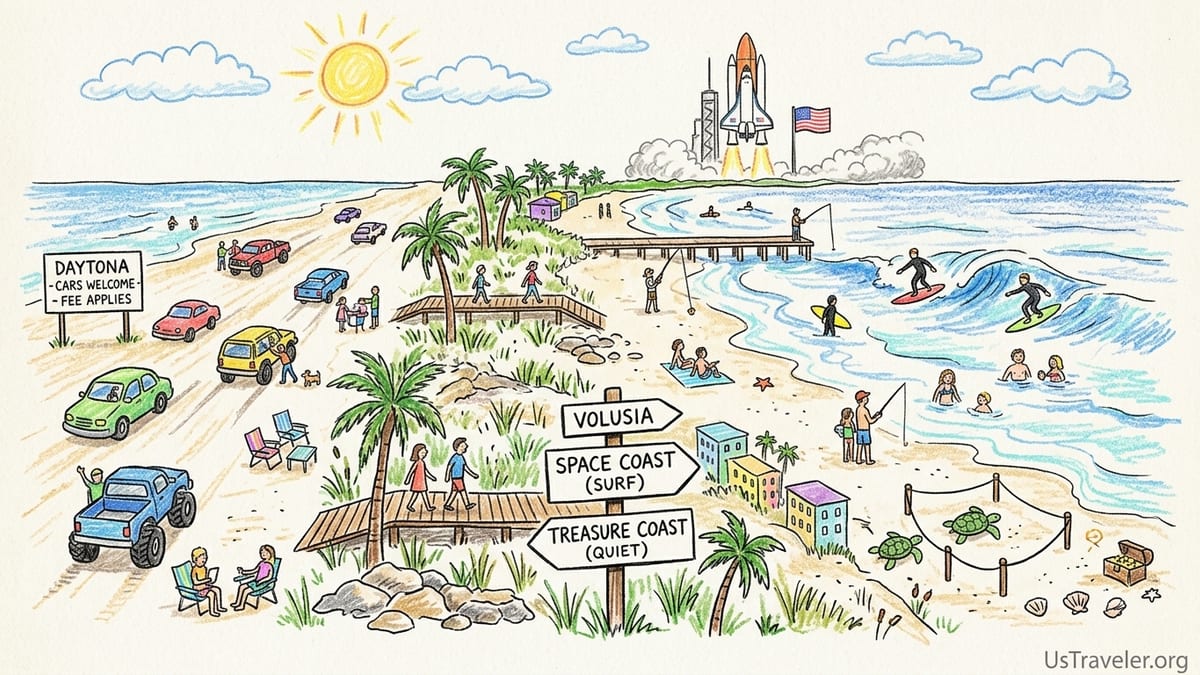
Florida’s central east coast is a long ribbon of Atlantic sand, but it is not one single destination. From the drive-on shores of Daytona Beach to the surf breaks of Cocoa Beach and the quieter dunes of Hutchinson Island, each stretch has a different personality, set of rules and level of development. This guide compares the main beaches in three key zones Daytona and the Volusia County coast, the Space Coast in Brevard County and the Treasure Coast around Indian River and St. Lucie counties so you can match your trip to the right sand, surf and scene.
How the Central East Florida Coast Is Organized
For trip planning, it helps to think of Florida’s central east coast in three distinct sections. To the north lies the Daytona Beach area in Volusia County, including Daytona Beach, Ormond Beach, New Smyrna Beach and the Apollo and Bethune sections of Canaveral National Seashore. South of there, Brevard County forms the Space Coast, home to Cocoa Beach, Playalinda Beach, Melbourne Beach and the famous surf and fishing around Sebastian Inlet. Continuing south, Indian River and St. Lucie counties form the Treasure Coast, where you will find Vero Beach, Fort Pierce and the quieter strands of Hutchinson Island, including Wabasso and South Beach Park.
These three zones share a broadly similar climate and ocean but feel very different on the ground. Volusia’s beaches are wide and hard packed, with sections where cars are allowed directly on the sand. Brevard’s Space Coast is defined by surfing, dunes and a clear rule that private vehicles stay off the beach itself. The Treasure Coast feels lower rise and more residential, with a mix of classic beachfront hotels, condo towers in pockets and long empty reaches where beach walks and wildlife are the main attraction.
Understanding that layout makes it easier to decide where to base yourself. Families who want lifeguards, playgrounds and an easy stroll from hotel to ice cream often gravitate to Daytona Beach, Cocoa Beach or central Vero Beach. Surfers focus on New Smyrna’s inlet, Cocoa Beach’s breaks and Sebastian Inlet’s jetties. Travelers seeking the quietest stays tend to look at Melbourne Beach, the less developed stretches around Wabasso or the northern and southern ends of Hutchinson Island.
Daytona Beach & Ormond Beach: Wide Sands and Drive-On Culture
Daytona Beach and its northern neighbor Ormond Beach sit on a broad barrier island with a long, relatively straight shoreline. The sand here is famously firm, which is why Volusia County still allows carefully regulated vehicle access on designated sections between Ormond Beach and Ponce Inlet. As of late 2026, nonresidents pay a published daily vehicle access fee of about 30 dollars per vehicle to drive on the beach; fees for county residents have been reduced or waived with registration, but visitors should budget for the higher nonresident rate when planning a day of beach driving. Driving is only allowed in posted zones, with reduced speed limits and regular patrols, and is prohibited near lifeguard towers, in swim-only sections and around environmentally sensitive areas.
Surf conditions on this stretch tend to be moderate for much of the year, with sandbars that create rideable waves for beginner and intermediate surfers when the swell is up. On calmer summer days, the water can be friendly for swimming, though the open Atlantic always carries the risk of rip currents. Daytona Beach and nearby Ormond Beach both have guarded areas with seasonal lifeguards, especially near main access points such as the Daytona Beach Pier and the central beachfront parks. Families often choose to swim inside these lifeguarded zones, avoiding driving lanes, which are set back behind flagged swim areas.
Daytona’s sands can feel busy in high season, particularly during speedway events, spring break periods and summer weekends. High-rise hotels and condo towers line much of the main Daytona strip, with big-name brands directly on the oceanfront. Ormond Beach, particularly north of Granada Boulevard, feels less commercial and somewhat quieter, with more low- and mid-rise buildings and several public beach parks with free or low-cost off-beach parking. Facilities vary by park, but most main accesses offer restrooms, showers and boardwalks over the dunes, with accessible ramps at larger parks closer to town.
Dining and services are concentrated in Daytona Beach proper, where visitors can step off the sand and into casual seafood cafés, bars and chain restaurants along Atlantic Avenue. Ormond Beach has its own small clusters of restaurants near beach approaches, but evenings are generally calmer than in Daytona’s core. For travelers who want easy logistics, the Daytona area offers the most straightforward combination of oceanfront hotels, walkable restaurants, lifeguards, restrooms and paid parking, with the unique option of legally driving and parking on the sand in regulated sections if you pay the Volusia County fee.
New Smyrna Beach, Bethune & Canaveral’s Apollo: Surf, Inlets and Dunes
South of Daytona, New Smyrna Beach occupies the northern side of Ponce Inlet and has a very different feel. The town’s main oceanfront, especially near Flagler Avenue and the central beachfront park, offers a compact, walkable district of low-rise hotels, inns and vacation rentals near beach access ramps. Surf here is more consistent than in Daytona, thanks to the way the offshore sandbars and nearby inlet shape the waves. New Smyrna is widely regarded as one of Florida’s surf capitals, so you will usually see a line of shortboards and longboards in the water when there is any swell.
Swimming at New Smyrna Beach is generally safe in the guarded central areas, but the inlet and jetty sections can have strong currents. Families with young children usually stay away from the inlet’s immediate mouth, where the tidal flow can be powerful and boat traffic is concentrated. Lifeguard coverage is strongest in the city’s main recreation areas, particularly near Flagler Avenue Beachfront Park and the central beach ramp. New Smyrna does have some designated zones where beach driving is allowed under Volusia County’s rules, subject to the same vehicle fee system as Daytona, though the town’s character is less dominated by cars on the sand.
South of New Smyrna’s main development, Bethune Beach offers a quieter, mostly residential stretch with dune-backed sand and views toward the undeveloped shores of Canaveral National Seashore. There are small county parks with off-beach parking, picnic tables and restrooms, and this area tends to attract couples, walkers and locals seeking less crowded sand. Surf can still be strong, and there are no lifeguard towers at the small neighborhood accesses, so it is better suited to confident swimmers.
Farther south, Apollo Beach marks the northern district of Canaveral National Seashore. Access here is via a park entrance with a per-vehicle fee that is set in line with other national park sites; as of 2026, a typical private vehicle pays in the mid-twenties for a seven-day pass that is valid at both Apollo and Playalinda. The Apollo section offers a series of numbered parking areas behind primary dunes, each with boardwalks over the sand and basic facilities such as restrooms. The beach is undeveloped and feels wild, with soft sand, nesting sea turtles in season and no commercial buildings in sight. Swimming is possible but unguarded, and the surf can be powerful. This is more of a nature and solitude destination than a classic family-swim beach.
Space Coast North: Cocoa Beach & Playalinda
Cocoa Beach is the best-known town on the Space Coast, combining a long, sandy shoreline with a deep-rooted surf culture. The sand here is lighter and slightly softer than Daytona’s and does not support vehicle traffic in the same way. A critical regulatory point for visitors: personal vehicles are prohibited on the beach in Brevard County. You cannot drive or park your car on Cocoa Beach, Playalinda or any of the other Space Coast beaches. Instead, access is via beachfront parks, municipal lots and street parking, many of which charge hourly or flat fees through meters or payment apps.
Surf conditions at Cocoa Beach range from gentle rollers on calm summer mornings to more challenging waves when winter cold fronts or tropical systems pass offshore. It is one of the most reliable places in Florida to find rideable surf, which is why it supports a cluster of surf shops, schools and local competitions. Families who want to learn to surf often book lessons near the Cocoa Beach Pier or in the central stretch south of State Road 520, where breaks are forgiving and several parks have lifeguards. Stronger swimmers and experienced surfers may head slightly south toward less crowded sections, though the entire town beach remains fairly active on weekends.
Cocoa Beach’s central oceanfront is backed by a mix of mid-rise hotels, older motels and condo buildings. Many offer direct beach walkovers and simple amenities such as pools and tiki bars. Restaurants, grocery stores and surf shops line the main highways inland from the beach, so you are rarely more than a few minutes’ drive from a casual seafood spot or café. Public beach accesses with restrooms, showers and accessible ramps are common, especially at popular parks near the pier and along the main boulevard. Parking during peak periods can be competitive and is generally pay-to-park, so factoring in daily parking costs is important for budget planning.
North of Cocoa Beach, Playalinda Beach in Canaveral National Seashore feels remote despite being within sight of Kennedy Space Center’s launch pads. Access is through a park road west of Titusville, ending at a series of numbered parking lots behind dunes. There is a national park entrance station where private vehicles pay a per-vehicle entry fee; in 2026 that charge is around 25 dollars and is usually valid for seven consecutive days. Facilities are deliberately simple: each lot has a boardwalk over the dune, outdoor showers and restrooms. There are no hotels, restaurants or stores on the beach itself, so visitors typically bring picnics and supplies from Titusville.
Playalinda offers a wide, mostly natural beach with a mix of families near the early parking areas and a quieter, more adult crowd farther north. Parts of the beach closer to the northern lots have an informal reputation for clothing-optional use, although regulations require standard beach attire and enforcement can vary. Swimming is unguarded throughout, and waves can be stronger than in town areas because of the open exposure. Another practical factor is launch activity: when SpaceX or NASA schedule rocket launches from nearby pads, the National Park Service often closes the Playalinda road and beach for safety, sometimes for extended windows. Access has also been periodically limited in recent years by storm damage, ongoing boardwalk repairs and resilience projects, so it is worth checking current conditions before committing to the drive.
Space Coast South: Melbourne Beach & Sebastian Inlet
South of Cocoa Beach, the Space Coast transitions into a quieter, more residential character around Melbourne Beach. The barrier island narrows, with State Road A1A running close to the ocean and low-rise homes and small inns tucked behind the dunes. Public beach accesses here are smaller than in Daytona or Cocoa, typically offering a compact parking lot, a dune crossover and an outdoor shower, sometimes with restrooms. There are no sections where cars can drive on the sand, and most accesses are unguarded, so this area suits independent travelers who are comfortable in open-ocean conditions.
Surf along Melbourne Beach can be excellent, particularly in the fall and winter swell seasons. The sandbars and occasional rocky coquina outcrops produce peaky waves that attract local surfers while remaining less crowded than Cocoa Beach or New Smyrna. Swimming is delightful on calm days, but strong shore breaks and rip currents can appear quickly when the surf picks up. Families with younger children often prefer to base themselves near one of the larger county parks closer to town that sometimes have seasonal lifeguards and better facilities, then venture to smaller accesses for walks and shelling.
Continuing south, Sebastian Inlet is one of the most famous surf and fishing locations on the entire Atlantic seaboard. Sebastian Inlet State Park spans both sides of the inlet between Brevard and Indian River counties and charges a modest per-vehicle entrance fee at its ranger stations. The park’s Atlantic shoreline includes long beaches, jetties that extend into the ocean and access to the calmer Indian River Lagoon. Surf on the north side of the inlet, in particular, is powerful and can be advanced-level when the swell is strong. Anglers line the jetties in search of snook, redfish and other species, helped by the fast tidal currents that sweep through the inlet.
Because the inlet channels tidal flow between the ocean and lagoon, swimming directly inside the inlet and near the jetties is not recommended for casual bathers. Strong currents and boat traffic make it more of a destination for skilled surfers and experienced anglers than for toddlers with floaties. Families who want to swim usually choose the more open beach zones in the park away from the inlet throat or use the shallower lagoon-side areas for wading. As of mid-2026, the long-planned Sebastian Inlet bridge replacement project on State Road A1A is underway, which has triggered phased closures of some parking areas, especially on the south side near the bridge and portions of the north parking lot. Authorities have stated that bridge work will be staged to keep the bridge itself open, but specific parking lots, sections of shoreline and even parts of the jetties may be periodically closed or fenced for safety while construction and jetty repairs continue.
Facilities at Sebastian Inlet State Park include restrooms, picnic pavilions, a small campground, museums and bait shops, but there are no high-rise hotels within the park boundaries. Visitors typically stay in Melbourne Beach, Sebastian or Vero Beach and drive in for the day, paying the state park entrance fee each visit or using an annual pass. This setup keeps night-time quiet and dark, which suits wildlife watchers hoping to see sea turtles during permitted walks or birders scanning dunes and mangroves. For those willing to accept construction-related inconveniences such as reduced parking and occasional detours, Sebastian Inlet remains a standout location for serious surf sessions and saltwater fishing.
Treasure Coast: Vero Beach, Fort Pierce & Hutchinson Island
South of Sebastian Inlet, the coastline softens into the Treasure Coast around Vero Beach and Fort Pierce. Vero Beach’s central oceanfront is lined mostly with mid-rise resorts, condo buildings and a walkable cluster of shops and restaurants. The main public beaches here, including those near Ocean Drive and South Beach Park, provide a more low-rise and landscaped feel than the busier strips in Daytona or Cocoa. Vero has cultivated a reputation for being quieter and more upscale, with tree-lined streets and an emphasis on preserving dune systems along the oceanfront.
Surf in Vero Beach is generally softer than around Sebastian Inlet, though the town still receives rideable waves and occasional strong swell when Atlantic conditions align. South Beach Park, a popular municipal beach near the southern edge of town, often has a mix of families, walkers and casual surfers. Lifeguards are typically on duty at the major city parks during daylight hours, and facilities include restrooms, showers and accessible ramps down to the sand. Parking at these parks is usually in paved lots close to the beach and has historically been free or modestly priced, but visitors should watch for any local changes to parking rules as coastal communities adjust revenue strategies and manage growing visitation.
Fort Pierce lies farther down the barrier island on North Hutchinson Island, offering a more laid-back mix of public beach parks and residential stretches. Oceanfront around Pepper Park Beach, Fort Pierce Inlet State Park and nearby accesses features broad sandy strands, rolling dunes and relatively low levels of commercial development. The town’s historic waterfront and marina sit on the lagoon side rather than directly on the ocean, so most oceanfront lodging is in small hotels, inns and condo rentals rather than large resorts.
Hutchinson Island in general stretches through parts of St. Lucie and Martin counties and is known for its quieter atmosphere compared with more northern resort towns. Public beach parks, including Wabasso Beach Park and South Beach Park near Vero as well as multiple county-operated parks farther south, typically offer free or low-cost parking, restrooms, showers and picnic facilities. Lifeguard coverage varies by park, with the more popular beaches near urban centers having staffed towers while some smaller accesses remain unguarded. Sand here is soft and often speckled with coquina shell fragments, and surf ranges from gentle to moderate depending on seasonal swell.
Because the Treasure Coast sits a bit farther from the major theme parks and international airports, crowds are noticeably lighter most of the year than in Daytona or Cocoa Beach. Winter brings a pulse of seasonal residents and snowbirds, but even then, it is usually possible to find relatively uncrowded sand, especially on weekdays and at the edges of public parks. Wildlife watching is excellent, with frequent sea turtle nests in season, shorebirds working the swash zone and occasional dolphins cruising just beyond the breakers. Travelers who value a slower pace, lower-rise skylines and easy access to nature often find the Treasure Coast a strong fit.
Quiet Corners & Wildlife Beaches: Wabasso, South Beach & Beyond
Within these three coastal zones are smaller pockets that are especially appealing to travelers seeking quiet, natural settings. Around Vero Beach, Wabasso Beach Park and the stretches of Hutchinson Island just north and south of it offer a good example. Parking lots here are compact rather than sprawling, and the surrounding development is dominated by dunes, vegetation and low-profile condo buildings. There are restrooms and showers at Wabasso, but no boardwalk-style entertainment, which helps keep noise low. Surf can be lively because of the region’s offshore sandbars and occasional reefy patches, so while the beaches are beautiful for walks and photography, families wanting very gentle swimming may prefer the more sheltered days or stick to lifeguarded sections.
South Beach Park, slightly closer to central Vero, is another relatively calm option that still provides a full set of facilities. A broad dune system fronts a wide, sandy beach, with a single main parking lot, restrooms, showers and a grassy area with shade. The park’s location at the southern end of Vero’s main oceanfront district means it sees local use but is rarely as busy as the most touristed Atlantic hotspots. Couples and small groups often base in nearby vacation rentals or small hotels and use South Beach Park as their daily “home beach,” then drive into town for dinners at locally owned restaurants.
Farther north, the undeveloped strands of Canaveral National Seashore, including both Apollo and Playalinda, stand out for wildlife watchers. Here the lack of construction means night skies are relatively dark, which is important for nesting sea turtles. Licensed guides run seasonal turtle walks under strict rules that control group size and the use of lights. Birders scan the dunes and marshes for species that are rare in urban areas, and beachcombers routinely find shells, driftwood and natural wrack that is cleared away more often on manicured city beaches. Restrooms and boardwalks exist only at the discrete parking areas, and visitors must accept a degree of rusticity and self-sufficiency in exchange for the wild setting.
Even within New Smyrna and Cocoa Beach, quieter corners exist. Bethune Beach, south of New Smyrna’s main strip, has a predominately residential backdrop and a series of small, street-end accesses with limited parking and basic showers. North of central Cocoa Beach, small neighborhood accesses without large lots keep numbers down compared with the bigger parks around the pier. In all of these quieter areas, there are usually no lifeguards, so visitors trade amenities and supervision for a sense of having the beach more to themselves.
Comparing Beaches by Traveler Type
For families with children who prioritize safe swimming, restrooms, lifeguards and easy access to snacks, a few beaches stand out. The central beachfronts of Daytona Beach, Cocoa Beach and Vero Beach all provide guarded swim zones, nearby parking and a dense cluster of restaurants within a short walk or drive. Daytona’s added feature of drive-on access makes it convenient for families who want to park their vehicle directly on the sand and set up shade, although the mix of cars and kids requires extra attention. New Smyrna’s central beach near Flagler Avenue is another good family base, provided families keep to the guarded areas away from the inlet’s strongest currents.
Surfers, in contrast, may build their itineraries around New Smyrna Beach, Cocoa Beach and Sebastian Inlet, adding Melbourne Beach and certain breaks near Vero Beach and Fort Pierce when conditions are right. New Smyrna’s inlet area often has some of the most consistent waves on the coast, while Cocoa Beach combines user-friendly waves with extensive surf schools, rentals and community infrastructure. Sebastian Inlet offers more powerful, advanced waves and the ability to switch between jetties and open sandbars depending on swell direction. In all these locations, early morning is typically the best time for clean conditions, and visiting surfers should always pay attention to local etiquette and flagged swim areas.
Couples looking for a relaxed, romantic setting often gravitate to Vero Beach, Melbourne Beach, Bethune Beach or the condo-lined but relatively peaceful stretches of Hutchinson Island. These areas offer enough dining and boutique shopping for evenings without the louder bar scenes found around Daytona’s boardwalk. Low-rise oceanfront inns in Vero, small motels in Melbourne Beach and vacation rentals on Hutchinson Island give plenty of options for waking up to direct ocean views without being in the middle of a resort high-rise corridor. Walking to dinner along tree-lined side streets in Vero or watching stars from a mostly dark beach access on Hutchinson Island can feel noticeably different from the neon glow of more commercial towns.
Wildlife watchers and travelers who value quiet above all else are often happiest at Canaveral National Seashore, Sebastian Inlet State Park and the lesser-known public accesses along Hutchinson Island and Melbourne Beach. Here, trade-offs include longer drives to restaurants, fewer restrooms and limited or no lifeguard coverage. In return, visitors enjoy more birdlife, better chances of seeing nesting turtles in season and the simple pleasure of long, uninterrupted beach walks. Accommodation value tends to improve as you move away from the marquee resort strips, with older but well-kept motels and condos in side streets often pricing lower than brand-new oceanfront towers in the most popular segments of Daytona and Cocoa Beach.
FAQ
Q1: Can I drive my car on the beach along Florida’s central east coast?
Volusia County allows beach driving on designated sections of Daytona Beach, Ormond Beach and New Smyrna Beach if you pay the daily vehicle fee. On the Space Coast and Treasure Coast, including Cocoa Beach, Melbourne Beach, Playalinda, Vero Beach and Hutchinson Island, personal vehicles are not permitted on the sand at all.
Q2: How much does it cost to drive on Daytona Beach if I am not a resident?
As of late 2026, Volusia County charges nonresidents about 30 dollars per day per vehicle for access to designated drive-on beach zones. Fees and resident discounts can change, so it is wise to confirm current rates with the county before you go.
Q3: Which beaches on this coast are best for families with young children?
Daytona Beach, central Cocoa Beach and the main public beaches in Vero Beach and parts of Hutchinson Island work well for families because they combine lifeguards, restrooms, nearby parking and easy access to restaurants. Families should still check local surf and rip current conditions on arrival and keep children within guarded swim zones.
Q4: Where are the strongest surf and inlet currents that beginners should avoid?
New Smyrna’s inlet area, Sebastian Inlet and the immediate mouths of other inlets near Fort Pierce all have strong tidal currents and sometimes powerful waves. These spots are better suited to experienced surfers and swimmers, while beginners should stick to guarded, open-beach areas away from inlet channels.
Q5: Are there still quiet, uncrowded beaches between Daytona and the Treasure Coast?
Yes. Apollo and Playalinda in Canaveral National Seashore, Bethune Beach near New Smyrna, stretches of Melbourne Beach and many accesses on Hutchinson Island often feel uncrowded outside holiday weekends, especially on weekday mornings and evenings.
Q6: How is the Sebastian Inlet bridge project affecting beach and fishing access?
Bridge replacement work that began in 2026 has reduced parking near the bridge and temporarily closed some areas around the jetties and shoreline for safety. Authorities have indicated that the bridge itself will remain open in phases, but visitors should expect limited parking and occasional closures of specific piers or lots while construction and jetty repairs continue.
Q7: Which beaches are best for seeing wildlife like sea turtles and shorebirds?
Canaveral National Seashore, Sebastian Inlet State Park, the quieter stretches of Hutchinson Island and undeveloped sections of Melbourne Beach are prime areas for wildlife. Guided turtle walks and birding outings are typically available in season through park programs and local nature centers.
Q8: Do all beaches have restrooms and lifeguards along this coast?
No. Major city and county parks in Daytona, New Smyrna, Cocoa Beach, Vero Beach and Fort Pierce generally provide restrooms and often lifeguards, but smaller accesses, especially in residential or undeveloped stretches, may have only a dune crossover and no facilities or lifeguard coverage.
Q9: Is parking free at most beaches on Florida’s central east coast?
Parking policies vary widely. Some parks on the Treasure Coast and in smaller state parks offer free lots, while central areas in Daytona, Cocoa Beach and parts of the Space Coast increasingly use paid parking managed through meters or mobile apps. National seashore and state park entrances also charge separate vehicle fees at their gates.
Q10: If I want both surfing and nightlife, where should I stay?
Cocoa Beach and central Daytona Beach offer the strongest combination of surf breaks, beach bars and walkable evening options. New Smyrna Beach also provides good surf with a compact restaurant and bar district near the ocean, but in a more low-key, small-town setting.