


On a humid August morning, I walked over the dunes at Flagler Avenue Beach access in New Smyrna Beach with a rental board under my arm and a knot in my stomach. I had surfed plenty of places in Florida, but this was my first real session at the beach so often labeled the shark bite capital of the world. The Atlantic looked inviting, with waist-to-chest high peaks rolling in near the Ponce de Leon Inlet, yet the reputation of these waters meant I found myself watching the shoreline flags and lifeguard stands more closely than usual. I was not here to prove I was fearless. I was here to enjoy the ocean, fully aware that Volusia County’s shark bite numbers have been unusually high for decades, and to figure out how to take that risk seriously without letting it steal the joy from the trip.
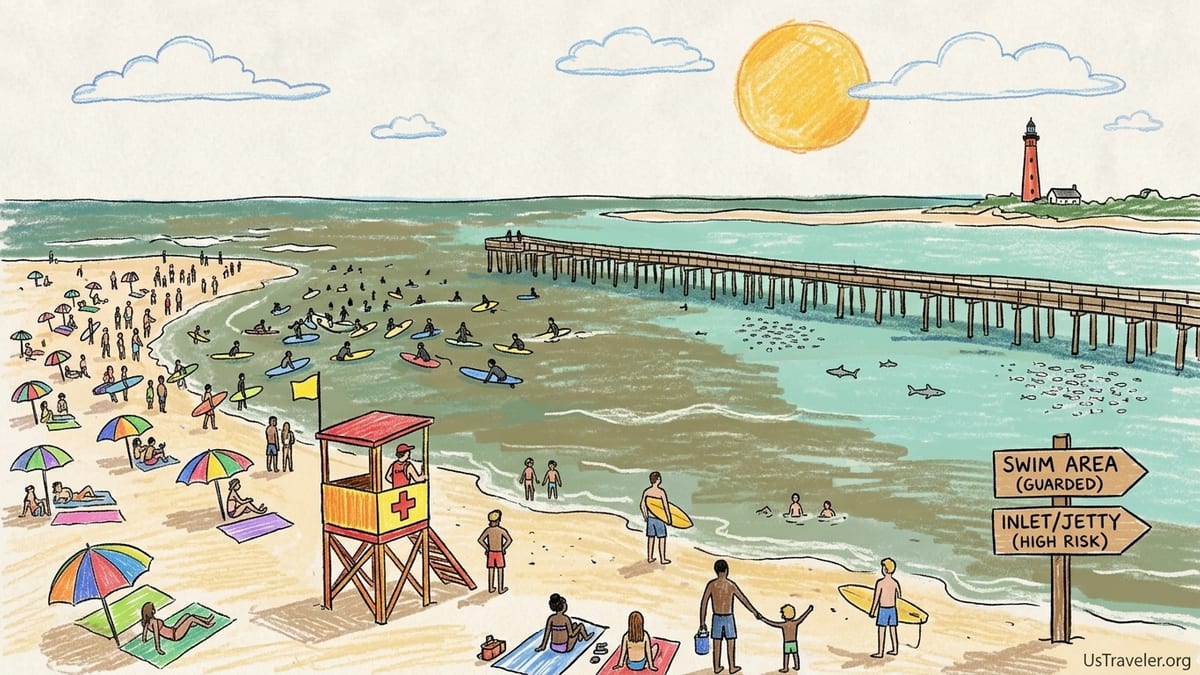
Stepping Into the Water Where the Statistics Get Real
I started my day in the central stretch of New Smyrna Beach, roughly between Flagler Avenue and the area locals call the inlet side, where surfers cluster near the Ponce de Leon Inlet jetty. By 9 a.m., the sand was already warm, the parking lot at Flagler Avenue Park was filling up, and the red-and-yellow lifeguard tower was staffed with a team scanning the water. The surf was in the 2 to 3 foot range, short-period wind swell that stacked into punchy peaks near the sandbar. Water visibility was typical for this area: a green-brown mix, clear enough to see your feet in knee-deep water when the sun hit at the right angle, but quickly turning murky once you stepped into waist-deep surf. It was not horror-movie murk; it was the normal, slightly silty Atlantic common along this stretch of Florida’s east coast.
In the lineup closest to the inlet, there were at least 40 surfers sharing a relatively compact takeoff zone, plus a fringe of kids and vacationers on soft-top rental boards farther inside. If you have only seen New Smyrna in viral drone clips showing sharks zigzagging under boards, it is easy to imagine this as some kind of gladiator arena. In person, the scene felt more like a crowded, ordinary East Coast beach day, only with occasional reminders that this is one of the most closely watched shark-bite locations on the planet. The Volusia County lifeguards on duty, for example, were not just watching for swimmers in trouble; they were also fielding curious questions about sharks and pointing people toward the safest swim zones.
Before paddling out, I walked up to the nearest stand and did what local authorities recommend: asked about the day’s conditions. The guard mentioned a moderate rip current risk and decent sandbars near the flags, then added that bait fish had been thick near the jetty earlier in the week. There had been no bites that day, but he noted that minor incidents are most common near the inlet in the surf zone, where small sharks and dense clusters of surfers intersect. That was not a command to stay out of the water. It was a realistic briefing that helped me decide how and where I wanted to surf.
In the end, I chose to paddle out slightly south of the heaviest cluster at the jetty, staying in the guarded area and giving myself a bit more elbow room. I was still very much in New Smyrna’s “high report” zone, but I was not shoulder-to-shoulder with every other visitor who had read the same shark headlines. Being able to make that kind of informed adjustment is exactly how awareness of the risk can shape your visit without canceling it.
What the Numbers Say About Shark Bites in Volusia County
New Smyrna Beach’s reputation is rooted in real, measurable data, not rumor. The International Shark Attack File, based at the Florida Museum of Natural History, tracks unprovoked shark bites globally. Recent annual reports show that Florida regularly leads the United States in unprovoked bites, and within Florida, Volusia County accounts for a disproportionate share. In the 2025 summary, the ISAF recorded eleven unprovoked shark bites in Florida, six of them in Volusia County. Those six are often casually described as happening “at New Smyrna Beach,” but the report itself groups incidents at the county level, which also includes beaches like Daytona Beach Shores and Ponce Inlet. The data are clear that this coastline has an unusually high number of reported encounters, but we cannot honestly say every one of those statistics came from the exact spot where I was paddling.
Longer-term mapping of shark bites reinforces Volusia County’s outlier status. Analyses of ISAF records have repeatedly placed the county at or near the top of global rankings for total, non-fatal bites, and some news coverage has noted that New Smyrna Beach alone has logged more documented shark-human interactions than any other single beach worldwide over recent decades. At the same time, those same datasets show that almost all of these bites are non-fatal and often relatively minor: quick nips to feet, ankles, or lower legs that result in stitches rather than funerals. A broad look at U.S. shark-bite data indicates that, nationwide, shark-related deaths average around one per year, and other hazards like lightning, dogs, and even bees kill many more people.
Standing at the shoreline with these statistics in mind, the picture that emerges is not that New Smyrna Beach is uniquely deadly, but that it is uniquely and consistently documented. The area has a dense population of surfers and water users, professional beach patrols, and ready access to medical care. When an incident occurs, it is reported, logged, and often covered by local television within hours. That is preferable to a place where bites go unrecorded, but it also feeds headlines that can make the risk feel larger than it is for any individual swimmer on a particular day.
None of this means the numbers are irrelevant. When you visit a county that accounted for more than half of Florida’s logged unprovoked shark bites in a given year, it is reasonable to give the subject more thought than you might at a Gulf Coast beach that rarely appears in annual reports. The key is to hold two truths at once: this is a proven hotspot for minor shark bites, and even here, the odds that any given dip in the ocean will end in an encounter remain very low.
Why the Ponce de Leon Inlet Area Sees So Many Encounters
The concentration of shark-human interactions near New Smyrna Beach is not random. The Ponce de Leon Inlet is a natural opening between the barrier islands, connecting Mosquito Lagoon and the Halifax River to the Atlantic Ocean. In practical terms, the inlet functions as a busy aquatic interchange. Tidal currents push nutrient-rich water in and out, baitfish schools pulse through the mouth, and the shifting sandbars along the adjacent beaches create classic, peaky surf. In other words, the exact ingredients that attract surfers and swimmers also attract predators that feed on small fish.
Locally common species like blacktip and spinner sharks are highly active hunters that patrol the surf zone, particularly where bait is thick and water visibility is limited. On the day I visited, the clarity varied from about ankle-deep transparency to only being able to see a faint outline of my feet in waist-deep water. That kind of semi-murky condition is very typical here and matters more than many visitors realize. If a fast-moving shark is chasing mullet or glass minnows through breaking waves, poor visibility increases the chance of a mistaken bite on a foot hanging off a surfboard or a hand trailing in the water.
Then there is the human factor. New Smyrna’s inlet area can pack dozens of surfers into a narrow strip just south of the jetty when the sandbars are good. On a solid weekend swell, that number rises, with shortboards, longboards, and bodyboards clustered essentially on top of the same fish traffic that draws sharks in the first place. Drone surveys and anecdotal reports often describe scenes where multiple sharks and dozens of people are sharing the same few hundred yards of water. Pure exposure matters. If you put that many people in the same small area where juvenile sharks feed, it is not surprising that the county records more nips and bites than beaches with far fewer surfers.
It is also worth noting the way these conditions change throughout the day. Local surfers often mention that early mornings around shifting tides, especially with overcast skies or stained water after rainfall, can produce the classic “shark bite” setup near the inlet. That does not mean the beach becomes safe at noon, but it does highlight that the risk profile is shaped by habitat, visibility, prey availability, and human crowding rather than by some vague curse attached to the name New Smyrna Beach.
Minor Bites, Fatalities, and What “Risk” Really Looks Like Here
One of the most important distinctions for travelers to grasp is the difference between the volume of bites and the severity of outcomes. Volusia County’s incident logs include many cases where surfers or waders receive quick, relatively shallow bites that require medical attention but are not life-threatening. News reports have described typical scenarios in which an 18-year-old surfer in New Smyrna Beach gets bitten on the foot or calf near the inlet, is helped to shore by friends or lifeguards, and is transported for stitches and evaluation. These are real, painful injuries and deserve to be taken seriously, but they are not equivalent to the much rarer, catastrophic attacks that dominate popular imagination.
Historical records of fatal shark attacks in the United States suggest that Volusia County, despite its huge tally of non-fatal bites, has not experienced frequent, clearly documented fatalities in the surf zone of New Smyrna Beach in modern times. There are disputed or older offshore cases listed for the wider county, but the overwhelming pattern along this stretch of sand is non-fatal, single-bite encounters where the shark releases and moves on. That does not make an individual incident any less frightening for the person involved, but it does matter when we talk about actual danger versus perceived threat.
For a visitor weighing whether to book a week at a condo near Flagler Avenue or a campsite at nearby New Smyrna Beach RV parks, the practical takeaway is that shark bites here are most often comparable to an unfortunate sports injury: serious enough to ruin your day and possibly your vacation, but extremely unlikely to be fatal. Contrast that with risks many people do not think about, like being caught in a strong rip current, struck by lightning in a summer thunderstorm, or driving at highway speeds on Interstate 4 to reach the coast. All of those hazards have claimed more lives in Florida than sharks have.
None of this should be used to minimize the psychological impact of the beach’s reputation. When a place is repeatedly labeled the shark bite capital in headlines, some travelers will reasonably decide that no wave or family swim is worth even a small uptick in risk. Others will react in the opposite direction, framing concern about sharks as irrational fear that should be mocked. In reality, acknowledging that there is a measurable but low personal risk, and then choosing how you personally feel about it, is a more honest and respectful approach than either dismissal or melodrama.
Beyond Sharks: Rip Currents, Lightning, and Inlet Hazards
Talking to Volusia County lifeguards makes it clear that sharks are only one of several serious safety concerns along New Smyrna’s oceanfront, and not always the most urgent on a given day. Rip currents, in particular, are a persistent hazard on this open Atlantic coastline. A rip is a narrow, fast-moving channel of water that flows away from the shore through the surf zone, sometimes pulling swimmers off their feet and funneling them seaward. National weather and lifeguard guidance emphasizes that even strong swimmers can get into trouble if they panic and try to sprint directly back toward the beach against the current instead of floating, conserving energy, and angling gradually toward the side.
On my visit, the National Weather Service had issued a statement noting a moderate rip current risk for Volusia County beaches. That translated into more frequent whistles from the lifeguard stands as swimmers drifted outside the designated flags or into deeper troughs between sandbars. Unlike shark encounters, which remain rare on any given day, rescues from rip currents are a routine part of beach patrol work here. For a family standing at the edge of a busy summer shoreline, the unseen pull of water under their feet is statistically a more likely problem than a shark.
Lightning is another underappreciated threat, especially during Florida’s summer rainy season. Afternoon thunderstorms roll across the peninsula with remarkable regularity. Volusia County Beach Safety and tourism boards stress that lightning can strike miles from the center of a storm, and local rules often call for clearing the beach at the first sound of thunder. It feels anticlimactic to pack up your beach cart because of a distant rumble, but Florida’s statewide lightning fatality numbers far exceed its shark records, and the wide-open expanse of a wet shoreline offers poor shelter when storms build.
The Ponce de Leon Inlet itself adds additional complexity. Strong tidal movements can create powerful, unpredictable currents near the jetty and channel edges, and boat traffic in the inlet shares space with anglers, surfers, and swimmers. Some of the more severe non-shark injuries in this area involve collisions with boats, impacts with submerged rocks or concrete near the jetty, or people swept into structures by fast-moving water. When you weigh risk at New Smyrna Beach, it is worth considering these mechanical and weather-related dangers alongside the more dramatic, but less frequent, shark bites.
Taking Safety Guidance Seriously Without Giving In to Hysteria
Volusia County publishes clear beach rules and safety tips that are prominently posted at access points and summarized on official materials. On the sand, you see these translated into simple directives: swim near a staffed lifeguard tower, heed the colored warning flags, and ask about rip currents before heading into deeper water. During my visit, the flags shifted from yellow to a brief red period as winds picked up and the tide changed, then back again. Each change was announced by lifeguards over loudspeakers, but I also saw plenty of visitors glance at the flag, shrug, and head straight for the unguarded sand south of the tower where parking was closer to their rental condo.
That kind of casual disregard is part of why both sharks and other ocean hazards can feel more dangerous than they often are on paper. The tools for risk reduction are present and visible, but only effective if people use them. Simple choices made a tangible difference in how I felt about my own session: staying within obvious sightlines of the tower, checking in with the guard about baitfish activity, and avoiding the tightest cluster of surfers stacked directly against the inlet jetty. None of those actions eliminated risk, but together they made it feel managed and considered rather than left entirely to chance.
For families, practical adjustments might include timing ocean swims during late morning or midday when lifeguard coverage is strongest and visibility is better, avoiding dawn and dusk sessions near the inlet, and keeping kids in the shallower, flagged zones instead of walking down to the more remote sections of beach. If I noticed dense schools of baitfish jumping just off the sandbar or bird activity diving repeatedly into one area, I would either move a little down the beach or take a break on shore, just as I would choose not to swim close to an actively fishing pier where lines and chum might attract predators.
Listening to official rip current and lightning advisories plays a similar role. If the forecast calls for a high rip risk, that might be the day to prioritize walking the historic streets of downtown New Smyrna, visiting local restaurants along Canal Street, or exploring the inland side at Smyrna Dunes Park instead of insisting on a long ocean swim. If thunderstorms are expected by mid-afternoon, planning your main beach time in the morning and retreating inland when the sky darkens is a rational response, not evidence that the beach is “too dangerous.” The point is not to erase risk, but to shift odds in your favor with the kind of small, concrete decisions that matter more than general bravado.
Why Both Alarmist and Dismissive Takes Miss the Point
Media coverage of New Smyrna Beach often veers into extremes. On one side are breathless headlines declaring the town a shark-infested danger zone, accompanied by cherry-picked drone footage of silhouettes circling beneath surfers. On the other are hot takes and social posts that mock anyone who worries about sharks at all, presenting the concern as ignorance about basic statistics. Having stood on that shoreline with the real numbers in mind, I find both approaches misleading in different ways.
The alarmist narrative ignores the nature of most local incidents and the broader context of beach safety. It suggests that the primary question facing travelers is whether they are willing to gamble their lives on a swim, when the historical data show that fatal shark attacks here are vanishingly rare and that the majority of recorded bites involve minor to moderate injuries. It also tends to gloss over other, more statistically significant hazards like rip currents and lightning that rarely make global headlines but occupy a large share of local rescue resources. The result is fear that is out of proportion to the specific risk and may keep people from engaging with a coastline that, for many, is a central part of their connection to Florida.
The dismissive narrative, however, can be just as unhelpful. Sweeping statements that “sharks aren’t a real danger” or that cautious visitors are simply paranoid erase the lived experiences of those who have been bitten and the legitimate responsibility of local authorities to manage an environment with more recorded shark encounters than almost anywhere else. Pretending the pattern of incidents does not exist can lead travelers to ignore reasonable advice about where and when to enter the water, how to position themselves relative to the inlet, or why talking to lifeguards matters more here than at a rarely visited stretch of sand elsewhere.
A more honest perspective treats those six Volusia County bites logged in the 2025 ISAF report as neither trivial nor apocalyptic. They are evidence that this coastline is an outlier and that local conditions around the Ponce de Leon Inlet produce a measurable cluster of non-fatal shark encounters. They also sit within a broader risk landscape where individual odds remain low, and where informed behavior can meaningfully influence exposure. A critical, traveler-focused guide has to hold that nuance instead of offering easy, emotionally satisfying answers.
My own experience combined the sensory reality of paddling out at a busy inlet sandbar with the intellectual understanding that I had stepped into one of the most thoroughly documented shark-bite environments on earth. I did not feel safe in the sense of guaranteed protection, but I felt reasonably confident that I had chosen a line between overreaction and denial that let me enjoy the waves while giving the risks their due respect.
The Takeaway
After spending time in the water at New Smyrna Beach, talking with lifeguards, and reviewing the data that drive its dramatic reputation, I would surf and swim here again. I would do it deliberately, not casually. When I come back, I will still paddle out near the inlet on a good swell, but I will avoid the tightest, shoulder-to-shoulder pack pressed against the jetty when baitfish are visible in the waves or the water has gone particularly dark and churned. I will keep my sessions within staffed, flagged zones and shorten or skip them if rip current statements escalate or a line of thunderstorms builds inland.
For travelers deciding whether to book that oceanfront condo or day trip from Orlando, the key is to align expectations with reality. You are not stepping into a blood-red danger zone where every dip is a life-or-death roll of the dice. You are visiting a beautiful Atlantic beach with excellent surf, lively town access, and a proven record of more non-fatal shark bites than almost anywhere else. If the idea of even a small additional risk of being one of those logged incidents weighs heavily on you, you might prefer a different stretch of coast. There is no shame in that choice. If, however, you are willing to balance that risk with concrete precautions, New Smyrna can be an immensely rewarding place to experience Florida’s east coast.
Practical steps are straightforward: swim near lifeguards, pay attention to daily flags and rip current advisories, talk to beach patrol about conditions, avoid swimming or surfing right on top of the inlet jetty or fishing hotspots when bait is thick, and clear the beach when thunder rolls. Parents can keep younger kids in shallower, lifeguarded zones and treat inlet explorations and jetty walks as dry-land activities rather than swim spots. Surfers can make small tactical choices about tide, time of day, and crowd density that respect the local shark habitat without abandoning some of the best waves in the region.
New Smyrna Beach’s shark bite reputation is not a myth, but it is also not a sentence. For me, taking the risk seriously means acknowledging the statistics, respecting the inlet’s unique conditions, and letting that awareness shape my decisions rather than my fears. The water here is worth entering. It simply demands that you do so with eyes open, judgment engaged, and a willingness to balance the thrill of the surf with the quiet discipline of listening to the people who know this coast best.
FAQ
Q1. Is it actually safe to swim at New Smyrna Beach given its shark bite reputation?
It is as safe as any ocean environment where wild animals live, which means there is always some risk. Volusia County does record more shark bites than most places, but these are overwhelmingly non-fatal and often minor. Swimming in guarded areas, avoiding the most crowded inlet sandbars when baitfish are present, and heeding lifeguard advice substantially reduce your personal risk.
Q2. Do all the shark bites in Volusia County happen specifically at New Smyrna Beach?
No. Official reports, including the International Shark Attack File, list incidents at the county level. In 2025, six unprovoked bites were recorded in Volusia County out of eleven in Florida, but those did not all necessarily occur on the main New Smyrna Beach strip. Other nearby beaches such as Daytona Beach Shores and areas closer to Ponce Inlet also contribute to the statistics.
Q3. Are there many fatal shark attacks at New Smyrna Beach?
Modern records show that New Smyrna Beach is associated far more with non-fatal bites than with fatalities. There have been disputed and older serious cases in the wider county, but the typical incident here involves a single bite to a foot or leg, medical treatment, and recovery. The area’s high numbers reflect frequency of minor encounters, not a pattern of deadly attacks.
Q4. Why does the Ponce de Leon Inlet area have so many shark encounters?
The inlet concentrates baitfish, tidal currents, and sandbars that create good surf, which attracts both sharks and surfers to the same confined zone. Murky water and fast-moving prey make it easier for small sharks to mistake a foot or hand for food. The high number of people in this small area, especially on good surf days, increases the chance that one of those mistaken bites will involve a human.
Q5. What can I do to reduce my shark bite risk if I still want to surf or swim there?
Stay within lifeguard-protected zones, avoid surfing right against the inlet jetty when the water is murky and baitfish are visible, and skip dawn or dusk sessions near the inlet if you are concerned. Do not swim near active fishing lines or where people are cleaning fish, and consider moving down the beach if you see birds repeatedly diving on bait just offshore.
Q6. How do rip currents compare to sharks as a danger in New Smyrna Beach?
Rip currents are a more frequent cause of rescues and can be life-threatening if swimmers panic or are weak. Lifeguards deal with rip-related incidents on a regular basis, whereas shark bites remain relatively rare in day-to-day operations. Learning how to recognize rip channels, swimming between the flags, and asking lifeguards about conditions are essential safety steps.
Q7. Is lightning really something I should worry about at the beach?
Yes. Florida records significantly more lightning injuries and deaths than shark-related fatalities. Storms can build quickly, and lightning may strike miles from rainfall. When lifeguards clear the beach or you hear thunder, it is important to pack up and seek shelter away from the open sand and water, even if the storm seems distant.
Q8. Are certain times of day or year better for avoiding shark encounters?
There is no guaranteed “safe” time, but many locals prefer to avoid the inlet area during low-visibility conditions, at dawn or dusk, or when baitfish runs are obvious. Summer and early fall see more people in the water, which can increase reported bites simply because exposure is higher. If you are concerned, consider later morning or early afternoon swims in clear, guarded areas rather than first-light inlet sessions.
Q9. Should families with small children avoid New Smyrna Beach altogether?
Not necessarily. Many families enjoy the beach safely by keeping young children in shallow, lifeguard-supervised zones away from the jetty and heavy surf. Parents who are deeply uncomfortable with the shark bite reputation might opt for another Florida beach, but those who follow local guidance, stay near guards, and treat the inlet and fishing areas with extra caution can still have a positive experience here.
Q10. If I am booking a trip, what is the single most important thing to know about New Smyrna Beach safety?
The most important point is that risk here is real but manageable. You are visiting a coastline with unusually high numbers of mostly minor shark bites and very active natural surf conditions. Choosing accommodations near guarded access points, planning beach time around weather and rip current forecasts, and committing to follow lifeguard and flag guidance will do more to shape your safety than fixating on dramatic headlines alone.