


On a humid June evening in Florida, I finally checked a lifelong dream off my list: watching a rocket leave Earth with my own eyes. The mission was a SpaceX Falcon 9 carrying a batch of Starlink satellites, lifting off from Cape Canaveral Space Force Station’s Space Launch Complex 40 on June 15, 2025. I watched from Space View Park in downtown Titusville, about 13 to 14 miles across the Indian River from the pad. It was my first launch, and the night delivered everything from goosebump‑inducing sound to frustrating delays and traffic. Here is exactly how it unfolded, what I actually saw and heard from that distance, and what I would do differently next time.
Zeroing In on a Real Launch: Mission, Date and Viewpoint
My first in‑person launch was a SpaceX Falcon 9 Starlink mission from Space Launch Complex 40 at Cape Canaveral Space Force Station on June 15, 2025. The window opened in the early evening, with sunset light still hanging over the Indian River. I chose to watch from Space View Park in Titusville, a classic free public viewing spot recommended by local guides and space‑flight enthusiasts, roughly 11 to 12 miles from Kennedy Space Center’s LC‑39 pads and about 14 miles from SLC‑40 across the water. From the park’s waterfront promenade, you face east toward the Cape, with a largely unobstructed horizon above the low scrub and industrial structures on the barrier islands.
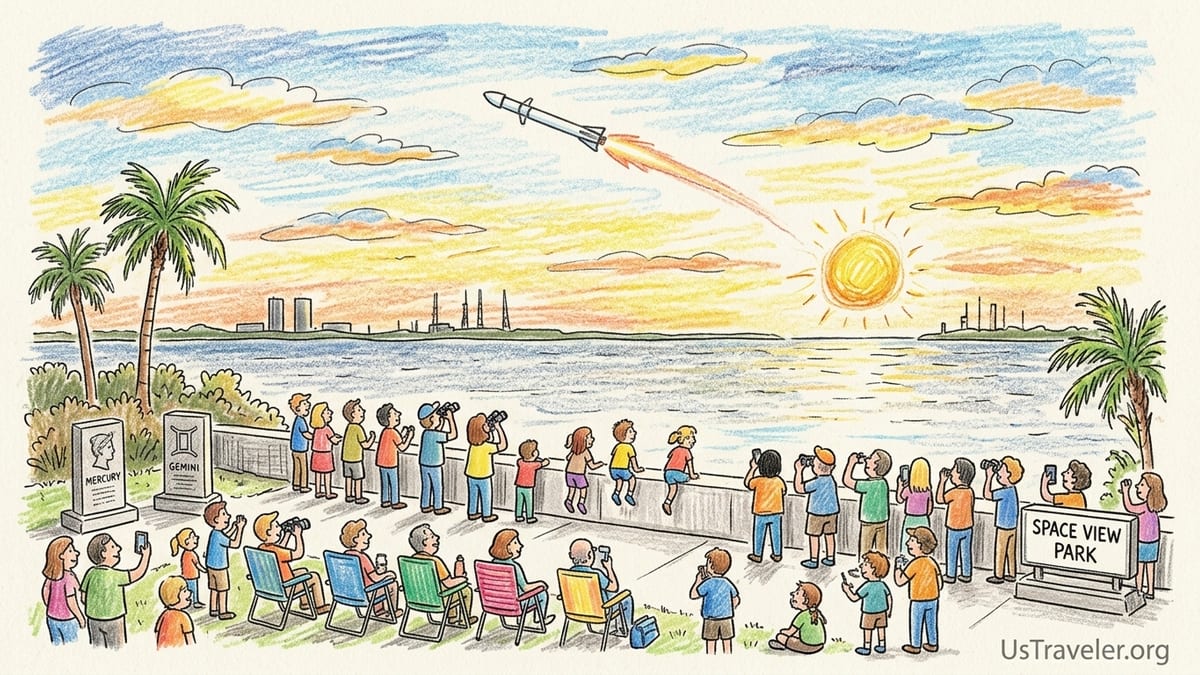
Space View Park is not an abstract name on a map. It is a small city park at the end of Broad Street, with engraved monuments to the Mercury, Gemini, Apollo and shuttle programs, a short seawall, a few trees for shade and modest restroom facilities. On launch days it turns into a makeshift grandstand. For this Starlink mission, the city had portable speakers set up near the monuments piping in a local radio station that switched to launch coverage as T‑0 approached. People lined the railing shoulder to shoulder, folding chairs and tripods filled the grass, and kids sat on the concrete embankment with their feet dangling over the river.
I positioned myself just south of the Gemini monument, where I could see the Vehicle Assembly Building far to the left and the low profile of Cape Canaveral to the right. With binoculars, SLC‑40 itself was a faint vertical line on the horizon, partially obscured, but I knew roughly where to look thanks to satellite images and local viewing maps I had studied beforehand. The view at ground level from Space View Park is not like the promotional photos taken from inside Kennedy Space Center; you will not be looking straight into the pad. Instead, you watch the rocket clear the invisible tree line and then climb into the sky against a wide, open backdrop.
That combination of real, slightly imperfect sightlines with a crowd of locals who knew exactly what they were waiting for is what made Space View Park the right choice for my first launch. I felt close enough to sense the power when it arrived but far enough away that the scene still felt grounded in the everyday life of Titusville.
Planning the Trip: Schedules, Scrubs and Picking Space View Park
Getting to that moment at the waterfront took more planning than I expected. I started a week out by watching the official launch calendar on the Kennedy Space Center Visitor Complex site and cross‑checking with independent launch‑tracking sites that compile the manifests for SpaceX, United Launch Alliance and NASA. The date for this Falcon 9 Starlink mission slid by about a day due to range scheduling and vehicle readiness, something that is common on the Space Coast. I learned quickly not to lock in my hotel or nonrefundable tickets around a single time, because rockets move more often than tourists would like.
Once the launch window settled on June 15, I narrowed viewing options to three realistic spots: Space View Park in Titusville, Playalinda Beach inside Canaveral National Seashore and Jetty Park at Port Canaveral. Playalinda offered the closest public access for some pads, as little as 4 to 7 miles in many cases, but being inside a national seashore meant a separate entrance fee, limited operating hours and the real possibility of the park closing early for security or weather. Jetty Park charged a per‑vehicle fee and can fill up quickly on launch days, especially on weekends, with a mix of cruise traffic and beachgoers. Space View Park, by contrast, was free, walkable to downtown restaurants and relatively straightforward to access from Orlando.
I was staying near Orlando International Airport, so the drive to Titusville was about an hour via State Road 528 and Interstate 95. Local tourism materials suggest budgeting at least 45 to 60 minutes from Orlando in good traffic, but for launch day I added another half hour, leaving three hours before the opening of the launch window. That turned out to be a wise call. As I approached Titusville, traffic thickened on US‑1 where it parallels the river, with digital signs warning of delays near the Max Brewer Bridge and downtown riverfront parks. Although the gridlock never came to a complete standstill, every light cycle took two or three rounds, and I spent at least 20 extra minutes just creeping the final mile.
Space View Park itself has only a small dedicated lot, and Titusville’s official visitor maps warn that it fills quickly on big missions. By the time I arrived, shortly after 5 p.m. for a roughly 7 p.m. target time, the park lot was full and nearby street parking was already heavily used. I ended up in a free public lot a few blocks west, near downtown shops, and walked to the riverfront carrying a folding chair, a small cooler and my camera bag. That ten‑minute walk is a detail many guides gloss over, but it matters if you are traveling with children, older relatives or more gear than you can comfortably carry in muggy weather.
Settling In at Space View Park: The Long Wait Before Liftoff
Waiting was a huge part of the experience. By the time I reached the park, the grassy areas were already covered with chairs, picnic blankets and tripods. I tucked into a gap between a family with a giant telescope and a couple of photographers with serious telephoto lenses. The speakers were playing classic rock while we waited for the station to switch to launch coverage. People pulled out weather apps every few minutes, checking the forecast for clouds or storms over the Cape. A thin line of showers on the radar had everyone trading opinions about whether SpaceX and the range would push ahead or slip the attempt.
As T‑0 approached, the live commentary started coming through the speakers with callouts like propellant loading, engine chill and final range checks. Because we were several miles away, there was no sense of activity on the horizon; the pad remained a static line in the distance. Without the audio feed, you could easily miss that a launch was even imminent. I also kept the SpaceX webcast open on my phone with headphones in one ear, which mirrored the callouts but with its own built‑in broadcast delay. That meant the on‑screen countdown was about 15 to 20 seconds behind the actual clock, a weird mental adjustment I did not anticipate.
About 20 minutes before the scheduled liftoff, the first frustration hit. An announcement over the park speakers mentioned a brief hold while the team evaluated upper‑level winds. The countdown clock recycled, and we got an updated T‑0 several minutes deeper into the window. You could hear the collective groan ripple down the waterfront. People shifted in their chairs, kids got restless, and a few locals casually mentioned that this was still better than a complete scrub, which would have pushed everyone to another day and another long drive back from Orlando.
Weather is the wildcard that every Space Coast veteran warns about. On this June evening, clouds were building inland but the area above the Cape looked promising. The hold extended just long enough to make everyone nervous. I started calculating whether I could make it back for a second attempt the next day if they scrubbed completely. Fortunately, the range gave the green light, the countdown clock resumed, and the park crowd settled again into a tense, expectant quiet.
The Moment of Launch: What I Actually Saw and Heard
From Space View Park, the rocket did not leap instantly into view. We watched an empty patch of horizon above where we knew SLC‑40 sat, guided mostly by experience from repeat visitors who pointed out the correct slice of sky. A faint orange glow softly lit the low clouds just a second before the rocket itself appeared, climbing slowly at first, then gaining speed. To the naked eye, the Falcon 9 was a bright, almost pure white point of light with a trailing plume, roughly the brightness of a very bright planet but clearly dynamic and alive. Through binoculars, I could see the shape of the exhaust expanding as it rose into thinner air, a tapered column turning into a wider fan.
The most surreal part was the silence. From roughly 14 miles away, light reaches you effectively instantly, but sound takes measurable time. Based on the distance and standard estimates for the speed of sound in humid air, the roar needed around 65 to 70 seconds to reach Titusville. For the first full minute of flight, it looked like a silent movie. People murmured quietly, a few shouted time calls as the stage approached Max Q and main engine cutoff according to the webcast, but the riverfront remained acoustically normal.
Then the sound arrived all at once. It started as a low, distant rumble that you felt more in your chest than in your ears, like far‑away thunder. Within a few seconds it built to something closer to a continuous crackling roar, layered with deeper bass elements that rolled over the water. At Space View Park, it was loud enough that conversations paused and you had to lean in to talk, but it was not painfully loud and did not rattle windows or set off car alarms. The overall effect matched what environmental assessments predict for Falcon 9 launches at distances similar to Titusville, where maximum levels can briefly rise above normal city noise but remain well below damaging thresholds.
As the rocket arced downrange to the southeast, the angle from Titusville meant it climbed from lower right to upper left in my field of view before fading into the brighter part of the sky. The first stage shut down and separated high enough that, from our distance and in the still‑bright sky, it was hard to pick out with the naked eye. I could not see grid fins or individual stages, just a slight change in the brightness of the main point and then a separate, smaller flicker that quickly faded. For this mission, the booster was landing downrange on a drone ship, which meant there was no return‑to‑launch‑site burn visible from Titusville and no sonic booms.
This is an important distinction for anyone planning a trip. Some Falcon 9 missions land their boosters back near the coast, leading to distinct sonic booms heard in parts of Brevard County. Others, like this Starlink launch, recover the booster far offshore, so from Space View Park you get no secondary sound event. The roar of ascent was spectacular in its own right, but if you imagine every launch coming with crackling shock waves and intense window‑shaking noise, watching from Titusville will reset your expectations. You feel the power, but in a more measured, almost contemplative way, framed by the river and the quiet excitement of the crowd.
Comparing Space View Park with Other Viewing Spots
In the days after the launch, I drove to a few other vantage points to better understand how Space View Park compared, knowing that I only had firsthand launch experience from Titusville. Playalinda Beach, for example, sits inside Canaveral National Seashore and can be as close as around 4 to 7 miles from certain pads, making it the nearest public option for many Kennedy launches when it is open. From the dunes near Parking Lot 1, the view toward LC‑39A is much more direct, and when pad operations allow, you can even glimpse parts of the rocket on the pad before liftoff. The tradeoff is access. The seashore charges a per‑vehicle entrance fee, gates close in the evening and security restrictions can shut the area entirely for some missions.
Jetty Park in Port Canaveral offers a different experience. You stand near the mouth of the port, about 11 to 12 miles from SLC‑40 but at a more southerly angle. The view of the pad itself is less direct behind structures on the Cape, but once the rocket clears the horizon it climbs above the scene with the Atlantic surf and fishing pier in the foreground. Jetty Park charges a parking or admission fee per vehicle or per person, and cruise ship schedules can dramatically affect crowds and traffic. The sound at similar distances to Titusville is broadly comparable in volume, but the ambiance is entirely beach‑oriented rather than riverfront town.
Cocoa Beach and the surrounding shoreline form the most relaxed option. From the pier or oceanfront parks, you are typically 18 to 20 miles from pads like SLC‑40, which means you will see the rocket as a bright streak rising along the coastline rather than a detailed vehicle. The sound delay stretches, and the roar is more muted, often competing with wind and waves. On the other hand, parking can be easier outside peak weekends, and you have a full beach town’s worth of restaurants and bars within a short walk. Many people I met at Space View Park said they default to Cocoa Beach when they want the launch to be part of a broader day at the ocean rather than the main event.
By comparison, Space View Park sits in the sweet spot for a first launch: free, reasonably close at around a dozen miles, focused on the history of spaceflight and a straight shot from Orlando. The biggest drawbacks are limited parking, potential crowding for high‑profile missions and the slightly offset sightline to the pads, which limits how much pad detail you see before liftoff. If you want the absolute closest public view and are willing to accept more variables around access and cost, Playalinda Beach is the step up. If you want beach culture with a launch as a bonus, Cocoa Beach fits the bill. Jetty Park comes in between, charging a fee for a practical but less iconic vantage point.
Inside Kennedy Space Center: General Admission vs Launch Packages
One decision I considered but did not choose for this first launch was watching from inside the Kennedy Space Center Visitor Complex. Standard daily admission includes access to the main exhibits, the rocket garden and the new observation tower area served by the regular bus tour, but it does not automatically guarantee a prime launch viewing location. For many missions, the visitor complex opens some on‑site areas for included viewing; you watch from the main lawn or from near the Atlantis exhibit, hearing live commentary and seeing the rocket rise above the treeline. From those distances, you are generally farther than Titusville for some pads and closer for others, but you are always watching from behind NASA’s security perimeter, which adds to the sense of occasion.
For select launches, especially crewed missions or high‑profile science payloads, Kennedy sells add‑on launch viewing packages. These Launch Transportation Tickets or premium experiences include bus transportation to special viewing locations like areas along the NASA Causeway or sites closer to Launch Complex 39. They are sold in addition to regular admission, so you pay once to enter the visitor complex and again for the package. Prices vary by mission and viewing location, but it is common for these premium tickets to cost a significant extra amount per person on top of the base admission, and they often sell out quickly once a firm launch date is announced.
The big difference between these paid packages and free public spots like Space View Park is proximity and infrastructure. From certain Kennedy locations, you may be around 3 to 7 miles from the pad with fully unobstructed views, dedicated bleachers or standing areas, professional commentary and easy access to restrooms and concessions. The sound delay shrinks to tens of seconds instead of a full minute or more, and the rocket appears larger and more detailed. You feel closer to the center of the action, surrounded by visitors who have spent the day immersed in exhibits about the very vehicles and programs they are about to see in flight.
There are, however, real risks. If the launch scrubs after you have used your visitor complex admission, you do not get that day back, and while some packages offer partial flexibility or rebooking, others are more restrictive. You must arrive earlier than for public spots to clear security and board buses, sometimes hours before T‑0, which can make delays especially draining. For my first launch, I decided that the free, flexible option at Space View Park was a better match. I wanted the option to retreat to a café or hotel room if weather turned bad, not to be locked into an on‑site commitment I had paid a premium for.
The Less Glamorous Side: Traffic, Scrubs and Weather Worries
No launch day story on the Space Coast is complete without mentioning the headaches. Even for a routine Starlink mission, the traffic in and out of Titusville was noticeably heavier than a normal evening. After the launch, everyone along the riverfront seemed to head for their cars at once. The narrow downtown streets around US‑1 and the access to the Max Brewer Bridge created a predictable bottleneck. It took almost 40 minutes just to clear the downtown grid and reach the wider lanes of US‑1 southbound. Drivers were generally patient, but pedestrians darted across the road between parked cars, and finding a gap to pull out from a street spot looked stressful.
I avoided the worst of it by lingering at the park for about half an hour after liftoff, watching the stages continue their work on my phone and letting the adrenaline taper off. Families with tired children had no such luxury, and you could see the tradeoff in their expressions as they hustled back to minivans. If you are traveling with a group, it is worth building that post‑launch traffic tax into your plans. Expect at least 30 to 60 minutes of slow movement if you parked near the most popular viewing areas.
Scrubs and delays are the other major frustrations. I was relatively lucky: our brief hold for upper‑level winds stayed within the same window, and we still saw the launch that evening. Talking to locals at Space View Park, I heard stories of people who had driven in from Orlando or even farther away only to watch a launch slip past the official closing time of Playalinda Beach, or to see repeated 24‑hour delays stack up into a week of almost‑launches. With commercial operators and NASA sharing range capacity and with more launches than ever, schedule changes are simply part of the experience.
Weather is a constant background stressor. Summer on the Space Coast brings afternoon thunderstorms, and even in other seasons, thick low clouds or upper‑level winds can violate launch criteria. Standing at Space View Park that June night, I watched cells blossom inland on weather radar and drift toward the coast, only to dissipate before reaching the Cape. The sunset painted the anvil clouds in dramatic colors that made for beautiful photos, but every flash of distant lightning pulled eyes away from the horizon in nervous silence. Launch criteria for lightning and cloud cover are strict for good reason, and no one in Titusville pretends otherwise.
What I Would Do Differently Next Time
Looking back, there are several things I would change if I could replay that first launch. First, I would arrive even earlier. Getting to Space View Park two hours before T‑0 was enough to secure a decent spot, but another thirty to sixty minutes would have given me more parking options within a shorter walk and a better position along the railing. As the park filled, late arrivals ended up several rows back, watching between shoulders or over the tops of tripods, which would have made it harder to keep the rocket in view without constantly shifting.
Second, I would bring more water and a small towel or cooling cloth. The humidity at the riverfront, even in the evening, clings to you while you wait, and the excitement of the countdown makes it easy to forget basic comfort. A lightweight chair was invaluable, and I would not attempt a launch from Space View Park without one unless I was prepared to sit on the concrete or stand for several hours. Closed‑toe shoes were also a good call, as the grass can be damp and you may find yourself stepping around cables or camera bags in the crowd.
Third, I would plan my audio setup more carefully. Having both the park’s loudspeakers and the webcast in one ear helped me follow the countdown, but the broadcast delay introduced confusion at key moments. Next time, I would rely on one or the other, preferably the on‑site feed, to avoid hearing calls out of sync with what my eyes saw. I would also download any critical apps or streams in advance over hotel Wi‑Fi instead of depending on congested cellular data with hundreds of other spectators trying to do the same along the riverfront.
Finally, I would pair the launch with a daytime visit to Kennedy Space Center on a different day. Seeing the Falcon 9 in person was powerful on its own, but having more context from exhibits about the Saturn V, Apollo and the commercial crew program would have deepened the experience. Separating the two days would also keep launch day more flexible, allowing me to move freely between viewing spots if weather or access changed without worrying about recouping the cost of a visitor complex ticket.
The Takeaway: Is Premium Viewing Worth It and Where I Would Go Again
If I could choose again for that first launch, I would still pick Space View Park in Titusville. The blend of cost, distance and atmosphere was exactly right for a newcomer. The launch felt accessible and communal, grounded in a small city that has lived alongside spaceflight for generations. I saw the rocket clearly, heard the delayed roar sweep across the river and felt the crowd’s shared gasp as the Falcon 9 climbed into the sky. At no point did I feel shortchanged by not paying for a premium spot.
That said, I came away with a clearer view of when paying extra might be worth it. For a crewed mission or a once‑in‑a‑lifetime science payload, the chance to stand just a few miles from the pad inside Kennedy, with unobstructed views and professional commentary, becomes far more compelling. The cost per person for launch transportation or special viewing packages is significant once you add it to general admission, but so is the emotional weight of seeing humans ride a pillar of fire or watching a flagship mission begin with a closer view and richer audio. If I were planning around a crewed launch with flexible travel dates, I would seriously consider a premium package, but I would build in extra days and a backup free viewing plan in case of scrubs.
For most uncrewed commercial missions, however, especially the frequent Starlink flights, I believe a smartly planned free vantage point like Space View Park, the Max Brewer Bridge or Jetty Park offers more than enough spectacle. You can arrive later, leave earlier if needed, and adjust your plans on the fly as weather and schedules shift. The money you save can go toward an in‑depth day at Kennedy on a separate date, dining in the growing restaurant scene in Titusville or Cocoa Beach, or simply an extra night on the Space Coast to chase another launch if the first one slips.
My main advice after that June evening is simple: treat a rocket launch as both an event and a journey. Prepare as carefully for traffic, weather, comfort and backup plans as you do for the few minutes of flame and thunder. Whether you choose a free riverfront park, a sandy beach, a portside pier or a premium NASA viewing area, the moment the rocket clears the horizon and the delayed roar finally rolls over you will feel like time itself has stretched. That sensation is what makes Florida’s Space Coast worth the effort, even when the road home is long and slow and the launch schedule never quite behaves.
FAQ
Q1. How early should I arrive at Space View Park for a rocket launch?
For a routine evening SpaceX launch, arriving 2 to 3 hours before the opening of the launch window is a safe target. This gives you time to find parking within a reasonable walk, claim a good spot along the riverfront and settle in before the countdown drama begins. For major missions like crewed flights, plan to arrive even earlier, as Titusville’s official maps and local experience suggest that the park and nearby lots can fill up well in advance.
Q2. Is the launch visible to the naked eye from Titusville, or do I need binoculars?
You can absolutely see the rocket and its plume with the naked eye from Space View Park. The Falcon 9 appeared as a very bright point of light with a clear exhaust trail as it climbed. Binoculars or a small telephoto lens enhance the experience by revealing more detail in the plume and stage events, but they are not required to appreciate the launch. If you bring optics, practice tracking moving objects beforehand to avoid losing the rocket in the sky at critical moments.
Q3. How loud is a Falcon 9 launch from around 12 to 14 miles away?
From Space View Park’s distance, the sound arrives roughly 60 to 70 seconds after liftoff as a deep rumble that grows into a rolling roar. It is loud enough that conversations pause and you feel a physical vibration in your chest, but it is not painfully loud and does not require ear protection for most people. The exact intensity depends on wind direction, humidity and background city noise. Other vehicles and closer viewing spots may produce different acoustic impressions, so do not assume every launch will sound the same.
Q4. Can I see booster landings or hear sonic booms from Space View Park?
You can sometimes hear sonic booms from booster landings on missions where the first stage returns to a landing zone near the coast, but my particular Starlink launch recovered the booster on a drone ship offshore, so there were no booms. From Titusville, return‑to‑launch‑site landings can produce distinct booms that are audible across parts of Brevard County, but they are not guaranteed. Check the mission profile in advance to see whether a ground landing is planned and be prepared for more subtle or absent effects if it is not.
Q5. How does Space View Park compare with Playalinda Beach and Jetty Park for a first launch?
Space View Park offers a free, riverfront experience about 12 to 14 miles from the pads, with easy access from Orlando and a strong local atmosphere. Playalinda Beach can place you roughly 4 to 7 miles from certain pads with more direct sightlines, but it requires a park entrance fee, follows strict operating hours and can close for security. Jetty Park sits near 11 to 12 miles from SLC‑40 at a more southerly angle, charges per‑vehicle or per‑person fees and mixes launch viewing with busy beach and cruise traffic. For a first launch focused on the rocket itself and budget flexibility, Space View Park is a very solid choice.
Q6. What is the difference between general Kennedy Space Center admission and paid launch viewing?
General admission to the Kennedy Space Center Visitor Complex grants access to exhibits, the bus tour and, for some launches, basic on‑site viewing areas where you can see the rocket rise above the treeline. Paid launch viewing options such as Launch Transportation Tickets or special viewing packages are add‑ons that provide transportation to closer, more exclusive locations like NASA Causeway or sites nearer the pads. These packages often include bleacher seating, enhanced commentary and better sightlines, but they cost extra per person and can sell out quickly.
Q7. What should I bring for a comfortable launch‑watching experience?
At a minimum, bring a folding chair, water, sun protection, insect repellent, a hat, snacks and a fully charged phone or radio for countdown updates. In summer, a small cooling towel or hand fan helps with the humidity, and light rain gear can be useful if passing showers threaten but the launch remains on track. A pair of binoculars adds to the spectacle without being as bulky as a full camera setup. Pack everything in a manageable bag, since parking may be several blocks from the viewing area.
Q8. How bad is traffic before and after a launch on the Space Coast?
Even for routine missions, roads into Titusville, Port Canaveral and Cocoa Beach get noticeably busier around launch time. In my case, it added about 20 minutes to the approach and roughly 40 minutes to clear downtown after the launch. For high‑profile missions, expect heavier congestion, especially near bridges and riverfront parks. Leaving extra time in your schedule, carpooling when possible and planning a post‑launch snack or walk before heading back to the highway all help reduce stress.
Q9. What happens if the launch is delayed or scrubbed after I arrive?
If a launch is delayed within the same window, you may wait through a hold and still see liftoff, as happened during my first experience when winds caused a brief pause. If it is scrubbed to another day, your only real options at free public sites are to enjoy the evening and decide whether you can return. For paid Kennedy Space Center tickets and launch packages, each mission has its own policy, so read the fine print carefully before purchasing. Scrubs are common enough that locals build flexible plans around them rather than assuming any single date is guaranteed.
Q10. Is paying for a premium launch viewing package worth it?
For frequent uncrewed launches like Starlink, a well‑chosen free spot such as Space View Park, Jetty Park or the beaches provides a memorable experience without extra cost, so many travelers are satisfied with that. For rare or emotionally significant missions, especially crewed flights, paying for a closer Kennedy Space Center viewing package can be worth the premium if your budget and schedule allow for possible scrubs. My own conclusion after a first launch is to start with a free location, learn how launch days feel on the ground, and then consider a premium package for a future mission you care deeply about.