


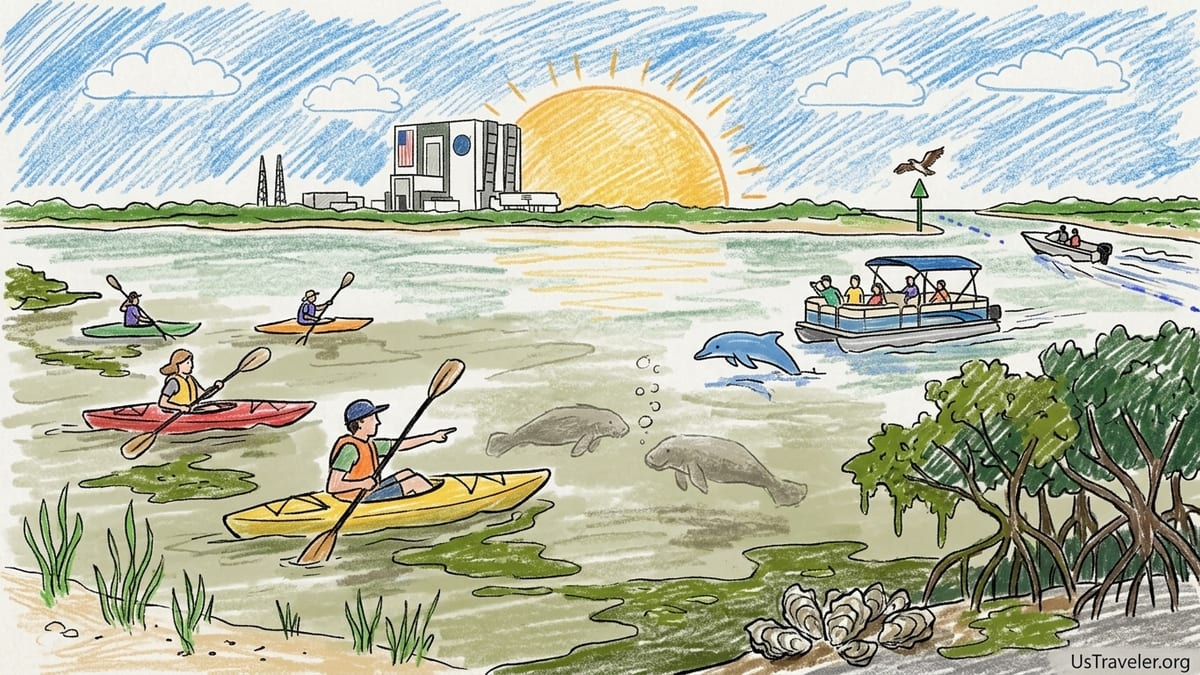
The brochure photo showed a child reaching toward a curious manatee in water as clear as glass. When I actually pushed my kayak off the sandy launch near Merritt Island one warm winter morning in 2026, the Indian River Lagoon around my bow looked more like weak coffee. A light wind pushed a sheen of greenish-brown algae against the mangroves. Somewhere under that murk, I had been promised, thousands of manatees grazed on lush seagrass, dolphins hunted mullet, and birds patrolled a thriving estuary. Within an hour on the water, I began to question not only the sales pitch of some wildlife tours, but also what “recovery” really means in a place that has recently starved its own manatees.
From Marketing Dream to Murky Morning
The tour description I had read the night before promised “crystal-clear water” and “guaranteed close encounters with gentle manatees.” I chose a small-group sunrise paddle launching from the Haulover Canal area, between Titusville and Merritt Island, where the Indian River Lagoon and Mosquito Lagoon meet. The operator’s social media feed was full of glowing teal water and nose-to-nose manatee selfies. It looked like an aquatic Eden.
On the day of my trip, the reality was different. Visibility into the water was barely a few dozen centimeters. Patches of filamentous algae clung to the mangrove roots. Every so often, a bubble trail and a gray back rolling at the surface hinted at a manatee moving along the edge of the channel, but they appeared as ghostly shapes rather than the postcard-perfect animals I had been primed to expect. Motorboats throttled through the marked channel toward the Intracoastal Waterway, their wakes slapping our kayaks against the oyster-crusted shoreline.
Our guide, a local naturalist, did not sugarcoat what we were seeing. He talked about years when brown tides and harmful algal blooms had turned stretches of the lagoon opaque and led to fish kills. He spoke quietly about the “unusual mortality event” for manatees that gripped this coast from December 2020 through April 2022, when 1,255 manatee carcasses were recorded along Florida’s Atlantic side and many of those deaths were linked to starvation in the Indian River Lagoon. I realized that some of the same tour marketing still in circulation looked suspiciously like it came from the “before” era.
By the time the sun cleared a thin haze over Kennedy Space Center, I had seen a handful of manatees surface briefly at a respectful distance and a pod of bottlenose dolphins corralling baitfish. Ospreys cried from channel markers, and a reddish egret danced through the shallows. It was an encounter worth waking up for. But it was neither guaranteed, nor framed in the crystalline water that many visitors still imagine when they book a wildlife tour here.
Why the Indian River Lagoon Matters Far Beyond the Postcard
The Indian River Lagoon stretches roughly 250 kilometers along Florida’s east coast, from Ponce Inlet near New Smyrna Beach to Jupiter Inlet north of West Palm Beach. It is actually a linked system of three estuaries the Mosquito Lagoon, the Banana River, and the Indian River proper. This long, shallow waterway is often called one of the most biologically diverse estuaries in North America, hosting hundreds of fish species, impressive numbers of bird species, and charismatic megafauna like manatees and dolphins.
For manatees, the lagoon is more than a scenic backdrop. It provides critical year-round habitat. Historically, dense seagrass meadows carpeted its shallow flats, offering both food and shelter. Seagrass is the salad bar that sustains these large herbivores, along with green turtles and many smaller grazers. The grass also stabilizes sediment, helps clear the water, and forms the foundation of a complex web that supports everything from shrimp and blue crabs to snook and red drum.
Yet this ecological engine room sits alongside some of Florida’s fastest-growing communities and some of its most engineered landscapes. Decades of canal construction, stormwater drainage projects, and shoreline development have funneled nutrient-rich water and sediments into the lagoon. The result has been an unstable system where water clarity, algal blooms, and seagrass coverage can swing dramatically from year to year. When you board a wildlife tour here today, you are stepping into an estuary that is both recovering and still very much in peril.
Recent monitoring by regional agencies has documented signs of seagrass rebound since the nadir of the early 2020s, with 2025 aerial mapping showing a significant increase in seagrass coverage compared with 2023. Some areas, especially parts of Mosquito Lagoon and segments of the central lagoon, now show more robust grass beds and clearer water for much of the year. But those gains are uneven. Other reaches remain degraded, which shapes what wildlife visitors are likely to see and how closely they should expect to see it.
Manatee Starvation, Official Recovery, and What Those Words Conceal
To understand why “manatee tour” marketing in the Indian River Lagoon deserves scrutiny, it helps to revisit the crisis that unfolded just a few years ago. Beginning in December 2020, wildlife managers documented a sharp rise in manatee deaths along Florida’s Atlantic coast. Many of the carcasses came from counties that border the Indian River Lagoon. Necropsies and habitat investigations tied the high mortality to starvation, rooted in the collapse of seagrass meadows after a decade of recurring algal blooms fueled by excess nutrients.
The Florida Fish and Wildlife Conservation Commission and the U.S. Fish and Wildlife Service formally designated an Unusual Mortality Event for Atlantic coast manatees. Between December 1, 2020 and April 30, 2022, they recorded 1,255 manatee carcasses within the event’s geographic scope, alongside more than a hundred rescues. In response, agencies and partners launched a controversial emergency feeding program, providing hundreds of thousands of pounds of romaine lettuce to hungry manatees at a warm-water site near a power plant, while longer term restoration and pollution reduction projects ramped up.
In March 2025, after several years of declining deaths and improving manatee body condition, the state administratively closed the Unusual Mortality Event. Officials noted that no manatee deaths linked to starvation from lack of forage in the lagoon had been documented since March 2023, and overall mortality had returned closer to expected background levels. Researchers highlighted areas like parts of Mosquito Lagoon where seagrass recovery had been particularly noteworthy, likely contributing to better foraging conditions.
It is tempting for tourism marketers to seize on this closure as proof that the crisis is over and the lagoon “back to normal.” That would be a misreading. The end of the event means the worst phase of starvation-driven mortality has eased and that emergency conditions have improved. It does not mean that manatees are no longer vulnerable to habitat changes, or that seagrass has returned to historic coverage. Nor does it erase ongoing threats like boat strikes, entanglement in debris, and periodic water quality declines. Any wildlife tour promising effortless, close manatee encounters without acknowledging this recent history is omitting a crucial part of the story.
What Lies Beneath: Nutrients, Seagrass Loss and Murky Water
On the surface, much of the Indian River Lagoon can look inviting. On calm mornings, wind-driven ripples make the water glint silver. From an elevated bridge, you might glimpse sandy patches and scattered seagrass. But because the lagoon is shallow and poorly flushed, it is extremely sensitive to what flows into it from land. That is where the problems begin.
Stormwater runoff from neighborhoods, golf courses, roads, and agricultural lands carries nitrogen and phosphorus into canals and ultimately into the lagoon. In older communities, thousands of septic tanks still leak nutrient-rich effluent into the groundwater. Decades of dredging and shoreline modification have allowed muddy sediments, often called muck, to accumulate in bottom depressions. These sediments can release nutrients back into the water, fueling blooms long after surface pollution is reduced.
Since 2011, the lagoon has endured multiple “super bloom” events, brown tides, and recurring harmful algal blooms. These blooms shade out seagrass, depriving it of the light it needs to photosynthesize. When the blooms crash, decomposing algae can strip dissolved oxygen from the water, causing fish kills. Environmental reports for 2023 and 2024 show that while some segments of the lagoon had relatively “okay” water quality, others experienced at least one harmful algal bloom event within a 12-month window, a reminder that conditions remain volatile.
Projects funded through the Indian River Lagoon Protection Program and related basin management plans now aim to reduce nutrient inputs by converting septic systems to sewer, upgrading wastewater plants, restoring wetlands that filter runoff, and dredging muck from key basins. Federal and regional grants support seagrass and shellfish restoration, including efforts to rebuild clam populations that can help clear the water by filter-feeding. Visitors may hear tour guides point to new oyster reef projects or living shoreline installations as hopeful signs. They are, but they are also triage for an estuary that still suffers the hangover of decades of mismanaged growth.
Boat Strikes, Crowded Waterways and the Pressure of Access
One detail that stood out on my own kayak trip was the soundtrack. Between bird calls and the slap of mullet on the surface came the steady drone of outboards. The Indian River Lagoon doubles as part of the Intracoastal Waterway, and in popular sections, especially near Titusville, Cocoa Beach, and Sebastian, recreational boat traffic can be heavy, particularly on weekends and holidays. For manatees and dolphins, these motorized corridors are both habitat and hazard.
Manatees are slow moving and must surface to breathe. They often travel and feed in shallow water, where boaters like to run. Across Florida, watercraft collisions remain one of the leading documented causes of manatee death, and Indian River Lagoon counties report their share of fatal strikes each year. Even non-fatal collisions can maim animals, leaving them with deep propeller scars that visitors sometimes see on the backs of otherwise healthy-looking manatees during tours.
Wildlife tour operators that use motorized vessels must navigate both the legal slow-speed zones and the ethical questions of how close to approach resting or feeding animals. In narrow channels like Haulover Canal or the residential canals around Cocoa Beach’s Thousand Islands, multiple tour boats jostling for position can easily crowd a small group of manatees, increasing stress and the chance of accidental strikes. I watched one morning as a non-tour recreational boat plowed past a cluster of anchored kayaks, its wake rocking the paddlers while a dolphin surfaced not far off the bow. Nothing obviously bad happened, but the margin for error felt small.
Responsible operators respond by keeping their distance, cutting engines early, and letting wildlife approach on their own terms if they choose to. They train guides to read body language and avoid surrounding an animal. From a marketing perspective, this can mean fewer dramatic photos of someone touching a manatee and more images of animals at a respectful distance. For travelers, that can translate to a subtle but telling distinction between companies that put the animals first and those that prioritize social media moments.
Comparing Wildlife Tours: Merritt Island to the Treasure Coast
Across the length of the Indian River Lagoon, wildlife tours take many forms. In the north, around Merritt Island and Titusville, operators launch kayaks and small boats into Mosquito Lagoon and the adjacent sections of the Indian River. This is also where many of the famous summer bioluminescence tours operate, guiding visitors on nighttime paddles to see glowing plankton in the water. Seasonal kayak eco-tours in this area often cost in the range of 60 to 80 dollars per person for two to three hours, with group sizes varying from a handful of paddlers up to a dozen or more per guide, depending on the company.
Some of the better-regarded small kayak operators near Merritt Island National Wildlife Refuge emphasize that wildlife sightings cannot be guaranteed, and that conditions such as water clarity and algal blooms influence what guests will see. They tend to use sit-on-top kayaks or clear-bottom boats and offer safety briefings that include how to avoid startling manatees or dolphins. Guides often highlight ongoing restoration projects, point out seagrass plots, and discuss manatee mortality trends with frankness. Launch sites might include Haulover Canal, the refuge’s canoe trail areas, or nearby county parks.
Around Cocoa Beach and the Thousand Islands area of the Banana River, tour companies blend wildlife watching with paddles through mangrove tunnels and around spoil islands. Prices here are broadly similar to Merritt Island, and some companies offer a choice between daytime eco-tours and nighttime bioluminescence paddles. One operator’s public rate for a guided bioluminescent kayak tour, for example, is currently listed at about 65 dollars per person. Group sizes on these popular trips can reach a dozen or more boats in a single outing during peak season, and multiple operators may be on the water at once.
Further south, in places like Sebastian, Vero Beach, and the broader Treasure Coast, wildlife tours often use small pontoon boats or covered vessels for birding, dolphin watching, and manatee viewing in season. Prices here range roughly from 35 to 70 dollars per adult for standard two-hour public cruises, with private charters costing more. Vessel capacities can run from six passengers on intimate flats boats up to twenty or more on larger pontoon-style tour boats. Some companies highlight their partnership with local conservation groups, while others lean hard into close-encounter marketing and “guaranteed dolphin sightings” language.
Red Flags in Eco-Tour Marketing
As I researched operators along the lagoon and compared their advertising to what scientists and agencies say about current conditions, several red flags emerged. The first is any promise of “crystal-clear water year-round” or photos that consistently show Caribbean-blue conditions without acknowledging that the lagoon’s water clarity fluctuates. Environmental reports from 2023 through mid-2026 make it clear that while some reaches have seen improved clarity and significant seagrass gains, others still experience turbid water and occasional blooms. A company that presents the entire lagoon as a permanently clear-water paradise is glossing over reality.
The second red flag is the phrase “guaranteed manatee encounters” or “up-close manatee interaction.” There is no ethical way to guarantee that a wild manatee will approach your kayak or boat within touching distance, and in many situations, encouraging or allowing that level of proximity could constitute harassment under wildlife protection rules. Operators who understand both the law and the animals usually frame their tours in terms of opportunities and probabilities rather than guarantees. They remind visitors that manatees are wild animals navigating a recovering ecosystem, not theme park attractions.
A third concern is crowding. If an operator routinely advertises very large group sizes for narrow, sensitive areas for example, twenty or thirty kayaks in a confined canal that should prompt questions. Similarly, motorized tours that boast of high-speed runs followed by sudden stops at manatee “hotspots” raise questions in a system where boat strikes remain a major cause of manatee mortality. When I see glossy photos of tightly clustered boats surrounding a surfacing animal, I think of the stressed manatees documented during the starvation event and the pressure that constant human attention can add.
Finally, pay attention to how companies talk about conservation. Some operators now highlight specific restoration projects they support, such as seagrass planting efforts, clam restoration, or shoreline cleanups. Others simply sprinkle “eco” into their name without any mention of actual environmental practices. If an operator cannot clearly explain how they minimize wildlife disturbance, manage waste, and contribute to lagoon health, their green branding deserves skepticism.
Choosing and Supporting Responsible Operators
During my time around the lagoon, I gravitated toward operators who seemed to wrestle honestly with its contradictions. In Titusville and Merritt Island, that meant small kayak companies that capped group sizes at roughly ten to twelve paddlers and scheduled trips around wildlife behavior and weather instead of packing the calendar. These guides spoke candidly about the manatee starvation event, the March 2025 closure of the Unusual Mortality Event, and the fact that no new starvation deaths linked to forage shortage had been documented since March 2023. They also emphasized that this positive trend did not erase broader habitat concerns.
In Cocoa Beach, I spoke with guides who avoid promising manatee encounters on bioluminescence tours, because summer manatee use of certain areas can be unpredictable and because the focus at night is the light show in the water rather than chasing large animals in the dark. Their safety talks included reminders not to use bright white flashlights on wildlife and to keep noise down in residential canals. Group sizes were similar to Merritt Island trips, but a few companies stood out by offering smaller-group premium tours at slightly higher prices for travelers seeking a quieter, lower-impact experience.
On the Treasure Coast, I found operators who limited passenger numbers on their boats well below licensed capacity, in order to reduce crowding at viewing spots and improve maneuverability around wildlife. A small Vero Beach outfit I visited described how the captain slows early, maintains a generous buffer, and shuts off the engine if manatees approach of their own accord. The crew talks openly about seagrass restoration and encourages guests to report injured or distressed animals to the appropriate hotlines.
In each of these cases, the tours cost a bit more per person than some of the more aggressively marketed options, but the difference felt like an investment in the lagoon itself. As a traveler, you might pay around 5 to 15 dollars more for a smaller-group, conservation-minded outing than for a high-volume tour, depending on the area and season. Considering the fragility of the ecosystem and the experience on the water, that premium looks modest.
The Takeaway
When I first slid my kayak into the Indian River Lagoon that murky morning, I felt a flicker of disappointment that the water did not match the brochure. By the time I hauled the boat back onto the shore, I realized that the real story here is more compelling than any marketing image. This estuary is both wounded and resilient. Seagrass is returning in many places, and with it, manatees and fish are in better condition than they were in the depths of the 2020 to 2022 crisis. The official end of the Unusual Mortality Event in March 2025 is real progress, as is the absence of new starvation deaths linked to forage shortage since March 2023. At the same time, nutrient pollution, stormwater runoff, habitat loss, and boat strikes continue to shape what visitors and wildlife experience every day.
As travelers, we sit at an uncomfortable intersection of wonder and impact. Every time we book a wildlife tour, we send a signal about what we value. If we reward companies that promise guaranteed close encounters and perfect water, we risk pushing operators toward riskier, more intrusive behavior in a system that can ill afford it. If instead we seek out guides who respect distance, acknowledge uncertainty, and engage honestly with the lagoon’s environmental challenges, we help shift the market toward protection rather than exploitation.
Personally, I would support tours that keep groups small, avoid baiting or chasing wildlife, are transparent about variable water quality, and can point to specific conservation actions or partnerships. I would be wary of anyone offering to guarantee that I will touch a manatee, see dolphins bow-riding the boat, or paddle through gin-clear water regardless of season. The most meaningful encounters I had on the lagoon involved watching a scarred manatee surface quietly several meters away, a dolphin herd fish along a mangrove edge, or a guide pause to show how new seagrass blades were pushing through the sand.
Wildlife protection in the Indian River Lagoon now depends as much on choices made by visitors as on regulations and restoration budgets. This estuary has already shown us the cost of ignoring the link between water quality, seagrass, and the animals we love to watch. If we want future travelers to see healthy manatees, thriving seagrass flats, and clean water here, we need to choose our tours with care, ask harder questions, and accept that responsible wildlife experiences may be quieter, farther away, and less Instagram-ready than the brochure suggests.
FAQ
Q1. Is the Indian River Lagoon safe to visit after the manatee mortality event?
The lagoon remains a major destination for wildlife watching and paddling, and agencies consider it safe for recreation in most conditions, though water quality can vary by location and season.
Q2. Does the closure of the Unusual Mortality Event in March 2025 mean manatees are fully recovered?
No. The closure reflects an improvement from crisis conditions, including the absence of new starvation deaths linked to forage shortage since March 2023, but long term threats like habitat loss and boat strikes persist.
Q3. Will I definitely see manatees on a tour in the Indian River Lagoon?
No tour can ethically guarantee manatee sightings. Responsible operators describe typical seasonal patterns and probabilities but acknowledge that wildlife movements are unpredictable.
Q4. Why does the water sometimes look brown or green instead of clear?
Color and clarity are influenced by algae, suspended sediments, tannins from vegetation, and recent weather. Nutrient pollution and past algal blooms have made the lagoon especially sensitive to these factors.
Q5. How can I tell if a wildlife tour operator is responsible?
Look for small group sizes, clear guidelines on not touching or feeding wildlife, frank discussion of variable conditions, and evidence of involvement in or support for conservation efforts.
Q6. Are bioluminescence tours harmful to the lagoon?
Bioluminescence tours can be relatively low impact when operators keep groups small, limit light and noise, avoid sensitive seagrass flats, and respect no-entry or slow-speed zones.
Q7. What is being done to improve water quality and seagrass in the lagoon?
State, federal, and local programs fund septic-to-sewer conversions, stormwater upgrades, muck removal, and seagrass and shellfish restoration, with recent monitoring showing encouraging but uneven recovery.
Q8. Are boat strikes still a major threat to manatees in this area?
Yes. Watercraft collisions remain a significant cause of manatee deaths along Florida’s east coast, including Indian River Lagoon counties, which is why speed zones and cautious boating are critical.
Q9. When is the best season to visit for wildlife viewing?
Cooler months often bring more manatees to warm-water sites and can offer clearer water in some segments, while spring and early summer may bring active bird life and, later, seasonal bioluminescence in certain areas.
Q10. What can I personally do to help protect the Indian River Lagoon?
You can choose responsible tour operators, follow no-wake and wildlife viewing rules, avoid littering, support local restoration groups, and reduce fertilizer and pollution if you live within the broader watershed.