


I paid my $30 at the booth on a bright Saturday in Daytona Beach with the kind of curious optimism only a first-timer brings. The idea of rolling my car straight onto Florida sand had always sounded a little rebellious and a lot convenient. Instead of circling for a spot or hauling chairs across hot pavement, I imagined a lazy day with the trunk as my personal cabana, the Atlantic framed by my open hatchback. What I found on the other side of the ramp was less a beach and more a linear parking lot pressed up against the tide line, where engines idled, backup alarms beeped and kids zigzagged between bumpers and beach chairs.
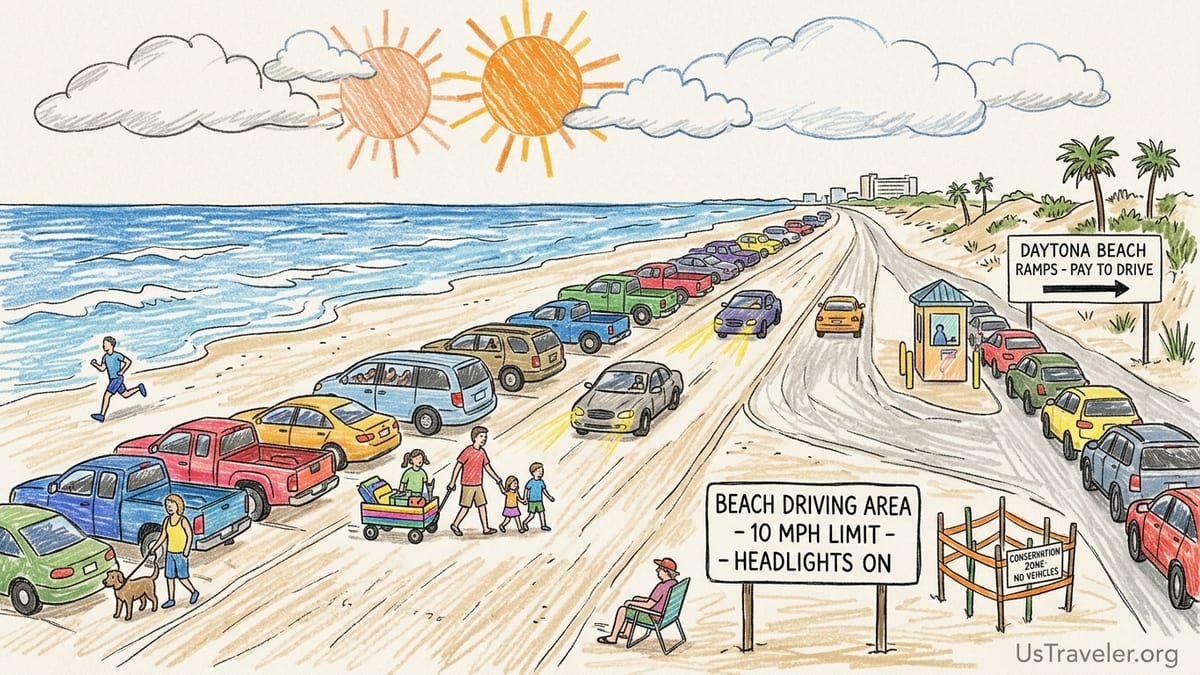
Paying to Park on the Sand: What I Expected vs. What I Got
At the main Daytona Beach ramp, the routine was straightforward. As a nonresident, I handed over $30 for a daily beach driving pass, the current Volusia County rate that covers one vehicle for the day. The attendant gave me a paper dashboard slip and a short reminder: stay in the marked driving lanes, obey the 10 mile per hour speed limit, keep headlights on and make sure a front window stays rolled completely down. It felt like merging onto a slow-motion road that happened to be made of sand.
I expected a novelty more than anything. I pictured a thin line of cars well back from the water, maybe a few pickup trucks with tailgates open, kids eating sandwiches in the shade. Instead, once my tires dropped from the ramp onto the hard-packed sand, I joined a continuous double row of vehicles parked nose-to-ocean, bumper-to-bumper across long stretches of shoreline. The designated driving lane ran like a two-lane road between that parked line and the wetter sand closer to the surf, with a steady flow of traffic cruising by at a crawl.
Trying to claim a spot for my chair meant choosing whether to sit in front of my car closer to the water, with vehicles creeping behind me, or behind my car nearer the dunes, where pedestrians and cyclists threaded through the same corridor as the tire tracks. Either way, there was always a vehicle moving within a few yards. Rather than the whoosh of waves and scattered conversations, the soundtrack became the crunch of tires, the low thrum of engines and the occasional honk when someone hesitated too long while parallel parking on the sand.
By midday, it was hard to forget that I had essentially paid $30 to place my beach towel inside a strip of active traffic. For some locals the routine felt familiar and casual. For me, as an out-of-town visitor used to vehicle-free beaches, it changed the entire mood of the day.
Is Direct Beach Access Actually Convenient?
The main argument for Daytona’s drive-on tradition is convenience. Volusia County’s own messaging highlights the ease of driving and parking on the beach in designated zones near Daytona Beach and New Smyrna Beach. Off the sand, the county now runs a unified ParkVolusia program for its own lots, charging visitors and unregistered residents $20 per day for off-beach parking, while allowing registered residents to park and drive for free in county facilities. In theory, a visitor faces a choice: $30 to drive and park right on the sand, or $20 to park in a nearby lot and carry gear a short distance.
On paper, the extra $10 to park on the beach feels like a modest premium for door-to-surf service. In practice, the experience is more complicated. Access ramps are limited and conditions change with tides, storms and sea turtle nesting season. Volusia County encourages visitors to check its beach app for real-time ramp status because some approaches close for high tides or soft sand. When several ramps are closed, the remaining ones can back up with vehicles waiting to get in, and the drivable segments can compress into crowded corridors.
On the day I visited, I waited in a slow-moving line on International Speedway Boulevard before inching down the ramp. Once I reached the sand, I spent nearly as long hunting for a reasonable gap between cars as I might have spent driving to an off-beach lot and walking. The supposed convenience began to feel less like freedom and more like securing a space in a beachfront garage that happened to have waves.
There is also the subtle stress of leaving your car in a place that still behaves like a road. Even parked, you are expected to angle your vehicle correctly around the conservation zone markers and leave enough drive lane. Beach Safety trucks make regular passes, and announcements about impending high tides or closures crackle from loudspeakers. It is far from the mental break many travelers seek when they picture a day by the water.
How the Rules Shape the Feel of the Beach
Volusia County’s rules for beach driving are unusually explicit, and they shape the experience in ways a first-time visitor may not anticipate. The county’s Beach Code limits vehicle speed to 10 miles per hour anywhere on the sand, whether you are entering, cruising or maneuvering into a parking space. Drivers are required to keep headlights on at all times and to roll down at least one front window completely while on the beach. These conditions are meant to improve visibility and allow for better communication and awareness between drivers, pedestrians and enforcement officers.
Driving is allowed only in designated “driving areas” and typically within marked lanes between the conservation zone near the dunes and the wetter sand closer to the ocean. You may park either facing the ocean or backed in toward the dunes, but you cannot cross into the conservation zone or block it. County guidance makes clear that driving and parking will be suspended when tides reduce the drivable lane to less than about 30 feet in width. During extreme high tides, some areas close to vehicles up to two hours before and after the peak to avoid forcing cars too close to dunes or into the conservation zone.
Seasonal rules further compress the experience. During sea turtle nesting season, which Volusia County defines as running roughly from May 1 through October 31 for lighting regulations and related protections, the beach driving day is restricted. County brochures indicate that during nesting season, beach driving is typically allowed from 8 a.m. to 7 p.m., assuming tides and weather are safe enough to open ramps. Outside nesting season, hours can be somewhat longer, but drivers should still expect closures in poor surf or storm conditions.
In theory, these rules are about safety and conservation. In practice, they also contribute to a low-grade sense of monitoring. Sitting in a beach chair a few meters from a posted 10 mile per hour sign, with vehicles circling and a patrol truck idling nearby, it is hard to pretend you are far from the usual world of rules and roads.
Sharing the Sand with Vehicles, Families and Wildlife
From a distance, the wide, compact sands of Daytona seem to swallow the cars easily. Up close, the conflicts become obvious. The main driving lanes double as walking paths. Families with wagons and coolers fan out from the ramp and then fan back in at the end of the day. Cyclists use the hard-packed sand as a shoreline bike path. Runners follow the waterline, drifting inland to avoid breaking waves. Dogs on leashes trot between tailgates. Every one of those users must constantly glance up to check for oncoming vehicles.
Volusia County and the Volusia Sheriff’s Office both publish safety reminders that stress the shared responsibility of drivers and pedestrians. They repeat that the 10 mile per hour speed limit is not optional, that children should not be allowed to play in the driving lanes and that electric bikes and scooters are subject to the same speed rules as trucks and sedans. Enforcement officers emphasize visibility reasons for the headlight and open-window requirements: drivers should make it easier for others to see them, and they should be able to hear voices or whistles calling out if someone is in danger.
Despite these measures, the arrangement never quite feels natural. When I tried to relax with a book, I found myself tensing every time a vehicle eased past in the lane just behind my chair. Parents sat in swivel camp chairs with one eye fixed on the surf and another watching the drive lane. Small children, who are already hard to see from a car’s front seat on a regular street, became nearly invisible when crouched building sandcastles beside a cooler at bumper level.
There is also the matter of wildlife. Volusia County acknowledges that its beaches host endangered and threatened sea turtles that nest in the sand. To protect them, the county has established a marked conservation zone along the upper beach where driving and parking are forbidden. When tides squeeze the available width, Beach Safety must sometimes close driving areas entirely so vehicles do not encroach into those zones. State wildlife guidance also reminds drivers that nesting season means more eggs and hatchlings hidden in the sand, and that any operation of a vehicle above the high tide line requires extra caution to avoid crushing nests or disoriented hatchlings that may be moving at night or near dawn.
Sea Turtles, Shifting Sand and Why Driving Lanes Change
One of the more surprising realities of Daytona’s drive-on tradition is how fragile it is. The smooth ribbon of drivable sand that appears on postcards is dependent on tidal cycles, sand profiles and storm activity that can change in a matter of days. Volusia County’s coastal management division notes that when waves eat into the beach and reduce the dry-sand area, the driving lane narrows. If that lane shrinks below a safe width, officials must suspend or relocate beach driving until the beach recovers naturally or through sand renourishment.
Sea turtle nesting further shrinks the usable space. During nesting season, biologists and trained volunteers survey the beach early in the morning, marking nest locations and often cordoning them off with stakes and tape. The result is a patchwork of conservation stakes, vehicle lanes and parking areas. Drivers are not allowed to cross the marked conservation boundary, and enforcement vehicles patrol to ensure that traffic does not cut too close to nests or dunes. This sometimes forces the driving lane closer to the water, where ruts and soft spots can trap unwary sedans.
Storms add another layer of unpredictability. After strong nor’easters or hurricanes, access ramps can be damaged, sand can scour away to expose coquina rock, and steep escarpments form along the dunes. In those periods, Volusia County may temporarily close specific ramps or entire stretches of drive-on beach while engineers and crews assess damage. Official ramp lists and maps published by the county include disclaimers that availability is subject to change, and residents often rely on the Volusia Beaches smartphone app or social media updates to learn which approaches are open on a given weekend.
For a visitor planning only one day at the beach, this variability matters. Paying $30 for a drive-on experience sounds straightforward, but if a late-morning high tide or a lingering storm swell means the vehicles must clear the sand for several hours, that fee begins to feel like a gamble compared with a fixed-price off-beach lot.
Daytona Beach Shores, New Smyrna and Vehicle-Free Space Coast Alternatives
Within Volusia County, the drive-on experience itself varies. South of central Daytona Beach, in Daytona Beach Shores, vehicle access is still part of the culture but the tone can be more subdued. Access ramps are tied to a string of parks, including Frank Rendon Park, Van Avenue Park and Larry Fornari Park, where visitors can either drive onto the sand or park in lots near the ramps. With a higher concentration of condos and fewer day-use visitors than central Daytona, parts of the Shores can feel less chaotic. On quieter days, the driving lane looks almost like a slow pathway for locals in Jeeps rolling between fishing spots.
Continue south to New Smyrna Beach and the character shifts again. New Smyrna offers both drive-on sections and traffic-free zones. Some ramps, such as those off Flagler Avenue, serve busy restaurant-lined streets and attract day trippers who like the carnival feel of a beach that doubles as a tailgate party. Other stretches closer to the inlet are more laid-back, though still shaped by the same Volusia County rules, conservation zones and seasonal closures. If you want to sample the novelty of beach driving but prefer a somewhat smaller scale than central Daytona, New Smyrna can be a reasonable compromise.
Travelers who find the whole idea of sharing the sand with vehicles unappealing have a clear alternative to the south along Florida’s Space Coast. In neighboring Brevard County, beaches in places like Cocoa Beach, Satellite Beach and Canaveral National Seashore are strictly vehicle-free on the sand. Parking is in lots or along streets, and any cars stay behind dunes or seawalls. The absence of vehicles shifts the social dynamics dramatically. Beachgoers spread out without worrying about drive lanes, kids play along the waterline without parents glancing over their shoulders for headlights, and sea turtle nesting proceeds without the complication of tire tracks near the surf.
For many visitors who try both experiences, the comparison can be stark. Daytona’s automotive tradition offers novelty and a certain nostalgic appeal, especially for car enthusiasts and motor sports fans drawn by the city’s racing history. Vehicle-free beaches elsewhere in Florida, however, often deliver the tranquil, postcard-ready experience that first-time visitors imagine when they picture a day on the Atlantic.
What One Beach Day Really Costs for Couples and Families
When I sat down after my drive-on experiment and compared numbers, the economics became harder to ignore. Under Volusia County’s current structure, a visitor who is not a registered resident faces two main county-controlled options for a full beach day. To drive and park a standard vehicle directly on the sand costs $30 per day. To park in a county-owned off-beach lot that participates in the ParkVolusia program costs $20 per day. These rates are per vehicle, not per person, and they do not automatically apply to separate city-owned or private garages, which may have their own fees.
Consider a couple arriving in a single car for one Saturday in Daytona. If they choose off-beach parking in a county lot, they pay $20 to leave the car on pavement and walk a few minutes over a boardwalk or beach access. If they opt for on-beach driving, the same couple pays $30 to park directly on the sand. The $10 difference buys them the ability to keep a cooler in the trunk within arm’s reach, avoid carrying chairs, and come and go during the day without moving the car from the beach. For some travelers with limited mobility or heavy gear, that premium may feel reasonable, particularly if they are staying in an inland hotel without its own garage.
Now imagine a family of five in a minivan. The numbers stay the same: $20 for a county lot, $30 for on-sand parking. On some busy weekends, that family might struggle to find space at a popular off-beach lot and may appreciate the certainty of driving onto the beach and following the line of vehicles until they see a gap. On the other hand, once parked on the sand, they must supervise young children constantly around moving vehicles. They also accept the risk that tides or storms may force an early exit, cutting the beach day short despite having paid the same fee as someone who arrived earlier.
The picture shifts again for longer stays. Volusia County currently offers a $150 annual visitor pass for beach driving, and a $100 annual visitor pass for off-beach parking in its lots. Frequent visitors who truly enjoy the drive-on culture may find value in those passes, especially if they return multiple weekends a year and treat the beach as a giant oceanfront parking lot. For occasional travelers, however, a single $30 day stands on its own. Against that cost, nearby areas with traditional parking and vehicle-free sand begin to look more attractive.
There is also an opportunity cost that does not appear on the receipt. By paying to put your vehicle on the beach, you accept that your entire day will unfold in a place where safety announcements, engine noise and tire tracks are part of the atmosphere. Choosing a $20 lot and a short walk instead buys something quieter and, for many, more relaxing.
The Takeaway
By the end of my first day driving on Daytona Beach, I understood both the appeal and the flaws of Volusia County’s longstanding automotive tradition. Rolling down a ramp and letting your tires hit the sand is undeniably memorable. There is a certain throwback thrill in watching a line of vehicles cruise along the tide line under strict 10 mile per hour limits, headlights glowing even in the sun, front windows down so drivers and Beach Safety officers can wave and call to each other.
Yet that same tradition reshapes the shoreline into something that feels far more like a managed roadway than an escape. The rules about headlights and open windows, the conservation zone markers and the tidal closures are all there for good reasons. They protect pedestrians, cyclists, nesting sea turtles and the dunes themselves. But as a traveler simply looking for a day of sand and surf, you feel those rules in every passing truck and every orange cone that pinches the driving lane around a fresh nest.
Is the novelty worth trying once? For many curious visitors, I would say yes, with clear expectations. Know that your $30 buys access to a moving parking lot on sand, not a secluded beach. Arrive early, drive cautiously, respect the conservation zones and be prepared for the possibility that tides or storms will shorten your time. If you have mobility challenges or heavy gear, the ability to park beside your spot can make a real difference.
Would I pay for it again? Personally, no. On my next visit, I would rather pay $20 to leave the car in an off-beach lot or choose a vehicle-free stretch of sand along the Space Coast, where my only concern is the rhythm of the waves instead of the rhythm of traffic. Daytona’s drive-on beach is a distinctive piece of Florida history, but for travelers seeking a truly relaxing day by the ocean, the convenience feels more like an unnecessary expense than an essential part of the experience.
FAQ
Q1. How much does it cost to drive on Daytona Beach for a day?
For nonresident visitors using Volusia County’s program, the daily fee to drive and park one vehicle on the beach is currently 30 dollars, valid for the entire day in open driving zones.
Q2. What is the fee for off-beach parking in Volusia County?
County-owned off-beach parking lots that are part of the ParkVolusia system charge visitors and unregistered residents a daily rate of 20 dollars per vehicle, separate from any city or private garages.
Q3. What are the beach driving hours during sea turtle nesting season?
During the core nesting season, generally May through October, Volusia County typically allows beach driving between about 8 a.m. and 7 p.m., though opening and closing times can change with tides and weather.
Q4. What safety rules apply when driving on Daytona Beach?
Drivers must stay in designated driving lanes, obey a strict 10 mile per hour speed limit, keep headlights on at all times, and ensure at least one front window is fully rolled down while on the sand.
Q5. Are there areas where vehicles are never allowed on the beach?
Yes. Volusia County posts traffic-free zones where vehicles are prohibited entirely, and every drive-on section has a marked conservation zone near the dunes where driving and parking are not permitted.
Q6. How do tides and storms affect beach driving access?
High tides that narrow the dry-sand area can force officials to suspend or limit driving and parking, and after strong storms some ramps or sections of beach may be closed until conditions are safe again.
Q7. What is the impact of beach driving on sea turtles?
Because endangered and threatened sea turtles nest on Volusia’s beaches, the county restricts driving near dunes, posts conservation zones, limits hours in nesting season and may close areas to vehicles when nests or hatchlings are at risk.
Q8. Is Daytona Beach Shores different from central Daytona for beach driving?
Daytona Beach Shores shares the same basic rules and fees but often feels a bit quieter, with access tied to park ramps and fewer day-trip crowds than the busiest central Daytona stretches.
Q9. How does Daytona’s drive-on beach compare with New Smyrna Beach?
New Smyrna offers both drive-on and traffic-free zones, so visitors can sample the novelty of beach driving in certain sections while seeking more traditional, vehicle-free sand in others.
Q10. Are there nearby Florida beaches where cars are never allowed on the sand?
Yes. To the south along the Space Coast, including areas such as Cocoa Beach and Canaveral National Seashore, vehicles are kept off the sand entirely, and access is by boardwalks or paths from off-beach parking areas.