


The first thing I noticed at the edge of Mosquito Lagoon was the darkness. Not the gentle dim of a city park, but a thick, rural blackness that made the distant red glow of Kennedy Space Center’s towers look almost theatrical. Our group was huddled near the dirt parking lot by the Haulover Canal kayak launch in Merritt Island National Wildlife Refuge, about 15 minutes east of Titusville, checking in with our guide from A Day Away Kayak Tours. I had seen the dreamy photos of neon-blue water online, but as I tightened my life jacket and glanced up at the mostly clear, moonless August sky, I wondered whether the real bioluminescent show in Mosquito Lagoon would live up to the hype.
Meeting the Guide at Haulover Canal
My tour was with A Day Away Kayak Tours, one of the longest-running outfitters operating in the Merritt Island National Wildlife Refuge. Their summer bioluminescence tours typically depart from the refuge side of Haulover Canal, between the Indian River and Mosquito Lagoon, at launch ramps such as Beacon 42 or the Haulover Canal kayak launch, depending on conditions and permits. When I booked online, my confirmation email specified the exact pin, driving directions from Titusville, and a note to arrive at least 30 minutes early because the refuge gates close promptly and there is no room for latecomers to sneak in.
The tour I chose was a standard tandem kayak bioluminescence tour scheduled for 9:00 p.m., priced around 60 to 70 dollars per person before taxes and fees, which was consistent with other operators along Florida’s Space Coast. At check-in, the guide, a local who had been paddling these waters for years, repeated a mantra I would hear more than once that evening: “Bioluminescence is a natural phenomenon. We expect good conditions tonight, but I can’t guarantee brightness.” It was a welcome dose of honesty after reading countless breathless online reviews.
Our group was a mix of first-time paddlers, a couple of experienced kayakers who had brought their own headlamps and dry bags, and a family with teenagers who looked both excited and slightly anxious. A Day Away provided stable sit-on-top tandem kayaks, paddles, and mandatory life jackets. They recommended closed-toe shoes and quick-dry clothing, which turned out to be very good advice once the mosquitoes woke up.
Before we carried the boats down to the water, our guide gathered us in a semicircle and gave a thorough safety briefing: how to hold the paddle, what to do if we bumped into manatees or dolphins, the importance of staying together, and a reminder that the refuge is a protected area. He also requested that we switch off or cover phone screens to protect night vision and reduce light pollution on the water.
Sliding into the Dark and First Glimpses of Glow
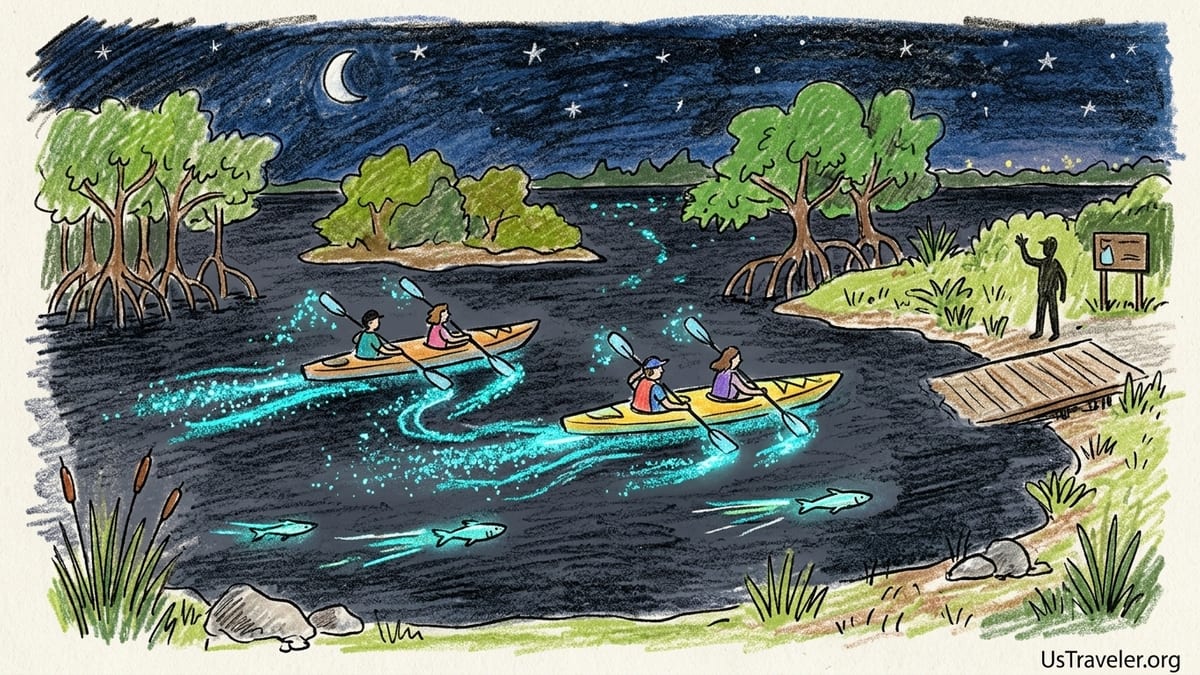
Launching into Mosquito Lagoon at night feels like gliding into a blank canvas. There are no city lights on this stretch of the refuge, only the faint outline of mangrove islands and the stars reflected in the black water. At first, there was no visible glow at all. The water looked completely ordinary, and I could tell some people were already wondering whether they had just paid 70 dollars for a regular night paddle.
The magic began in small, almost shy flashes. With the first few paddle strokes, I noticed a thin, smoky trail of pale blue following the blade as it slipped through the water. It was subtle, more like a watercolor wash than the blazing neon seen in marketing photos. When a small fish darted away from the boat, it left a quick, bright streak that faded in less than a second. Our guide explained that this summer display came from bioluminescent dinoflagellates, tiny plankton that emit light when disturbed.
As our eyes adapted to the dark, the effect intensified. The paddles started to carve glowing commas through the water, and every drip off the blade winked like a tiny falling star. When a mullet fish jumped nearby, its splash exploded into a burst of electric blue before vanishing into blackness again. It was not like paddling through liquid light, but more like seeing invisible currents revealed for a heartbeat at a time.
The guide had us gather in a loose circle and instructed us to swirl our hands in the water. My fingers disappeared into cool, brackish liquid and emerged traced in blue sparkles that clung for a second before dimming. Up close, the glow looked grainy and slightly green-blue, just bright enough to make you catch your breath. In that moment, the hype started to make sense.
Dinoflagellates versus Comb Jellies: Two Different Kinds of Magic
One thing I did not fully appreciate before this trip is that the Space Coast’s bioluminescence comes in two main flavors. During the warmer months, typically from June through October, the waters of Mosquito Lagoon, Banana River, and the Indian River Lagoon often light up with dinoflagellate bioluminescence. These are microscopic plankton that create spray-like sparks and streaks when disturbed. In the cooler months, especially late fall through winter, the same estuaries can host glowing comb jellies, gelatinous creatures that produce softer, pulsing light, sometimes seen more clearly when gently cupped in the hand.
On my August tour, the star of the show was clearly dinoflagellates. Each paddle stroke created a sharp, quick flash, as if the water was full of tiny fireflies. The brightness varied from stroke to stroke, likely depending on how concentrated the plankton were in that patch of water. When small schools of fish passed under the kayaks, they appeared as a constellation of darting blue dots tracing invisible lines just below the surface.
Our guide described how comb jelly tours in the cooler months feel different. Instead of chasing flashes, you search for faint, floating orbs that respond to gentle handling. He emphasized the difference in texture and intensity. Dinoflagellate nights tend to deliver more explosive, high-contrast “sparkles” along hulls and paddles, while comb jelly nights offer a more meditative, lantern-like glow that seems to come from within the animals themselves. Both are real, but they look very different from the social media images that rarely specify which phenomenon is being shown.
Hearing that contrast helped me calibrate my expectations. My experience on Mosquito Lagoon was not a solid neon river but a shifting mosaic of sparks that rewarded slow, deliberate movements rather than splashing for the camera.
Why Timing and Moonlight Matter More Than You Think
Florida’s Space Coast tourism office and several local outfitters emphasize that the most reliable dinoflagellate bioluminescence typically occurs between June and early October, with many paddlers and guides informally naming July, August, and early September as the strongest months. Warm water, higher plankton concentrations, and relatively stable weather patterns in late summer often combine to create brighter displays. That context shaped my decision to book for mid-August instead of earlier in the season.
However, even at the seasonal peak, there are no guarantees. Our guide stressed several variables that can mute or enhance the glow on any given night. Recent heavy rain can flush freshwater into the lagoon, potentially diluting plankton concentrations in certain areas. Strong winds can mix the water column and move the brightest pockets of bioluminescence away from usual routes. Localized algae blooms or water quality issues can also affect clarity. This is part of why operators may adjust launch sites, choosing pockets of the lagoon with better conditions that week.
Moonlight is another major factor. My tour was scheduled around a new moon period specifically to reduce sky brightness. With no moon overhead, the contrast between the ink-black water and the blue flashes was much stronger. On nights with a bright half or full moon, guides often still run tours, but they sometimes shift to more sheltered or shaded waterways in the Thousand Islands or around mangrove tunnels, where nearby land features can help block some of the glare.
Cloud cover plays a complicated role. Thin clouds can bounce light pollution from distant towns back down onto the water, slightly diminishing the perceived glow. Thick cloud cover, on the other hand, can sometimes darken the sky enough to improve contrast if there are few city lights nearby. On my night, high, patchy clouds and the remote refuge setting combined to create a remarkably dark dome, with only faint ambient light from Titusville on the western horizon.
Kayak Types, Paddling Effort, and Who This Trip Is For
For my tour, A Day Away used traditional sit-on-top tandem kayaks, which are wide, stable, and forgiving for beginners. Paddling in the calm waters of Mosquito Lagoon was manageable for most people in our group. There was almost no wind, the water was largely flat, and the distance covered during the roughly 90-minute tour was modest. Anyone comfortable with light exercise and able to sit upright for an hour or two could handle it, though parents did occasionally have to coach tired teenagers to keep paddling on the way back.
Other operators in the region, such as Cocoa Beach Kayaking and Cocoa Kayaking in the Thousand Islands and Banana River area, also run bioluminescent tours, often in similar sit-on-top kayaks, with per-person pricing around 60 to 70 dollars for one-and-a-half to two-hour trips. Several companies, including Get Up and Go Kayaking and some Merritt Island outfitters, offer clear-bottom tandem kayaks that cost a bit more, typically around 90 to 100 dollars per adult, with lower child rates. Those boats are fully or partially transparent, so the glow appears beneath and around you instead of only off the sides.
After talking with other travelers who took clear-bottom tours near Haulover Canal and Merritt Island, the tradeoff seems to be this: clear kayaks create a more immersive floor-level view when the water is very bright, but they can sit slightly lower in the water and may feel more cramped for taller paddlers. In clouded or weaker conditions, the difference between standard and clear hulls can be less dramatic than marketing photos suggest, though many people still enjoy being able to look straight down at darting fish trails.
Sunset-to-night combination tours, which some companies run from locations like Kiwanis Island Park or Kelly Park East in the Indian River Lagoon, appeal to those hesitant about launching in total darkness. These trips usually start about an hour before sunset, include time for wildlife viewing and a sunset on the water, then transition into full dark to catch the bioluminescence. They often run closer to two and a half or three hours, which means a bit more paddling effort but a more varied experience overall.
Weather, Bugs, and Other Realities of a Mosquito Lagoon Night
There is an uncomfortable truth hiding in the name “Mosquito Lagoon.” The insects can be intense. On my tour, the marshy air was still and humid, and while a light breeze over the open water helped a bit, the moment we stopped near mangroves or paused at the shoreline, mosquitoes and no-see-ums found us quickly. I had applied a liberal amount of insect repellent before leaving the car, and I was still swatting at my ankles by the end of the night.
The humidity was also a factor. Even after dark, late-summer temperatures hovered in the upper 70s to low 80s Fahrenheit, with the kind of saturated air that makes clothing cling. Paddling itself generated a mild sweat, but the real discomfort came from simply sitting in that heavy, still air for close to two hours. Anyone planning this trip should treat it as a warm-weather workout, not a cool evening stroll, and bring plenty of water.
The darkness, though essential for the visual effect, can be disorienting. Away from the faint glow of the launch ramp, our group felt like we were floating in a void framed only by starlight and occasional distant boat lights. Our guide used a small, shielded flashlight and glow stick on his boat to keep the group together, and he checked in frequently with the slower paddlers. I would not have wanted to navigate these waters alone without local knowledge of channels, shallows, and wildlife refuge rules.
One question everyone silently carried was whether the glow we were seeing matched what we had hoped for. It was undeniably beautiful and unusual, but it was not as overwhelmingly bright as many online videos implied. In some patches of water, my paddle created only a faint shimmer. In others, fish bursts looked like blue fireworks. The variability itself became part of the experience, but it is important for travelers to arrive expecting a subtle, shifting light show rather than a guaranteed neon spectacle.
Why Your Phone Will Not Capture What Your Eyes See
Almost as soon as the glow became visible, several people in our group reached for their smartphones. The results were predictably disappointing. Modern phones are powerful, but bioluminescent sparks are small, fast, and low light, and they move in three dimensions across rippling water. When I tried to shoot short videos, the screen mostly showed black with an occasional grainy flash that looked nothing like the real thing.
Our guide gently warned us in advance that most guests leave with memories rather than Instagram-ready footage. To photograph bioluminescence properly, you would typically need a camera capable of longer exposures, a sturdy tripod, and a very stable platform, none of which are realistic from a floating kayak at night. Longer exposures also tend to blur the brief flashes that make dinoflagellate displays so charming in person.
He encouraged us to put phones away after a few attempts and simply watch the water. Once I stopped trying to record every flicker, I noticed more details: the way the paddle blade would leave a temporary glowing outline of its shape, the faint blue mist clinging to my skin when I ran a hand through the water, and the shapes of startled fish zigzagging away beneath the hull like fast-moving comets.
If you go, it is reasonable to try capturing a keepsake photo or two, but it is worth releasing the expectation that your images will match what your eyes and brain perceive when fully immersed in that dark, quiet environment.
Comparing Mosquito Lagoon with Banana River and Indian River Lagoon
Before booking this trip, I researched other popular bioluminescence locations on Florida’s Space Coast. The Indian River Lagoon system, which includes Mosquito Lagoon, the Banana River, and the Indian River proper, stretches for more than a hundred miles and has become famous among paddlers for both dinoflagellate and comb jelly displays. Outfitters based in Cocoa Beach, Merritt Island, and Titusville run tours across these connected waterways, often choosing routes for a balance of darkness, wildlife, and access.
Banana River and the Thousand Islands area near Cocoa Beach are known for their maze of mangrove tunnels and relatively sheltered water. Companies like Cocoa Beach Kayaking and Cocoa Kayaking often launch from locations such as the Cocoa Beach Country Club or nearby ramps, where shallow flats and limited motorboat traffic can make for a calmer introduction to night paddling. These areas do, however, sit closer to developed shorelines, so light pollution from homes and streets can be more noticeable, especially on hazy or partly cloudy nights.
In contrast, Mosquito Lagoon within the Merritt Island National Wildlife Refuge feels much wilder and more remote. There are no houses on the shoreline, and the darkness is far deeper. Several local paddlers and guides I spoke with, as well as comments I later found from repeat visitors, praised the lagoon’s “10 out of 10” setting for its combination of stars, silence, and consistent summer bioluminescence. The tradeoff is a slightly longer drive from beach towns, basic dirt parking areas, and very limited amenities.
From a purely aesthetic standpoint, my Mosquito Lagoon tour felt more like an escape from civilization than what I saw on the Banana River from shore. If I were traveling with younger children or anyone nervous about total darkness, I might consider a Banana River or Thousand Islands tour for easier logistics. But for a first deep dive into the phenomenon, the refuge’s remoteness added an unforgettable layer to the night.
The Night’s Highs, Lows, and Was It Worth the Cost?
Looking back on the evening, my strongest memory is not a single bright flash but an accumulation of small, quiet moments. Paddling slowly through glassy water while tiny blue streaks curved away from my bow. Hearing the exclamation from a nearby kayak when a mullet erupted beside them in a splash of light. Stopping to float in silence while the Milky Way arched faintly overhead and the occasional fish scribbled luminous runes beneath our boats.
There were also very human realities. By the time we returned to the launch, everyone was sweaty, a bit sticky with salt film, and several of us were comparing mosquito bites on our ankles. One tandem had to push hard against an outgoing tide on the paddle back, and a couple of first-timers admitted they underestimated the effort. The glow itself oscillated between “wow” and “is it still there?” depending on where in the channel we were. No one in our group got the jaw-dropping time-lapse-style visuals that online marketing often suggests.
For roughly 60 to 70 dollars per person, including guide, kayak, and gear, I felt the experience was worth the price, but with some caveats. Travelers who are only interested in getting social media content or who expect an unbroken corridor of bright blue liquid might feel underwhelmed on a moderate-glow night. On the other hand, anyone who enjoys quiet nature experiences, does not mind a bit of sweat and salt, and can appreciate subtle, fleeting light will likely come away satisfied, especially if conditions line up on the stronger side.
The tour’s cancellation policy, which allowed rescheduling or refunds in the event of lightning, unsafe winds, or park closures, gave me some peace of mind. Operators across the region have similar approaches, often making final go or no-go decisions a few hours before launch based on radar and marine forecasts. It is worth checking these policies carefully when booking, particularly in late summer when thunderstorms are frequent.
The Takeaway
If I had the chance to plan another bioluminescent kayak trip on Florida’s Space Coast, I would likely aim again for Mosquito Lagoon within the Merritt Island National Wildlife Refuge. The wild, undeveloped shoreline and profound darkness amplified everything I loved about the experience. I would choose a date between late July and early September, when warm water and recent history suggest stronger dinoflagellate concentrations, and I would aim for the three or four nights around a new moon to maximize contrast.
I would also watch the weather closely in the preceding week, looking for stretches without heavy sustained rain or strong winds that might churn or dilute the water, and I would be mentally prepared for variability. Even in mid-season, the glow might range from softly mysterious to strikingly bright, and that unpredictability is part of what keeps it feeling like a genuine natural encounter rather than a staged attraction.
Next time, I might try a clear-bottom kayak tour out of a launch like Kiwanis Island Park or Haulover Canal to see how the glow differs beneath my feet, but I would keep my expectations aligned with what I now know: that hardware cannot create light that is not in the water, and that no boat design can transform a weak-glow night into a neon river. I would also bring a lightweight long-sleeve shirt, stronger bug spray, and a more relaxed attitude about photography, resigned to leaving with mostly mental images.
Ultimately, was my bioluminescent kayaking experience “really that magical”? In its own, understated way, yes. Not in the filtered, long-exposure sense familiar from posters and travel brochures, but in the quiet shock of realizing that every paddle stroke in a dark Florida lagoon can briefly reveal a galaxy of living light. For me, that was worth every mosquito bite and every dollar.
FAQ
Q1. What time of year is best for bioluminescent kayaking in Mosquito Lagoon?
Most outfitters and local tourism sources highlight June through October as the primary dinoflagellate bioluminescence season on Florida’s Space Coast, with many guides informally favoring July, August, and early September as the strongest months, depending on weather and water quality.
Q2. Which tour companies run bioluminescent trips in Mosquito Lagoon and nearby areas?
A Day Away Kayak Tours, based near Titusville, is a longtime operator in the Merritt Island National Wildlife Refuge and Mosquito Lagoon area. In the broader Indian River Lagoon system, companies such as Cocoa Beach Kayaking, Cocoa Kayaking, Get Up and Go Kayaking, and others run tours from launch sites around Cocoa Beach, Merritt Island, and Titusville.
Q3. How much does a typical bioluminescent kayak tour cost?
Standard sit-on-top kayak tours on the Space Coast usually cost around 60 to 70 dollars per person for roughly 1.5 to 2 hours on the water. Clear-bottom kayak tours tend to be more expensive, often around 90 to 100 dollars per adult, with somewhat lower rates for children where offered.
Q4. How difficult is the paddling on these night tours?
Most guided bioluminescent tours are designed for beginners and involve calm, sheltered water with modest distances. You should be comfortable with light to moderate paddling for 60 to 90 minutes, able to sit upright in a kayak, and willing to follow the guide’s instructions in the dark.
Q5. Are children allowed on bioluminescent kayak tours?
Policies vary by company, but many Space Coast operators accept children, often with minimum ages ranging from about 3 to 8 years old depending on boat type, tour route, and whether a tandem kayak with an adult is required. It is important to confirm age and weight limits when booking.
Q6. What are the pros and cons of clear-bottom kayaks versus standard kayaks?
Clear-bottom kayaks can make the bioluminescence more visible directly beneath you, especially on bright nights, and can feel more immersive. They can, however, be slightly more snug for taller paddlers and may not dramatically change the experience on weak-glow nights compared with a traditional sit-on-top.
Q7. Why do some nights look amazing in photos while others feel subtle in person?
Bioluminescence strength changes with water temperature, recent rainfall, tides, and plankton concentration, so some nights are naturally brighter than others. Many promotional images also rely on long camera exposures that intensify the light beyond what the human eye typically sees in real time.
Q8. What weather and moon conditions should I look for when booking?
For the best contrast, many paddlers aim for nights near the new moon when the sky is darkest. Calm winds, warm water, and a stretch of days without heavy freshwater runoff from rain can also help, although local guides often have the most up-to-date knowledge about where the glow is strongest at any given time.
Q9. How bad are the mosquitoes and how can I prepare?
Mosquito Lagoon and surrounding marshes can have very active mosquitoes and no-see-ums, especially in warm, still weather. Wearing long sleeves and pants in lightweight fabric, applying insect repellent, and avoiding overly fragrant products can all help reduce bites, but it is wise to expect some level of insect activity.
Q10. Is a bioluminescent kayak tour really worth the money?
For travelers who appreciate quiet nature experiences, are comfortable on the water at night, and go in with realistic expectations about variability and subtlety, most find the cost worthwhile. Those primarily seeking guaranteed social media visuals or who dislike heat, bugs, or darkness may feel less satisfied, especially on weaker-glow nights.