


East Central Florida rewards slow coastal drives, small beach towns and surprising pockets of wildlife between Daytona Beach and Stuart. This guide builds two concrete road trips you can actually follow on the ground: a seven day loop from Daytona Beach to Vero Beach, and a ten day version that continues south through Fort Pierce, Hutchinson Island, Jensen Beach and Stuart, with the option to duck inland toward Lake Okeechobee. Every day includes realistic mileage, driving time, suggested stops, meal ideas, hotel bases and approximate budgets for a couple and a family of four.
Planning Your East Central Florida Coastal Road Trip
East Central Florida is compact enough for relaxed one to two hour driving days, yet varied enough to feel like a real journey. Daytona Beach, New Smyrna Beach, the Space Coast and the Treasure Coast all sit within about 160 miles of shoreline between Daytona International Speedway and downtown Stuart. With careful planning you can combine classic speedway history, space launches, surf beaches, wildlife refuges and laid back coastal downtowns in a single itinerary.
The seven day route focuses on Daytona Beach, New Smyrna Beach, Titusville and Kennedy Space Center, Cocoa Beach, Melbourne, Sebastian and Vero Beach. It keeps driving days in the 45 to 110 mile range, usually under two hours behind the wheel. The ten day version keeps the same first week and then adds Fort Pierce, Hutchinson Island, Jensen Beach and Stuart, plus an optional inland day toward Lake Okeechobee for travelers who want to see Florida’s agricultural interior.
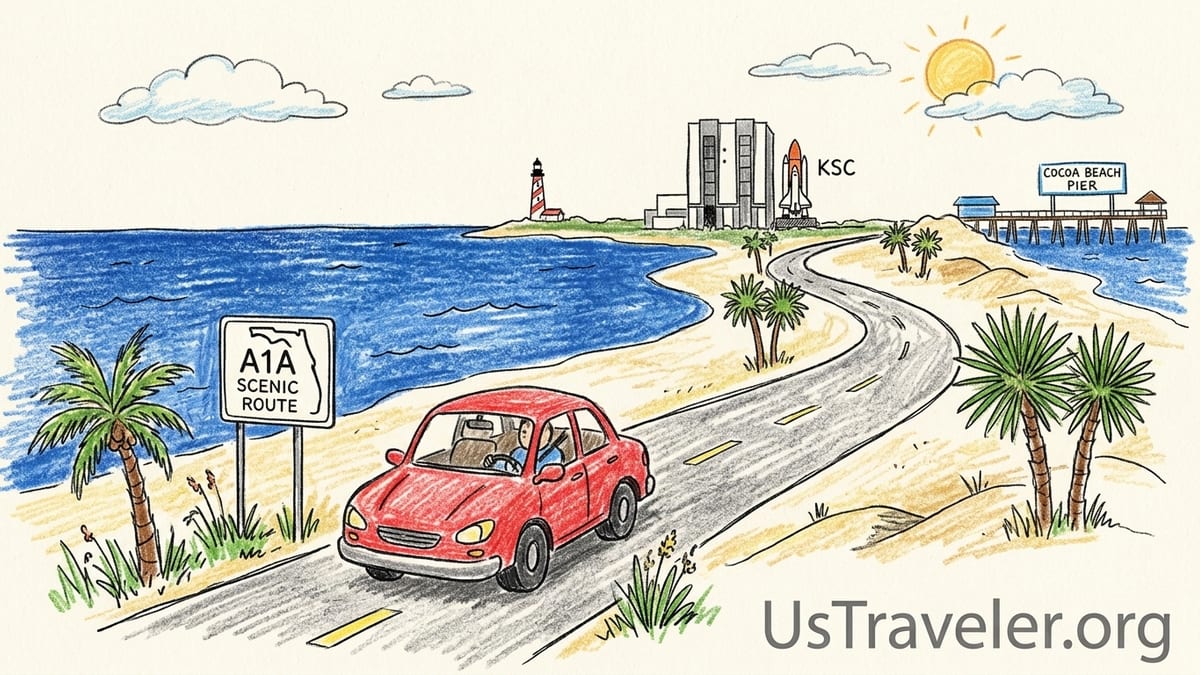
For both itineraries you can choose between fast interstate driving on I‑95 and slower, more scenic coastal stretches on Florida State Road A1A and related barrier island roads. As a rule, I‑95 works best when you have a time sensitive booking like Kennedy Space Center tickets or hotel check in. A1A is worth the slower pace whenever you can spare an extra 20 to 40 minutes for beach and dune views, especially between Ponce Inlet and Canaveral National Seashore, around Cocoa Beach and Satellite Beach, and again between Sebastian Inlet and Vero Beach.
This article uses typical drive times checked against recent digital map routing, along with current sample prices for major attractions and car rentals. Exact prices and opening hours can change at short notice, so always confirm key details directly with operators a few days before you travel, especially for Kennedy Space Center tickets, wildlife refuge closures and rocket launch schedules.
Rental Cars, Airports and Driving Practicalities
Most travelers start this trip by flying into a Central Florida airport and picking up a rental car. Orlando International Airport, commonly abbreviated MCO, is usually the most practical choice for price and availability. It hosts all major rental brands such as Alamo, Avis, Budget, Enterprise, Hertz, National and Thrifty. A typical midsize rental booked ahead in regular season might run around 40 to 60 US dollars per day before taxes and fees, with higher prices during holiday weeks and major events like the Daytona 500 or spring break.
Melbourne Orlando International Airport, known as MLB, is closer to the southern half of this itinerary around Melbourne, Sebastian and Vero Beach. Rental rates here sometimes run slightly higher than MCO because of smaller fleets, but the airport is quieter and often more convenient if you plan to spend most of your time on the Space Coast and Treasure Coast rather than in the Orlando area. Smaller airports such as Daytona Beach International and Vero Beach Regional can also offer rentals, though with fewer car classes and more limited hours.
One way rentals are common across Florida, and dropping a car in a different city from where you started is usually possible for a fee. A traveler who arrives at MCO, road trips south along the coast and finishes in West Palm Beach or Miami, for example, may see a one way drop charge added to the rental bill. This fee can range from modest to significant depending on season and the company, so it is important to compare total rental quotes that include all surcharges, not just the daily base rate.
Fuel prices in Florida fluctuate, but as a rough example, a compact or midsize car might average around 30 miles per gallon. On a seven to ten day itinerary covering approximately 350 to 550 miles, a couple may spend in the region of 50 to 90 US dollars on gasoline if prices remain near recent statewide averages. Tolls are another consideration. Many Central Florida expressways and bridges use electronic tolling, and rental companies often offer toll programs that charge a daily convenience fee plus the tolls themselves. If you expect to spend most of your time on I‑95 and coastal roads rather than urban expressways, toll spending may remain relatively low, but it is still wise to ask the rental desk exactly how their toll system works before you leave the airport.
Day 1 and Day 2: Daytona Beach, Speedway and Ponce Inlet
Begin your seven or ten day trip in Daytona Beach. From Orlando International Airport to Daytona Beach the drive is approximately 60 miles and generally takes 1 hour to 1 hour 15 minutes via Interstate 4 and I‑95. Once in town, check into a beachfront or riverfront hotel that fits your budget. For planning, a midrange oceanfront hotel in Daytona Beach might cost somewhere between 160 and 260 US dollars per night depending on season, while simpler motels and inland chains can be substantially lower.
Spend your first afternoon at Daytona International Speedway, a core part of this itinerary. The track typically offers tours that take you onto the infield and to key viewing points. Prices and formats can change, but a standard adult tour ticket is often a few tens of dollars, with discounts for children. Budget around 80 to 120 US dollars for two adults including parking and a modest souvenir, and about 160 to 220 dollars for a family of four who may want extra merchandise or snacks. For lunch, nearby options along West International Speedway Boulevard and the One Daytona shopping and dining complex offer casual grills, sports bars and chain restaurants at around 15 to 25 dollars per person for a meal with a drink but not including alcohol.
On your second day keep driving to a minimum and focus on the coast. Start in central Daytona Beach and head south on South Atlantic Avenue and Peninsula Drive toward Ponce Inlet. The distance is roughly 12 to 15 miles depending on your exact starting point, with a typical driving time of about 25 to 30 minutes without major traffic. Visit the Ponce Inlet Lighthouse & Museum, where climbing the historic lighthouse rewards you with far reaching views of the Atlantic and inland waterways. There is an admission fee per person that is usually under 20 dollars. Add a modest amount for souvenirs and snacks.
After the lighthouse, continue to local waterfront spots for lunch, where you might find fresh seafood baskets and sandwiches in the 15 to 30 dollar range per adult meal. In the afternoon, relax on the beach or explore nearby nature trails before returning to your Daytona Beach hotel. Plan daily spending, including hotel, meals, fuel and attractions, at approximately 280 to 420 US dollars for a couple and 420 to 650 dollars for a family of four, depending on your choice of lodging and dining style.
Day 3: New Smyrna Beach, Flagler Avenue and Canaveral National Seashore
On day three, drive from Daytona Beach to New Smyrna Beach. This is about 15 to 20 miles, with a typical travel time of 30 to 35 minutes via US‑1 or the more scenic South Atlantic Avenue and State Road A1A where available. New Smyrna Beach retains a small town feel, with surf shops and cafes clustered around Flagler Avenue, which is one of the required stops on this itinerary. Park near Flagler Avenue and stroll toward the ocean, browsing boutiques and coffee houses as you go.
After a late breakfast or early lunch on or near Flagler Avenue, budgeted at around 15 to 20 dollars per person, continue south toward Canaveral National Seashore. The northern entrance to this protected barrier island area is known as Apollo Beach and is accessed through the New Smyrna Beach side of the park. The southern entrance, Playalinda Beach, is accessed from the Titusville side. This distinction matters because there is no road or drivable shoreline connecting Apollo Beach and Playalinda Beach inside Canaveral National Seashore. You cannot simply drive along the sand or a back road from one entrance to the other. Instead you must exit to the mainland and drive around via US‑1 or I‑95 if you want to visit both ends during your trip.
From Flagler Avenue to the Apollo Beach entrance station is roughly 12 to 15 miles and typically takes about 25 to 30 minutes. The park collects an entrance fee per vehicle that is comparable to other national seashore sites. Once inside, you can drive the main park road, stop at various beach access points and watch for shorebirds, dolphins and occasional sea turtles depending on season. Plan to spend several hours walking the sand or exploring short trails. There are no major food vendors inside the park, so bring water and snacks purchased earlier in New Smyrna Beach.
In the late afternoon, return to New Smyrna Beach or continue directly to Titusville, which will be the logical base for day four. If you return to New Smyrna Beach, your daily mileage stays modest at around 40 to 55 miles, with driving time of about 1 hour 15 minutes to 1 hour 30 minutes total. A couple staying in a midrange New Smyrna Beach inn and eating at independent cafes may spend between 260 and 380 dollars for the day including park fees, while a family of four selecting larger portions, extra snacks and some souvenirs might plan on 380 to 580 dollars.
Day 4: Titusville, Kennedy Space Center and Merritt Island Wildlife
Day four combines space history with one of Florida’s best wildlife refuges. From New Smyrna Beach to Titusville using I‑95, the drive is about 45 to 50 miles and usually takes 45 to 55 minutes. I‑95 is the logical choice for this leg because it is faster than following the smaller coastal roads north of the Indian River, and this is a day when you are likely to have timed tickets for the Kennedy Space Center Visitor Complex.
Plan to reach Kennedy Space Center, located on Merritt Island near Titusville, close to opening time. A full visit can easily fill six to eight hours if you tour the Space Shuttle Atlantis exhibit, the Apollo/Saturn V Center, the main rocket garden and included bus tours. Adult admission is typically in the low three figure range for two adults; children’s tickets are usually lower, and some optional experiences cost extra. For budgeting purposes, a couple might spend 220 to 320 dollars here including tax and parking, and a family of four may see a total closer to 360 to 520 dollars once food, drinks and a modest souvenir are added.
Leave time either before or after your Kennedy Space Center visit to explore Merritt Island National Wildlife Refuge, which borders the space center. The refuge offers driving routes such as Black Point Wildlife Drive, where you may see wading birds, alligators and other wildlife from your car and short boardwalks. Some parts of the refuge or certain trails can close or adjust hours during rocket launch preparations or other operational needs, so always check the latest notices through official park channels. Entry is usually inexpensive per vehicle, sometimes covered by nationwide federal passes.
Because rocket launch schedules are highly dynamic and often slip by days or even weeks, it is best to keep launch viewing intentions very flexible. If a launch is scheduled while you are in Titusville, consider it a bonus and allocate extra time along the riverfront or at designated viewing areas, but avoid planning your entire itinerary around a specific date that may change. With a full day at Kennedy Space Center and a shorter visit to the wildlife refuge, expect to drive around 60 to 80 miles in total with 1.5 to 2 hours of driving time. Daily spending will be higher due to admission costs, roughly 380 to 520 dollars for a couple and 520 to 780 dollars for a family of four including a Titusville hotel at a comfortable but not luxury level.
Day 5: Cocoa Beach and the Pier
On day five, head south from Titusville to Cocoa Beach. This is a short drive of roughly 25 to 35 miles that usually takes 35 to 45 minutes depending on your exact route across the Indian River and Banana River. For efficiency, join State Road 528 or 520 toward the barrier island, then continue south along A1A into Cocoa Beach. Because distances are small, choosing the coastal A1A alignment through town is sensible today, both for scenery and access to beaches.
Cocoa Beach is a classic Florida surf town, with low rise hotels lining the shore, surf shops and laid back cafes. One of the required stops on this itinerary is the Cocoa Beach Pier, a long fishing and dining pier that projects into the Atlantic. There may be a fee for pier access or for specific activities such as fishing. Expect to spend a few hours here enjoying ocean views and perhaps a casual lunch at one of the pier side bars or restaurants, where sandwich and seafood plates often land in the 18 to 30 dollar range for an adult meal not including alcohol.
In the afternoon, walk or relax on the sand near the pier or in Lori Wilson Park, or visit the historic surf shops in central Cocoa Beach for beachwear and rental boards. With very limited driving and a single hotel base in Cocoa Beach for the night, this can be a lower key day. Total mileage may reach only 40 to 50 miles, and driving time may stay under 1.5 hours. Daily spending, including a midrange Cocoa Beach hotel and meals, might fall around 260 to 380 dollars for a couple and 380 to 560 dollars for a family of four, depending on accommodation style.
Travelers who want a wildlife focused variant can also allocate part of this day to the Thousand Islands area of Cocoa Beach for a kayak tour in the mangroves. Local outfitters offer guided paddles that often run around half a day at prices in the double digit range per person. Manatee and dolphin sightings are possible, especially in warmer months, but never guaranteed.
Day 6 and Day 7: Melbourne, Sebastian Inlet and Vero Beach
Day six takes you from Cocoa Beach to Melbourne and then south toward Sebastian. Begin by driving south on State Road A1A from Cocoa Beach through Satellite Beach and Indialantic. The distance from Cocoa Beach to Indialantic, where A1A connects back to the Melbourne area across the causeway, is roughly 20 to 25 miles and takes about 35 to 45 minutes with normal traffic. This is a stretch where A1A is worth the extra time because you pass dune parks, beach pull offs and oceanfront neighborhoods that showcase the Space Coast at a slower pace.
Stop in downtown Melbourne or the nearby Eau Gallie Arts District for coffee, lunch and a walk. Central Melbourne offers local cafes and small galleries with meal prices around 15 to 25 dollars per person. In the afternoon continue south on US‑1 or I‑95 toward Sebastian. The Melbourne to Sebastian leg is about 20 to 30 miles with a driving time of 30 to 40 minutes. If you choose US‑1 you will see more of the Indian River and small roadside businesses, while I‑95 trims a few minutes off the drive. Overnight options include riverfront inns in Sebastian or chain hotels just inland.
On day seven, focus on Sebastian Inlet and Vero Beach. From Sebastian to Sebastian Inlet State Park you will cross onto the barrier island via State Road 510 or 512 and then drive along A1A. The distance from central Sebastian to the park is approximately 15 to 20 miles and usually takes 25 to 35 minutes. Sebastian Inlet State Park charges a per vehicle entry fee. Inside, you can fish from jetties, swim or surf in designated areas and watch for marine life in the inlet channels. Bring sun protection and budget a few hours here for swimming or shoreline walking.
Later, continue south on A1A to Vero Beach. Sebastian Inlet to central Vero Beach is about 17 to 22 miles, often 30 to 40 minutes of easy driving. Once again, A1A is the scenic choice and is justified here due to its continuous Atlantic views and multiple beach access points. In Vero Beach, one of your required stops is McKee Botanical Garden, a historic garden on the mainland side that often features tropical plantings, water features and occasional art installations. Admission is charged per person. Plan perhaps two hours here before checking into a beachside or mainland hotel for the night.
Adding up both days, expect around 110 to 140 miles of driving with roughly 3 to 4 hours on the road. A couple staying in midrange hotels and visiting both Sebastian Inlet State Park and McKee Botanical Garden may spend 520 to 760 dollars across the two days. A family of four planning picnic lunches at beach parks to save on restaurant costs might still budget around 720 to 1,050 dollars total depending on lodging choice.
Extending to 10 Days: Fort Pierce, Hutchinson Island, Jensen Beach and Stuart
To extend the route from seven to ten days, continue south from Vero Beach to Fort Pierce and the rest of the Treasure Coast. On what becomes day eight, drive from Vero Beach to downtown Fort Pierce. The distance is approximately 30 to 35 miles via US‑1 or I‑95, with a typical driving time of 40 to 50 minutes. For this section, US‑1 offers more direct access to waterfront parks and downtown Fort Pierce, while I‑95 is marginally faster but less scenic. Because you have several sightseeing stops today, favoring US‑1 makes sense unless time is very tight.
One of your required stops is downtown Fort Pierce, which has been steadily revitalized with waterfront parks, small museums and regular farmers markets on certain days. Plan to park near the waterfront and explore on foot, allowing 2 to 3 hours for a walk, lunch at a local seafood or Latin restaurant and perhaps a short visit to a small museum or gallery. Lunch prices here remain similar to earlier towns, around 15 to 25 dollars per person at casual sit down places.
Stay overnight either in Fort Pierce proper or on nearby Hutchinson Island, which will feature more prominently on day nine. A moderate hotel room in this part of the Treasure Coast may cost 160 to 260 dollars per night in many seasons, with simple inns and roadside motels available for less. Including meals, fuel and small attractions, a couple can expect daily spending in the neighborhood of 260 to 380 dollars and a family of four 380 to 560 dollars, assuming midrange choices.
On day nine, cross onto Hutchinson Island via one of the causeways from Fort Pierce. Spend the morning exploring the island’s beaches and parks, which face the Atlantic on one side and the Indian River Lagoon on the other. You might choose to visit public beaches or small museums and nature centers dedicated to sea turtle conservation or coastal ecology, which often request modest admission fees or donations. After lunch at a beachfront grill, where meals often fall in the 18 to 30 dollar per adult range, continue south along A1A toward Jensen Beach. This is another stretch where A1A is absolutely worth the slower speed limits, because the road closely follows the dunes with frequent ocean views.
From Fort Pierce to Jensen Beach via Hutchinson Island the driving distance is about 25 to 35 miles and may take 45 minutes to just over an hour depending on stops. In Jensen Beach, stroll through the compact downtown with its mix of cafes, ice cream shops and small boutiques. Overnight options include hotels and inns in Jensen Beach itself or across the water in Stuart, which anchors the southern end of your ten day route.
Stuart, Optional Okeechobee Detour and Alternative Themes
Day ten centers on Stuart and, if you choose, an inland glimpse of Lake Okeechobee country. From Jensen Beach to central Stuart the distance is short, around 7 to 10 miles, and typically takes 15 to 25 minutes via local bridges and streets. Start your morning in historic downtown Stuart, where low rise buildings house galleries, restaurants and shops near the St. Lucie River. Enjoy a final brunch or lunch with typical prices of 15 to 25 dollars per person, then choose how to spend your afternoon.
For a purely coastal itinerary, remain near Stuart and enjoy riverfront parks, a short boat tour if available, or more beach time on nearby Hutchinson Island. This keeps your total driving for the day to around 20 to 35 miles and under an hour behind the wheel. Spending will resemble prior days, with a couple likely to budget 260 to 380 dollars and a family of four 380 to 560 dollars for lodging, food and minor activities.
Travelers curious about Florida’s interior can use Stuart as a launching point for an optional inland detour toward Lake Okeechobee. One realistic choice is to drive west toward the town of Okeechobee on US‑98 and State Road 70. The distance from Stuart to Okeechobee is approximately 55 to 65 miles with a typical driving time of 1 hour 15 minutes to 1 hour 30 minutes one way. This route passes cattle pastures, citrus groves and flat wetlands that contrast strongly with the coastal landscapes you have seen so far. Once at the lake, you can stop at public parks along the levee for views of the water and, in some seasons, birdwatching. This inland out and back adds roughly 110 to 130 miles and 2.5 to 3 hours of driving to your day, so plan fuel and daylight accordingly.
Beach focused and wildlife focused variants of this whole itinerary look slightly different even if they use the same overnight stops. Beach focused travelers might trim museum time and spend extra hours on the sand in Daytona Beach, New Smyrna Beach, Cocoa Beach, Sebastian Inlet and Hutchinson Island. They may prioritize hotels with direct beach access, which can raise nightly accommodation costs by 50 to 100 dollars compared with inland equivalents. Wildlife focused travelers can add or expand time at Canaveral National Seashore, Merritt Island National Wildlife Refuge, Sebastian Inlet tide pools, the Indian River Lagoon and Lake Okeechobee wetland views, potentially booking guided kayak or airboat tours in several locations.
Across the full ten days, a couple choosing midrange hotels along the coast, visiting all major paid attractions listed here and eating mainly at sit down restaurants may see a total trip budget in the approximate range of 3,200 to 4,800 dollars before flights. A family of four making similar choices may budget in the vicinity of 4,600 to 7,200 dollars, with savings possible through vacation rentals, picnic lunches and fewer paid activities. These are broad examples rather than precise quotes, and actual spending will vary based on travel dates, exchange rates and personal preferences.
FAQ
Q1: Is it better to rent a car at Orlando International Airport or Melbourne Orlando International Airport for this trip?
For most travelers, Orlando International Airport offers the widest choice of rental companies, generally competitive daily rates and more flexible one way options. Melbourne Orlando International Airport is closer to the Space Coast and Treasure Coast but usually has smaller fleets and sometimes slightly higher prices. If your flights and budget line up, starting at Orlando and finishing at the same airport keeps rental logistics straightforward and can reduce one way drop fees.
Q2: How many miles of driving should I expect on the seven and ten day routes?
The seven day route from Daytona Beach through Vero Beach usually adds up to roughly 350 to 430 miles, while the ten day extension through Fort Pierce, Hutchinson Island, Jensen Beach and Stuart can raise the total to around 450 to 550 miles. Adding the optional inland detour to Lake Okeechobee may push the total higher by another 110 to 130 miles. These figures assume modest detours and normal in town driving.
Q3: When should I choose I‑95 instead of A1A along this coast?
Use I‑95 when you have time sensitive obligations such as reserved Kennedy Space Center tickets, hotel check ins late in the day or long north south transfers between major towns. It is notably faster between Daytona Beach and Titusville and again between Vero Beach and Fort Pierce. Choose A1A and related coastal routes when your day is flexible and focused on scenery, such as the drives between Cocoa Beach and Melbourne, around Sebastian Inlet and between Hutchinson Island and Jensen Beach, where ocean views and beach access justify the slower pace.
Q4: Can I drive along the beach between Apollo Beach and Playalinda Beach at Canaveral National Seashore?
No, you cannot drive along the shoreline between Apollo Beach and Playalinda Beach. They are separate entrances to Canaveral National Seashore, one accessed from the New Smyrna Beach area and the other from the Titusville side. There is no drivable connection along the sand or a hidden road behind the dunes. To visit both ends you must exit the park, return to the mainland and drive around via highways such as US‑1 or I‑95.
Q5: How far in advance should I buy tickets for Kennedy Space Center?
It is wise to purchase Kennedy Space Center tickets at least a few days in advance for popular dates, especially during school holidays and major launch windows. Buying earlier secures your preferred day and sometimes allows for minor price advantages or bundled add ons. However, because rocket launches often shift at short notice, it is usually better not to tie a nonrefundable space center ticket to a specific launch time unless you are comfortable if the launch moves.
Q6: What are realistic daily budgets for a couple and a family of four on this trip?
For a couple staying in midrange hotels, visiting paid attractions like Daytona International Speedway, Kennedy Space Center, Sebastian Inlet and McKee Botanical Garden, and eating at casual sit down restaurants, a realistic daily budget is roughly 260 to 520 dollars depending on the day’s activities. A family of four on similar patterns often sees daily totals in the 380 to 780 dollar range. Costs rise on days with major admissions and can fall on relaxed beach days with picnic lunches.
Q7: Is this road trip suitable for younger children?
Yes, this route works well for families with younger children because driving days are relatively short, usually under two hours behind the wheel. Attractions such as the beach segments, Daytona International Speedway tours, Kennedy Space Center exhibits, Cocoa Beach Pier and Sebastian Inlet tide pools offer hands on or visually engaging experiences. It helps to pace the trip with plenty of beach time and playground stops, and to schedule longer museum or center visits earlier in the day when children are more alert.
Q8: Do I need a four wheel drive vehicle for any part of this itinerary?
No four wheel drive is required for the described routes. All suggested roads and attractions are accessible by regular passenger cars, and beach driving is not essential for this itinerary. Some sections of Daytona Beach have designated areas where vehicles can drive on the sand, but these are optional experiences and subject to local rules, weather, tides and separate fees or restrictions.
Q9: When is the best time of year to take this East Central Florida road trip?
Many travelers favor the cooler, drier months from roughly late fall through early spring, when humidity is lower and daytime temperatures are comfortable for walking in places like Kennedy Space Center, Canaveral National Seashore and McKee Botanical Garden. Summer brings hotter temperatures, higher humidity and a greater chance of afternoon thunderstorms, but it also offers warm water for swimming and longer daylight hours. Hurricane season runs through late fall, so it is sensible to monitor forecasts and consider flexible bookings.
Q10: How can I make this route more wildlife focused instead of beach focused?
To emphasize wildlife, allocate extra time to Canaveral National Seashore, Merritt Island National Wildlife Refuge, Sebastian Inlet, the Indian River Lagoon around Cocoa Beach and Melbourne and the Lake Okeechobee detour. Book guided kayak trips in mangrove areas near Cocoa Beach or Merritt Island, look for birdwatching hotspots in refuges and along riverfronts, and consider sunrise or sunset walks when animals are more active. You can still enjoy beach time, but you will prioritize habitats and guided nature experiences over long hours of sunbathing.