


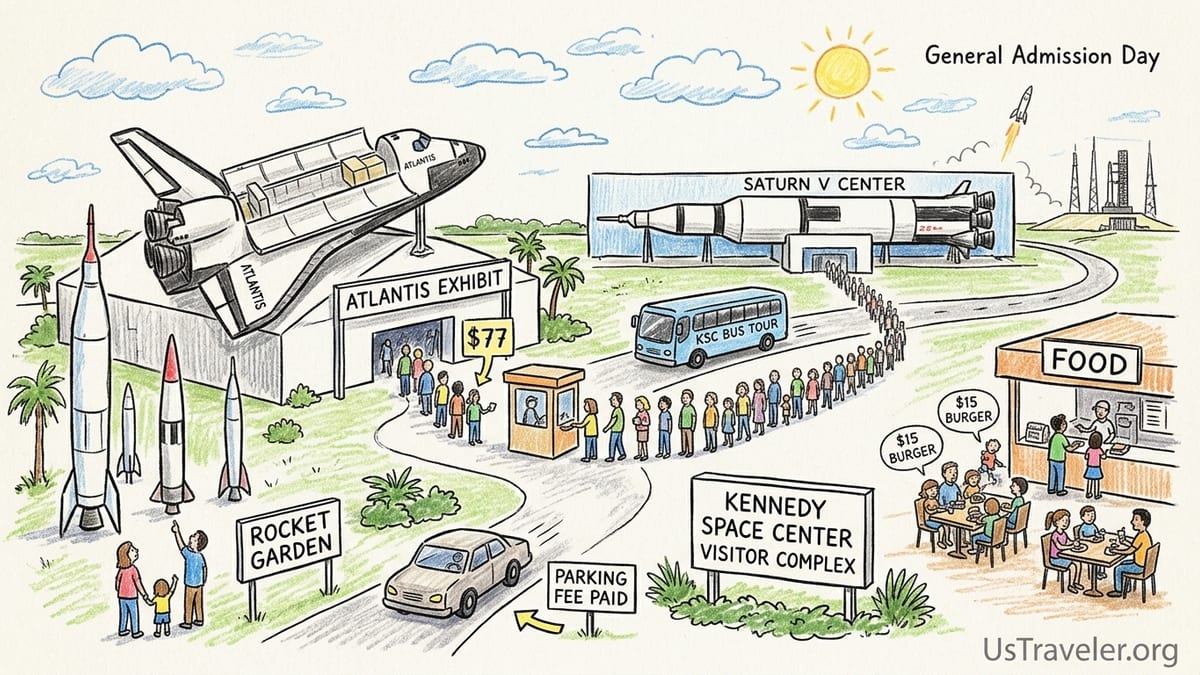
On September 18, 2026, I paid for a full-price adult ticket to Kennedy Space Center Visitor Complex, drove out from Orlando, paid to park, and spent a full operating day trying to experience as much as general admission would reasonably allow. I walked in expecting something close to a behind-the-scenes look at America’s active spaceport: launch pads in the distance, some sense of current NASA work, maybe even a glimpse of SpaceX or Artemis hardware beyond the marketing videos. What I actually found was a carefully curated museum experience wrapped in modern theme-park pricing, where a 77 dollar entrance fee is only the starting point and many of the most tempting elements are fenced off behind upgrades, add-ons, and launch packages that do not always deliver the access their price tags suggest.
The Reality Behind a “General Admission” Day
At the time of my visit, the official gate price for a single-day adult ticket hovered around 77 dollars including tax, with a child ticket listed lower and a two-day option marketed as the way to “experience everything” if one day is not enough. That 77 dollar benchmark is important, because it sets an expectation that you are buying something on par with a full-scale theme park day or a deep science museum experience, and the marketing language strongly leans on the idea that you are visiting an active NASA facility. In practice, what you are buying is access to a self-contained visitor complex plus a standard bus tour out to the Apollo/Saturn V Center, not open-ended access to the space center itself.
From the moment you park, you are reminded that the 77 dollars is only part of the bill. Official parking for a standard car is an extra fee per day, collected at the booth before you even see the entrance plaza. A couple in one vehicle starts the day nearly 200 dollars in before buying a single bottle of water. A family of four with two adults and two children is in the same range once parking is paid and everyone has a ticket. Those numbers matter when crowd levels, line lengths, and real access do not always match the glossy promotional images.
The first surprise many visitors have, and one I heard repeated several times that day in line, is learning that “Kennedy Space Center Visitor Complex” is not the same thing as being turned loose on the NASA center itself. You do not drive through gates into a working launch facility and wander around pads and hangars. Instead, you enter a self-contained attraction operated under license, with tightly controlled access “behind the gates” limited to set routes and specific tours. General admission does include one important behind-the-gates element, the included bus tour to the Apollo/Saturn V Center, but that tour follows a fixed route and does not stop at operating launch pads.
By midday on a non-launch weekday, the complex felt as busy as a regional theme park. Atlantis and Gateway had steady queues, the bus tour line was posted at around 30 minutes and at times stretched longer, and the food court seating was crowded enough that solo travelers circled tables waiting to pounce on a recently vacated chair. That level of crowding might be acceptable at a pure theme park, but when you are paying museum-plus prices for what is fundamentally a museum-heavy day, the pressure on your time becomes a real part of the value equation.
Space Shuttle Atlantis: Brilliant Artifact, Theme-Park Shell
The emotional core of the complex is Space Shuttle Atlantis, and it deserves that place. The orbiter itself is jaw-dropping in person, tilted and displayed as if frozen in orbit, payload bay doors open and Canadarm extended. The pre-show film that culminates in the reveal is slick and effective, and for a moment it feels like the 77 dollar ticket price might be justified by this exhibit alone. The supporting galleries ring the main hall with simulators, hands-on displays, and a memorial to the lost crews of Challenger and Columbia that is respectful and moving.
However, the crowding and noise inside Atlantis undercut the impact. On my visit, the queue for the pre-show was around 20 to 25 minutes in the middle of the day, and the reveal room filled quickly with people rushing to the rail for photos and selfies. Floor markings funneled us past key interpretive displays at a pace that felt more like a ride exit corridor than a science museum gallery. Waiting again for the Shuttle Launch Experience, the motion simulator tucked into the same complex, added another 30 to 40 minutes in line for a few minutes of admittedly well-produced vibration and G-load theatrics.
If you love the Shuttle program, you will probably grit your teeth through the crowd and find your way to quiet moments in front of Atlantis, especially if you time your visit early or late in the day. But if you are measuring value in minutes of meaningful engagement rather than minutes of queuing, it is hard not to notice that the experience has been designed with throughput in mind. The underlying artifact is priceless, but the container around it sometimes feels like a theme park ride queue wrapped around a museum object.
The Shuttle Launch Experience itself is also frequently oversold in marketing materials and third-party brochures. It is a fun, solid motion ride that simulates some of the sounds and sensations of ascent, but it does not deliver anything approaching a real launch, and it inevitably invites comparison with simulators included in the price of other science centers that charge less for admission overall. For visitors sensitive to motion, lines can end with last-minute walkouts, which means time invested without a payoff, yet there is little upfront guidance on intensity beyond a late-arriving safety video.
Saturn V Center, Rocket Garden and Gateway: How Much “Access” Do You Really Get?
The included bus tour from the main complex to the Apollo/Saturn V Center is, on paper, the piece of general admission that takes you closest to the iconic infrastructure of Kennedy Space Center. The buses follow a fixed route along pre-approved roads, passing within viewing distance of structures like the Vehicle Assembly Building and launch pads out on the horizon. Commentary on the onboard screens points out pads and facilities, but windows tint, reflections and the bus motion mean your actual photographs often capture more glare than rocket.
At the Saturn V Center itself, the experience improves dramatically. Inside, the full Saturn V rocket is displayed horizontally, and the galleries around it, including the re-created Firing Room show, do an effective job of putting the Apollo era in context. The exhibit is included with general admission and is, in my view, one of the most genuinely valuable parts of the day. Here, you get relatively close to hardware that defined a generation of exploration, and you have a bit more room to breathe compared to Atlantis. Even so, on my visit, some parts of the center, especially the main food counter, were jammed around lunchtime, and lines for the return bus to the main complex peaked around 20 to 30 minutes.
Back at the main visitor complex, the Rocket Garden is one of the first sights you see after the entry gate, a photogenic cluster of historic rockets rising over landscaped paths. It is atmospheric and great for orientation, yet closer inspection reveals that climbing into capsule replicas and walking beneath hardware is more limited than marketing photography suggests. Much of the sense of scale comes from looking up from a distance rather than exploring around and under every rocket. For many visitors, especially those traveling with children, the Rocket Garden functions as a backdrop for photos rather than a deeply interpretive space.
Gateway: The Deep Space Launch Complex is one of the newest headline additions and features hardware from the commercial spaceflight era alongside interactive exhibits and a multi-theater ride element marketed as a journey to deep space destinations. While the static hardware is compelling, the ride experiences themselves are short, and on busier days the queue management can feel confused, sending you up and down stairs for a few minutes of media that, while immersive, is ultimately still a screen-based attraction. When you factor in time spent in line here along with Atlantis, Shuttle Launch Experience, and the bus tour, your supposedly full day can disappear into a handful of bottlenecked spaces.
Food, Lines and What General Admission Does Not Include
Inside the complex, food and drink prices are firmly in theme park territory, not museum territory. A basic quick-service meal, such as a burger combo or similar, runs in the low to mid-teens per person before tax. Bottled drinks can be several dollars each. For a solo visitor trying to keep costs down, skipping the full meal and grabbing a snack still easily tops 10 to 15 dollars over the day. For a couple, two modest meals and a couple of drinks push the food bill toward 40 dollars without much effort. For a family of four, a single lunch with drinks often lands in the 60 to 80 dollar range, especially if you add a few treats for children.
Lines and crowding exacerbate the feeling of poor value. On my visit, the included bus tour line waxed and waned between virtually no wait first thing in the morning and around half an hour by late morning, stretching longer as more guests funneled toward the loading area. The return line from the Saturn V Center fluctuated in a similar band. Atlantis, Shuttle Launch Experience, and Gateway each had their own queues, so planning the day required tradeoffs: stand in another 30-minute line or skip an advertised experience entirely. None of this is unusual for a popular attraction in central Florida, but combined with a 77 dollar price tag marketed as access to an active spaceport, it begins to dent the value proposition.
Crucially, general admission does not grant unrestricted access to launch complexes, current operational pads, or working processing facilities. You do not roll past a Falcon 9 on the pad at a few hundred meters, nor are you walking under the mobile launcher for Artemis 2. The standard bus tour deliberately keeps you at a respectful distance. Photographs in brochures showing people close to launch towers are either taken from special media locations, limited access tours, or during periods when infrastructure is not active.
Many visitors arrive assuming that simply buying a general admission ticket will let them “see the launch pads up close” or somehow peek into the operational side of modern spaceflight. That expectation is not met. Instead, what you receive is curated storytelling about both historical and current programs, with limited physical proximity to anything that is actually flying today. To cross that line, you have to buy specific add-ons, and even then, the access is narrower than the marketing language might lead you to believe.
KSC Explore Tour and Other Paid Upgrades: When Do They Add Real Value?
Among the most aggressively marketed add-ons is the KSC Explore Tour, a guided bus tour that costs about 30 dollars per adult on top of regular admission. Official descriptions highlight “iconic photographic views” and multiple stops for pictures outside secure areas, with a space expert providing commentary. Compared to the standard bus route, the Explore Tour does offer more time out on the restricted roads and a slightly closer look at selected facilities, and for deep spaceflight enthusiasts, those marginal gains may matter.
The question is whether those incremental benefits justify the extra cost and time for the average visitor. On a normal day, the standard bus included with general admission already takes you past the Vehicle Assembly Building and gives distant views of the two big historic pads on Launch Complex 39. The Explore Tour may get you a little closer to some structures, but you are still not walking around the flame trench of an active pad or standing at the base of a rocket ready to go. You are stepping off the bus into another controlled photo stop, snapping pictures with a telephoto lens, then getting back on.
Because the Explore Tour also consumes a large block of your day, taking it means sacrificing time elsewhere. If your ticket is for a single day, a realistic schedule that includes Explore Tour, standard attractions like Atlantis, Gateway, Heroes & Legends, the Rocket Garden, the free bus to Saturn V, and a proper visit to the Astronaut Memorial starts to feel nearly impossible. You either skim everything or skip marquee experiences, which can make the incremental 30 dollar upgrade feel like a poor trade unless you are already deeply familiar with the rest of the complex.
For that reason, I would only consider Explore Tour good value for a second-day visit, or for returning guests who have already spent one full day working through the core exhibits. In that scenario, a two-day ticket plus Explore Tour can be framed as a deeper dive for serious spaceflight fans. For first-time or one-time visitors, especially families paying for multiple tickets, the marginal closeness to pads against the cost and time investment is a trade I would not recommend.
Launch Viewing Packages and the Fine Print on Scrubs
Another major category of upsell is launch viewing packages, sold separately from or on top of daily admission. These mission-specific packages, branded with names like “Feel the Heat” or similar, advertise the closest public access to launches, often at premium sites such as the Banana Creek viewing area near the Apollo/Saturn V Center. Package prices can climb into the hundreds of dollars per person for high-profile missions, particularly crewed or heavy-lift launches, yet what you are really buying is a specific combination of viewing location, transportation, and sometimes food or souvenirs linked to one mission, not a flexible ticket for any launch.
The scrub policy is where value quickly erodes for visitors with fixed travel plans. Official guidance makes it clear that launch viewing packages are tied to a mission rather than a fixed date and that scrubs can occur at any point before liftoff, sometimes with very little notice. If a scrub or delay is announced before the visitor complex opens for the day, you often have the choice to hold onto your package for the next attempt or, in some cases, request a refund for unused package tickets. Once your ticket has been scanned at the gate, however, the rules tighten significantly, and the ability to get money back is sharply limited.
In more detailed scrub rules, Kennedy Space Center spells out that if a launch attempt is scrubbed after you are already inside and especially within a few hours of the planned liftoff time, you may be entitled to a return visit within a set window to enjoy the exhibits, and your transportation to a viewing site may carry over to the next attempt. What you are not guaranteed is a full cash refund for a day in which you paid launch-viewing-level prices but saw no rocket fly. In short, you are accepting the launch schedule’s inherent uncertainty as your own financial risk.
For travelers who can easily drive back for a second or third attempt, that trade may be acceptable. For those flying in from out of state or abroad with only one or two potential launch days in their itinerary, the value proposition is far shakier. You could pay many hundreds of dollars for a family to attend a specific launch, endure crowds and Florida heat for hours, and still go home with only an admission day under your belt and a promise of future access that you will never use.
Given the number of free or low-cost viewing sites along the Indian River and at nearby parks outside the complex, I found the premium for official launch packages hard to justify unless you absolutely must be as close as public access allows and you have very flexible travel plans. The idea that launch viewing from inside the visitor complex itself without a special package offers great views is also misleading. In some past cases, general-admission viewing areas at the complex provided only distant or partially obstructed views, with better public vantage points available offsite.
Two-Day Tickets, Promotions and Realistic Budgets
Kennedy Space Center sells a two-day admission product that, according to official materials and verified ticket sheets, allows guests to return within several months to see “everything” in more depth. The gate price for two days is higher than a single-day ticket but not double, effectively offering a discount per day for those able to return. On paper, this looks like a solid value booster, because so much of the complex is difficult to cover in one visit. In practice, the usefulness of that second day depends almost entirely on whether you are local or planning to be in central Florida again within the validity period.
For a single adult traveler, a realistic one-day budget looks something like this. One general admission ticket at roughly 77 dollars, parking at just over 10 dollars, a modest lunch and drink at about 18 to 20 dollars, and a small souvenir or coffee later in the afternoon around 10 dollars. That puts the solo visitor at approximately 115 to 120 dollars for a basic day, assuming no paid add-ons. Add the Explore Tour, and you are now around 145 to 150 dollars. Opt for a launch viewing package on a mission with higher pricing, and your total jumps to several hundred dollars before you even consider gas or a rental car.
For a couple driving in from Orlando, the baseline day without extras is closer to 77 dollars times two for admission, plus the parking fee and food for two. That quickly lands in the 230 to 260 dollar range once you factor in basic meals and perhaps a shared souvenir. If both partners decide to add the Explore Tour, the total heads toward 300 dollars. Toss in a mid-tier launch package for a marquee launch, and it is easy to reach 600 dollars or more for a day that still carries a notable risk of ending without an actual liftoff.
A family of four faces the steepest bill. Two adult and two child admissions, plus parking, basic lunch, snacks, and perhaps a small souvenir each, puts a straightforward non-upgraded day into the 350 to 450 dollar range depending on how much you spend on food and extras. If that same family tries to build a trip around an official launch viewing package with bleacher seating, transportation, and included meals, the cost can surge toward four figures, all in service of an event that may or may not happen within their trip window.
Occasional promotions, such as discounts through military ticket offices, local tourism passes, or multi-attraction cards, can soften these numbers slightly, shaving 5 to 20 dollars per ticket in some cases. However, those savings rarely change the structural reality: Kennedy Space Center Visitor Complex is priced and merchandised like a premium theme park experience, while delivering something much closer to a high-end science museum plus a limited bus tour.
The Takeaway
After a full day on site, carefully tracking my own spending and listening to the conversations around me, I came away convinced that Kennedy Space Center Visitor Complex delivers a powerful emotional hit for committed space enthusiasts, but a questionable value proposition for casual visitors paying full price. The highlights are unmistakable. Standing under the real Saturn V and in front of Atlantis are experiences that any spaceflight fan should have once. The storytelling around Apollo and Shuttle, the memorials to lost crews, and the chance to see some commercial hardware up close are deeply compelling.
The problem is that these genuine strengths are wrapped in a pricing and upsell structure that often overshoots the access actually being provided. General admission does not get you close to active pads or current rockets on the pad. The included bus tour is meaningful but distant. The KSC Explore Tour, at around 30 dollars extra per adult, offers only marginally closer views that come at the cost of time you could spend with the exhibits your ticket already includes. Launch viewing packages, while thrilling if the countdown reaches zero, ask families to shoulder most of the risk of Florida weather and technical scrubs, with limited refund options once a ticket has been scanned.
On a personal level, I would not pay for the Explore Tour again on a one-day visit, nor would I recommend launch viewing packages to anyone bound by a fixed travel schedule. I would also think carefully before paying for a two-day ticket unless I lived within easy driving distance or knew I would be back within the allowed return window. For most travelers, the best approach is to treat Kennedy Space Center as a very expensive, one-time museum day: arrive early, prioritize Atlantis and Saturn V, accept that you will not see everything, and budget realistically for food and parking to avoid sticker shock.
Who should spend the money? Serious space fans, especially those who grew up with Apollo or Shuttle and will savor every panel and artifact, are likely to find their own justification for the 77 dollar ticket. Families with children deeply obsessed with space may also see real value, provided they enter with clear expectations about what they will and will not see. Who should think twice? Casual tourists looking for a thrill-ride-heavy day, budget-conscious families comparing this to other Orlando-area attractions, and anyone considering an expensive launch package without flexible dates. For them, the cost to experience a polished, curated version of spaceflight history, while physically close to but not truly inside the modern space program, may feel like money that could have been better spent elsewhere.
FAQ
Q1. Does a standard Kennedy Space Center ticket let me go up to the launch pads?
Ordinary general admission does not provide close access to active launch pads or operational areas. You see pads from a distance on the bus route and from certain vantage points, but you are not driven right up to the base of current rockets or allowed to walk around modern launch towers.
Q2. What exactly is included with the basic 77 dollar adult admission?
The standard adult ticket includes entry to the main visitor complex exhibits such as Space Shuttle Atlantis, Gateway, Heroes & Legends, Rocket Garden, IMAX screenings when offered, and the regular bus tour to the Apollo/Saturn V Center. It does not include premium guided tours, launch viewing packages, or certain add-on experiences that are sold separately.
Q3. How long does the included bus tour take, and what do you actually see?
The included bus tour typically runs as a continuous loop, with the outbound trip to the Saturn V Center taking around 15 to 20 minutes and the return trip a similar length, plus any time you spend exploring the center itself. Along the way you see the Vehicle Assembly Building and some launch complexes from a distance through the bus windows, but you do not stop at active pads.
Q4. Is the KSC Explore Tour worth paying extra for?
The Explore Tour can be worthwhile for serious space enthusiasts or repeat visitors who want slightly closer photographic angles on some facilities, and who have enough time for a longer tour. For first-time, one-day visitors, the extra cost and time commitment usually outweigh the incremental benefit, since you are still limited to controlled stops and distant views.
Q5. How expensive is food inside Kennedy Space Center?
Food pricing is similar to what you would find at other major attractions in central Florida. A basic quick-service meal often costs in the low to mid-teens per person, bottled drinks are several dollars, and a simple family lunch for four can easily land between 60 and 80 dollars depending on choices.
Q6. What happens to my launch viewing ticket if the rocket launch is scrubbed?
Launch viewing packages are tied to a specific mission, not a fixed date, and scrubs are an accepted risk. If a launch is scrubbed before the visitor complex opens, you may be able to hold your package for the next attempt or request a refund for unused package tickets. Once your ticket has been scanned and especially if a scrub occurs close to launch time, you are more likely to be offered a return visit or future viewing opportunity rather than a full cash refund.
Q7. Are two-day tickets a better value than a single-day visit?
Two-day tickets reduce the cost per day and give you more time to see exhibits without rushing, so they can be good value for locals or travelers who know they can return within the validity window. For visitors with only a short stay in central Florida, paying for a second day that you cannot use does not make financial sense.
Q8. How crowded does Kennedy Space Center get, and how much time will I spend in lines?
On typical non-launch days, expect moderate to heavy crowds, especially late mornings and early afternoons. Queue times of 20 to 40 minutes are common for headline experiences such as Atlantis, Shuttle Launch Experience, Gateway ride elements, and the bus tour during busy periods, which means a significant portion of your day can be spent waiting.
Q9. Can I watch a rocket launch from inside the visitor complex without buying a special package?
Sometimes launches are visible from general areas of the visitor complex, but the views can be distant or partially obstructed, and you are not guaranteed commentary or bleacher seating. The closest official public viewing locations with transportation and better sightlines are usually bundled into paid launch viewing packages, which are sold separately from general admission.
Q10. Who is most likely to feel that Kennedy Space Center is worth the money?
Travelers who are passionate about space history, who want to stand in front of Atlantis and Saturn V, and who understand the limits of access before arriving are most likely to feel their money was well spent. Visitors seeking thrill rides, casual tourists with only mild interest in space, or families on tight budgets may find that the cost of tickets, parking, food, and potential upgrades outweighs the benefits of what is essentially a premium-priced museum experience.