


From the Ventura Harbor parking lot, Santa Cruz Island looks deceptively close, a low blue line across the morning haze. My ticket with Island Packers was already in my pocket, a sea-cave kayak reservation with Channel Islands Adventure Company was waiting on the other side, and I had a heavy backpack full of food, water, and gear because, out there, there are no restaurants, no shops, and no second chances if you forget something important. A day trip to Channel Islands National Park is marketed as a quick escape, but it feels much more like stepping off the grid.
Setting Out From Ventura: Tickets, Weather and Expectations
I booked my Santa Cruz Island trip the way most people do, by starting with Island Packers, the authorized ferry concessionaire for Channel Islands National Park. On my visit, the standard round-trip fare from Ventura Harbor to Santa Cruz Island ran just under 70 dollars per adult for Scorpion Anchorage, depending on the exact date and taxes. Prices can shift a bit by season and day of the week, but that ballpark is accurate for most of the current schedule. The ferry ticket covers transportation only. Everything else on the island, from kayaking to camping, layers on top of that base cost.
My boat was a morning departure out of Ventura Harbor. The marine layer sat thick over the coast, classic Southern California “June gloom,” even though my trip was later in summer. Air temperature at departure hovered in the low 60s Fahrenheit with almost no wind in the harbor, but whitecaps were visible farther offshore. That contrast turned out to be the theme of the day. On shore the trip feels like a casual coastal outing. Once you leave the breakwater, it becomes a real open-channel crossing.
Island Packers staff check passengers in at their harbor office well before boarding, and they are serious about punctuality. For my 8:00 a.m. sailing, I was asked to arrive at least 45 minutes early. Checked coolers and large gear went into labeled bins on the dock, while daypacks stayed with us on board. On the manifest for my day, the majority of passengers were heading to Scorpion Anchorage, with a small group ticketed to Prisoners Harbor, the other public landing on Santa Cruz Island that offers very different terrain and far fewer services.
On paper, I expected a pleasant hour-long cruise, some light hiking, a guided kayak tour, and a lazy afternoon on the beach. The reality, as I would learn, is that Channel Islands National Park is still a largely undeveloped, often physically demanding place. There are rangers, signs, and a small visitor center at Scorpion, but there are also steep dirt trails, cold water, no lifeguards, and a complete absence of the usual California coastal comforts like cafés, boardwalks, or paved promenades.
Scorpion Anchorage vs Prisoners Harbor: Choosing Your Landing
Before ever stepping on the boat, I had to decide where to land. Island Packers typically offers two options on Santa Cruz Island: Scorpion Anchorage and Prisoners Harbor. Both are on the same island, but the experience they offer could not be more different. For this trip I chose Scorpion, but I paid close attention to the Prisoners Harbor group because I had debated that option for a more remote hiking day.
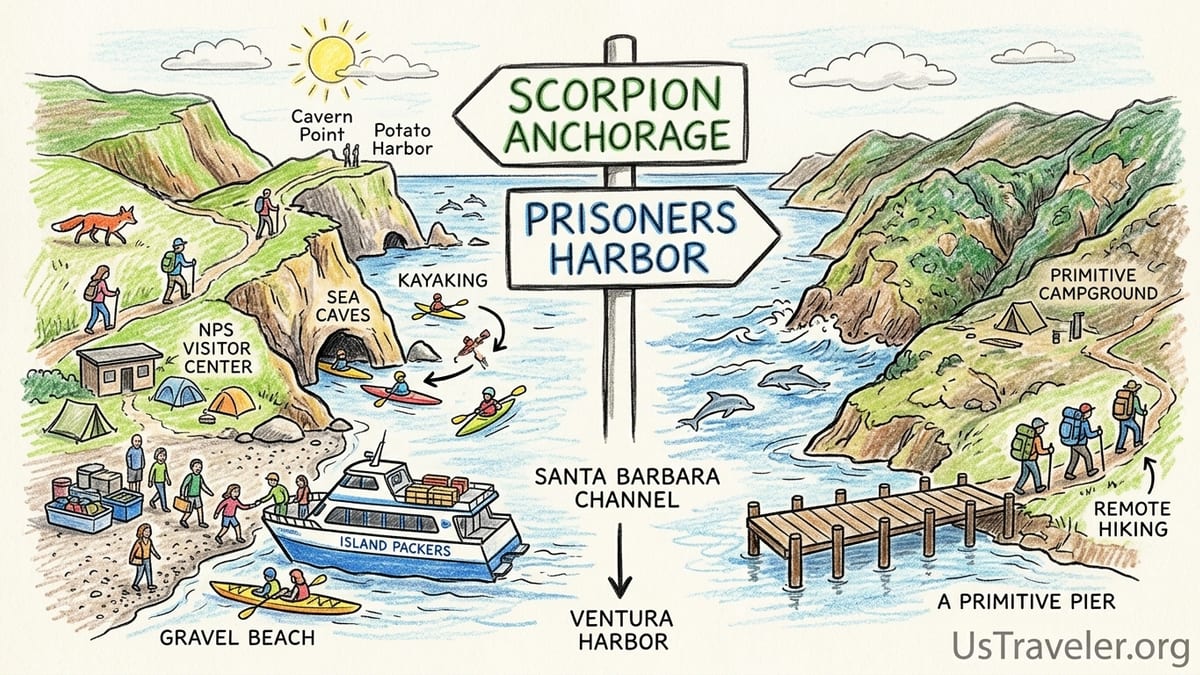
Scorpion Anchorage, on the island’s eastern side, is the main hub for visitors. This is where you will find the small NPS visitor center, Scorpion Canyon Campground, potable water, vault toilets, shade structures, and the base for Channel Islands Adventure Company’s sea cave kayaking and snorkel operations. Trails to Cavern Point, Potato Harbor, and Smugglers Cove all radiate from here, making it ideal for first-time visitors who want a flexible mix of guided and self-guided activities with relatively straightforward logistics.
Prisoners Harbor, by contrast, is much wilder. There is a small pier and a primitive campground uphill from the landing, but there is no potable water and no outfitter presence. Hiking from Prisoners tends to feel more like a backcountry excursion, and trip reports from recent seasons describe it as quieter, less structured, and more demanding in terms of self-sufficiency. Some backpackers hike over from Prisoners to Scorpion on longer trips, but that route requires carrying substantial water weight and being comfortable with long, exposed climbs.
For a single-day visit that included sea-cave kayaking, Scorpion made the only practical sense. Channel Islands Adventure Company operates exclusively from Scorpion Anchorage, and their guided tours are the safest way for first-time visitors to explore the nearby caves. It also meant I could refill water on the island, use the campground taps and toilets, and have multiple short hikes available before and after paddling. If your priority is remote hiking and you are willing to carry every drop of water you need, Prisoners Harbor offers that solitude. If you want a concentrated day of scenery, activities, and basic amenities, Scorpion is the better landing.
The Crossing: Swell, Wildlife and Sea Reality
Once we exited the Ventura Harbor breakwater, the mood on the boat shifted. The marine layer thinned, revealing a low, wind-streaked sky over the Santa Barbara Channel. Swell on my crossing ran in the three to five foot range, with a light chop on top of the rolling seas. Island Packers’ catamarans are stable, but there were still moments of weightlessness as the bow lifted, followed by the solid thump of hull meeting trough. Several passengers made quick use of the seasick bags, and crew members walked the deck offering advice to focus on the horizon.
I had hoped for a classic Channel Islands wildlife show. The crew, who know the crossing intimately, keep an eye out for common dolphins, humpback and blue whales in season, and rafts of seabirds. On my particular trip, we had a more subdued day. A few gulls and brown pelicans tracked the boat for a while, and we passed isolated cormorants sitting on drifting kelp mats. No dolphins surfaced at the bow, and no whale blows broke the horizon. It was a reminder that, even in a biologically rich marine sanctuary, sightings are not guaranteed.
The absence of marquee wildlife actually made it easier to focus on the channel itself. The Santa Barbara Channel has a reputation for rapidly changing conditions. On the outbound leg, winds stayed moderate and we made the crossing in roughly an hour. The captain warned us, though, that afternoon winds often increase, stacking steep chop against the underlying swell. That matters not just for the ride back, but also for anyone planning to kayak or swim. What felt like a manageable ripple at 9:00 a.m. could become a very different sea state by mid-afternoon.
Approaching Santa Cruz Island, the sheer cliffs rose abruptly from the water, streaked with orange lichen and green patches of vegetation. The closer we came, the more obvious it became that there is no soft edge to this park. Aside from the small gravel landing beaches at Scorpion and a few sheltered coves, the island meets the ocean in vertical rock. There are no marinas, boardwalks, or seaside villages waiting for you. When the boat finally swung into Scorpion Anchorage and the crew lowered the metal skiff to shuttle us ashore, it felt less like arriving at a tourist attraction and more like a supply drop.
First Impressions of Scorpion Anchorage: Facilities and Limitations
Landing at Scorpion is a small adventure in itself. Passengers step from the Island Packers boat into a skiff, then from the skiff into the shallows of a cobble-and-sand beach. Wet feet are a given. From there, gear is offloaded in plastic tubs onto the upper beach. Ranger staff and Channel Islands Adventure Company guides meet each arriving boat to give quick briefings and gather groups. It is efficient but decidedly low-frills. There are no paved piers or luggage carts. If you brought it, you carry it.
Scorpion’s infrastructure is concentrated in a short walk from the beach. A dirt path leads past picnic tables and shade structures to vault toilets, a basic NPS visitor center housed in a historic ranch building, and the trailhead signs. Just beyond, the Scorpion Canyon Campground spreads up a shallow canyon with tent sites tucked among eucalyptus and native vegetation. Multiple spigots provide potable water, which is a critical point of contrast with other parts of the island like Prisoners Harbor and Del Norte, where visitors must bring all the water they need.
What Scorpion does not have is equally important. There are no restaurants, snack bars, vending machines, or general stores. The closest thing to retail on the island is Channel Islands Adventure Company’s small gear stand near the beach, where they handle kayak and snorkel equipment for their clients and sell a very limited range of convenience items such as basic sunscreen or simple souvenirs. You cannot rely on buying lunch, coffee, or last-minute hiking supplies on the island. Every calorie and every layer of clothing must arrive with you from Ventura.
Cell service at Scorpion is spotty at best. On my visit, a few people caught weak signals closer to the bluff edges, but I spent the day effectively offline. That has safety implications. You cannot count on using maps, ride-hailing apps, or messaging in an emergency. Navigation on the trails is straightforward thanks to NPS signage and established paths, but if you are used to urban trailheads with real-time weather and service, Scorpion feels distinctly analog.
Sea Cave Kayaking With Channel Islands Adventure Company: Gear, Briefing and Effort
The core of my day was a Discovery level sea-cave kayak tour with Channel Islands Adventure Company, the official kayak guide concessionaire at Scorpion Anchorage. At the time of my trip, their shorter Discovery sea cave tour was priced around 159 dollars per adult, while the longer Adventure tour was listed around 219 dollars per adult. Those prices cover guiding, kayaks, paddles, helmets, life jackets, and wetsuits, but they do not include the Island Packers ferry ticket. When you add roughly 70 dollars for the boat, a Discovery tour day comes out in the neighborhood of 230 dollars per person, and an Adventure tour day around 290 dollars per person, before parking or meals.
Check-in for my mid-morning Discovery tour happened on the beach near the kayak staging area. Guides laid out sit-on-top tandem kayaks, spray jackets, PFDs, helmets, and full-length wetsuits for anyone who wanted extra warmth. The water around Santa Cruz Island stays cool for most of the year, typically in the 50s or low 60s Fahrenheit, so I accepted the wetsuit. After wriggling into neoprene and adjusting helmet straps, we gathered beneath the bluff for a detailed safety briefing.
Guides covered paddle basics, how to steer a tandem kayak, and what to do if we capsized. Sea caves, they emphasized, are inherently hazardous environments. Rockfall, reflected swell, and sudden changes in surge can all cause problems, and conditions sometimes deteriorate during the tour. The company and park policies are clear that entering caves is always at the guide’s discretion. On some days, certain caves are simply off-limits due to swell direction or wave height. That reality check was sobering and reassuring at the same time. The point of the trip is to see the caves, but not at all costs.
Launching was a coordinated shuffle through small breaking waves. Guides stood thigh-deep in the water, holding the kayaks stern-first while paddlers climbed aboard, then gave a hard push between sets. Once beyond the inner surf zone, the paddling rhythm settled. The Discovery tour covers a shorter distance than the Adventure tour, roughly a couple of miles round-trip along the cliffs. Even so, the effort was real. A light northwest swell wrapped into Scorpion, and each time we approached a cave entrance, we had to time our approach between sets so the surge at the opening was manageable.
Inside the Sea Caves: Conditions and Physical Reality
Our guides selected sea caves based on the day’s conditions, so the specific lineup they chose was not guaranteed in advance. We started with a relatively open-sided cavern, paddling through a high-arched entrance where the swell rolled gently but predictably. Inside, the light shifted to an aquatic green, reflecting off the kelp and rock walls. It was noisy but not intimidating, the sort of cave that builds confidence for first-timers. The guides had us pause in the shadowed interior so they could talk about the volcanic origins of Santa Cruz Island and the way wave action slowly carves and enlarges these corridors over millennia.
As the tour progressed, we graduated to tighter slots where reflected waves rebounded off both walls, and the guides had us wait and watch outside before committing. In these caves, timing and teamwork mattered. The lead guide would call, “Paddle, paddle, paddle,” as a lull approached, and we would sprint forward to slip inside before the next set arrived. Even on a day that the guides described as “moderate” swell, the water inside some caves surged several feet up and down the walls. Helmets no longer felt like a formality; they were clearly necessary.
Physically, the Discovery tour demanded steady but not extreme effort. Paddling into the swell required stronger strokes from the bow paddler, while the person in the stern focused on steering and keeping the kayak aligned with the cave entrances and exits. When we turned downwind for the return leg, the paddling grew easier, but several people in the group were noticeably tired. It was easy to imagine how the longer Adventure tour, which spends closer to four hours on the water and visits more distant caves, would push the limits of those unused to upper-body endurance.
We saw harbor seals hauled out on low rocks and a few California sea lions porpoising near the kelp line, but again, this was not a wildlife extravaganza. No one in our group spotted leopard sharks or bat rays in the kelp, and the water clarity, while decent, was a bit clouded by recent wind. The highlight was not a single creature or Instagram-ready moment, but the cumulative experience of moving at sea level along sheer cliffs and ducking briefly into the island’s hollowed-out interior. It was immersive, occasionally nerve-wracking, and very far from a casual rental-boat paddle.
Hiking Above Scorpion: Cavern Point and the Feel of the Island
After returning the kayaks and peeling off wetsuits, I had several hours before the afternoon ferry back to Ventura. That window was just enough time for the signature hike from Scorpion Beach up to Cavern Point and out toward the Potato Harbor overlook, with a relaxed return through the interior bluff trail. This route offers some of the best “introductory” scenery on Santa Cruz without committing to the full, longer trek to Smugglers Cove.
The climb from the beach to Cavern Point is short but steep. A dusty trail switchbacks up from the campground to the cliff edge, where the view opens suddenly onto a panorama of the Santa Barbara Channel, the mainland coast, and the Island Packers boat sitting small in the anchorage below. On my visit, an NPS volunteer naturalist led a free guided walk for anyone interested, pointing out evidence of Chumash settlement and explaining the ongoing fox and vegetation restoration work. Joining that walk, even briefly, helped contextualize what I had just kayaked beneath.
Continuing toward Potato Harbor, the trail follows the cliff edge across rolling grassland, cut by occasional drainages and dotted with low shrubs. The hiking is moderate rather than difficult, but the exposure is significant. There are no railings along the bluff, and inland shade is minimal. I was grateful for a wide-brim hat and the extra liter of water I had debated leaving on the boat. Despite the island’s latitudes, the afternoon sun and wind combine into a dehydrating mix, and it is easy to underestimate how much you will drink over a full day.
Wildlife encounters on the hike were subtle but memorable. I saw several island foxes, Santa Cruz’s famous endemic canids, trotting confidently near the campground and along the lower trail. They are smaller than mainland gray foxes and utterly habituated to human presence. Rangers and signs repeatedly warn visitors not to feed them and to secure food at all times. Their boldness is charming until you watch one test the zipper on an unattended daypack. On the bluffs, red-tailed hawks rode thermals, and swallow-like birds flicked in and out of the cliff faces. It never felt like a zoo, more like an evolving success story of species that have been given space to rebound.
Conservation and the Reality of Limited Services
Channel Islands National Park and the surrounding marine sanctuary exist first as conservation spaces and only second as recreation areas. That hierarchy is obvious once you spend a few hours at Scorpion. Trails are well defined but few in number. There are informational panels about restoration work and sensitive species, but there are no interpretive theaters, souvenir shops, or concession food stands. The absence of typical park tourism infrastructure is not an oversight; it is deliberate.
The island fox program is a prime example. Decades ago, fox populations on several Channel Islands plummeted due to golden eagle predation and other human-related pressures. Intensive recovery work, including captive breeding and the removal of feral species, helped bring the foxes back from the brink. Their current visibility near camp and trail is a conservation success, not a promise of guaranteed sightings. On my day, seeing multiple foxes felt almost casual, but it is the result of long-term management, and visitors are constantly reminded that our responsibility is not to turn them into begging animals.
Marine protection around Santa Cruz Island is equally significant. Waters off Scorpion fall within state and federal marine reserve boundaries, where recreational and commercial fishing are prohibited. Kayak guides talk openly about this during their briefings, explaining that the kelp forests, fish populations, and invertebrate life are all benefiting from reduced extractive pressure. For visitors, it means that activities like fishing must be carefully planned in designated areas away from Scorpion. The payoff is a coastline where, even on a modest-visibility day, the water feels particularly alive.
The trade-off for this conservation focus is inconvenience from a tourist’s perspective. There are no lifeguards on the beaches, no staffed medical station, and no on-island transportation. Injuries, dehydration, and overexposure are handled by rangers where possible, but serious incidents rely on boat or helicopter evacuation that can take time. Every sign on the island pushes the same message: you are responsible for your own safety. That mindset is essential. A misjudged scramble near a cliff edge or an impulsive swim in heavy surf has very different consequences here than in a guarded, urban beach environment.
Hiking Day vs Guided Kayaking Day: Which Feels More Rewarding?
Before the trip, I debated whether to skip kayaking entirely and dedicate the day solely to hiking. After experiencing both, I can say that each approach shapes your understanding of Santa Cruz Island in a different way. A hiking-focused day from Scorpion could easily include the Cavern Point and Potato Harbor loop, plus an out-and-back up Scorpion Canyon or, for very strong hikers with an early boat and late return, the demanding Smugglers Cove route. That kind of day rewards leg endurance, offers broad views, and allows for quieter moments away from the busier beach.
A kayaking day, especially with the Discovery tour, compresses the timeline. Between check-in, gearing up, safety briefing, paddling, and debrief, the tour occupied roughly three to four hours of my time on the island. That left room only for the Cavern Point and Potato Harbor hike at a relatively brisk pace. I did not attempt the longer Smugglers Cove hike, and I had to keep a close eye on the clock to ensure I was back at the beach well before the return ferry boarding window. For visitors who prize unhurried trail time or photography, stacking an Adventure-length kayak tour with ambitious hiking in a single day will feel cramped.
On the other hand, the perspective from sea level is something hiking cannot replicate. Looking back at the Cavern Point cliffs from a kayak, seeing the same trail where I would later walk, framed by vertical rock and swirling kelp, gave the island a three-dimensional feel that a purely land-based visit might lack. The exertion of paddling through caves also created a more visceral connection to the ocean conditions that shape the island’s shoreline. It is one thing to read that swell carves tunnels in volcanic rock; it is another to feel that swell heave under your boat in the half-light of a cave chamber.
If you are deciding between the Discovery and Adventure kayak tours, cost and fitness should be front of mind. The roughly 159 dollar Discovery option, added to the ferry fare, already places the outing into “special trip” territory for many travelers. The approximately 219 dollar Adventure tour, with its longer time on the water, is likely best for those who arrive with solid paddling stamina and who are comfortable dedicating the majority of their day to the sea. For a first visit, especially if you also want to hike, the Discovery tour struck a better balance. If I return, I might choose an all-hiking day or the Adventure tour paired with a shorter bluff walk, rather than try to do everything at once again.
The Takeaway: Costs, Mistakes and Whether One Day Is Enough
By the time the afternoon Island Packers boat appeared off Scorpion and the ranger called for boarding, the wind had picked up and whitecaps flecked the channel. The return ride was rougher, and more passengers succumbed to seasickness. Back on the mainland, shoes still sandy and hair crusted with salt, I tried to tally what the day had really entailed. The direct expenses were straightforward. Between the roughly 70 dollar round-trip ferry ticket and about 159 dollars for the Discovery sea cave tour, I spent just over 230 dollars before factoring in parking, gasoline, and food I had brought from home. The Adventure tour alternative would have raised the on-island activity cost to around 219 dollars, pushing the total day toward 290 dollars per person.
The non-monetary costs were equally real. A full day on Santa Cruz Island involves repeated lifting and carrying of gear, exposure to sun and wind, walking on uneven surfaces, and, if you choose to kayak, periods of intense upper-body exertion and cold-water splashes. For me, these were welcome challenges. For someone expecting a casual beach picnic, they might come as an unpleasant surprise.
I made a few clear mistakes. First, I underestimated how much water I would want. Knowing that Scorpion had potable water taps, I brought only two liters from Ventura. That was technically enough, but I ended the day rationing sips on the hike back from Potato Harbor. If I could redo it, I would carry at least three liters, refilling at the campground before starting any longer hike. Second, I cut my pre-boat grocery stop too close, relying on a small mainland market instead of packing more thoughtfully at home. Given that there is no food for sale on the island, this was an unnecessary stress point that could have gone badly if the shop had been short on ready-to-eat options.
Finally, I tried to fit too much into a single day. Between the round-trip crossing, Discovery kayaking, and the Cavern Point / Potato Harbor loop, I felt like I was moving from one agenda item to the next without much idle time just to sit and watch the light change on the cliffs. One day was absolutely enough to get a compelling first impression of Santa Cruz Island and Scorpion Anchorage, but it was not enough to feel unhurried.
Would camping make for a more rewarding experience? In my view, yes, if you are comfortable with basic facilities and prepared for island logistics. A night at Scorpion Canyon Campground would allow time for both extensive hiking and a kayak tour on separate days, with early morning and late afternoon light on the bluffs that day-trippers rarely see. It would also give space for weather and swell variability; if one day turned rough on the water, you could pivot to hiking and try paddling another day. For visitors with only a single day, though, a focused choice between a dedicated hiking itinerary or a carefully selected kayak tour, backed by realistic expectations and sufficient supplies, will still deliver the essential truth of Channel Islands National Park: close to mainland California, but very far from ordinary.
FAQ
Q1. How much does a Santa Cruz Island day trip from Ventura really cost?
For most visitors landing at Scorpion Anchorage, you can expect to pay around 70 dollars per adult for a round-trip Island Packers ferry ticket from Ventura Harbor, plus any on-island activities. A Discovery-level sea cave kayak tour with Channel Islands Adventure Company is currently around 159 dollars per adult, while the longer Adventure tour is about 219 dollars. When you add the ferry, a Discovery kayak day comes out around 230 dollars per person and an Adventure kayak day around 290 dollars, before parking, fuel, and the food you bring from home.
Q2. What are the main differences between Scorpion Anchorage and Prisoners Harbor?
Scorpion Anchorage is the primary visitor hub on Santa Cruz Island. It has a campground with potable water, vault toilets, a small NPS visitor center, established hiking trails to Cavern Point, Potato Harbor, and Smugglers Cove, and it is the base of operations for Channel Islands Adventure Company’s guided sea cave kayaking and snorkel tours. Prisoners Harbor is far more primitive, with a small campground but no potable water and no commercial outfitter. Hiking there feels more remote, and it is better suited to self-sufficient backpackers than first-time day-trippers who want guided activities and easier logistics.
Q3. Are there any restaurants or stores on Santa Cruz Island?
No. There are no restaurants, cafés, snack bars, vending machines, or general stores anywhere on Santa Cruz Island. The only minor exception is that Channel Islands Adventure Company maintains a small gear stand at Scorpion Anchorage where they provide kayak and snorkel equipment for their clients and sell a very limited range of convenience items. You cannot rely on buying meals, coffee, or significant supplies on the island. All food, drinking water (except what you may refill at Scorpion), and clothing layers need to come with you on the ferry from Ventura.
Q4. Is sea-cave kayaking safe for beginners?
Sea-cave kayaking at Santa Cruz Island is designed to be accessible for beginners, but it is still an adventure activity in a dynamic ocean environment. Guided tours with Channel Islands Adventure Company include instruction, safety briefings, helmets, life jackets, and wetsuits, and guides choose which caves to enter based on swell and wind conditions. Capsizes are possible, and paddlers must be comfortable in cold water, able to follow directions, and ready for moderate to strenuous upper-body effort. There are no lifeguards, and cave entry is never guaranteed; guides may skip certain caves entirely if conditions are not safe.
Q5. How much hiking can I realistically do on a kayak day trip?
If you combine the Discovery sea-cave tour with a day trip from Ventura, you will typically have time for one solid hike, such as the Cavern Point and Potato Harbor loop, in addition to paddling. The Discovery tour, including gearing up and debriefing, can take three to four hours out of your on-island window. The longer Adventure tour, closer to four hours on the water, usually leaves room only for shorter bluff walks before you must be back for the ferry. If your priority is longer routes like Smugglers Cove, it is better to plan a hiking-only day or to stay overnight at Scorpion Canyon Campground.
Q6. What should I pack for a day trip to Santa Cruz Island?
At a minimum, bring enough food for the entire day, at least two to three liters of water per person, sun protection, sturdy closed-toe shoes, a warm layer for wind, and a small first-aid kit. If you are kayaking, quick-drying clothing that fits comfortably under a wetsuit is ideal, along with a hat that can be secured. Because there are no stores or restaurants on the island, simple extras like extra snacks, a backup water bottle, or a light rain shell can make a big difference. A dry bag or waterproof case for your phone and camera is also useful given the wet landings and potential for splashes.
Q7. Can I visit Santa Cruz Island without joining a tour?
Yes. Your only mandatory booking is transportation with Island Packers or another authorized carrier. Once on the island, you are free to hike the established trails, picnic, and explore the Scorpion area on your own within marked boundaries. Guided sea-cave kayaking and snorkel tours with Channel Islands Adventure Company are optional add-ons. Many visitors choose a purely self-guided hiking day to keep costs down or to enjoy more flexible pacing. Even without a tour, you will still need to bring all food, most of your water, and suitable gear because there are no traditional visitor services on the island.
Q8. How rough is the ferry ride between Ventura and Santa Cruz Island?
The crossing typically takes about an hour, but sea conditions can vary dramatically. On calm days, the ride feels relatively smooth and may include wildlife sightings like dolphins or whales, though those are never guaranteed. On windier days or with larger swell in the Santa Barbara Channel, the boat can pitch and roll enough that seasickness is common. Island Packers provides sick bags and crews offer advice, but anyone prone to motion sickness should consider taking preventative medication, sitting on the open deck where they can see the horizon, and avoiding heavy meals just before departure.
Q9. Is one day on Santa Cruz Island enough, or should I camp?
One day is enough to gain a strong first impression of Santa Cruz Island, especially if you focus either on hiking from Scorpion Anchorage or on a single guided sea-cave kayak tour plus a shorter hike. However, the schedule will feel compressed, and you may leave wishing for more unstructured time. Camping at Scorpion Canyon Campground for one or more nights allows you to separate kayaking and longer hikes into different days, enjoy sunrise and sunset light on the bluffs, and have more flexibility to adapt to changing weather and ocean conditions. The trade-off is carrying camping gear, dealing with simple facilities, and planning more carefully for food and water.
Q10. What are the biggest mistakes first-time visitors make?
Common missteps include underestimating how much water and sun protection they will need, assuming there will be food or gear for sale on the island, overloading a single day with both long hikes and the longest kayak tour, and arriving at the Ventura Harbor too close to departure time. Some visitors also underestimate the effort involved in sea-cave kayaking or the potential for seasickness on the ferry. Planning conservatively, packing as if there were no services at all, and choosing a realistic mix of activities for your fitness level will go a long way toward making a Santa Cruz Island day trip both safe and rewarding.