


Northeast Florida, often branded as Florida’s First Coast, stretches from the Georgia state line south toward Daytona Beach and combines wide Atlantic beaches, a deep sense of history, and an easygoing, less crowded feel than much of the state. For first-time visitors, the region’s main vacation zones link together along coastal Highway A1A and Interstate 95, making it simple to mix a historic city stay in St. Augustine with time on Amelia Island’s dunes, a Jacksonville urban break, or a quieter escape in Palm Coast and Flagler Beach.
Where Is Northeast Florida and What Is Florida’s First Coast?
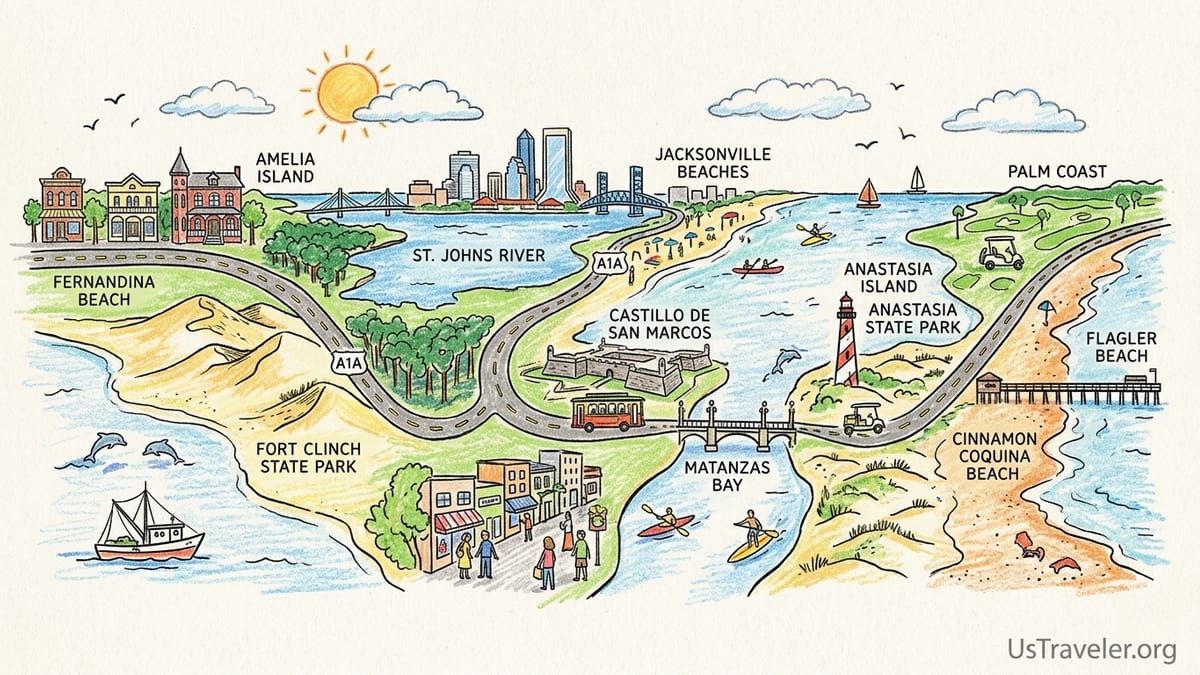
Northeast Florida covers the Atlantic corner of the state around Jacksonville, running roughly from Fernandina Beach and Amelia Island at the Georgia border down through Jacksonville, Ponte Vedra Beach, St. Augustine and Anastasia Island, and on to Palm Coast and Flagler Beach. Local tourism boards and many residents use the phrase Florida’s First Coast for this stretch, a nod both to the region’s early colonial history and to the idea that it was one of Florida’s first major resort areas. In practical terms, when travelers talk about the First Coast they usually mean exactly this line of coastal communities and barrier islands anchored by Jacksonville and St. Augustine.
The region is compact enough that its main hubs sit within about a two-hour drive of one another. Jacksonville to St. Augustine is about 45 minutes by car in normal traffic, while Jacksonville to Amelia Island is roughly 30 to 45 minutes depending on route. St. Augustine to Palm Coast and Flagler Beach is approximately 45 minutes to an hour. This close spacing makes it realistic for first-time visitors to experience more than one destination in a single trip without turning their vacation into a road marathon.
What sets Northeast Florida apart from South Florida or the Gulf Coast is the combination of wide, often less developed beaches, major historic sites like Castillo de San Marcos in St. Augustine, and extensive marshes, rivers and state parks. The coastline features high dunes in places such as Amelia Island and stretches of coquina sand and cinnamon-colored beaches near Flagler Beach. Inland from the shore you will find tidal wetlands, maritime forests and the broad St. Johns River flowing through Jacksonville, giving travelers options that range from kayaking and birdwatching to urban dining and shopping.
For planning purposes, it helps to think of Northeast Florida as a chain of overlapping visitor zones: Amelia Island and Fernandina Beach to the north, Jacksonville and the Jacksonville Beaches including Atlantic and Neptune Beach, the upscale golf and resort enclave of Ponte Vedra, the historic core around St. Augustine and Anastasia Island, and finally the quieter Palm Coast and Flagler Beach extension. Each of these areas has its own personality, lodging styles and price range, but they are linked by A1A and I‑95, so you can combine them in a single itinerary if you choose your bases thoughtfully.
Amelia Island & Fernandina Beach: Victorian Charm and Quiet Dunes
Amelia Island is the northernmost barrier island on Florida’s Atlantic coast and sits just below the Georgia line. The city of Fernandina Beach on the island’s north end has a preserved historic district with blocks of Victorian-era buildings now housing boutiques, ice cream shops and cafés. Visitors often combine mornings on the beach with afternoons strolling Centre Street, browsing independent bookstores, and stopping into casual seafood spots for shrimp fresh from the local boats.
The island’s beaches run for about 13 miles, with soft sand fronted by substantial dunes in many areas. Main Beach Park near Fernandina is a typical first stop, with parking, restrooms and playground equipment. More nature-focused travelers gravitate to Fort Clinch State Park at the island’s northern tip, where a 19th-century brick fort looks over the inlet and undeveloped shoreline. The park offers fishing piers, shaded bike paths and a beach that feels wilder than many in Florida, especially on weekdays outside peak summer.
On the oceanfront south of the historic district you will find a mix of condo-style rentals and full-service resorts, including high-end properties with golf courses and spa facilities. These resorts often price rooms in the mid to upper range of Northeast Florida, especially in March and April or over summer holiday weeks, while older motels and vacation rentals farther from the water can be more budget-friendly. Kayak tours through the back-island marshes typically run half a day and give first-timers a good look at the tidal creeks, with chances to see wading birds, dolphins and sometimes manatees in warmer months.
For many travelers, Amelia Island works best as a quieter bookend to a broader First Coast trip. Because it sits only about half an hour’s drive from Jacksonville International Airport, it is convenient to fly into JAX, spend a few days on Amelia’s beaches and then drive south along A1A to Jacksonville, Ponte Vedra and St. Augustine. If you are short on time, Amelia can also stand alone as a three- or four-night stay focused on walking the historic town, visiting Fort Clinch, riding horses on the beach with outfitters who operate permitted tours, and making at least one day trip down the coast.
Jacksonville & The Jacksonville Beaches: City Energy Meets Surf Towns
Jacksonville is the region’s urban anchor and one of the largest cities in the southeastern United States, spread along the St. Johns River. For visitors, the city offers a mix of cultural attractions, including the Cummer Museum of Art & Gardens on the riverfront, the Museum of Science & History near the downtown Southbank, and neighborhoods like Riverside and San Marco with independent restaurants and craft breweries. Many travelers who come for the beaches still make time for a day or evening in town, especially if a concert, sports event or festival coincides with their visit.
East of the city along the Intracoastal Waterway, the Jacksonville Beaches stretch across the barrier island locals simply call “the Beaches.” The main communities are Atlantic Beach, Neptune Beach and Jacksonville Beach, each with its own flavor. Atlantic and Neptune have a more village-like feel with low-rise buildings and a cluster of restaurants around the Beaches Town Center. Jacksonville Beach has a livelier strip with oceanfront hotels, bars and a fishing pier, popular with younger visitors and families who want a built-up beach atmosphere without the intensity of South Florida.
The beaches here are wide and generally flat, with light-colored sand and lifeguards at popular access points in season. Parking near the water is often metered or in paid lots, so first-time visitors should factor that into their budget and arrive earlier on busy spring and summer weekends. Surf lessons, beach rentals and casual places for fish tacos or shrimp baskets are easy to find a short walk from most public access points. Compared with quieter St. Johns County beaches to the south, Jacksonville Beach in particular can feel busy, especially when surf conditions are good.
Because Jacksonville sits at the crossroads of I‑10 and I‑95, it is a natural starting or ending point for First Coast road trips. Many visitors fly into Jacksonville International Airport, spend one or two nights downtown or at the beaches, and then continue to other coastal towns. Others base themselves entirely at the beaches and treat Jacksonville’s neighborhoods, riverfront parks and sports venues as day-trip options. For a first visit focused on variety, combining two nights in the city or at the beaches with three or four nights farther south in St. Augustine or Palm Coast works well.
Ponte Vedra: Golf, Upscale Resorts and Quiet Sand
South of Jacksonville Beach but still within easy driving distance of the city, Ponte Vedra Beach is known for manicured neighborhoods, quiet residential stretches of sand and high-profile golf courses. The area hosts the Players Championship at TPC Sawgrass, and golfers frequently plan trips around tee times at the Stadium Course or neighboring resort layouts. Even if you do not play, the presence of dedicated golf travelers influences the local lodging scene, which leans toward full-service resorts and higher-end vacation rentals.
The beachfront in Ponte Vedra is less built up than many visitors expect. Much of the oceanfront is lined with homes rather than large hotels, and public access points such as Mickler’s Landing provide a way for day visitors to enjoy the sand. The beaches here tend to be quieter than Jacksonville Beach, especially outside of holiday periods, which makes them appealing for travelers who want a more residential, low-key atmosphere. Parking at Mickler’s is free but can fill up on sunny weekends, so arriving earlier in the day is wise in peak seasons.
Inland from the ocean, Ponte Vedra offers a cluster of resort properties with spa facilities, tennis courts and golf packages. Prices often spike during major tournaments and in winter when Northeastern snowbirds head south, so first-time visitors on a budget may want to look at shoulder seasons such as late April, early May or late September. Dining runs from casual seafood shacks along A1A to white-tablecloth restaurants inside the larger resorts, giving couples and families options for both simple post-beach meals and special-occasion evenings.
For planning, Ponte Vedra works well as a base if your top priorities are golf, spa relaxation and quieter beach time within a short drive of both Jacksonville and St. Augustine. It sits about 30 minutes south of the Jacksonville Beaches and roughly 30 minutes north of downtown St. Augustine via A1A. That makes it realistic to spend a day exploring St. Augustine’s historic district, another day at Jacksonville’s museums or zoo, and still come home to a resort pool and uncrowded stretch of sand.
St. Augustine & Anastasia Island: America’s Oldest City and Beach Breaks
St. Augustine markets itself as the oldest continuously occupied European-founded city in the United States, with a compact historic core facing Matanzas Bay. For first-time visitors to Northeast Florida, this is usually the must-see stop, especially for those interested in history or architecture. The pedestrian-friendly streets around the Castillo de San Marcos, the Cathedral Basilica, and Flagler College are lined with stone walls, courtyards and a mix of historic buildings and newer shops. Popular activities include touring the 17th-century fort, climbing the lighthouse across the inlet, and joining a guided walking tour or trolley route for context on the city’s Spanish and British eras.
Just across the Bridge of Lions from downtown, Anastasia Island holds much of the area’s beach-focused lodging. Anastasia State Park preserves wide, dune-backed sands and is one of the region’s best examples of relatively undeveloped beachfront within minutes of a historic city center. A few miles south, St. Augustine Beach offers a more classic beach-town feel with condo rentals, modest motels, casual restaurants and a fishing pier. This combination allows travelers to spend mornings exploring museums and historic sites, then retreat across the bridge for relaxed afternoons in the surf.
St. Augustine has a wide range of accommodations, from bed-and-breakfast inns in restored buildings to national-brand hotels along US‑1 and A1A and family-oriented condo complexes at the beach. Prices vary widely by season. Late December through March, as well as special events such as the Nights of Lights holiday display, can push room rates higher, while midweek visits in early fall often bring more moderate prices. Families often appreciate that attractions like the Alligator Farm Zoological Park on Anastasia Island, pirate-themed museums and boat tours on the bay keep children engaged between historic sites.
For a first-time First Coast itinerary, many travelers give St. Augustine at least two full days: one focused on the historic core and fort, and another that balances time at Anastasia State Park or St. Augustine Beach with a lighthouse visit and perhaps a sunset cruise. From here, you can easily drive 45 minutes north to Ponte Vedra and Jacksonville or 45 minutes south to Palm Coast and Flagler Beach. Those who prefer to keep driving to a minimum can simply base in St. Augustine or on Anastasia Island for an entire week, taking optional day trips up or down the coast as interest and weather allow.
Palm Coast & Flagler Beach: Laid-Back Extension of the First Coast
South of St. Augustine, the coastline transitions into Palm Coast and Flagler Beach, a quieter extension of Northeast Florida that still shares much of the First Coast’s character. Flagler Beach is a low-rise town centered around a fishing pier and a strip of small restaurants, surf shops and motels. The sand here often has a warm, cinnamon hue due to crushed coquina shell, and the oceanfront highway runs very close to the water, so you are rarely far from a sea view. Visitors who find Jacksonville Beach or parts of St. Augustine too busy often appreciate the slower pace and smaller scale in Flagler Beach.
Palm Coast, just inland, is a planned community with a patchwork of residential neighborhoods, golf courses and natural preserves. For travelers, it offers a collection of chain hotels along I‑95, villa and condo rentals in gated communities near the Intracoastal Waterway, and a handful of oceanfront resorts. Nearby state parks and preserves, such as Washington Oaks Gardens, add walking trails and riverfront picnic areas to the mix, while the beach parks north and south of Flagler Pier give access to less crowded stretches of sand with basic facilities.
The Palm Coast and Flagler Beaches area often attracts visitors looking for good value along the Atlantic. Lodging prices here can be lower than in Amelia Island or Ponte Vedra, especially outside school holidays, and parking at beach accesses is generally free or inexpensive. Dining leans toward casual, with seafood shacks, breakfast cafés and a growing number of independent spots that draw both locals and visitors. While there is nightlife, it is far more subdued than in Daytona Beach to the south, reinforcing the area’s family-friendly, low-key identity.
In the context of a First Coast trip, Palm Coast and Flagler Beach can serve as the southern anchor, especially for travelers driving up from Central Florida theme parks who want to finish with a few quieter days by the ocean. From St. Augustine Beach to Flagler Beach, the oceanfront drive along A1A is one of the most scenic in the region, hugging dunes and offering frequent pulloffs. It is entirely realistic to base here and take a day trip north to St. Augustine’s historic district, as the drive usually runs under an hour each way in normal conditions.
Nature, Golf, Family Activities and Where to Stay
Across Northeast Florida, nature experiences are never far from the main resort zones. On the northern end, Little Talbot Island and Big Talbot Island State Parks between Jacksonville and Amelia protect beaches, maritime forests and the driftwood-strewn “boneyard” shoreline that photographers love. Fort Clinch State Park on Amelia adds maritime hammock trails and shaded campgrounds to its historic fort. To the south, Anastasia State Park near St. Augustine and the coastal preserves around Palm Coast and Flagler Beach provide more options for birdwatching, paddleboarding and walking among dunes and coastal scrub.
Golf is a major draw throughout the region, but especially in Ponte Vedra and Amelia Island, where resort courses sit close to the ocean and marsh. The Players Championship at TPC Sawgrass puts Ponte Vedra firmly on the golf map, and many visiting golfers pair tee times there with rounds at other nearby courses. On Amelia Island, resort complexes bundle golf with spa and dining, making it easy for couples or groups to split days between the fairways and the pool. Farther south, Palm Coast has its own set of courses set among pine forests and waterways, often at price points lower than the higher-profile north.
Families find that the First Coast offers a softer-edged Florida experience than major theme park areas while still providing plenty to do. In addition to safe swimming beaches with lifeguards at popular spots, children can explore the hands-on exhibits at Jacksonville’s Museum of Science & History, watch gators and exotic birds at the St. Augustine Alligator Farm, clamber around the decks of replica ships in St. Augustine’s historic attractions, or take beginner surf lessons in places like Jacksonville Beach and St. Augustine Beach. Simple pleasures, such as crabbing from docks, watching shrimp boats at work, or hunting for shells near the tides, remain key parts of many family itineraries.
Accommodation across the region ranges from campground loops and state park cabins to oceanfront condominiums, boutique inns and large resorts. Budget travelers might choose older motels along US‑1 near St. Augustine or national-brand hotels around Jacksonville’s airport and I‑95 interchanges, then drive to the beach each day. Midrange options often include condo rentals in St. Augustine Beach, family-run motels in Flagler Beach, and mainstream beach hotels in Jacksonville Beach. Those seeking a splurge can look to full-service resorts on Amelia Island and in Ponte Vedra or historic inns in downtown St. Augustine housed in restored buildings with courtyards and on-site dining.
Airports, Driving Logistics and How Many Destinations to Combine
For most first-time visitors arriving by air, Jacksonville International Airport is the primary gateway. The airport sits north of downtown, with rental car counters in-terminal and major chain hotels close by for late arrivals. From JAX, driving to Amelia Island takes about 30 to 45 minutes, depending on traffic and route; reaching Jacksonville Beach typically takes 35 to 45 minutes; and St. Augustine lies roughly an hour to the south via I‑95 or the more scenic US‑1 and A1A combination. Smaller general-aviation airports exist around the region, but for commercial flights JAX is the practical choice.
The coastal A1A highway runs as a scenic spine for much of the First Coast, although it is broken by inlets that require bridges or short highway detours. Many travelers choose to follow A1A at least for the sections between Mayport and St. Augustine or from St. Augustine Beach to Flagler Beach, where the road arcs just behind dunes and the Intracoastal Waterway. Interstate 95, farther inland, provides the fastest north-south link for longer legs, such as driving from Palm Coast back to Jacksonville to catch a flight. Rental cars are the norm; while limited public transportation exists, it is not designed for comprehensive coastal sightseeing.
When deciding how many destinations to include, it helps to match your time frame and travel style. With three or four nights, most first-time visitors pick one primary base, such as St. Augustine or Amelia Island, and add only short day trips. With a week, it becomes realistic to spend three nights on Amelia Island, three nights around St. Augustine or Palm Coast, and treat Jacksonville and Ponte Vedra as day-trip targets along the way. Trying to sleep in a different town every night tends to feel rushed, especially in summer when afternoon thunderstorms or beach traffic can add time to drives.
Weather on the First Coast is generally warm and humid from late spring through early fall, with peak summer bringing hot afternoons and frequent short thunderstorms. Ocean water is usually comfortable for swimming from about late April into October, warming earlier than parts of the Mid-Atlantic but staying cooler than South Florida’s tropical waters in midwinter. Room rates typically follow demand, rising for school holidays, long weekends and special events. Travelers with flexibility often find that late April and October provide a good balance of pleasant weather, moderate water temperatures and lighter crowds, making it easier to explore multiple destinations in a single trip.
FAQ
Q1. What exactly counts as Florida’s First Coast for travelers?
The First Coast commonly refers to the stretch of Northeast Florida that includes Amelia Island and Fernandina Beach, Jacksonville and the Jacksonville Beaches, Ponte Vedra, St. Augustine and Anastasia Island, and then south toward Palm Coast and Flagler Beach. Some definitions extend a bit farther inland, but most visitors experience it as this chain of towns and barrier islands along the Atlantic.
Q2. Is it realistic to visit Amelia Island and St. Augustine in one trip?
Yes. The drive between Amelia Island and St. Augustine typically takes around an hour and a half using a mix of highways and coastal roads, so it is practical to spend three nights on one end and three on the other in a weeklong trip. Many visitors fly into Jacksonville, start on Amelia Island for a quieter beach stay, then road-trip down A1A with a stop in Jacksonville or Ponte Vedra on the way to St. Augustine.
Q3. Which area is best for a first-time visitor without a car?
St. Augustine and Anastasia Island usually work best if you prefer to minimize driving or forgo a car. The historic district is compact and walkable, many tours depart from central points, and ride-hail services can connect you with beach areas on Anastasia Island. That said, having at least occasional access to a car or shuttle makes reaching state parks and more remote beaches much easier anywhere on the First Coast.
Q4. How do Jacksonville’s beaches compare with St. Augustine Beach or Flagler Beach?
Jacksonville Beach, Atlantic Beach and Neptune Beach offer wide sands close to a denser strip of restaurants, bars and midrise hotels, so they feel livelier and more urban. St. Augustine Beach blends resort-style condos and motels with a relaxed, family feel, while Flagler Beach is smaller and more low-rise, with a classic pier, roadside cafés and fewer large hotels. If you want lots of nightlife, Jacksonville Beach is strongest; for a quieter, retro atmosphere, Flagler Beach usually fits better.
Q5. When is the best time of year to visit Northeast Florida?
Weather and crowds vary, but many travelers favor late April, May, late September and October. During these shoulder seasons, ocean temperatures are often comfortable for swimming, humidity is more manageable than midsummer, and room rates and crowds can be lighter than during school holidays. Winter brings mild air temperatures but cooler water, which is fine for sightseeing-focused trips that prioritize St. Augustine’s historic sites or golf over swimming.
Q6. Are Northeast Florida’s beaches good for families with young children?
Yes, many First Coast beaches are family-friendly, with gentle slopes into the water and lifeguards at popular access points during peak seasons. Places like Main Beach on Amelia Island, Jacksonville Beach, St. Augustine Beach and the areas around Flagler Pier typically have nearby playgrounds or family-oriented amenities. Parents should still watch surf conditions, respect flag warnings and be prepared for strong sun and occasional jellyfish in warmer months.
Q7. Is a visit to Jacksonville itself worth adding if I mainly care about the beach?
For travelers who enjoy museums, riverfront walks, sports events or food-focused neighborhoods, a night or full day in Jacksonville can be a rewarding addition. The city offers attractions like the zoo, the Cummer Museum of Art & Gardens and lively districts such as Riverside and San Marco. If your time is very limited and you prefer a smaller-town atmosphere, you may opt to focus that time on St. Augustine, Amelia Island or Flagler Beach instead.
Q8. How expensive are accommodations along the First Coast compared with South Florida?
In general, Northeast Florida tends to be somewhat more affordable than marquee South Florida destinations, especially outside of peak holiday periods. High-end resorts in Amelia Island and Ponte Vedra can reach similar nightly rates to upscale properties farther south, but many midrange motels, condo rentals and chain hotels in St. Augustine, Jacksonville and Palm Coast often price lower than equivalents in Miami or Fort Lauderdale during the same season.
Q9. Do I need to rent a car, or can I rely on ride-hailing and taxis?
Renting a car is strongly recommended if you want to explore multiple destinations or reach state parks and quieter beach accesses. Ride-hailing services operate in the major towns, but distances between them can be significant, and public transportation along the coast is limited. A car makes it far easier to follow scenic A1A routes, stop at viewpoints and small towns, and adjust plans around weather or traffic.
Q10. How many days should a first-time visitor plan for Northeast Florida?
With three or four days, you can get a good taste of a single base, such as St. Augustine and Anastasia Island, with perhaps a short day trip to nearby beaches or parks. With a full week, most travelers comfortably combine two or three areas, for example starting with two or three nights on Amelia Island, then moving south for three or four nights around St. Augustine or Palm Coast, using Jacksonville and Ponte Vedra as flexible day-trip options along the way.