


Northeast Florida’s Atlantic coastline strings together a surprisingly varied set of beach towns and historic neighborhoods, all within roughly a two-hour drive of one another. From the Victorian seaport of Fernandina Beach on Amelia Island to the family condos of Palm Coast and the old-Florida feel of Flagler Beach, this stretch of coast rewards travelers who slow down, mix city days with quiet island time, and treat A1A as a scenic route rather than a raceway. Jacksonville, Amelia Island and St. Augustine are the region’s primary anchors, with smaller beach communities working best as side trips or stops on a coastal road journey.
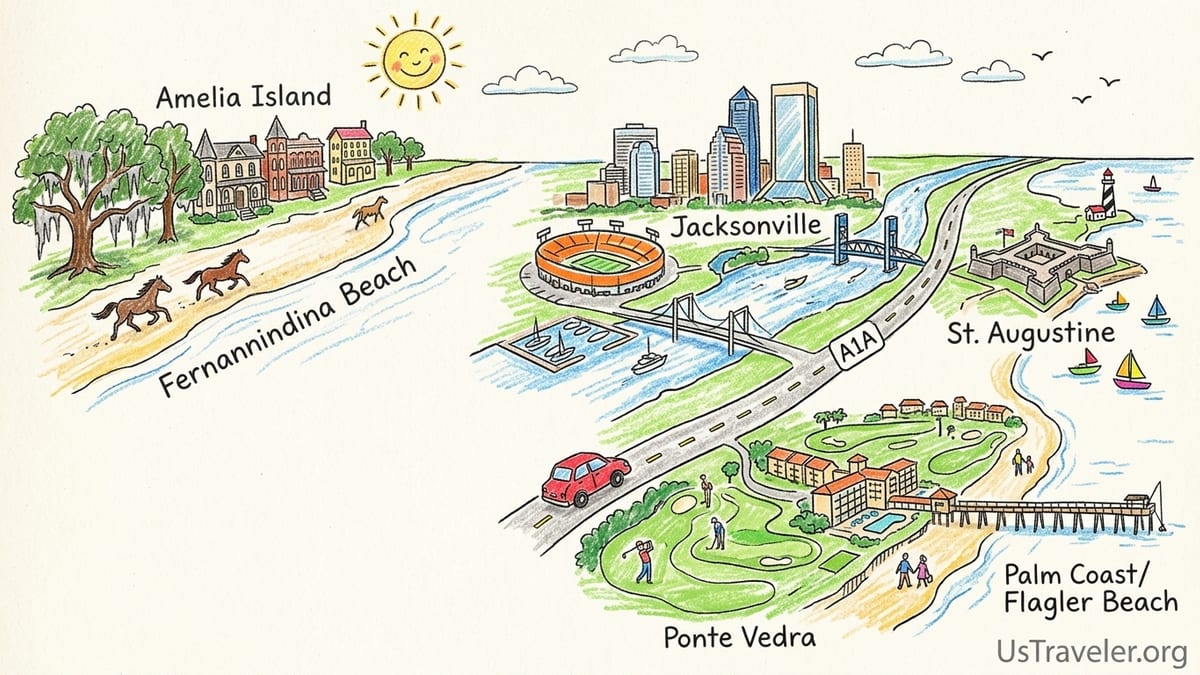
How Northeast Florida Fits Together
The coastal arc from Amelia Island in the north to Palm Coast and Flagler Beach in the south is compact enough to explore in a week, yet diverse enough that each stop has a distinct personality. Amelia Island and Fernandina Beach lean historic and romantic, St. Augustine adds deep Spanish colonial history and walkable nightlife, Jacksonville provides big-city culture and sports, while Ponte Vedra Beach and the southern beaches tilt toward golf, resorts and quieter escapes. You can fly into Jacksonville International Airport, rent a car, and be on Amelia Island in about 30 minutes or in downtown Jacksonville in under 25, which makes multi-stop itineraries easy to pull off.
In practical terms, most visitors choose two or three bases and then drive A1A or parallel highways for day trips. A common one-week plan is three nights on Amelia Island, two nights in historic St. Augustine, and two nights in either Jacksonville Beach or Ponte Vedra Beach for a livelier or more upscale finale. Those with less time might spend a long weekend based in Jacksonville or St. Augustine and make day trips to nearby beaches like Atlantic Beach, Anastasia Island or Flagler Beach to sample different coastal vibes without packing and unpacking multiple times.
Budget also shapes the route. Amelia Island’s major oceanfront resorts and Ponte Vedra’s golf properties price at a premium, especially in spring and over holiday weekends, while Jacksonville Beach and Flagler Beach often offer more modest motels and older condos a block off the sand. For many travelers, it makes sense to pair a few splurge nights at a resort with more affordable stays in city or roadside hotels. Driving distances between key points like Fernandina Beach and St. Augustine are typically 60 to 90 minutes, so you can justify staying put and exploring regionally, rather than hopping hotels every night.
Seasonally, March through May and October into early December usually offer the best mix of pleasant temperatures and manageable crowds. Peak summer brings warmer ocean water and family vacation energy, but also higher rates and stronger sun. Winter can be breezy and cooler, yet room prices often drop, making it an appealing time for golfers, couples and history-minded travelers who care less about long swims and more about quiet streets.
Amelia Island & Fernandina Beach: Romantic, Historic and Unhurried
Amelia Island, the northernmost of Florida’s Atlantic barrier islands, feels like a bridge between the Lowcountry and Florida: live oaks draped in Spanish moss, salt marshes threaded by creeks, Victorian storefronts in downtown Fernandina Beach, and 13 miles of relatively uncrowded shoreline. Fernandina’s historic district, with more than 50 blocks of preserved architecture, works beautifully as a base if you like strolling to cafes, local boutiques and bars in the evening and driving or biking to the beach by day. Upscale inns and small hotels around Centre Street and 2nd Street often run in the mid to high range in peak season, with more modest motels and vacation rentals on the outskirts.
Beach lovers generally head to the island’s eastern side, where wide, pale sand fronts low-rise condos and small hotels. Family-friendly spots like Seaside Park cluster casual restaurants, playground-style amenities, and public parking, so you can realistically spend an entire day without getting back in the car. Just north, Fort Clinch State Park offers a different backdrop: a Civil War era brick fort, shaded hiking and biking trails, and a long stretch of natural beach where shelling and surf fishing are common. A day pass to the park is relatively inexpensive, making it a good value for families who want both a historic site and time on the sand.
Amelia Island is especially suited to couples and travelers seeking a quieter, upscale feel. Horseback rides along the surf at sunrise, sunset sails out of Fernandina Beach Harbor, and spa days at one of the major oceanfront resorts give the island a pampered but not flashy character. Golfers have multiple courses to choose from, including resort layouts on the south end of the island. With this mix of beaches, marsh kayaking tours, charming downtown streets and comfortable dining, Amelia Island easily warrants three nights, and many travelers happily stretch it to four or five as part of a longer Northeast Florida stay.
Families do well here too, particularly those with school-age kids who appreciate a calmer atmosphere than some of Florida’s louder beach destinations. Mini-golf, bike rentals, and kid-friendly seafood spots where baskets of shrimp and fish tacos are standard keep days simple and manageable. Because nightlife is subdued and venues tilt toward wine bars and mellow pubs rather than clubs, young adults looking for a strong late-night scene might prefer to split time with Jacksonville Beach or downtown Jacksonville.
Jacksonville & The Beaches: Urban Energy Meets Surf Culture
Jacksonville is one of the largest cities in the contiguous United States by area, with a collection of distinct neighborhoods that can feel like separate towns. For visitors, its appeal lies in the blend of urban offerings and easy access to the coast. You can spend a morning at the Cummer Museum of Art & Gardens or the Museum of Science & History, grab lunch in neighborhoods like Riverside or San Marco, then be on the sand in Jacksonville Beach or nearby communities in roughly 30 to 40 minutes by car. That makes Jacksonville a logical base if you want pro sports, concerts, craft breweries and a real downtown alongside your beach time.
Jacksonville Beach itself reads like a classic Florida beach town, with a central pier, surf shops, casual taco joints and a strip of bars within walking distance of the ocean. Visitors typically choose this area for its social energy and nightlife, especially around weekends and warm-weather evenings. You will find a mix of mid-range chain hotels close to the water, older motels, and rising numbers of vacation rentals. Prices here can be lower than Amelia Island or Ponte Vedra in shoulder seasons, especially for simple places a few blocks inland, making it appealing to younger travelers and groups splitting costs.
Just to the north, Neptune Beach and Atlantic Beach feel calmer and more residential, with tree-lined streets, smaller oceanfront inns, and a compact town center shared between the two communities. This area is excellent for couples and families who want walkable access to restaurants and low-key beach bars but do not necessarily need a loud party scene. You can finish a day on the sand and head to neighborhood favorites for fresh Mayport shrimp, local craft beer, or a cocktail by the dunes without ever moving your car. Parking can be tighter near the core, so many visitors prefer lodging within easy walking or biking distance.
Given the variety, Jacksonville and its beaches merit at least two or three nights if you are interested in both city and shore. Travelers focused mainly on the beaches could use Jacksonville Beach or Atlantic Beach as a home base for four or five nights and still have new restaurants, coffee shops and surf breaks to try each day. Those treating Jacksonville mainly as an urban stop could spend two nights downtown or in Riverside, pairing it with day trips east to the sand and south to St. Augustine. Either way, this segment of the coast is best for visitors who want a busier scene, more nightlife and a broader range of price points than the purely resort-focused towns.
Ponte Vedra Beach: Golf, Resorts and Upscale Quiet
South of Jacksonville Beach, Ponte Vedra Beach shifts the tone toward manicured neighborhoods, golf courses and established resorts. It is home to the PGA Tour’s TPC Sawgrass, whose Stadium Course features one of the most famous par-3 holes in the world, and the Sawgrass Marriott Golf Resort & Spa, which often sells packages bundling rooms with tee times. Nearby, long-standing oceanfront properties such as Ponte Vedra Inn & Club and The Lodge & Club Ponte Vedra Beach emphasize full-service stays with beachfront pools, tennis courts and refined dining. Nightly rates are typically higher than neighboring towns, especially around major golf events or school holidays.
While Ponte Vedra Beach does have public beach access points, including boardwalks that cross protective dunes, much of the immediate oceanfront is lined with residences and resort property. Visitors staying at larger resorts often spend full days rotating between the beach, pool decks and spa facilities, with diversions like pickleball clinics, kids’ activities and golf lessons built into their stay. That makes Ponte Vedra particularly attractive for couples’ getaways, celebrations and traveler groups for whom the resort itself is the destination, rather than those seeking an offbeat or budget-conscious beach town.
Non-golfers still find reasons to include Ponte Vedra as a stop, from special-occasion dinners at beachfront dining rooms to wellness weekends centered on spa treatments and sunrise walks on relatively quiet sand. That said, if your priorities are extensive nightlife, quirky shops and a dense grid of independent cafes, you might be happier splitting more nights between Jacksonville Beach, Atlantic Beach or downtown St. Augustine. Ponte Vedra works best as a two or three night splurge within a longer trip or as a dedicated long weekend centered on golf and relaxation.
Families with older kids who golf or who appreciate resort amenities may enjoy several days here, especially in cooler months when walking the courses and bike riding feel comfortable. For younger families on tighter budgets, however, a short visit for a scenic drive along A1A, lunch at an oceanfront spot and a walk on the public beach can capture the feel of the area without committing to premium room rates. From a road-trip perspective, Ponte Vedra is an ideal mid-point pause between Jacksonville’s beaches and St. Augustine.
St. Augustine & Anastasia Island: History, Culture and Classic Beaches
St. Augustine, often promoted as the nation’s oldest continuously occupied European-established settlement, is the historical and cultural heart of this region. Its compact downtown clusters Spanish colonial and Gilded Age architecture, cobbled lanes, and major landmarks like Castillo de San Marcos National Monument, the Cathedral Basilica and Flagler College’s grand courtyard. Staying in or near the historic district allows you to park once and walk to museums, historic homes, wine bars and small restaurants. Room prices within the most atmospheric streets can be on the higher side, particularly at well-known inns and boutique hotels, but budget chains and motels line nearby U.S. 1 for more economical options.
For families, St. Augustine offers a dense lineup of attractions that pair easily with beach time. Trolley-style tours provide hop-on, hop-off transportation between key sights, which is helpful for travelers with kids or older relatives. Hands-on stops like the pirate museum, small local museums, and a climbing ascent up the St. Augustine Lighthouse on Anastasia Island add variety between historic sites and ice cream breaks along pedestrian streets. Evening ghost tours and live music in bars and open-air courtyards give the city a low-key nightlife that skews more toward couples and friend groups than late-night club-goers.
Across the Bridge of Lions, Anastasia Island holds much of the area’s actual beachfront. Here, St. Augustine Beach spreads wide and sandy, backed by low-rise condos, small hotels and casual seafood joints, while Anastasia State Park protects dunes and maritime hammocks along the shoreline. This island is especially good for families and travelers who want easy transitions from beach to historic center: you can spend a sunny morning swimming or surfing, rinse off at your motel or rental, and be seated for dinner downtown in roughly 15 to 20 minutes. Concerts at the local amphitheater and seasonal events add to the appeal for repeat visitors.
Because St. Augustine marries history, food, and beaches so closely, it makes sense to plan at least three nights here, and four is better if you want unhurried time on both sides of the bridge. Couples might choose two nights in a historic inn downtown followed by two nights at a simple motel or condo on Anastasia Island, while families could base entirely on the island for easier parking and drive into the city for targeted sightseeing. From here, day trips to Ponte Vedra Beach, Palm Coast, Flagler Beach or even Jacksonville are straightforward, so St. Augustine often anchors the middle of a broader Northeast Florida itinerary.
Palm Coast & Flagler Beach: Laid-Back and Less Developed
Continue south along A1A and the coastline softens into quieter Palm Coast and retro-feeling Flagler Beach. This stretch appeals to travelers who want fewer high-rises and more open vistas, with long segments of two-lane road running between dune fields and the Atlantic. Flagler Beach in particular retains a classic, small-town atmosphere, with a central fishing pier, low storefronts in coastal colors, and simple motels and vacation rentals within walking distance of the sand. The surf can be lively, and local cafes and taco spots make it easy to spend full days on the beach without driving inland.
Palm Coast, set slightly off the immediate shore, offers a broader suburban spread of condos, golf communities and larger resort developments. Some properties here position themselves as lower-key alternatives to Orlando or Daytona, with amenities like lazy rivers, multiple pools and on-site restaurants that cater especially well to families. Vacation rental prices can be attractive compared with higher-profile resorts to the north, particularly outside of school holidays and major event weekends. Because the communities are more spread out, first-time visitors may want a car for even simple errands and dinners.
These southern towns are best for travelers who prioritize quietly enjoying the ocean over nightlife or a long restaurant list. Couples seeking relaxed mornings, long beach walks and sunset drinks on a motel balcony will likely appreciate Flagler’s older building stock and manageable scale. Parents with kids who love the pool as much as the beach may find Palm Coast’s condo resorts convenient, especially if driving to St. Augustine for a day of sightseeing is part of the plan. From St. Augustine, you can often reach Flagler Beach in under an hour depending on traffic, which makes it realistic as either a day trip or an extended stay.
Given the lower density of attractions and shopping, Palm Coast and Flagler Beach usually work well as two to three night add-ons or relaxed endings to a busier trip through Jacksonville or St. Augustine. Travelers on a tighter schedule might simply include them as scenic breaks on an A1A drive, stopping for lunch, a few hours on the sand, or a pier walk before continuing north or south. The relative lack of large-scale nightlife or luxury infrastructure is part of their charm, particularly for repeat visitors looking to unplug.
Designing Your Trip: Who Should Stay Where
Choosing the right base along this stretch of coast comes down to matching destinations with travel style. For beach-focused family holidays with kids who need easy access to the sand and casual dining, Amelia Island, Jacksonville Beach, Anastasia Island and Palm Coast all work well. Amelia and Anastasia add state parks and nearby historic districts, providing extra rainy-day and educational options. Jacksonville Beach, by contrast, layers in more overt surf-town energy, boardwalk strolls and a cluster of bars that appeal to parents traveling with adult children or multi-generational groups looking for livelier evenings.
Couples often lean toward Amelia Island’s inns and resort properties or the historic bed-and-breakfasts of St. Augustine’s old town, depending on whether beaches or architecture are the bigger draw. A classic pairing is two or three nights wandering Fernandina Beach’s streets and beaches followed by three nights in St. Augustine, making room for one more night in Ponte Vedra Beach as a resort-focused interlude. Those celebrating anniversaries or honeymoons sometimes choose to splurge on oceanfront suites paired with activities like sunset cruises, spa days and fine dining, with day trips into Jacksonville for museums or sporting events as needed.
Golfers, naturally, gravitate to Ponte Vedra Beach thanks to TPC Sawgrass and several neighboring courses, but Amelia Island and Palm Coast also offer resort layouts within short drives of beachfront accommodations. A realistic plan could include three nights in Ponte Vedra with one or two rounds at marquee courses, then a few nights in Palm Coast or Amelia for a mix of different styles and course conditions. Because tee time costs at famous venues can be significant, many travelers build in a blend of one premium round and several more moderately priced games at less-publicized courses nearby.
Travelers after nightlife and a more urban experience do best basing around Jacksonville Beach, Neptune and Atlantic Beach, or downtown Jacksonville, where breweries, music venues and clubs stay active into the night. In contrast, those wanting quiet coastal trips, birding, and slow mornings over coffee on a balcony lean toward Fernandina Beach, Anastasia Island, and Flagler Beach. By mapping your priorities against this spectrum, it becomes easier to see which stops deserve full overnights and which are better treated as scenic pauses on a longer A1A drive.
FAQ
Q1. How many days do I need to see Amelia Island, Jacksonville and St. Augustine?
Most travelers are comfortable with six to eight days to see all three anchors, often splitting two or three nights each between Amelia Island, Jacksonville or its beaches, and St. Augustine with day trips to smaller beach towns in between.
Q2. Which Northeast Florida beach town is best for families with young kids?
Amelia Island, Anastasia Island near St. Augustine Beach, and parts of Palm Coast stand out for wide, generally gentle beaches, casual family restaurants and easy access to parks or simple attractions suitable for young children.
Q3. Where should couples stay for a romantic long weekend?
Couples often favor a mix of two nights in a historic inn in St. Augustine’s old town followed by two nights at an oceanfront resort on Amelia Island or Ponte Vedra Beach for a balance of culture and quiet beachfront time.
Q4. Is Jacksonville Beach better than Neptune or Atlantic Beach for nightlife?
Jacksonville Beach has the densest cluster of late-night bars and a livelier atmosphere, while Neptune and Atlantic Beach offer a more relaxed scene with neighborhood bars and restaurants that stay active without feeling rowdy.
Q5. Do I need a car to explore these Northeast Florida destinations?
A car is highly recommended, as public transit between towns is limited and attractions are spread out. With a car, you can comfortably day trip between Amelia Island, Jacksonville, St. Augustine and the smaller beach communities.
Q6. Which area is best for a golf-focused vacation?
Ponte Vedra Beach is the top choice for serious golfers thanks to TPC Sawgrass and neighboring courses, but Amelia Island and Palm Coast also provide convenient access to several resort and public layouts within a short drive.
Q7. Are Palm Coast and Flagler Beach good bases or just day trips?
They can work as either, but many travelers treat them as two to three night stays for quiet beach time or as relaxed day-trip destinations from St. Augustine when they want a less developed shoreline and smaller-town feel.
Q8. When is the best time of year to visit Northeast Florida’s coast?
Spring and fall generally offer the best balance of pleasant temperatures, lower humidity and moderate crowds, while summer brings warmer water and more families, and winter can be cooler but often more affordable.
Q9. Which towns are best for travelers on a tighter budget?
Jacksonville Beach, parts of Atlantic Beach, roadside hotels near but not in St. Augustine’s historic district, and older motels or condos in Flagler Beach often provide better value than marquee resorts in Amelia Island or Ponte Vedra.
Q10. Is it realistic to drive A1A as a scenic route between these destinations?
Yes, many visitors use A1A as a slower, more scenic alternative to inland highways, stopping at state parks, public beach accesses and small towns along the way; just allow extra time for lower speed limits and occasional traffic.