


Northeast Florida is made for road trips. Jacksonville International Airport is the main gateway for travelers headed to Amelia Island, the Jacksonville beaches, Ponte Vedra and historic St. Augustine, all linked by sweeping sections of coastal A1A. The region is spread out, but not every visitor needs a car for every day of the trip. Smart choices about where and when to rent can save time, money and stress while still giving you the freedom to explore.
Why Start Your Road Trip at Jacksonville International Airport
Jacksonville International Airport, commonly called JAX, sits about 15 miles north of downtown Jacksonville and directly on the main north south interstate, I 95. For most visitors flying in, it is the most convenient place to pick up a rental car because you can be on the highway toward Amelia Island or St. Augustine within minutes of leaving baggage claim.
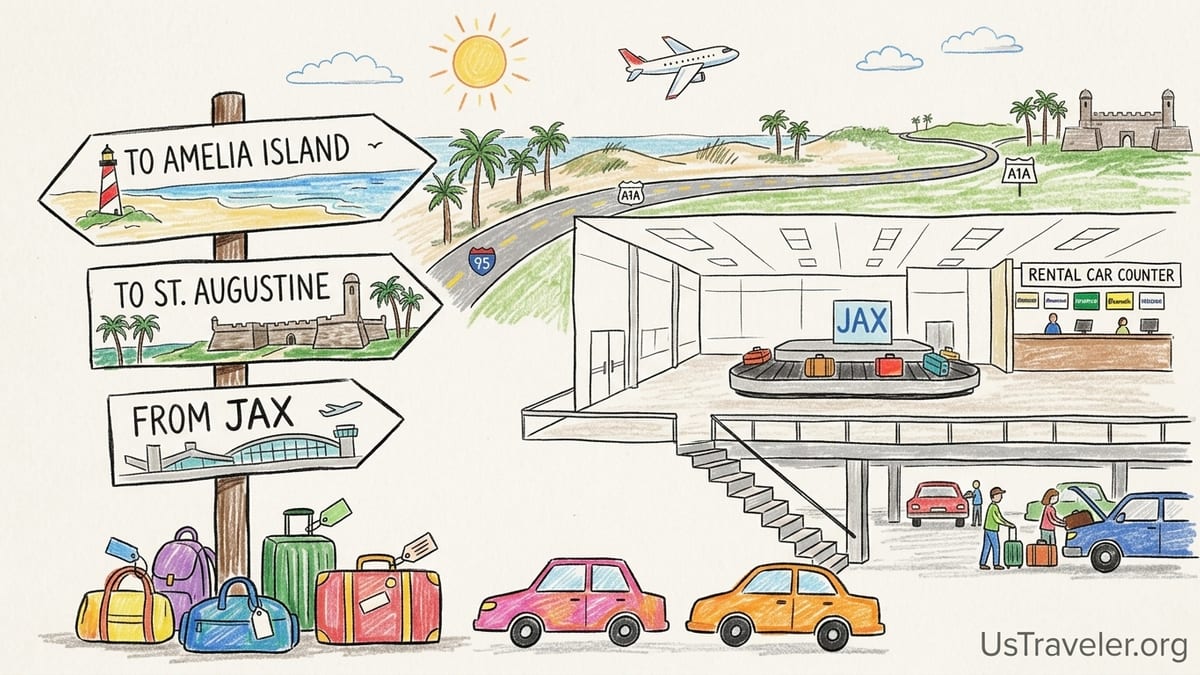
All on airport rental counters and car pick up areas are located on the lower level adjacent to baggage claim in the main parking garage, so there is no off site shuttle bus to manage with luggage. You walk from the carousel straight to the rental desks for brands such as Alamo, National, Avis, Budget, Dollar, Enterprise, Hertz, Sixt and Thrifty, then out to a covered garage to choose your vehicle. This is especially useful after evening arrivals when you want to be on the road quickly rather than waiting outside for a shared shuttle.
From JAX, driving times are manageable to each coastal destination. In light traffic, it is roughly 40 minutes to Amelia Island via I 95 and State Road A1A toward Fernandina Beach, about 35 to 45 minutes to the Jacksonville Beaches area via I 295 and Butler Boulevard, around 35 minutes to Ponte Vedra Beach, and about 60 to 75 minutes to St. Augustine depending on traffic through the south side of Jacksonville. Those times can increase during weekday rush hours on I 95 and State Road 202, so late morning or mid afternoon arrivals tend to be more relaxed for first time visitors.
For a typical one week coastal itinerary, many travelers choose to rent at JAX on arrival, keep the car for the full stay, and return it before flying out. Others combine a few car free days in compact historic St. Augustine with a shorter period of car rental at the beginning or end of the trip. Both approaches can work, but they suit different styles and budgets.
Airport Pickup vs City Pickup: What Actually Saves Money
On paper, city rentals in Jacksonville, St. Augustine or Fernandina Beach sometimes show slightly lower daily base rates than the airport because they avoid certain airport concession fees. In practice, the savings can disappear once you factor in the cost and time of getting from the airport to that off airport branch, especially if you need to pay for a rideshare or taxi for a family of four with luggage.
For example, imagine a long weekend trip arriving Friday mid afternoon and departing Monday morning. An on airport compact car at JAX might price around a certain nightly rate plus taxes and fees, with the advantage that you collect the car within the terminal and drive straight to your accommodation on Amelia Island. Choosing a neighborhood branch in Jacksonville could shave some dollars off the daily base rate, but you would need to pay for an Uber or Lyft ride of roughly 20 to 30 minutes into town, then repeat the trip in reverse at the end of your stay. For two travelers, that extra ground transport plus the lost time usually outweighs the small savings on the base rate.
City pickup can make sense if you plan to spend several car free days in downtown Jacksonville or the St. Augustine historic district at the start of your trip and only need a car later for a day trip loop along A1A. In that scenario, you might rideshare from JAX to your hotel, walk and use local transport for two or three days, then collect a rental from a city branch once you are ready to explore further afield. This approach avoids paying for a car that will mostly sit in a hotel garage while you wander on foot.
One practical middle ground is to rent at the airport on arrival, keep the car while you visit Amelia Island or the beaches, then drop it in St. Augustine if your final days are fully walkable. Certain national brands operate small downtown St. Augustine and Jacksonville Beach locations where one way returns are possible, although availability fluctuates seasonally and there may be a one way drop charge. Checking both airport and city locations for your specific dates will reveal whether this hybrid plan is price competitive.
Understanding One Way Rentals and Sample Itineraries
One way rentals in Northeast Florida are generally straightforward when you stay within major brands and within the same metro area. Picking up at JAX and returning to a branch in Jacksonville proper or even St. Augustine, about 50 to 60 miles away, is often either included in the rate or incurs a modest one way fee. The exact amount varies by company, season and car type, so it is worth running a few dummy bookings to see how prices change if you adjust the return location.
A classic coastal loop might look like this in practice. Fly into JAX on a Saturday, pick up a midsize SUV at the airport and drive straight to Amelia Island for two nights, staying at a beachfront resort near Main Beach Park. On Monday, continue south on A1A through Big Talbot Island and Little Talbot Island State Parks, pausing for short hikes to Boneyard Beach and a picnic stop. That afternoon, swing through Atlantic Beach and Jacksonville Beach, then check into a hotel in Ponte Vedra for two nights to enjoy the golf courses and quiet beaches.
On Wednesday, drive A1A along the Guana Tolomato Matanzas National Estuarine Research Reserve and cross the Vilano Beach bridge into St. Augustine, where you drop the car at a downtown rental branch if one way returns are available. You then spend two or three nights car free in the historic district, walking to the Castillo de San Marcos, St. George Street, and the Bridge of Lions. When it is time to fly home, you can either take a pre booked shuttle or a rideshare back to JAX, or rent another car one way from St. Augustine back to the airport for a single day.
If you are ending your trip far from Jacksonville, one way rentals can become more expensive. Taking a JAX rental and dropping it in Miami or Orlando can trigger substantial drop fees, particularly for larger vehicles and during peak seasons such as March golf events or late December holidays in St. Augustine. In those cases, compare the cost of a one way rental with the alternative of doing a simple round trip from JAX and using an intercity bus or train for the other legs of your Florida journey.
Tolls, Bridges and Driving A1A Between Islands and Beaches
Most of the core routes between JAX, Amelia Island, Jacksonville Beach, Ponte Vedra and St. Augustine do not involve traditional tollbooth turnpikes, but there are some tolled expressways and electronic toll segments around the metro area. The main limited access toll facility nearby is the First Coast Expressway, also signed as State Road 23, which forms part of an outer belt around southwest Jacksonville. Many out of town visitors do not need to use it, but your navigation app might route you that way during heavy traffic on I 295.
Florida tolls in this region are largely cashless, paid by SunPass or by license plate billing. Rental car companies typically offer an optional toll program that charges a daily convenience fee plus the actual tolls when you drive on cashless roads. For a traveler planning a simple loop from JAX to Amelia Island and down coastal A1A to St. Augustine and back, the easiest choice is often to decline any expensive toll add on at the counter and simply avoid the tolled expressway segments by selecting “avoid tolls” in your navigation settings. If you expect to use toll express lanes regularly, such as during a longer stay in the Jacksonville suburbs, the rental company pass may be worthwhile even with the daily service fee.
The signature drives in Northeast Florida are almost all on non tolled roads. From JAX to Amelia Island, you follow I 95 briefly before exiting onto State Road A1A over the marshes to Fernandina Beach. The bridges to Big and Little Talbot Islands are free, and the scenic sections of A1A through the Talbot Islands and Hannah Park area offer frequent pullouts for beach access and photo stops. Continuing south, Butler Boulevard connects I 95 to Jacksonville Beach without tolls, and A1A then hugs the shoreline through Neptune Beach and Atlantic Beach to Ponte Vedra, where the highway becomes a narrow two lane road between dunes and coastal houses.
South of Ponte Vedra, A1A runs beside protected land and estuaries before crossing the Tolomato River into Vilano Beach and over the Bridge of Lions into historic St. Augustine. That route is not tolled, but parking at popular beach accesses can fill quickly on warm weekends. Knowing that there are no surprise toll plazas on the main coastal drive lets visitors relax and enjoy the scenery without obsessing over every bridge crossing.
Parking Realities in Jacksonville Beaches, Amelia Island and St. Augustine
Parking patterns vary widely between the region’s beach towns and historic cores. On Amelia Island, many resorts and vacation rentals include on site parking at no extra cost, and downtown Fernandina Beach has a mix of free timed street parking and paid public lots near Centre Street and the marina. In high season, especially on festival weekends, you may need to circle once or twice, but most visitors find a spot within a few blocks of the main dining and shopping streets.
On Jacksonville Beach, Neptune Beach and Atlantic Beach, public beach access points often have small surface lots that are free or modestly priced, along with on street parking on side streets. Regulations change by municipality, so always check posted signs for time limits and resident permit requirements. For example, a Saturday in July might see the lots at the end of Beach Boulevard fill by late morning, while quieter accesses a few blocks north or south still have spaces. Staying in a beachfront hotel or condo with its own lot is one of the easiest ways to avoid daily parking searches.
St. Augustine is the tightest parking environment of the group, especially within the colonial street plan of the historic district where many streets are narrow and one way. The city’s main Historic Downtown Parking Garage near the Visitor Information Center offers roughly 1,200 spaces with a flat daily entry rate that is typically around the cost of a casual restaurant meal per car. The garage sits a short walk from St. George Street and the Castillo de San Marcos, so many visitors simply park there for the day and explore on foot.
Street and lot parking around the historic core uses meters and pay stations, with time limits that are enforced regularly. During major events such as the Nights of Lights holiday display, the city supplements the garage with park and ride shuttles from satellite lots, and both prices and restrictions can change on peak dates. If your hotel or vacation rental in the historic district includes a dedicated parking space or a garage pass, that benefit can be worth a significant amount over a long weekend because it removes the daily search for a legal spot.
When You Can Skip the Car in St. Augustine and When You Should Not
Historic St. Augustine is one of the few places in Northeast Florida where a visitor can genuinely spend several days without needing a car at all. The core of the town is compact and walkable, centered on pedestrian focused St. George Street, the bayfront, and nearby historic sites. If you stay within or just outside the walled historic district, you can walk to the Castillo de San Marcos, the Bridge of Lions, Flagler College, the Lightner Museum, and dozens of restaurants and bars in ten to fifteen minutes.
In this car free scenario, many travelers arrive by rental car from JAX, drop the vehicle once they reach St. Augustine, and finish their trip on foot and by local transport. Others take a shuttle, rideshare or intercity bus from Jacksonville to St. Augustine and skip renting altogether for a two or three night city break. Sightseeing trolleys and tour trains loop through the main visitor districts, acting as a hop on hop off system for reaching outlying stops like the Fountain of Youth Archaeological Park and the Old Jail without driving.
You are more likely to need a car if your St. Augustine plans include frequent trips across the Bridge of Lions to Anastasia Island beaches, late night dining on the island with limited transport options back, or day trips south along A1A to places like Fort Matanzas National Monument. Families hauling beach gear may find that the flexibility of their own vehicle outweighs the challenge of finding parking, particularly when traveling with small children or older relatives.
Another reason to keep a car is if your base is outside the walkable core, for example a hotel along U.S. 1, on the north side of town beyond the gates, or at St. Augustine Beach several miles from the historic streets. While local ride hail options exist, service can be spotty late at night or during midweek off season periods. In those cases, a rental car may be the most reliable way to move between your lodging, the historic district and the beaches on your own schedule.
Designing Itineraries That Combine Islands, Beaches and A1A
To experience the best of Northeast Florida’s coastline, many visitors design itineraries that stitch together multiple bases along A1A. A common pattern is to start on Amelia Island, shift to Jacksonville Beach or Ponte Vedra, then finish in St. Augustine. The key transport question is how many days you really need a car versus how many days can comfortably be spent in one walkable zone.
One realistic one week plan might look like this. Day one, arrive at JAX mid afternoon and pick up a compact car. Drive to Amelia Island for two nights, focusing on the Victorian charm of Fernandina Beach, Fort Clinch State Park, and sunset at the marina. Day three, check out and drive south on A1A, stopping for a mid morning walk at Big Talbot Island’s Boneyard Beach, a picnic at Little Talbot, and a quick detour into Atlantic Beach for coffee and a stroll. Continue to Ponte Vedra for two nights, perhaps at a golf resort or a smaller beachfront inn, using the car for short hops to different beach accesses.
On day five, continue along A1A through the protected dunes of the Guana preserve, pausing at one of the public boardwalks. Cross the Vilano Beach bridge into St. Augustine, drop your luggage at a historic district inn with on site parking, and consider returning the car that afternoon if your next two days are entirely within the old town. Spend day six and day seven walking, visiting the fort, climbing the lighthouse on Anastasia Island by taxi or trolley, and enjoying evenings on foot without needing to think about driving or parking.
For visitors who most value flexibility, keeping the car for the entire trip can still make sense. A vehicle allows last minute sunset runs to Vilano Beach, spontaneous side trips inland to freshwater springs, and easy grocery runs if you are in a rental condo on Amelia Island or St. Augustine Beach. The tradeoff is the ongoing parking cost and occasional congestion, particularly when trying to reach the St. Augustine historic core at mid day on a busy Saturday.
Whichever pattern you choose, the general rule is that you need a car to connect the islands and beaches along A1A and to explore state parks and natural areas, but you can reduce or eliminate car days when you are based within the dense historic grid of downtown St. Augustine or in a self contained beach resort where you are content to walk or bike.
How Long to Rent and Typical Cost Considerations
Rental duration plays a major role in overall trip cost, especially as daily rates rise during holidays and school breaks. In Northeast Florida, a three day weekend rental covering a Friday to Monday period from JAX will often price higher per day than a full week rental because of typical yield pricing. If your stay is six days, it is worth checking the price for seven days as well, since the weekly rate might be only slightly more and add useful flexibility for early arrival or late departure.
Fuel costs are relatively modest because distances between key points are not vast. A loop from JAX to Amelia Island, down A1A to St. Augustine, and back to the airport is typically under 200 miles, which is well within a single tank for a compact or midsize car. Parking costs and resort fees can quietly add more than fuel over the course of a trip. A downtown St. Augustine hotel that charges a nightly fee for on site parking, combined with the daily rate at the Historic Downtown Parking Garage for any extra vehicles, can add a significant amount over four or five nights.
For a couple planning a mixed itinerary, a productive strategy might be to rent a car at JAX for the first four or five days to cover Amelia Island, the Talbot Islands, and Jacksonville Beach, then return it once settled into a historic district inn in St. Augustine. The last two or three days become car free, saving rental and parking costs while you focus on walking oriented sightseeing. Families staying primarily in condos or rental houses, by contrast, often accept the cost of a full trip rental in exchange for the convenience of transporting groceries, beach gear and multiple generations comfortably.
Whatever your plan, check the rental agreement for details such as added driver fees, young driver surcharges for renters under 25, and any special rules about driving on unpaved access roads within state parks. While most beach and park parking areas are paved, some smaller accesses on Amelia Island or near the Guana preserve involve hard packed sand or shell surfaces, which are generally fine for standard cars driven cautiously.
The Takeaway
Northeast Florida rewards travelers who think carefully about when they truly need a car and when they can let the keys rest. Jacksonville International Airport is an efficient and straightforward place to begin a road trip, with all major rental brands clustered just steps from baggage claim and quick access to I 95, A1A and the beaches.
For itineraries focused on hopping between Amelia Island, the Talbot Islands, Jacksonville Beach, Ponte Vedra and the A1A corridor, a rental car for most or all of the trip is close to essential. It allows you to time beach visits around the tides and weather, stop at trailheads and overlooks on a whim, and carry everything from surfboards to picnic coolers. At the same time, the compact historic heart of St. Augustine offers a chance to design a car free finale, where the biggest transport decision is whether to stroll along the bayfront before or after dinner.
By comparing airport and city pickups, weighing one way options, understanding where tolls actually appear, and looking honestly at your own appetite for driving and parking, you can put together a Northeast Florida itinerary that feels both liberating and efficient. The reward is a smoother journey from jet bridge to beach chair, from fortress walls to island sunsets, with the right wheels under you only when they add genuine value.
FAQ
Q1. Do I really need a rental car if I only plan to stay in historic St. Augustine?
If your accommodation is inside or just outside the historic district and you are happy focusing on downtown sights, you can comfortably skip a rental car. You can arrive by shuttle, rideshare or intercity bus, then walk and use local trolleys for two or three days without major inconvenience.
Q2. Is it better to rent a car at Jacksonville International Airport or in the city?
For most visitors, renting at Jacksonville International Airport is more convenient because the counters and cars are in the main garage next to baggage claim and you avoid paying for rideshares into town. City rentals work best if you are deliberately planning several car free days before you start driving.
Q3. Are there many toll roads between Jacksonville Airport, Amelia Island and St. Augustine?
The main coastal routes between JAX, Amelia Island, Jacksonville Beach, Ponte Vedra and St. Augustine are largely toll free, especially if you stay on I 95, Butler Boulevard and A1A. Some expressway segments around the metro area use cashless tolling, but most beach focused visitors can avoid them by selecting “avoid tolls” in their navigation settings.
Q4. How difficult is parking in downtown St. Augustine?
Parking in the historic core can be challenging at peak times, but the large garage next to the Visitor Information Center provides a reliable option for most cars. Street and lot spaces exist but often have time limits and fill quickly on busy weekends and during events such as Nights of Lights.
Q5. Can I do a one way rental from Jacksonville International Airport to St. Augustine?
Many major rental companies allow one way rentals between the airport and city branches in places like St. Augustine, sometimes for a small drop fee. Availability and cost vary by date and car type, so it is important to check both locations during your search.
Q6. What is driving the A1A coastal route like between Amelia Island and St. Augustine?
The A1A coastal drive is generally relaxed, with a mix of marsh views, dunes and beachfront communities. Most of the road is two lane with moderate speeds, and there are frequent pullouts for beach access, state parks and photo stops, though traffic can slow near popular beach towns on sunny weekends.
Q7. Should I keep a rental car if I am staying on Amelia Island the whole time?
Yes, a car is usually helpful on Amelia Island even if you are based in one place. It makes it easy to reach state parks like Fort Clinch, different beach accesses, and the restaurants and shops of downtown Fernandina Beach without relying on limited local transport.
Q8. Is it easy to visit Jacksonville Beach and Ponte Vedra without a car?
Relying on rideshares alone at the beaches can be hit or miss, especially late at night or during shoulder season. A rental car gives you more freedom to move between beach accesses, restaurants and accommodations, which are spread out along the shoreline rather than clustered in a single compact district.
Q9. How many rental days should I plan for a week split between beaches and St. Augustine?
A common strategy is to rent for the first four or five days to cover Amelia Island, the Talbot Islands and the beaches, then return the car once you settle into a central St. Augustine hotel. The last two or three days can then be fully walkable, saving on rental and parking costs.
Q10. Are there special driving considerations for state parks and beach accesses along A1A?
Most park and beach parking areas are paved or use firm shell surfaces that standard cars can handle with cautious driving. Pay attention to posted rules about soft sand, avoid driving into unmarked dune areas, and use designated lots instead of pulling onto fragile roadside shoulders.