


Northeast Florida has quietly become one of the most compelling golf destinations in the United States. Stretching roughly 100 miles from Amelia Island in the north to Palm Coast in the south, the region marketed as Florida’s First Coast of Golf bundles more than 70 courses with Atlantic beaches, historic towns and full-service resorts. For travelers weighing a bucket-list round at TPC Sawgrass against a more relaxed beach-and-golf holiday in Ponte Vedra, Amelia Island, St. Augustine, Jacksonville or Palm Coast, understanding how these areas differ in access, pricing and overall experience is essential.
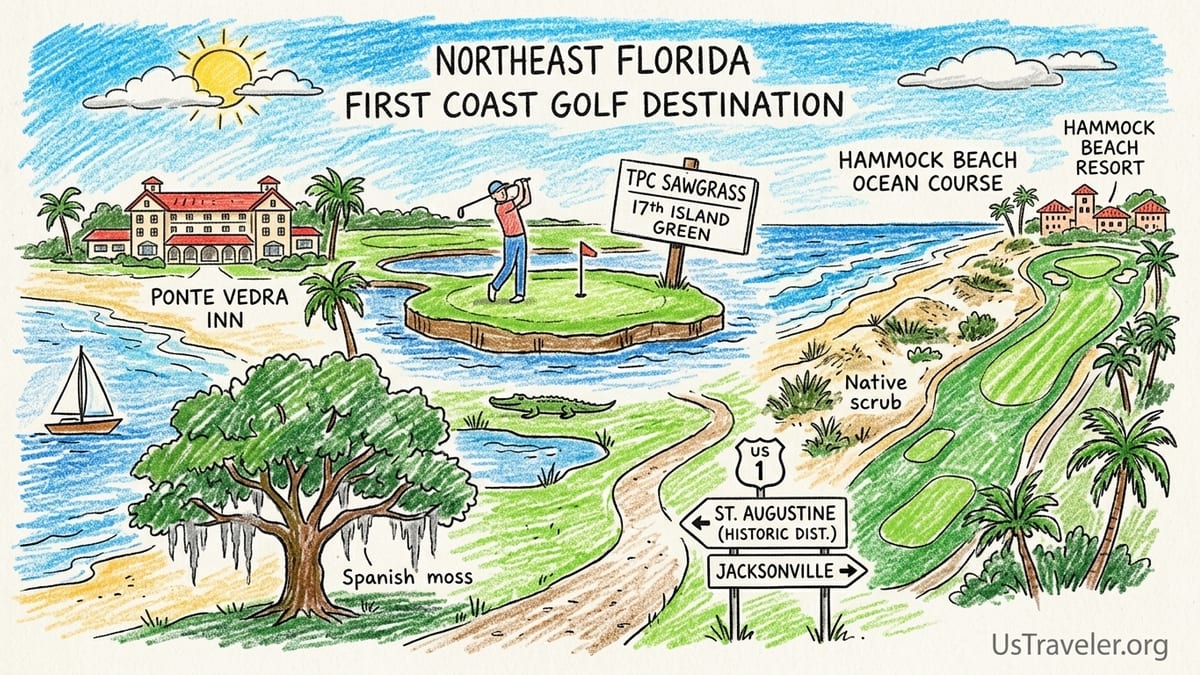
TPC Sawgrass and Ponte Vedra: Bucket-List Golf on the First Coast
TPC Sawgrass in Ponte Vedra Beach is the undisputed headliner of Northeast Florida golf and one of the most recognizable public-access courses in the world. The Stadium Course hosts The Players Championship and is designed to test every part of a golfer’s game, from the demanding tee shot on 18 to the famous island-green 17th. The facility also includes Dye’s Valley, a strong layout in its own right and often used for professional and high-level amateur events. For serious golfers, simply walking the same lines as the world’s best players is the primary reason to build an entire trip around Sawgrass.
Access, however, is very different here than at a typical beach resort course. The Stadium Course is open to the public but priced at the very top of the national market. Recent reports put standard green fees in a rough range from about 550 dollars in the off-peak summer months to 700 dollars or more in the prime season between roughly September and May, with dynamic pricing and package rates nudging that number higher or lower. Some travelers pair tee times with a stay at nearby full-service hotels such as the large conference-style resort adjacent to the property, which can make it easier to secure preferred times but does not necessarily reduce the overall spend.
Tee times at the Stadium Course can be difficult during Players Championship build-up and in peak spring weeks. Many visitors book months in advance, especially for mornings or weekends. Dye’s Valley generally offers better availability and lower green fees, making it a useful option for a second round or for groups that want a Sawgrass experience without paying top Stadium Course rates. Both courses strongly encourage at least a forecaddie, and on the Stadium Course a caddie or forecaddie plus customary tip can easily add more than 150 dollars per foursome to the total cost.
Beyond the TPC complex, Ponte Vedra itself is a long-established golf enclave. Historic properties such as Ponte Vedra Inn & Club, which opened its first course in the late 1920s and is known for featuring one of the earliest island greens, offer private-club caliber golf to resort guests. While these courses are not generally open to the public, they illustrate why Ponte Vedra is often seen as the most upscale of the region’s beach golf communities, with manicured neighborhoods, gated communities and a country-club atmosphere that appeals to travelers who want golf wrapped in a traditional luxury resort setting.
Amelia Island: Oceanfront Resort Golf and Relaxed Island Vibe
About 45 minutes north of downtown Jacksonville, Amelia Island feels noticeably quieter and more intimate than Ponte Vedra. Golf here pairs naturally with salt-marsh views, live oaks and wide beaches. Omni Amelia Island Resort anchors the island’s southern end and offers on-site golf amid 3.5 miles of beachfront. Guests can roll out of ocean-view hotel rooms or villas and onto resort-managed courses that weave between dunes, marshes and wooded corridors, with a mix of player-friendly and more demanding holes.
For visitors, the biggest advantage of Amelia Island is how easily golf fits into a broader beach or family vacation. Resort guests typically enjoy preferred tee-time access and bundled stay-and-play offers, where a night in a standard room plus a round of golf can be more cost-effective than booking a high-end green fee separately. Independent vacation rental companies on the island also market golf packages that combine condominium stays with rounds at local clubs such as The Golf Club of Amelia Island, where holes run alongside the Atlantic and give players the classic seaside experience without the atmosphere of a major tournament venue.
Public-access options beyond the main resort help keep costs manageable. Courses like Amelia River Golf Club and municipal or semi-private layouts inland from the beach often charge significantly less than the top resort rates, and they tend to have more flexible day-of or next-day tee-time availability. For a group of mixed-ability golfers, it is realistic to play a premium resort course one day and a more forgiving public layout the next, all within a short drive of beachfront accommodations.
Non-golfers on Amelia Island find plenty to do within a compact area. The historic district in Fernandina Beach offers restaurants, boutiques and harbor views, while the island’s state parks, biking paths and kayaking outfitters give active travelers an easy way to fill their days while others are on the course. The combination of walkable beach access, low-rise development and multiple mid-range golf options makes Amelia Island particularly attractive for couples or families who want golf to be a central part of the trip but not the sole focus.
Jacksonville-Area Courses: Variety and Value Beyond the Resorts
Jacksonville and its surrounding suburbs provide the broadest spectrum of golf experiences on the First Coast, especially for travelers who prioritize value and variety over resort amenities. Within an hour’s drive of downtown, golfers can find everything from budget-friendly municipal tracks to upscale daily-fee designs built within master-planned communities. While specific price points change seasonally, it is common to find weekday green fees on good-quality public courses in the Jacksonville metro for a fraction of the cost of a single round on the Stadium Course at TPC Sawgrass.
This variety makes Jacksonville appealing for groups who prefer to stay in standard hotels or vacation rentals and allocate more of the budget to playing multiple rounds. For example, a long weekend could include a round at one of the better-regarded municipal courses, a semi-private club that offers public tee times, and a day trip to a coastal layout near the beach. Booking tee times is usually more flexible than at the headline resorts, with golf management platforms and course websites showing a healthy spread of mid-morning and afternoon options even in popular months, though winter and early spring weekends still book up fastest.
Because Jacksonville is a large city rather than a single resort complex, non-golfers have considerable freedom in how they spend their days. Beaches in Jacksonville Beach and Neptune Beach are an easy drive from many courses, as are cultural stops such as museums, riverfront parks and professional sports venues. The trade-off is that the experience feels more like an urban golf road trip than a self-contained resort holiday. Travelers should budget additional drive time between hotel, restaurants and courses, especially during commuter hours.
For dedicated golfers who are comfortable planning logistics themselves, this diversity can be a strength. It allows itineraries that might mix higher-end rounds in Ponte Vedra or Amelia Island with more affordable tee times west of the Intracoastal Waterway or south toward St. Johns County, all while keeping lodging costs in check at mainstream business hotels or vacation rentals throughout the metro area.
St. Augustine and the Surrounding Coast: History Meets Fairways
South of Jacksonville, St. Augustine and its surrounding coastal communities offer a blend of historic sightseeing and modern golf developments. Many visitors base themselves near St. Augustine Beach or the Intracoastal and commute to inland courses that form part of master-planned residential communities. These courses often sit in a mid-range price band, more expensive than a basic municipal layout but substantially less than top-tier destination resorts, which appeals to travelers who want quality conditions without paying marquee premiums.
The region’s official golf marketing efforts highlight this area as a convenient middle ground: guests can spend a morning on the course and an afternoon exploring the narrow streets, fort and waterfront of the nation’s oldest continuously occupied European-established city. This makes St. Augustine particularly attractive to couples where only one partner plays golf, since there is always a non-golf activity within a short drive, from historic tours and art galleries to dining and nightlife concentrated in a compact, walkable district.
Access to St. Augustine-area golf is generally straightforward. Many courses are semi-private, which means they reserve some times for members but sell the remainder to the public through their own shops and standard tee-time platforms. Travelers can often reserve a midweek morning tee time just a week or two in advance outside of the busiest spring weeks. Green fees tend to reflect seasonal demand, with higher prices from late winter through early spring and more aggressive promotions in the heat of summer and during late-fall shoulder periods.
Because St. Augustine sits roughly in the middle of the First Coast corridor, it can also function as a flexible base for golfers willing to drive. From town, it is realistic to plan day trips north to Ponte Vedra and TPC Sawgrass, as well as south to Palm Coast and its oceanfront resort complexes, while still returning to the same hotel or vacation rental each evening. Travelers who value a consistent home base plus a variety of courses within an hour’s drive often gravitate to this part of the coast.
Palm Coast and Hammock Beach: Oceanfront Golf Resort Destination
Palm Coast marks the southern anchor of Northeast Florida’s golf coastline and is home to Hammock Beach Golf Resort & Spa, a large oceanfront property that positions itself squarely as a dedicated golf getaway. Sitting on a stretch of relatively undeveloped beach, Hammock Beach features two signature courses: the Jack Nicklaus designed Ocean Course, where several holes run alongside the Atlantic, and the Tom Watson designed Conservatory Course, a sprawling inland design known for its numerous bunkers and tournament pedigree. The resort’s courses have hosted professional events in the past, underscoring their stature within the state.
Hammock Beach and nearby Palm Coast clubs operate largely on a resort or semi-private model rather than pure daily fee, which affects access. Guests of the main resort typically enjoy priority access and package rates that bundle lodging, golf and sometimes extras like breakfast or spa credits. Green fees for resort guests tend to sit below the most premium national destinations but remain in line with high-end coastal golf, while outside guests, where allowed, may see higher walk-up rates and tighter tee-time windows. Beyond the resort, public-access courses such as Palm Harbor Golf Club provide additional options at more moderate price points, and regional marketing partners promote stay-and-play deals that pair these courses with mid-range hotels in Palm Coast.
For non-golfers, Hammock Beach functions as a classic full-service beach resort, with a large pool complex featuring a lazy river, multiple restaurants, a spa, tennis and direct beach access. This makes Palm Coast especially suitable for families and mixed groups in which only some travelers play golf. While one part of the group heads to an early tee time, others can spend the day at the pools, book spa treatments, rent bikes along the coast or simply enjoy the quieter feel of this section of shoreline compared with more built-up stretches farther north.
Because Palm Coast sits a bit farther from a major city, travelers focused on off-course dining and nightlife may find fewer standalone options than in Jacksonville or St. Augustine. The trade-off is a more self-contained resort environment where most needs are met on property or within a short drive, and where the visual drama of oceanfront holes and elevated tees above the dunes is a daily highlight rather than a rare treat.
Resort Guests vs Public Access, Green Fees and Tee-Time Logistics
Across Northeast Florida, access and pricing vary significantly by course type. At the top of the spectrum, TPC Sawgrass operates in a category of its own as a globally recognized tournament venue, with public access but premium pricing and relatively tight tee-time windows around The Players Championship each March. Travelers who want to guarantee a Stadium Course round during prime months should be prepared to book months ahead and to factor in not just the headline green fee but also caddie or forecaddie services and gratuities, which can raise the all-in cost of a single round into the high three figures per person.
Resort-based golf operations such as Omni Amelia Island and Hammock Beach strike a more traditional balance between access and exclusivity. In both areas, staying on property usually unlocks better tee-time selection, sometimes discounted or included rounds, and package add-ons like replay rates in the afternoon. Non-guest access policies differ by property and can change seasonally, but many resort courses either limit outside play in peak periods or price it noticeably higher than guest rounds. Travelers considering a multi-round trip in these areas should compare nightly room rates plus bundled golf to the cost of booking golf separately while staying off-site, as the package often represents better value.
Public and semi-private courses around Jacksonville and St. Augustine offer the widest range of green fees, generally trending lower the farther they sit from the prime oceanfront. Dynamic pricing is common, so early-morning weekend slots during the popular winter and spring months can still be relatively high, while midweek midday times in the warmer months often see meaningful discounts. Booking windows are more forgiving here; groups can often finalize itineraries a few weeks before arrival and still secure desirable tee times, particularly if they are flexible about exact start times and willing to play afternoon rounds.
As a practical matter, travelers should also weigh the cost of transportation and pacing. In Ponte Vedra and Amelia Island, it is feasible to park the car and spend most of the trip within a limited radius, shuttling between resort, course and beach. In Jacksonville and some St. Johns County developments, by contrast, the best-value golf may require 30 to 45 minutes of highway driving from lodging, especially for groups that want to play a different course every day. Factoring this time into tee-time selections can prevent rushed mornings and ensure that non-golfers are not left without easy access to activities while the golfers are away.
Choosing the Right Area for a Dedicated Golf Vacation
For travelers building a trip primarily around golf, each major pocket of Northeast Florida offers a distinct personality. TPC Sawgrass and Ponte Vedra are ideal for those seeking a once-in-a-lifetime bucket-list experience and a refined country-club environment. A typical three-night Ponte Vedra trip might feature one flagship round on the Stadium Course, a second round on Dye’s Valley or at a private-resort course accessible through lodging, and additional time spent at upscale beach clubs, fine-dining restaurants and coastal neighborhoods where golf carts and bicycles are as common as cars.
Amelia Island is best suited to golfers who value a relaxed island feel and want courses that are strong but not necessarily tournament-hardened. An extended weekend could include a round at the main resort course, another at The Golf Club of Amelia Island with its oceanfront scenery, and a third at an inland semi-private club with more forgiving pricing. Off the course, days can be filled with beach walks, bike rides through maritime forest and evenings in the historic downtown, making this an excellent choice for couples’ trips and family gatherings where some guests may play less or not at all.
Palm Coast and Hammock Beach sit in the sweet spot for those who want a single, self-contained resort that feels purpose-built for golf yet remains approachable for non-golfers. A four-night stay might include alternating rounds on the Ocean and Conservatory courses, with a rest day spent at the pool complex or spa. Because many of the area’s better-known holes run adjacent to the Atlantic, guests get recurring exposure to dramatic coastal scenery that reinforces the sense of being on a golf-specific vacation rather than a general beach holiday with occasional tee times.
Golfers focused on value and course variety may find Jacksonville and St. Augustine more attractive. Here, the goal is to play as many different layouts as possible while keeping individual green fees moderate. A group of friends might split a vacation rental, drive to a different public or semi-private course each day, then spend evenings at local breweries, waterfront restaurants or historic attractions. In this model, a single high-cost round at TPC Sawgrass can be treated as the marquee event in an otherwise cost-conscious itinerary, rather than the template for every day of the trip.
The Takeaway
Northeast Florida’s First Coast of Golf covers more than 70 courses along roughly 100 miles of Atlantic shoreline, giving travelers an unusually wide array of choices for a golf-focused trip. At one end of the spectrum is TPC Sawgrass, with its world-famous Stadium Course, high green fees and tournament aura that appeals to golfers chasing a bucket-list experience. At the other are quieter, more budget-friendly public courses around Jacksonville and St. Augustine that allow visitors to log multiple rounds without overwhelming the travel budget.
In between sit destinations such as Ponte Vedra’s resort clubs, Amelia Island’s oceanfront layouts and Palm Coast’s Hammock Beach Resort, each blending quality golf with distinctive coastal settings. Choosing between them comes down to priorities: the thrill of walking in the footsteps of tour professionals, the ease of a self-contained beach resort, the charm of a historic town or the flexibility of a city-based golf road trip. With thoughtful planning around tee times, lodging and non-golf activities, it is possible to tailor a First Coast itinerary that satisfies serious players and casual companions alike.
Whether you envision yourself standing on the tee at the 17th at TPC Sawgrass, strolling a quiet Atlantic beach after an afternoon round at Amelia Island, or watching the sun sink behind the dunes at Hammock Beach after a day on the Ocean Course, Northeast Florida delivers a compelling mix of golf and coastal escape. For many travelers, that blend of high-profile venues, accessible public courses and year-round playability is what turns a one-time trip into an annual tradition.
FAQ
Q1. Is TPC Sawgrass open to the public, or do I need to be a member?
TPC Sawgrass is open to the public, and you do not need to be a member to play. However, tee times on the Stadium Course are expensive and book up quickly around The Players Championship and peak spring dates, so planning well in advance is recommended.
Q2. How much should I budget for a round on the Stadium Course at TPC Sawgrass?
Exact rates vary with season and demand, but recent public information suggests a general range from roughly 550 dollars in slower summer periods to 700 dollars or more in peak months, before caddie or forecaddie fees and tips. Travelers should confirm current pricing directly when planning.
Q3. Which area is best if my group wants an all-in-one golf resort with plenty for non-golfers?
Palm Coast’s Hammock Beach Resort and the larger Amelia Island resorts are strong choices. Both offer on-site golf along with pools, spas, beach access and family activities, so non-golfers can easily fill their days without leaving the property.
Q4. Is Ponte Vedra or Amelia Island better for a couples’ golf getaway?
Ponte Vedra suits couples seeking a more traditional luxury and country-club feel, with marquee golf and upscale dining. Amelia Island tends to feel more relaxed and intimate, with walkable beaches, historic Fernandina Beach and a mix of resort and public courses that work well for couples who want golf but also value unhurried island time.
Q5. Can I find affordable golf around Jacksonville and St. Augustine without staying at a resort?
Yes. The Jacksonville and St. Augustine metro areas include numerous public and semi-private courses at mid-range or budget-friendly green fees, especially for weekday and off-peak tee times. Staying in a standard hotel or vacation rental and driving to different courses each day is a common strategy for value-focused groups.
Q6. Do I need a rental car for a golf trip to Northeast Florida?
In most cases, yes. While resort shuttles and ride-hailing services exist, having a rental car makes it much easier to reach different courses, restaurants and attractions, especially around Jacksonville and St. Augustine where distances can be significant.
Q7. When is the best time of year to play golf in Northeast Florida?
Late fall through early spring is generally the most comfortable, with lower humidity and moderate temperatures. Winter and early spring are popular and often more expensive, while summer offers longer daylight and lower rates but higher heat and the possibility of afternoon storms.
Q8. Is it realistic to play both TPC Sawgrass and Hammock Beach on the same trip?
Yes. Ponte Vedra and Palm Coast are within a few hours’ drive of each other, and many travelers build itineraries that combine a bucket-list round at TPC Sawgrass with a few resort days at Hammock Beach or another coastal property further south.
Q9. Are there good options for beginner or high-handicap golfers on the First Coast?
There are. While courses like TPC Sawgrass can be punishing, many public and resort layouts around Jacksonville, Amelia Island and St. Augustine are more forgiving, with wider fairways, multiple tee boxes and friendly staff accustomed to hosting less experienced players.
Q10. How far in advance should I book tee times for a Northeast Florida golf vacation?
For premium courses such as TPC Sawgrass or marquee resort layouts in peak season, aim to book several months in advance. For most public and semi-private courses, especially in shoulder or summer seasons, a few weeks is often sufficient, though weekends and mornings still fill first.