


North Central Florida is the Florida many first-time visitors never see: a landscape of clear blue springs, moss-draped live oaks, quiet university towns and working horse farms, all a long way in spirit from the high-rise beach resorts and theme parks farther south. For travelers who prefer rivers to roller coasters and seafood shacks to nightclubs, this inland-and-Gulf region can be the most rewarding part of the state to explore on a first visit.
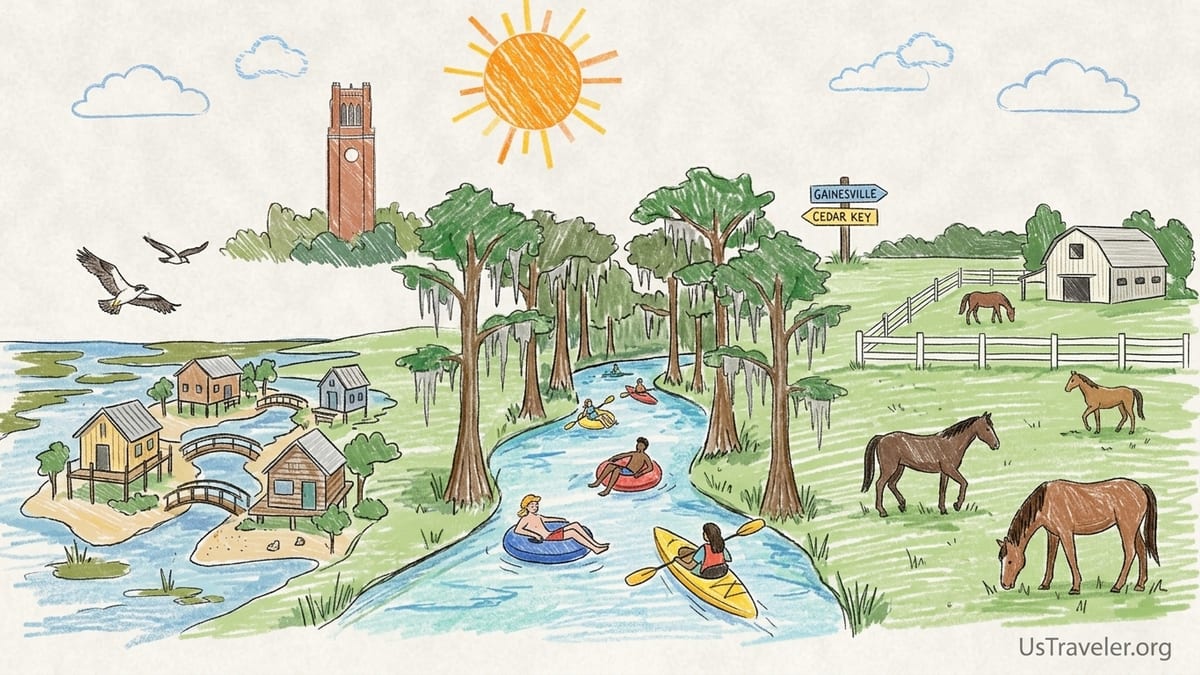
Where North Central Florida Fits On The Map
North Central Florida sits in the middle of the state’s northern tier, between the Atlantic coast cities of Northeast Florida and the Panhandle beaches of Northwest Florida. It roughly includes Alachua, Levy, Gilchrist, Suwannee and surrounding counties, anchored by the city of Gainesville inland and Cedar Key on the Gulf side. From Gainesville, most of the region’s highlights are within a 30 to 90 minute drive in any direction, whether that means heading west to the Santa Fe and Suwannee rivers, south toward Ocala’s horse farms or southwest to the marshes and islands of the Nature Coast.
This region feels distinct from other parts of Florida. Compared with Central Florida around Orlando, North Central Florida is more rural and academic, with the University of Florida shaping Gainesville’s food, arts and nightlife. Compared with Northeast Florida around Jacksonville and St. Augustine, it is less about Atlantic beaches and more about freshwater springs and rivers. And unlike the Panhandle’s resort-heavy Northwest Florida, the Gulf here is shallow and marshy, with low-key fishing villages such as Cedar Key instead of high-rise condo strips. The pace is slower, the prices are generally lower, and the tourism is centered on nature rather than built attractions.
For a first-time visitor, it helps to think of North Central Florida as a hub-and-spoke region. Gainesville is the natural base, with easy road access via Interstate 75 and a small but useful airport. From there you can day-trip to High Springs and the Santa Fe River springs to the northwest, the Ichetucknee and Suwannee country to the west and north, Ocala horse country and springs to the south, and Cedar Key and the Nature Coast to the southwest. With three to seven days you can realistically combine several of these areas without rushed, all-day drives.
Because the region is inland and on the Gulf side, it also has a different climate feel from South Florida. Summers are hot and humid, but river and spring water stays around 72 degrees Fahrenheit year-round, and evening temperatures cool faster than on the concrete-heavy coasts. In winter, cold snaps can be surprisingly brisk by Florida standards, with occasional frosts and jacket weather, but that cooler air paired with clear blue spring water has its own appeal and keeps crowds lighter.
Gainesville: Cultural Hub in the Middle of Nature
Gainesville is the largest city in North Central Florida and functions as the region’s cultural and logistical hub. Home to the University of Florida, it combines a student-heavy downtown with leafy historic neighborhoods and quick access to parks and preserves on all sides. Travelers who like to end a day of paddling or hiking with a craft beer, a vegan taco or a college football game will feel very comfortable basing here for several nights.
For nature, Payne’s Prairie Preserve State Park just south of town is one of the most distinctive landscapes in Florida, with herds of bison and wild horses grazing on a vast, seasonally flooded prairie. From an observation tower off U.S. 441, visitors often spot sandhill cranes in winter and alligators year-round. Devils Millhopper Geological State Park on Gainesville’s northwest side provides a different experience: a sinkhole you reach via a steep staircase, where a miniature rainforest thrives at the bottom. These parks are close enough that you can pair them with time in the downtown area the same day.
Gainesville’s food and lodging scene is more developed than in the surrounding small towns, which makes it a good base for first-time visitors. In the walkable downtown and adjacent Depot Park area you will find everything from casual taco spots and ramen bars to Southern-style brunch cafés. Midrange chain hotels cluster along Interstate 75, often with nightly rates lower than those in Orlando or on the coasts, especially outside of University of Florida football weekends. For something more local, small inns and restored motels appear along older corridors like Southwest 13th Street and University Avenue.
Logistically, Gainesville Regional Airport offers daily flights to major hubs such as Atlanta, Charlotte, Dallas–Fort Worth and Miami, which allows travelers to connect from many parts of the United States with only one layover. The city sits on Interstate 75 about a 2-hour drive from both Jacksonville and Orlando airports, so some visitors choose to fly into a bigger city, rent a car and then start their trip in Gainesville before radiating outward into the countryside.
High Springs and the Santa Fe River Springs
About 25 to 30 minutes northwest of Gainesville, the small town of High Springs has become a gateway to some of Florida’s clearest freshwater springs. This is a place of two-story brick storefronts, antique shops and cafés, with pickup trucks parked along Main Street and dive gear for sale in several local shops. Many visitors stay at campgrounds or simple motels on the edges of town and spend their days on or in the water.
The Santa Fe River winds through this landscape, dotted with springs that range from family-oriented swimming holes to world-renowned cave diving sites. Ginnie Springs, a privately operated complex, is popular with both campers and divers. It offers tent sites, RV hookups, riverfront cabins and equipment rentals for tubing and paddling. On warm weekends from late spring into early fall, you will see groups floating downstream in rented inner tubes, coolers lashed to their sides, taking advantage of the steady 72 degree water even as the air temperatures push into the 90s.
Nearby, state parks such as O’Leno State Park and River Rise Preserve State Park offer a more low-key, under-the-radar experience. At O’Leno, visitors can hike through pine woods to see where the Santa Fe River disappears underground, then re-emerges miles away at River Rise. The parks provide shaded campgrounds, picnic areas and modest entrance fees per vehicle, making them good value for families or couples who want to mix hiking with time by the water. High Springs itself has a handful of local restaurants, from barbecue to sandwich shops, so you do not need to drive back to Gainesville every night if you prefer a quieter base.
High Springs and the Santa Fe River springs pair naturally with Gainesville in a single trip. A common pattern is to spend a couple of nights in Gainesville to explore its parks and downtown, then shift bases to a riverfront campground or a small inn near High Springs for two or three days of paddling, tubing and spring hopping. Driving times are short enough that you can also stay in Gainesville the whole time and treat High Springs as a series of day trips if you prefer hotel comforts and a wider choice of evening activities.
Ichetucknee and Suwannee Country
West of High Springs, the landscape opens into forest and farmland punctuated by famous spring-fed rivers. Ichetucknee Springs State Park, reached via rural roads near Fort White, is considered one of Florida’s classic tubing destinations. In summer, especially on weekends, the park now caps daily tube access because the clear water and shaded banks attract such heavy visitation. Visitors can rent tubes just outside the park or bring their own, then float lazily along a section of the Ichetucknee River for several hours while watching turtles, fish and the occasional otter in the water.
Ichetucknee is not only about tubing. The state park has nature trails, swimming areas and designated launches for kayaks and canoes. Simple concessions, restrooms and shaded picnic grounds mean you can easily spend a full day without leaving. Entrance and rental prices are modest compared with boat tours or theme park tickets elsewhere in the state, which makes the experience accessible for families and student groups. In cooler months, the same river is popular with paddlers and divers who enjoy fewer crowds and clearer views into the spring vents.
Beyond Ichetucknee, the Suwannee River and its connected springs create another cluster of destinations. State parks such as Troy Springs, Lafayette Blue Springs and Fanning Springs offer river access, campgrounds or day-use areas where locals gather to swim, barbecue and launch boats. Some, like Manatee Springs farther south, see West Indian manatees in colder months when the animals move into warmer spring water from the Gulf. Nearby private campgrounds and riverfront lodges cater to paddlers and boaters who plan multi-day trips along the Suwannee.
Accommodations in this part of Suwannee country are simple but atmospheric. Expect river-cabin rentals, RV parks and rustic campgrounds more often than brand hotels. Travelers who want a bed-and-breakfast or a full-service hotel typically base themselves in Lake City or Gainesville and drive 45 to 75 minutes out to the river each day. For a first-time visitor combining Ichetucknee and the Suwannee with High Springs, two or three nights in the springs-and-river area is usually enough for multiple swims, a tubing run and at least one full day of paddling.
Ocala Horse Country and Nearby Springs
Roughly an hour south of Gainesville, the Ocala area is known internationally as horse country. Rolling pastures, white-fenced farms and live oak canopies line the local roads, and many top thoroughbred and show horse operations keep training facilities here. For travelers, this opens opportunities to book guided trail rides, visit farm attractions or attend equestrian competitions, often at prices that are reasonable compared with similar experiences in Kentucky or Western states.
The World Equestrian Center in Ocala has brought a new level of visibility to the region, with regular show schedules, arenas and on-site lodging that range from RV sites to upscale hotel rooms. Even if you are not an equestrian, wandering the grounds during a show weekend can be an interesting window into this aspect of Florida life. Smaller, family-run stables around the county also offer trail rides through pine forests or along quiet dirt lanes, usually by reservation and with strict weight and age guidelines for safety.
Ocala is also a gateway to several major springs and clear rivers. Silver Springs State Park, just east of town, is famous for its glass-bottom boat tours that drift over eelgrass beds and old movie set remnants on the river bottom. Visitors can rent kayaks, paddleboards or canoes to explore on their own, often spotting turtles, fish and sometimes monkeys along the banks. Farther southwest, Rainbow Springs State Park near Dunnellon offers another spring complex with swimming areas, gardens and a river popular for tubing and paddling. Both parks charge per-vehicle entry fees that are modest by national standards.
For a first trip focused on North Central Florida, Ocala horse country and its springs can be combined either with Gainesville and High Springs or with a broader loop that also reaches the Gulf. The drive from Gainesville to Ocala is about an hour on four-lane highways, and from Ocala to Cedar Key it is generally under two hours via smaller roads. Because the horse-focused experiences and the spring activities are both daytime pursuits, it is possible to spend a night or two in Ocala, ride in the morning and paddle in the afternoon, then continue your journey north or west the next day.
Cedar Key and the Nature Coast
Cedar Key sits on a cluster of islands about 50 miles southwest of Gainesville, linked to the mainland by low bridges that cross tidal marsh. This small fishing village turned arts community feels far removed from Florida’s better-known beach towns. There are no high-rise hotels, a limited number of vacation rentals, and a compact historic core where clapboard buildings face a working marina and a small beach park. For many visitors, that simplicity is the point.
The Cedar Key area is part of Florida’s broader Nature Coast, where the Gulf is shallow and dotted with oyster bars, grass flats and estuaries. Instead of deep, wide sandy beaches, travelers find fishing charters that target redfish and trout, kayak outfitters that lead trips to shell middens and bird rookeries, and wildlife refuges that protect islands and salt marsh. Birders come for ospreys, pelicans and migrating shorebirds; paddlers for quiet, often glassy water, especially at sunrise and sunset.
On a practical level, Cedar Key offers a small selection of motels, historic inns and mom-and-pop lodgings, many within walking distance of the waterfront dining spots that specialize in local seafood. Rates can be attractive compared with busier Gulf destinations, especially outside winter peak and major holiday weekends. Some travelers do day trips from Gainesville, since the drive takes about an hour and a half, but staying a night or two allows time for both a kayak excursion and slow wanders through town in the early morning and evening when the light is most beautiful.
Cedar Key and the Nature Coast pair naturally with the inland springs and Gainesville. A classic 5 to 7 day North Central Florida trip might include three nights in Gainesville or High Springs for spring-hopping and hiking, then two nights in Cedar Key to shift focus to Gulf wildlife, seafood and sunsets. The driving between these areas is relaxed, two-lane-highway travel through pine forest and pasture, and you can easily add brief stops in small towns such as Chiefland or Cross City for lunch or supplies along the way.
Getting Around, Where to Stay and Trip Combinations
North Central Florida is fundamentally a driving destination. Local transit is limited outside Gainesville, and Lyft or Uber coverage becomes sparse once you move into rural areas. Renting a car at your arrival airport is the most flexible choice. From Gainesville Regional Airport to downtown Gainesville is about a 15 minute drive, to High Springs roughly 30 to 35 minutes, to Ichetucknee Springs State Park around an hour, to Ocala close to an hour, and to Cedar Key just under 90 minutes in normal traffic. Jacksonville, Orlando and Tampa airports can also serve as gateways if flight options or prices into Gainesville are limited.
Lodging runs the full range from chain hotels and university-adjacent inns in Gainesville and Ocala to rustic river campgrounds and family-owned motels in High Springs, along the Suwannee and in Cedar Key. Spring and summer weekends bring heavier demand, especially around major rivers and during University of Florida football season, so booking ahead is wise. Outside those peaks, visitors often find better value than in Florida’s major coastal metro areas. Camping is a strong option here, whether in state park campgrounds with basic facilities or private RV parks that add pools and organized activities.
Not every part of North Central Florida fits comfortably into a short first trip, so it helps to choose one or two themes. A freshwater-focused itinerary might combine Gainesville, High Springs and Ichetucknee country over four or five days, with mornings on the water and afternoons exploring small towns or Gainesville’s museums. A more varied loop could start in Gainesville, include a day or two on the Santa Fe River, continue to Ocala for horses and Silver Springs, then end with two nights in Cedar Key before driving back inland to fly home.
Some combinations are less realistic on a short visit. For instance, trying to add Northeast Florida’s Atlantic beaches around St. Augustine or Jacksonville, or the Panhandle’s resort strip, will stretch driving days and dilute your time in North Central Florida’s springs and rivers. If you have a full week or more, you can add a night on the Atlantic side or in a Panhandle town, but for first-timers with five days or less it usually makes sense to keep the focus on the Gainesville-centered inland and Gulf cluster described in this guide.
Practical Tips for Springs, Rivers, Horses and Wildlife
First-time visitors are often surprised by how clear and cold the springs feel even on a sweltering July afternoon. Water temperatures hold near 72 degrees Fahrenheit year-round, which is refreshing but can feel chilly at first. Bringing or renting a thin neoprene vest or shorty wetsuit can make longer swims and snorkel sessions more comfortable, especially for children. Water shoes are helpful on rocky or shell-strewn entry points, and many parks require flotation devices for younger swimmers in deeper areas.
Most state parks in this region charge a small entrance fee per vehicle and have posted hours that often run from early morning to sunset. On popular summer weekends, parks such as Ichetucknee Springs, Silver Springs and Rainbow Springs may fill to capacity, with rangers closing gates until enough visitors leave. Arriving early in the day, especially before 10 a.m., increases your chances of getting in and lets you enjoy clearer water before large crowds stir up sediment. Rentals for tubes, kayaks and canoes are usually available just outside park entrances or through concessionaires inside the parks; prices vary but are generally modest compared with guided tours in major beach markets.
For horse experiences around Ocala, booking ahead is important. Many stables limit daily rides to protect animals from summer heat, and some rides may not operate in the height of afternoon temperatures. Morning and late-afternoon slots are more comfortable for riders, too. Wearing long pants and closed-toe shoes is usually required, and weight or age limits are common on trail rides. Visitors who are not interested in riding can still enjoy the landscape by driving scenic farm roads or visiting horse-oriented visitor centers and arenas.
On the Gulf side, wildlife encounters are a major draw. In colder months, manatees congregate in several springs that connect to the Gulf, including Manatee Springs State Park and other sites slightly outside the strict boundaries of North Central Florida. Birdlife is strong year-round, with particularly rich viewing during migration seasons. Kayak outfitters around Cedar Key and along the Suwannee often provide basic instruction, maps and safety briefings for beginners. Mosquitoes and no-see-ums can be intense at dawn and dusk in marsh and river areas, so packing effective insect repellent and light long-sleeve layers is advisable.
FAQ
Q1. How many days do I need for a first trip to North Central Florida?
Most first-time visitors are happy with 4 to 7 days, which allows time for Gainesville, at least one springs-and-river area such as High Springs or Ichetucknee, and a short stay in Cedar Key or Ocala.
Q2. What is the best time of year to visit the springs and rivers?
Late spring and early fall offer a good balance of warm air temperatures, manageable humidity and lighter crowds. Summer brings peak tubing weather but also the heaviest visitation, while winter has clearer water and fewer people but cooler air.
Q3. Can I swim in the springs year-round?
Yes, swimming is typically possible year-round because the springs stay near 72 degrees Fahrenheit. In cooler months you may want a wetsuit or short swim sessions, but many locals swim even in midwinter on sunny days.
Q4. Is North Central Florida a good destination for families with children?
It can be excellent for families who enjoy the outdoors. Shallow spring runs, easy tubing sections, short hiking trails and wildlife viewing all suit a range of ages, as long as adults pay close attention to water safety and park rules.
Q5. Do I need a car, or can I rely on rideshares and shuttles?
A car is highly recommended. Rideshares are practical within Gainesville and Ocala but become unreliable in rural areas around High Springs, Ichetucknee, the Suwannee and Cedar Key, where most springs and river access points are located.
Q6. Which airport should I fly into for this region?
Gainesville Regional Airport is the closest and most convenient for centering a trip in North Central Florida. If flight options are limited or expensive, Jacksonville, Orlando and Tampa airports are workable alternatives with rental cars and a 2 to 3 hour drive to Gainesville.
Q7. Are there budget-friendly lodging options near the springs?
Yes. State park campgrounds, basic private campgrounds, older motels in towns like High Springs and riverfront cabins along the Suwannee often provide more affordable stays than coastal resorts or big-city hotels.
Q8. How does Cedar Key compare to bigger Gulf beach destinations?
Cedar Key is quieter and more low-key than major Gulf beach towns. Instead of wide sandy beaches and nightlife strips, expect small inns, seafood shacks, working boats and kayaking or birdwatching in marshes and around islands.
Q9. Can I realistically combine Ocala horse country and the springs in one trip?
Yes. Many travelers base in Ocala for a night or two, booking a morning trail ride and spending afternoons at nearby springs such as Silver Springs or Rainbow Springs, then continue on to Gainesville, High Springs or Cedar Key.
Q10. Are alligators a concern when swimming or paddling?
Alligators live in most natural freshwater bodies in Florida. In heavily used swimming areas at popular springs, human activity tends to keep them away, but you should always follow park advisories, keep a safe distance from any wildlife you see and avoid swimming at dawn, dusk or night.