


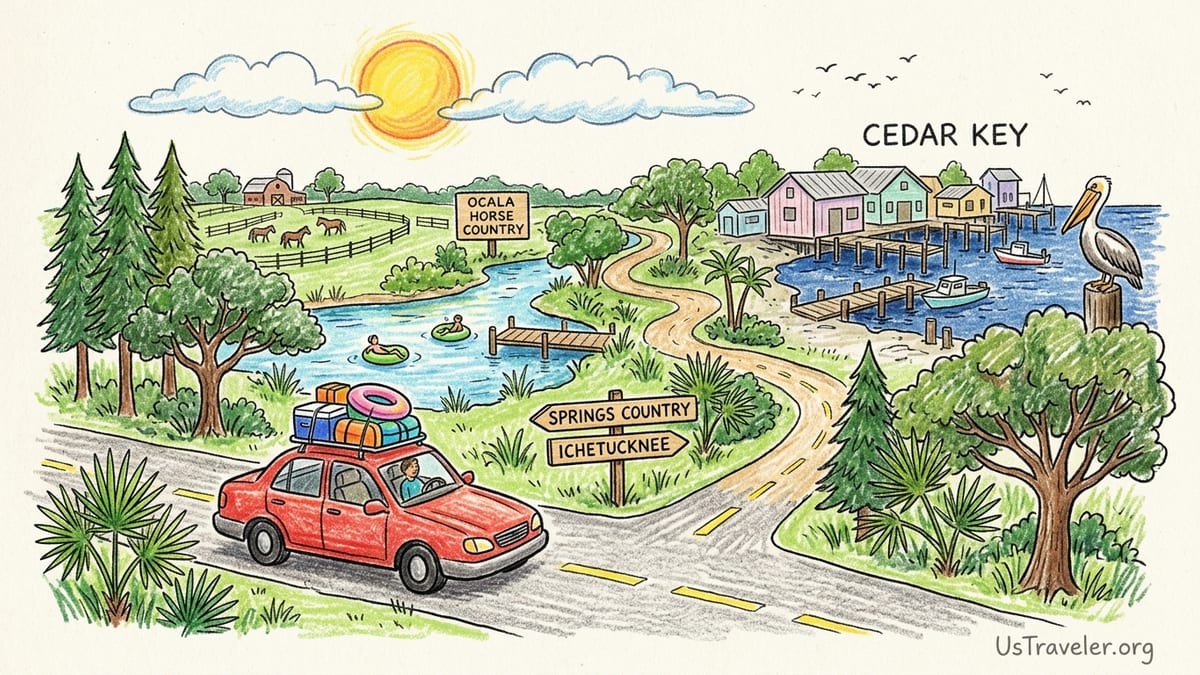
North Central Florida is one of the easiest places in the state to slow down. Within a two-hour radius of Gainesville you can float clear springs, follow the Suwannee River toward the Gulf and end days with sunsets over Cedar Key or horse-country views near Ocala. This loop keeps driving times short and rural, focusing on a realistic Gainesville → High Springs and Ichetucknee → Suwannee River country → Cedar Key → Ocala circuit that works for a long weekend or a leisurely week.
Why Start and End in Gainesville
Gainesville works well as the hub for this loop because it combines a university city’s services with quick access to quiet backroads. Gainesville Regional Airport has limited commercial flights, but many travelers arrive via Jacksonville, Orlando or Tampa and then drive 1.5 to 2.5 hours into town. Once you are here, the key advantage is that no destination on this circuit is more than roughly 90 minutes away in normal traffic, which cuts down on one-night hotel hops and long highway slogs.
For a typical five to seven day itinerary, plan to spend at least two nights in Gainesville at the start or end. This gives you time to sort out your rental car, shop for last‑minute road‑trip supplies and sample the local dining scene before you head into more rural territory where late‑night options and big grocery stores are limited. Chains like Publix supermarkets and well-known outdoor outfitters in Gainesville are useful places to stock up on snacks, water jugs, dry bags and a basic cooler for spring visits.
In terms of car rental, you will find the most choice and competitive pricing at the larger city and airport locations. In 2026, compact and midsize rentals in Florida often run in the range of 40 to 70 US dollars per day before insurance and taxes, with major brands such as Enterprise, Hertz and Budget all represented. A standard sedan is usually sufficient for this route, since all points are reachable by paved roads, but a slightly higher-clearance SUV can feel more comfortable on some of the patched county roads near the Suwannee or in heavy summer downpours.
Gainesville itself is also worth a bit of time. Between spring-hopping days, you can walk the trails at Paynes Prairie Preserve State Park, visit the Florida Museum of Natural History on the University of Florida campus or eat in the compact downtown around Main Street and University Avenue. Parking is generally straightforward outside of major university events; most hotels and vacation rentals include free on-site parking, something you will want throughout this road trip.
Practical Road Logistics and Driving Times
This loop is compact enough to feel relaxed, but it still involves rural stretches where planning ahead matters. The direct drive from Gainesville to Cedar Key covers around 57 miles and typically takes about 1 hour 20 minutes in normal conditions, which is a good benchmark for how short many legs can be if you choose the simplest routes. Other segments, such as Gainesville to High Springs, often take 30 to 40 minutes, while Cedar Key to Ocala usually runs around 1 hour 30 minutes via interior highways.
Fuel is readily available in and around Gainesville, High Springs, Chiefland and Ocala, but can thin out between small towns in Suwannee River country and closer to Cedar Key. A simple rule is to start each day with at least a half tank and top up whenever you pass through a larger junction town. For example, when driving from High Springs toward Branford and Old Town near the Suwannee, you will typically find standard gas-station services in Branford, then fewer choices as you angle down toward the remote canals around the town of Suwannee on the Gulf.
Parking is rarely a serious problem outside of festival weekends in Cedar Key or busy holiday periods at major springs. Most state parks such as Ichetucknee Springs and popular private spring parks use large surface parking lots; on peak summer days staff may temporarily halt admission or close lots when they reach capacity, so arriving early in the morning is a smart tactic. In Cedar Key, the historic core has public parking along Dock Street and side streets, along with additional lots near City Park and by the school; during big events such as art festivals, the town may add temporary lots and shuttle services, so check local announcements close to your travel dates.
Given the rural nature of some stretches, a modern navigation app with offline maps downloaded is helpful, particularly if you plan to explore gravel side roads to trailheads or river landings. Cellular coverage can drop along parts of the Suwannee and in pine forest corridors, so it is wise to have your key routes saved in advance rather than depending on live turn‑by‑turn instructions.
Gainesville to High Springs and Ichetucknee: Springs Country
The first leg north from Gainesville to High Springs introduces you to the limestone spring belt that defines this part of Florida. High Springs itself is a compact town with cafes, gear shops and gas stations. Many travelers base here for a night or two to explore nearby springs such as Ginnie Springs, Poe Springs and Blue Springs along the Santa Fe River. While Ginnie Springs is privately operated and known for camping and tubing, the county and state-run parks in the area tend to have quieter atmospheres and more predictable capacity limits, making them appealing for families or visitors focused on clear water and nature.
Ichetucknee Springs State Park, northwest of Fort White, is one of the marquee stops on this loop. The park protects a cluster of springs that feed the Ichetucknee River, famous for tubing in crystal-clear water framed by cypress and hardwood forest. The park is open year‑round, but the full tubing season with tram shuttles and rental services operates mainly in the warmer months. In recent years the north entrance tubing season has typically started around the Friday before Memorial Day and run through the summer, while other parts of the river and swimming areas remain accessible in cooler months. Hours, shuttle operations and daily visitor limits can shift, so always check the current park information shortly before your visit.
Spring entry timing matters. On hot weekends and holidays, daily visitation limits for tubing and parking can be reached by mid‑morning, especially at Ichetucknee. Aim to arrive at opening time for the first tubing runs, then use the hotter mid‑afternoon hours for shaded hikes or a return drive to your lodging. Tube rental prices at Ichetucknee and nearby outfitters are often in the rough range of 7 to 25 US dollars per person depending on tube style and trip length, with separate park entrance fees per vehicle. Many travelers bring their own US Coast Guard-approved life jackets for children even when rentals are available.
Overnight, you can choose between simple motels in High Springs, tubing-oriented campgrounds near the Santa Fe River and vacation rentals in the countryside. For example, rustic cabins and RV sites near the river appeal to divers using the many cave and spring systems, while small inns in downtown High Springs place you within walking distance of restaurants and coffee shops. Wherever you stay, verify parking arrangements in advance; even small motels generally offer free parking right outside your room, which is convenient when loading boards, coolers and wet gear after a long spring day.
Through Suwannee River Country to the Gulf
From the High Springs and Fort White area, the route swings west into Suwannee River country, a landscape of pine forests, farm fields and small towns. Driving through Branford, you cross the Suwannee itself, a tannin-dark river that has carried steamboats and timber in past centuries. Today, the river draws paddlers, anglers and history-minded travelers who stop in communities like Branford, Old Town and the riverside settlement of Suwannee near the Gulf of Mexico. Roadside parks and boat ramps offer views of the river’s cypress-lined bends, and in several spots you will see outfitters launching kayaks and fishing skiffs.
This segment is ideal for a slower driving day with planned pauses. For example, you might leave High Springs after breakfast, stop in Branford for fuel and a grocery top-up, then detour down county roads through Old Town to quiet river landings. Some travelers choose to spend a night in or near the town of Suwannee at the lower river, where small marinas, canal-front cottages and simple motels cater to boaters and birders exploring the nearby wildlife refuges. Others continue toward Chiefland or Cedar Key the same day, stopping only briefly at Suwannee viewpoints.
A key practical point in this area is that services concentrate in larger nodes. Branford and Chiefland offer multiple gas stations, hardware stores and full-size supermarkets, but once you turn down the long spur roads toward Suwannee or other small communities, options narrow to convenience marts, bait shops and small diners. Keep an eye on your fuel gauge before leaving the main highways, and carry sufficient drinking water and snacks in case you linger longer than planned at a boat launch or riverside trail.
For accommodations, you are more likely to find rental cottages and small independent lodges than branded hotels. Many list private driveways or gravel parking under the trees, which suits travelers carrying kayaks or bikes on roof racks. If you expect to arrive after dark, coordinate check‑in details and directions in advance, as signage along rural roads can be minimal and GPS routing occasionally inaccurate near dead‑end canals.
Cedar Key: Old Florida on the Edge of the Gulf
Cedar Key is the emotional highlight of many North Central Florida road trips, a compact island town set beyond salt marshes where the Gulf of Mexico laps against weathered docks. From Gainesville, you reach Cedar Key by driving west on state routes through Chiefland and across causeways and small bridges. In normal conditions the journey takes a bit over an hour, but it feels further away in character: pastel cottages, working boats and pelicans replace inland pines and college traffic.
The town’s walkable historic core runs along Dock Street and Second Street, with low-rise inns, vacation rentals and seafood restaurants clustered near the water. Many visitors choose to spend two or three nights here, using Cedar Key as a base for kayaking among mangrove islands, booking fishing charters or simply enjoying slow mornings with coffee overlooking the marina. Given the compact layout, most lodging options include on-site parking, often limited to one space per unit, with additional public parking available along side streets and in town lots.
Parking and crowding can feel different on festival weekends compared with ordinary weekdays. Events such as the annual art festivals bring a surge of visitors, and in recent years the town and businesses have responded with additional parking areas on the edge of town and informal shuttle services to ease congestion. Outside major events, day-trippers from Gainesville and Ocala usually have little trouble finding spaces, especially if they arrive before late morning. Expect to walk a few blocks between your parking spot and the waterfront if you come during sunset peak or on holiday weekends.
Because Cedar Key sits at the fringe of the Gulf, it is more exposed to tropical weather than inland stops. In the aftermath of major storms, some waterfront properties may still be under repair or have adjusted operations, while others reopen quickly. When planning a visit between June and November, build in some flexibility, buy travel insurance that covers weather-related disruptions and confirm that your chosen lodgings and key restaurants are open as usual. Even outside storm season, bring insect repellent for marshy evenings and be prepared for strong sun reflecting off the water during mid‑day kayak or boat tours.
Ocala, Horse Country and the Return to Gainesville
From Cedar Key, the loop bends southeast toward Ocala, trading coastal marshes for rolling pasture and live‑oak avenues. This region is famous for its horse farms, and even if you never set foot in a stable, you will notice white-fenced fields and training tracks along the drive. The route typically passes through Chiefland or Williston and then into the greater Ocala area, with a drive time of around 90 minutes in normal traffic. Arriving in Ocala gives you access to a different set of landscapes, including the clear waters of Silver Springs and the national forest beyond.
Ocala is larger than any other stop on this loop except Gainesville, so it can be a comfortable place to end the trip with a bit more dining choice and hotel variety. National hotel chains cluster around the I‑75 interchanges, offering predictable amenities, free parking and late check‑in. Closer to the historic downtown square, boutique inns and renovated motor courts target travelers looking for walkable access to restaurants, galleries and small breweries.
Silver Springs State Park, just east of Ocala, is a worthwhile day trip. The park’s glass-bottom boat tours glide over clear spring vents where fish and aquatic plants are visible year‑round. Reservations for popular time slots can be useful in peak season, particularly on weekend mornings. Parking is provided in surface lots near the entrance, and as with other popular attractions on this loop, arriving early helps you avoid the heaviest heat and crowds.
From Ocala, it is an easy final leg back to Gainesville, generally taking 1 to 1.5 hours depending on your chosen route and traffic. Many travelers time this return for earlier in the day so they can drop off rental cars during business hours and spend a last evening walking Gainesville’s neighborhoods or campus before flying out the next day. If you began your trip with only one night in Gainesville, consider ending with two, giving yourself a buffer in case of delays along the route.
Seasonal Timing, Weather and Safety
North Central Florida’s road‑trip season runs effectively all year, but your experience will vary by month. Late spring through early fall brings hot, humid days ideal for swimming and tubing the springs, but it also coincides with higher rainfall, afternoon thunderstorms and the Atlantic hurricane season. Winter and early spring are cooler and often drier, which suits hiking, paddling and long drives with windows down, though water temperatures in the springs remain a steady, refreshing chill even on cooler days.
For tubing-focused trips to Ichetucknee and nearby springs, late May through early September usually offers the fullest set of services such as tram shuttles and rental operations, but also the biggest crowds. If you prefer quieter conditions, consider shoulder-season visits in April or early May, or in late September and October when air temperatures are still warm enough for most swimmers and crowds have thinned. Outside of peak tubing season, the springs shift toward paddling, wildlife watching and diving rather than mass float trips.
Weather awareness is important on this circuit, especially in rural segments. Summer afternoons often bring intense but brief thunderstorms; plan long drives and open‑water activities for mornings where possible. On unlit rural highways, nighttime driving can mean sudden encounters with deer or open-range livestock near fences, so moderating speed after dark is wise. Keep an emergency kit in the car with water, a basic first-aid kit, a flashlight and a portable battery for phones.
Personal safety issues are generally straightforward. The main risks come from heat, sun exposure and water activities rather than crime. Wear sun-protective clothing and broad-spectrum sunscreen, drink plenty of water even when you are in and out of the springs and never mix alcohol with tubing or paddling. Where lifeguards are not present, stay within your swimming ability, and use life jackets for children and less confident swimmers even in shallow, clear water.
Optional Extensions Without Overstretching
This loop intentionally avoids stretching all the way to Jacksonville, Orlando or the Panhandle to keep driving days short and focused on nature. That said, there are realistic add‑ons that fit within the same general region without turning your trip into a marathon. One option is to add a night near Live Oak or White Springs, northeast of the main Suwannee corridor, to explore additional riverfront parks and historic towns. Another is to include a stop in Micanopy or Cross Creek south of Gainesville, small communities known for antique shops, literary history and lakeside landscapes.
If you have extra days and a particular interest, you might also add a night of camping in Ocala National Forest between Ocala and the St. Johns River corridor. Springs such as Juniper Springs or Alexander Springs offer a line of sight into the different ecosystems east of your main loop while still keeping total drive times manageable from Gainesville. When adding these segments, watch for seasonal closures, fire restrictions and capacity limits at campgrounds, which can change from year to year.
Travelers with horses or a strong interest in equestrian culture may choose to spend more time around Ocala and skip one of the northern river segments, using farm‑stay style accommodations or guided stable visits instead. Others might extend their Cedar Key stay to four or five nights, using the town as a base for multiple fishing charters or long, lazy days in rental cottages with screened porches. The point is to add depth rather than distance: by staying longer in a few places and minimizing daily mileage, you keep the trip closer to the slow‑travel spirit that North Central Florida encourages.
Whatever extensions you choose, maintain the same practical habits that support the core circuit: start drive days with a comfortable fuel level, confirm check‑in details and daily opening hours shortly before you arrive, and carry enough cash for small-town diners, produce stands and spring concessions that may not always accept cards or mobile payments.
The Takeaway
A North Central Florida road trip built around Gainesville, High Springs and Ichetucknee, Suwannee River country, Cedar Key and Ocala offers a compact loop rich in water, wildlife and small‑town character. Drive times stay mostly in the 30‑ to 90‑minute range, which means more hours floating down clear rivers or watching marsh sunsets and fewer stuck on interstates. With thoughtful timing around spring capacities, simple fuel and parking strategies and a mix of multi-night stays, the journey feels unhurried yet full.
By anchoring the trip in Gainesville and avoiding long detours to Orlando, Jacksonville or the distant Panhandle, you keep the focus on springs, rivers and coastal marshes that many visitors to Florida never see. Add in a bit of flexibility for weather, a realistic sense of your group’s energy levels and an openness to roadside discoveries, and this loop becomes less a checklist of stops and more a string of easy days where the rhythm of North Florida’s water and forests sets the pace.
FAQ
Q1. How many days do I need for this North Central Florida loop? Most travelers are comfortable with five to seven days, which allows at least one or two nights each in Gainesville, Cedar Key and either Ocala or Suwannee River country without rushing.
Q2. Is a regular rental car enough for this route? Yes. All destinations on this circuit are reachable on paved roads, so a standard sedan works well; a small SUV can be more comfortable on patched rural pavement and in heavy rain.
Q3. When is the best time to visit the springs around High Springs and Ichetucknee? Late spring through early fall offers warm air temperatures for swimming and tubing, while shoulder seasons like April, May, September and October balance comfortable water time with lighter crowds.
Q4. Do I need to book spring and park visits in advance? For popular spots such as Ichetucknee Springs State Park or Silver Springs boat tours, checking current rules and reserving tubing windows or tour slots in advance is wise, especially on weekends and holidays.
Q5. Are gas stations and food options limited on this circuit? Larger towns like Gainesville, High Springs, Branford, Chiefland and Ocala have full services, but choices thin out near the lower Suwannee and Cedar Key, so topping up fuel and carrying snacks and water is important.
Q6. Is Cedar Key still recovering from recent storms? Cedar Key is accustomed to preparing for and recovering from Gulf storms. Conditions can change season by season, so before booking, confirm that your chosen lodging and key services are operating normally for your travel dates.
Q7. Can I swim and tube year‑round? The springs stay clear and cool all year, but full tubing operations and shuttles typically run only in the warmer months; in cooler seasons, focus on paddling, hiking and short swims if you are comfortable in chilly water.
Q8. Is this loop suitable for families with children? Yes, provided you plan around shorter drive segments, early starts at busy springs, life jackets for kids in any water setting and lodging with easy on‑site parking and space for gear and downtime.
Q9. How far in advance should I book accommodations? For peak periods such as spring break, holiday weekends and major festivals in Cedar Key or Ocala, booking several months ahead is sensible; for ordinary weeks, a few weeks’ notice usually secures solid options.
Q10. Do I need travel insurance for this type of road trip? While not mandatory, comprehensive travel insurance that covers weather disruptions, medical needs and flexible cancellation can be helpful, especially during hurricane season or if you are booking nonrefundable stays and tours.