


I have driven New York State enough times to learn one stubborn truth: the best road trip here is not a heroic statewide loop. New York is too big, too varied, and too traffic-sensitive for a one-size-fits-all circuit that pretends NYC, the Adirondacks, the Finger Lakes, and Niagara are all easy neighbors. The trips that actually felt good were built in clusters: one region per drive block, with honest rest stops, reasonable arrival times, and at least a couple of two-night bases so you are not unpacking every morning with sore shoulders and a dashboard full of coffee cups. This is the route plan I would build now, after doing the long cross-state pushes, misjudging the time change between “map miles” and “mountain miles,” and paying more than I needed to in tolls because I had the wrong E-ZPass plan for New York.
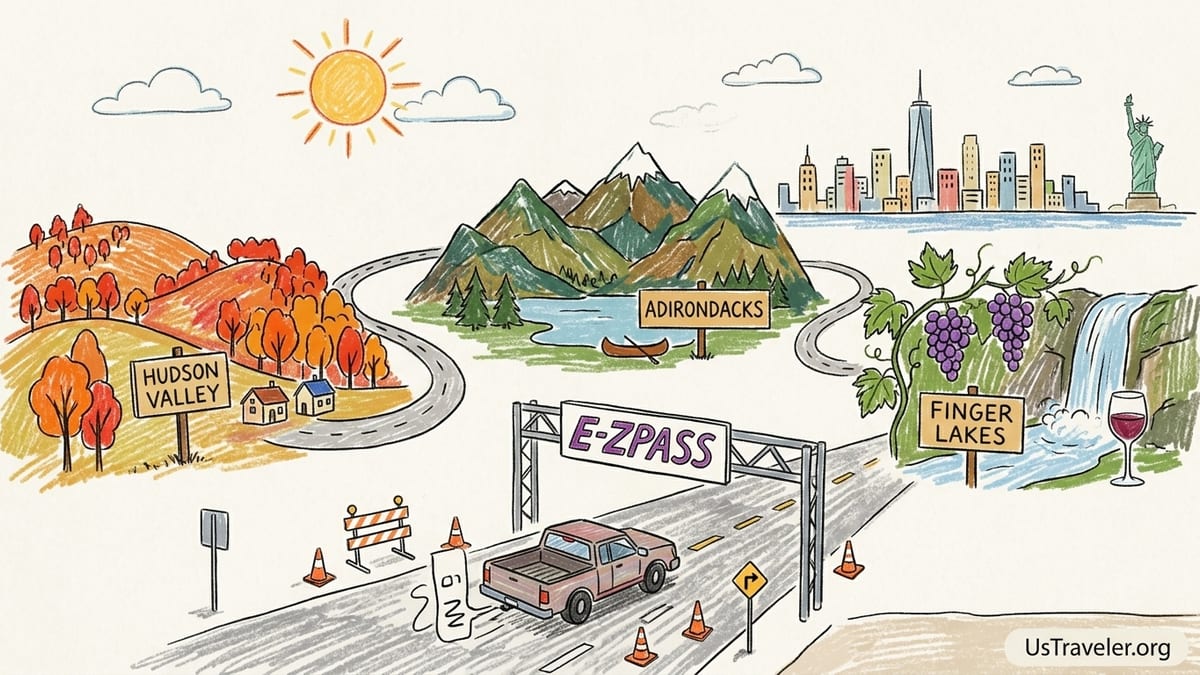
Start With The Car, Not The Map: Pickups, toll math, and the first-day trap
If you are flying in, I would pick up a rental car outside Manhattan whenever possible. A Queens or Brooklyn pickup can be convenient, but it invites two immediate problems: expensive parking while you pack or sightsee, and the possibility you will pay a Manhattan Congestion Relief Zone toll if your route dips into the zone south of and including 60th Street. If your New York road trip begins in the city, I prefer doing NYC without a car, then renting on the day you leave. In practice, that means a morning pickup near a train line, loading once, and driving straight out.
Before turning the key, I now do one unglamorous thing: I confirm how the rental agency handles tolls. New York has widespread cashless tolling, and the New York State Thruway uses all-electronic tolling with gantries. For Thruway travel, rates differ significantly depending on whether you have a New York-issued E-ZPass versus a non-New York E-ZPass or tolls-by-mail, and that difference is big enough to change which routes I recommend for a longer trip. If your rental company offers a toll transponder program, read the daily fee and the “per-toll” add-ons carefully and compare them to simply opening a New York E-ZPass account if your trip is long enough. I have made the mistake of accepting the rental toll program on autopilot, then realizing on day two that the convenience premium cost more than a nice dinner in Saratoga.
Traffic and fatigue are the other first-day trap. Leaving NYC at 3 p.m. because you wanted “one last museum” sounds reasonable until you are white-knuckling through late-day congestion with a four-hour drive still ahead. When I do NYC to the Hudson Valley or Catskills now, I either leave by mid-morning or I commit to a short first leg and a very early dinner. Your first day sets the tone for the rest of the trip, and the biggest quality-of-life upgrade is not a fancier hotel, it is arriving before dark with enough energy to take a walk.
Trip Structure 1: NYC to Hudson Valley to Catskills (the “easy win” route)
This is the most forgiving New York State road trip structure, and the one I recommend when someone says, “I want fall color, small towns, and hikes, but I do not want to live on the interstate.” The Hudson Valley gives you scenic driving that still feels connected, with plenty of river views, historic towns, and manageable distances. Then the Catskills add elevation, winding roads, and that quiet, woodsmoke-in-the-air vibe once nights cool down.
The best way I have found to drive this is to choose one Hudson Valley base for two nights and one Catskills base for two nights, rather than trying to “do it all” in singles. My one-night mistake here was moving too often: I once did a late arrival, early checkout, then a long day of short stops that left me tired and oddly unsatisfied, like I had sampled the region instead of experiencing it. Two nights lets you do a morning walk and still have time for a long lunch or a winery stop without watching the clock.
Real-world road notes matter on this route. Weekend traffic can thicken fast on the major corridors, and parking in popular river towns can be tighter than you expect, especially during foliage weekends. I build in one deliberate “easy afternoon” to reduce road fatigue: a scenic river drive, a short hike, then an early dinner. When I tried to stack too many “must stops” between NYC and the Catskills, I ended up doing the last hour in the dark on curvier roads, the kind of driving I do not repeat unless I have to.
If you are building this trip for fall, New York’s own current fall road-trip material is useful because it splits the experience into distinct itineraries instead of pretending the whole state is one route. I use that same philosophy: pick a Hudson Valley line and a Catskills line, then connect them with one satisfying drive day rather than a frantic day of detours.
Trip Structure 2: Albany and Saratoga to Lake George to Lake Placid (Adirondacks without regret)
If you want mountains, lakes, and classic upstate towns, this is the cluster that consistently delivers, but it demands realistic pacing. The biggest mistake I made the first time was underestimating how tiring Adirondack driving can be even when the mileage is modest. Curves, slower traffic behind RVs, and frequent “pull over for photos” moments stretch a day. The second mistake was trying to “touch Lake Placid” for one night. Lake Placid deserves two nights if you plan to hike, paddle, or even just walk the village without feeling rushed.
From a road-practical standpoint, I like this route because it has clean logistics. Albany has straightforward car access, Saratoga Springs is an easy add-on, and then you head north toward Lake George and into the Adirondacks. If you are using I-87 in the Capital Region, keep an eye on current advisories and lane-closure schedules. New York State DOT and the Thruway Authority publish traveler advisories and weekly closure lists, and I have had drives slowed by overnight lane closures and bridge work that were easy to anticipate if I had checked before leaving the hotel.
Trailhead access is the Adirondack-specific reality check. For High Peaks hiking, “parking” is often the limiting factor, not your fitness. Some trailheads have fees, some have strict capacities, and some access points rely on shuttles or reservations. A prime example is the Adirondack Mountain Reserve system, where parking access has been managed with a reservation approach in peak season. The lesson I learned the hard way: if a hike is important to you, plan your access first, then build the drive day around that start time.
Another concrete tip: embrace the shuttle concept when it exists. In the Route 73 corridor near Keene, seasonal shuttle service has been used to manage trailhead crowding and overflow parking, including service tied to popular trailhead access. That kind of local system is the difference between a calm hike day and a morning of circling lots, burning time and tempers. When I ignored the shuttle option once and “just tried my luck,” I started hiking later than planned and finished with that stressful feeling of chasing daylight.
Trip Structure 3: Finger Lakes to Greater Niagara (waterfalls, wine roads, and one long push)
The Finger Lakes and Niagara pair naturally, and it is one of the few cross-region connections that feels logical rather than forced. You get gorge trails, lake drives, tasting rooms, and then a big crescendo at Niagara Falls, plus Buffalo as a food city worth a night if your schedule allows. But it comes with two planning gotchas: seasonal park access and the temptation to do too much in one day.
Watkins Glen is the classic example of why you must check access before you promise yourself a specific hike. The park’s own status updates can include gorge trail closure information tied to ongoing infrastructure work, and these closures can change how you experience the park. I have driven into a destination expecting the signature walk, only to learn on arrival that the marquee trail was not fully accessible. It was still worth visiting, but the day felt different than the fantasy version I had built.
On the road, I would not repeat a Finger Lakes winery-heavy day followed immediately by a late drive to Niagara. The tastings are fun, but they slow your timeline, and the cumulative fatigue is real. When I tried to do a long scenic day, dinner, then “just finish the drive,” I arrived wired and tired, and I barely enjoyed the evening view. Now I place a firm stop: if I am doing Finger Lakes tastings, I sleep in the region and drive to Niagara the next morning.
Tolls matter here if you are using the New York State Thruway for long segments. The Thruway’s current toll schedules, including rates effective in 2026, can make the Buffalo-to-NYC-line drive dramatically different in cost depending on whether you have a New York-issued E-ZPass or are paying tolls by mail or with an out-of-state transponder billed at a higher rate class. I do not recommend guessing. I build the route with the Thruway’s own toll and distance calculator before I commit, especially if I am connecting Finger Lakes to other clusters.
How I Connect Clusters Into A Longer Trip (and what I refuse to do in one day)
When I have more time, I connect only two clusters, sometimes three, and I do it with a deliberate “bridge day” that has one anchor stop and a clean arrival. A realistic longer trip might look like: NYC to Hudson Valley to Catskills, then a transfer day toward the Finger Lakes, then Finger Lakes to Niagara. Or start in Albany and Saratoga, go north to Lake George and Lake Placid, then return south and pivot west to the Finger Lakes. The key is that the trip is not a perfect circle. It is a chain of logical blocks.
There are specific legs I personally do not repeat in one day anymore. One is trying to go from NYC all the way to the Adirondack High Peaks area with meaningful stops. You can do it, but the arrival is often late, and late arrivals are how you end up settling for whatever food is open and starting the next day behind. Another is trying to combine a full hike day in the Adirondacks with a long repositioning drive afterward. That is how you end up fighting drowsiness on dark highways, stopping for caffeine when you should be stopping for sleep.
Road fatigue management is not glamorous, but it is what makes a New York road trip feel good. I now schedule breaks at real facilities rather than “we will pull off when we need it.” On the Thruway, the service areas have been redeveloped and include common, predictable amenities. I plan for one longer midday stop at a service area, then a shorter stop later. In the Adirondacks, I use the Northway rest areas and welcome centers strategically because cell service can be inconsistent in some corridors, and the cleanest bathroom is sometimes the difference between a calm drive and an anxious one.
Finally, I build in one “nothing night” every four or five nights: a two-night stay where the second afternoon is intentionally light. New York rewards energy: stairs in gorges, long walks in villages, extra stops at overlooks. The best trip I have driven across the state was not the one with the most pins on the map, it was the one with the most mornings I woke up genuinely excited to get back in the car.
Parking, park access, and seasonal realities you should verify right before you drive
New York’s road trip problems are rarely about finding something to do. They are about access and timing: where you can park, when a road is open, whether a trail or scenic drive is seasonal, and how local rules change the plan. In the Adirondacks, trailhead demand can be intense in peak foliage and summer weekends, and systems like shuttle operations and reservation-managed access exist for a reason. If you are targeting a specific hike, treat the trailhead like a timed ticket experience: confirm the parking approach, know your backup, and do not assume you can “figure it out at 9 a.m.”
In the Finger Lakes, gorges and waterfalls often have seasonal conditions that change the experience, even when a park is technically open. Wet stairs, freezing spray, and maintenance closures can re-route you to rim trails. For fall trips, I confirm park notices the week I drive, not the month I book. I also plan my footwear and timing around early sunsets, because a gorge that is magical at noon can feel slick and shadowy late in the day.
For state park entry, the Empire Pass is a real-world value tool if you are visiting multiple state parks or DEC day-use facilities. New York State Parks sells a 2026 Empire Pass in a digital option and a physical card option, each with its own price point, and it is valid through December 31, 2026. I like the digital option when I am flying in and do not want to wait for mail delivery, but I still screenshot purchase confirmation details and keep the app handy in case cell signal is weak at a gate.
Construction is the last seasonal reality. Between DOT traveler advisories, 511 updates, and the Thruway’s weekly lane-closure postings, you can avoid the worst surprises. I have lost an hour to predictable work zones simply because I did not check the night before. Now I do it as part of my evening routine: tomorrow’s start time, tomorrow’s major highway segments, and whether any closure patterns suggest leaving earlier or later.
The Takeaway
After driving across New York State more than once, the route I would build today is not one giant loop. It is a set of smart regional road trips you can actually enjoy: NYC to Hudson Valley to Catskills for the easiest scenic win; Albany and Saratoga to Lake George to Lake Placid for a classic Adirondack arc that deserves two-night bases; Finger Lakes to Greater Niagara for waterfalls, wine country, and a natural westward payoff. When you have longer time off, connect only the clusters that fit your energy and your season, and budget for the non-negotiables: toll strategy, realistic drive days, trailhead access, construction checks, and one or two “rest evenings” that keep the whole trip from turning into a grind.
If you plan like a driver instead of a map collector, New York rewards you with the kind of moments you cannot schedule: a sudden overlook on a scenic byway, a perfect diner coffee after a rainy hike, a quiet lake at dusk when everyone else is racing toward the next pin. That is the New York road trip worth repeating.
FAQ
Q1. Do I need a New York-issued E-ZPass for a New York State road trip?
Not strictly, but Thruway tolls can be significantly cheaper with a New York-issued E-ZPass than with tolls-by-mail or a non-New York transponder, so it can be worth it for long Thruway segments.
Q2. What is the biggest mistake you made driving across New York State?
Leaving NYC too late in the day, then trying to “make up time” with a long evening push. The stress and fatigue were not worth the extra night saved.
Q3. Which destinations deserve two nights instead of one?
Lake Placid is the clearest two-night base if you plan to hike or explore. In the Finger Lakes, a central lake town also benefits from two nights if you want a relaxed gorge-and-winery rhythm.
Q4. Can I realistically do NYC, the Adirondacks, the Finger Lakes, and Niagara in one week?
It is possible, but it often becomes a high-mileage trip with late arrivals. A better one-week plan is two clusters, not all four.
Q5. Are there seasonal shuttles for Adirondack trailheads?
Yes, shuttle service has been used seasonally in the Route 73 corridor near Keene to reduce roadside parking pressure and improve access to popular trailheads.
Q6. How should I plan rest stops on long I-90 or Thruway drive days?
Use Thruway service areas for predictable bathrooms and food, and schedule one longer midday stop plus one shorter stop later to manage fatigue instead of pushing until you feel desperate.
Q7. What should I check right before I drive to a gorge or waterfall park in the Finger Lakes?
Confirm current trail status and any gorge trail closures or detours. Conditions and maintenance work can change the signature walk even when the park is open.
Q8. Is the Empire Pass worth it for a road trip?
If you plan multiple visits to New York State Parks and participating DEC day-use facilities, it can pay off quickly versus paying separate day-use fees.
Q9. What drive leg would you never repeat in one day?
A full Adirondack hike day followed by a long repositioning drive. The combination is a recipe for tired, risky evening driving.
Q10. How do I avoid surprise delays from construction?
Check New York State DOT traveler advisories and the Thruway’s weekly lane-closure schedules the night before each major drive day, then adjust departure times accordingly.