


I planned this New York State fall foliage road trip the way I plan most autumn trips now: I refused to pick “peak weekend” months ahead and hoped for the best. Instead, I built a route that could bend with the weather, the elevations, and the honest truth every leaf-peeper learns sooner or later: the map turns when it turns. For the week of September 23 to 29, 2026, New York’s official I LOVE NY weekly report had the Adirondacks showing the strongest changes statewide, with additional progress in the Catskills and Central New York. So that’s where I pointed the car first, with a loose plan, a warm layer for cold mornings, and the expectation that at least one region would be earlier or later than I guessed.
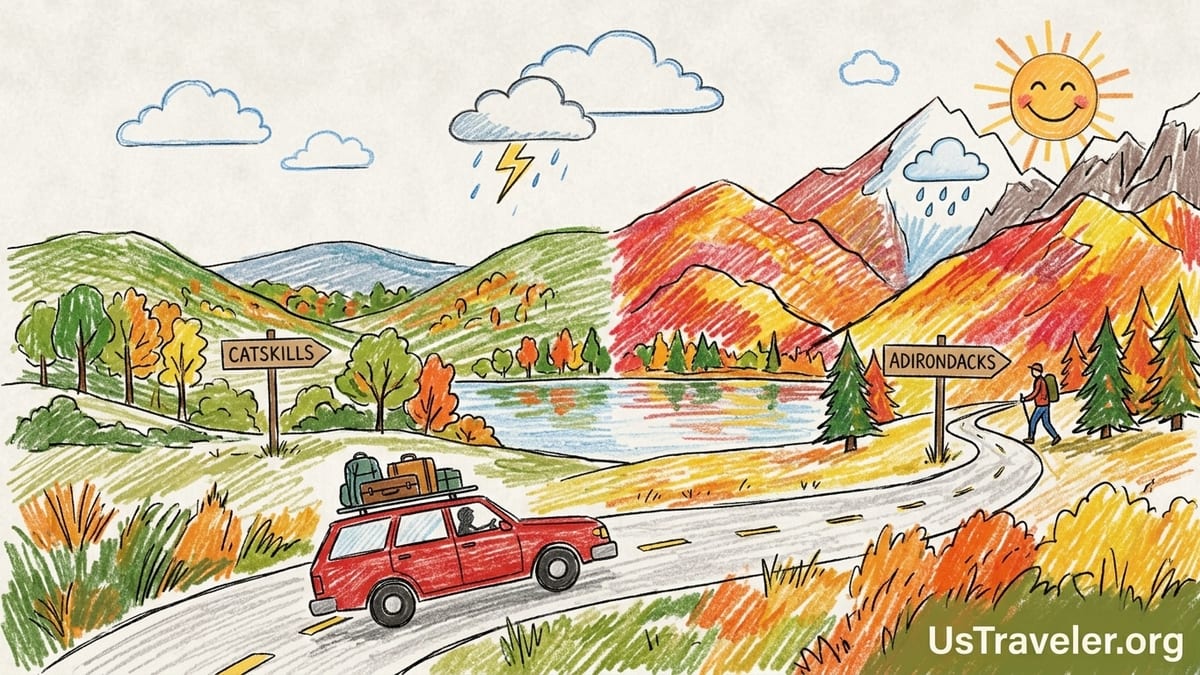
Plan the trip like a weather chase, not a holiday weekend
The backbone of this road trip was not a fixed itinerary, but a weekly reality check: the I LOVE NY Fall Foliage Report, which updates once a week during the season and is built from field reports by volunteer observers. For September 23 to 29, 2026, the report flagged the Adirondacks as the state’s most advanced area, with notable movement also expected in the Catskills and Central New York. It even called out specific places likely to be among the most changed that weekend, including Wilmington, Tupper Lake, Newcomb, Benson, Lake Pleasant, Long Lake, and Old Forge in the Adirondacks, plus Delhi, Windham, and Highmount in the Catskills, and Sharon Springs, Cherry Valley, and Utica in Central New York.
That level of specificity changes how you plan. Instead of booking one nonrefundable hotel and praying, I held two cancellable reservations and treated them like chess pieces: one in the Adirondacks for the first nights, and one further south as a fallback. I also built the driving days so I could bail out early if rain or wind arrived, or if a higher-elevation region jumped ahead faster than expected. The guiding idea was simple: color generally starts earliest at higher elevations, especially the Adirondack High Peaks, then creeps through mid-elevation areas like the Catskills and Central New York, and only later reaches the lower Hudson Valley, Long Island, and New York City. But “generally” is doing a lot of work, and I planned around that uncertainty instead of ignoring it.
I left a few days after that September 23 report window opened, aiming to be in the High Peaks before weekend traffic fully stacked up. The decision felt like a hedge against the year’s variability: if the Adirondacks were truly leading the state, I wanted to see those first strong changes while they still had texture on the mountainsides, not after a storm stripped the maples and left only bare branches and ground color.
Leg 1: Adirondack High Peaks, where mornings start cold and color starts first
I drove north with an early start and a jacket on the passenger seat. In the High Peaks region, mornings can feel like a different season than downstate, and even local visitor guidance stresses that summit temperatures can run at least 10 degrees colder than the base. That temperature spread is part of why the Adirondacks so often lead New York’s foliage timeline: cold nights arrive sooner at elevation, and the first real color moves through the high country before most of the state is ready to join in.
For the “live conditions” pulse check, I treated Wilmington and the Whiteface area as my first checkpoint because the official weekly report named Wilmington among the places expecting significant change. If you want a high-effort, high-reward viewpoint, the Whiteface region gives you options that scale with weather and crowds: a drive up the Whiteface Veterans’ Memorial Highway when conditions allow, or gondola access on operating days, or shorter walks near town when clouds sock in. I got there early, because Whiteface itself warns that foliage weekends can create long afternoon lines and that arriving early helps.
The second Adirondack checkpoint was a hiking day that could still work if parking was chaotic. In the High Peaks, trailhead logistics can make or break a leaf weekend. At the Adirondak Loj (Heart Lake), Adirondack Mountain Club parking is pay-to-enter; ADK’s own guidance lists a discounted member rate of $10 per day and $6 per half day, and independent trail guides commonly describe non-member day rates in the same ballpark range depending on time of day. I planned to be at the gate early, with a backup plan to use the South Meadows approach for Marcy Dam access if the main lot filled and I didn’t want to gamble on roadside overflow.
What I saw matched the reason you come early: in sheltered valleys, plenty of green still held, but on open slopes and along high ridgelines the first serious yellows and oranges were already reading from a distance. The most useful lesson was not “it’s peak” or “it’s not peak,” but that change was uneven. A single viewpoint could look close to peak in one direction and stubbornly late in another, depending on elevation, exposure, and which species dominated that hillside.
What happened when the Adirondacks were ahead, but not everywhere at once
Even in the region with the strongest statewide change, the trip immediately proved why you should not treat a foliage report like a promise. The Adirondacks were clearly further along than the rest of the state, but the color was patchy: bright bands on higher terrain, mixed green-and-gold near lakes, and pockets that looked like they needed another week. This is exactly where travelers get frustrated if they only think in calendar terms. They arrive expecting every mile to look like a postcard, when real foliage is more like weather radar: bands, pockets, and sudden surprises.
One afternoon, light rain moved through and flattened the contrast. Wet leaves can glow when sun follows, but under gray skies the palette looked muted and darker, and the best photos came from close range rather than big panoramas. That rain also changed the next morning’s plan. Instead of committing to a long exposed hike, I chose shorter viewpoints that still gave me a “read” on the region’s progress: roadside pull-offs, lake edges, and quick climbs where I could turn around if the clouds dropped lower.
Traffic was the other variable. In the High Peaks corridor, weekend leaf traffic tends to compress around a few famous access points, and the difference between arriving at a gate early versus late can be the difference between hiking and negotiating for a spot. I treated each morning like a small race: coffee first, parking next, scenic stops after.
That day-by-day flexibility mattered because the Adirondacks were doing what they often do: starting first, but not finishing all at once. The trip’s best color moments were earned by moving with elevation and light, rather than waiting for a mythical day when everything turns simultaneously.
Leg 2: Catskills scenic drives, when the “next wave” is developing
After the Adirondack days, I pointed south toward the Catskills, not because I expected them to outshine the High Peaks that week, but because the weekly I LOVE NY report showed additional progress there and even singled out places like Delhi, Windham, and Highmount as likely to see significant change that weekend. The Catskills are a perfect second act because they are closer to downstate cities, easier to tackle as a long weekend, and full of classic roadside overlooks that don’t require committing to an all-day summit push.
The Catskills also taught the trip’s most practical lesson: a region can be “in progress” and still deliver a great drive if you choose roads with elevation swings. A valley town can look mostly green, then a few miles later on a higher ridge you can hit a pocket of early color that feels like you drove into a different week. That’s why scenic drives here are not just about the destination, but about the climb: you’re chasing temperature and elevation, not a date on a calendar.
On this leg, the mood changed from alpine bite to damp woodland. A light drizzle and low clouds pushed me to prioritize viewpoints that were reliable even in poor visibility: waterfalls, not just mountain vistas; short hikes, not exposed ridges; and stops that still feel rewarding if the horizon disappears. I treated each stop like an editing decision: if the sky is flat, go where the forest canopy is close and the leaf color is the subject, not the background.
One more reason the Catskills worked as a flexible pivot is lodging variety. If the Adirondacks were surging into peak and prices were climbing, the Catskills gave me more options to reposition without committing to a single expensive resort stay. I considered a day pass option near New Paltz for a more curated trail network; Mohonk Mountain House, for example, sells a hiking trails day pass that is valid from 7 a.m. until dusk. When I can’t confirm a fair “typical” price across the whole region, I plan around what I can verify: whether a pass exists, what it includes, and how strict the time window is.
Leg 3: Cooperstown to Watkins Glen, using Central New York as the smart hedge
When one region runs early or late, Central New York and the Finger Lakes can be the trip saver. The weekly I LOVE NY report for September 23 to 29, 2026 did not just nod vaguely at “upstate”; it specifically pointed to Central New York progress and highlighted places like Sharon Springs, Cherry Valley, and Utica. That aligned well with a road-trip-friendly route that tourism planners have been suggesting for the season: Cooperstown to Watkins Glen through Central New York and into the Finger Lakes.
This is the leg I recommend to anyone who wants a foliage trip that still works when the mountains are unpredictable. Cooperstown gives you a walkable town base and easy day drives, and the roads south and west toward the Finger Lakes let you track subtle foliage changes as elevation and microclimates shift. In late September, that “subtle” part matters: you might not be in full blaze yet, but you will often see enough change to feel the season beginning, especially around higher ground and along cooler waterways.
By the time I reached the Watkins Glen area, I planned around what I could confirm from official sources: the state park’s gorge trail is seasonal and typically closes in mid to late October depending on weather, and parking fees may be charged. That uncertainty is not a flaw; it is a real planning factor. On a foliage trip, you do not want to arrive assuming a gorge will be open only to learn conditions changed, so I always build an alternate: lakeside walks, town viewpoints, or a second park within driving range.
This leg also illustrated how “later than expected” can still be a win. If you arrive and the hills are not yet at peak, you can still have a memorable day by choosing experiences where foliage is not the only show: the gorge walls, waterfalls, and stonework of Watkins Glen are compelling even when the canopy is mostly green. In other words, Central New York is where I go when I want the trip to succeed even if the color refuses to cooperate.
Where the trip went sideways, and how the weekly report would change my next attempt
The road trip’s one real frustration was that I tried to treat “progressing in the Catskills and Central New York” like it meant “comparable to the Adirondacks.” It didn’t. The Adirondacks were still the headline, and when I mentally compared every stop to High Peaks color, I was setting myself up for disappointment. The better comparison was not between regions, but between elevations within each region: in the Catskills, go higher; in Central New York, seek out cooler corridors and higher ground; in the Adirondacks, accept that some valleys lag even when the ridges are firing.
If I were doing the same week again, I would tighten the time window between the Wednesday report and my departure even more. The I LOVE NY report updates weekly, and that cadence is perfect for a “few days before” go decision. My improved playbook would be: check the report on Wednesday, book Thursday for Friday arrival, and keep cancellations flexible until the last realistic moment. That strategy respects the fact that wind and rain can change the look of a region overnight, and that peak can be brief at elevation.
I would also use the report’s named locations more aggressively. When the report says Wilmington, Tupper Lake, Newcomb, Long Lake, or Old Forge are among the most changed that weekend, that is not just trivia. It is a routing hint. It suggests where observers are seeing progress now, not where peak usually lands on a historical calendar. The trip felt most “dialed in” when I followed those specific breadcrumbs rather than chasing generic regional labels.
Finally, I would budget more time for traffic and parking around the most famous viewpoints, and I would keep at least one “quiet day” built in. Leaf season crowds are not just an inconvenience; they can determine whether you can safely park, whether you can linger at a pull-off, and whether a short hike remains pleasant. A flexible itinerary gives you permission to pivot to a less-hyped trailhead and still feel like you won the day.
The Takeaway
If you want to chase peak color in New York without guessing the dates, you have to plan like you’re tracking a moving front. In late September 2026, that front was clearly strongest in the Adirondacks, with the Catskills and Central New York developing behind it, and lower-elevation regions still mostly waiting their turn. The winning approach was not locking in a single “peak weekend,” but building a route that could shift by a few hours or a few hundred miles based on live conditions and a weekly official snapshot.
Drive north first when the Adirondacks lead, especially if the weekly report says the strongest changes are there. Then be ready to pivot south to the Catskills for elevation-based scenic drives, and keep the Cooperstown-to-Watkins Glen corridor in your pocket as a high-reliability, scenery-rich hedge when the mountains are early, late, wet, windy, or simply uneven. And above all, remember the most comforting truth of leaf season: every year differs, but flexible planning works every year.
FAQ
Q1. What is the best way to time a New York fall foliage road trip without guessing?
Use the weekly I LOVE NY Fall Foliage Report and decide your route only a few days before departure, prioritizing the regions reporting the strongest current changes.
Q2. Which New York region typically changes first?
Higher elevations typically change first, especially the Adirondack High Peaks, because colder nights arrive earlier at elevation.
Q3. For September 23 to 29, 2026, where were New York’s strongest foliage changes?
During that week, the Adirondacks were highlighted as showing the state’s strongest current changes, with additional progress in the Catskills and Central New York.
Q4. What Adirondack areas were highlighted for significant changes that week?
Examples named in the weekly report included Wilmington, Tupper Lake, Newcomb, Benson, Lake Pleasant, Long Lake, and Old Forge.
Q5. What Catskills areas were highlighted for significant changes that week?
Examples named in the weekly report included Delhi, Windham, and Highmount.
Q6. What Central New York areas were highlighted for significant changes that week?
Examples named in the weekly report included Sharon Springs, Cherry Valley, and Utica.
Q7. How should I build a road trip route that can pivot if one region is early or late?
Plan a north-to-south progression with flexible lodging, starting in the Adirondacks, then shifting to the Catskills, and using a Cooperstown-to-Watkins Glen route as a reliable mid-state option.
Q8. What is a realistic crowd and parking strategy for the High Peaks?
Arrive very early at popular trailheads, expect pay-to-park access at some locations, and keep a backup trailhead or approach in case lots fill.
Q9. What weather detail matters most for foliage planning?
Cold nights and storms matter most. Cold accelerates change at elevation, while wind and heavy rain can knock leaves down quickly, shortening the best window.
Q10. Is Watkins Glen still worth visiting if leaves are not at peak?
Yes. The gorge and waterfalls are compelling even when canopy color is early, and you can still get strong autumn atmosphere on cool, damp days.