


New York State rewards patience. The best stops are rarely the ones closest to the highway exit, and the drives that look long on a map often turn into the trips you keep talking about. I planned my routes around regions that feel genuinely distinct: the Hudson Valley’s river towns and estates, the Catskills’ mountain hamlets, the Adirondacks’ big-wilderness scale, the lakes and racetracks around Saratoga, the Finger Lakes’ wineries and gorges, the raw force of Niagara, and Long Island’s beaches and wine country. What follows is how I’d choose destinations now, based on the arrivals that felt promising, the check-ins that made me exhale, the meals I still remember, and the very specific moments that justified every mile.
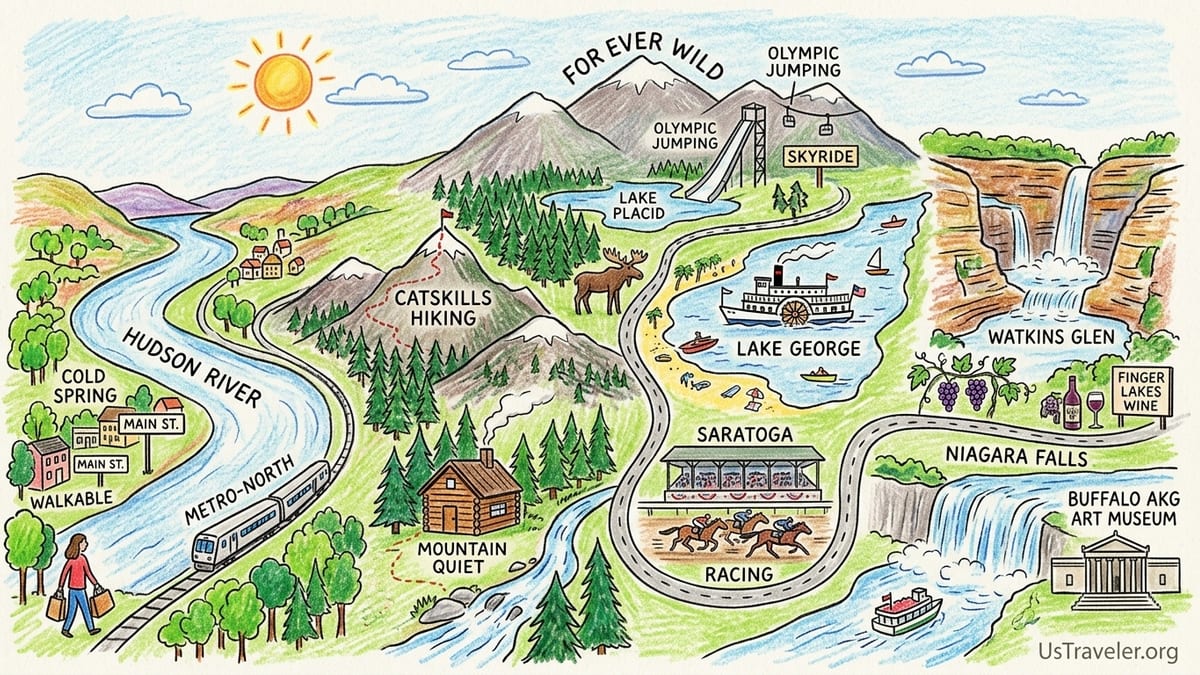
Hudson Valley: The easy escape that still feels like a trip
The Hudson Valley is my favorite “start here” region because the arrival is immediate: the river begins to run alongside you, the light changes, and towns start popping up with real main streets rather than strip malls. It’s also the part of the state that works as a short extension from New York City, whether you’re driving or taking Metro-North and renting a car for the last leg. If I only had a long weekend and wanted scenery, history, and good meals without committing to a huge mileage day, this is where I’d point the car first.
For lodging, I’d book two nights in a walkable river town so evenings don’t require more driving. A simple rhythm worked best for me: arrive before dark, park once, and spend the first night strolling for dinner rather than chasing a reservation across counties. The Hudson Valley does “choose-your-own” well: couples can build days around galleries, estates, and farm-to-table dining; families can anchor around playgrounds, riverfront paths, and low-stress hikes with big payoffs.
What made the Valley worth including wasn’t a single attraction, but the way a day strings together. Morning coffee, then a drive that’s scenic even at 35 mph. A mid-day stop at a historic site or riverfront park. Late afternoon when the river goes silvery and every overlook looks like it was composed on purpose. Crowds can be real on peak foliage weekends, so I’d travel with a “Plan B” mindset: if a popular overlook lot is full, pivot to a quieter backroad viewpoint and keep moving.
If I were allocating nights today, I’d give the Hudson Valley 2 to 3 nights as a standalone trip, or 1 to 2 nights as a “bookend” on either side of a longer upstate loop. It suits first-timers, food-focused travelers, and anyone trying to keep a road trip feeling restorative rather than relentless.
Catskills: Mountain air, small towns, and the kind of quiet you can hear
The Catskills are where I go when I want the drive to slow me down. The roads begin to bend, the shoulders narrow, and suddenly you’re in terrain that looks like it’s been doing its thing long before you arrived. The mood shifts from river-valley pastoral to mountain-forest dramatic, especially in shoulder seasons when the trees are either on fire with color or still skeletal and moody.
Where you stay matters here because the Catskills are spread out and the best moments often happen early or late in the day. I like booking a place that makes coming “home” feel like part of the trip, not just a crash pad. Think: somewhere you can dry boots, make a quick breakfast, and get to a trailhead without a full hour of driving. That setup also helps if you’re traveling with kids and need a flexible base for naps and snack breaks.
Meals in the Catskills are at their best when you treat them like a reward for time outside. On a day with a longer hike, I plan dinner somewhere casual enough that dusty shoes don’t feel like a problem. On a slower day, I’ll aim for a more intentional meal and treat it as the main event. Crowds are the wildcard: popular weekends can make parking and trailhead starts feel competitive, so I’d start earlier than you think you need to, then build in a mid-afternoon break when day-trippers are driving back toward the Thruway.
Nights to budget: 2 to 4. This is a hiking-forward region, but it also works for couples who want cabins, fireplaces, and long breakfasts. If you’re chasing waterfalls later in the trip, the Catskills can be a calm “mountain reset” before the gorge-heavy Finger Lakes.
Lake Placid and the Adirondacks: The six-million-acre feeling you can’t fake
The Adirondacks are the part of New York that changes your sense of scale. It’s one thing to read that the Adirondack Park covers roughly six million acres and is often described as “Forever Wild,” but it’s another to feel how quickly towns fall away and how big the landscape gets once you commit to the drive north. This is not a quick detour. It’s a destination that wants multiple nights, and it pays you back with the kind of air that feels like it’s doing something medicinal.
Lake Placid is my preferred first base because the arrival is friendly even if you’re not an outdoors expert. You get a real village, lakeside views, and a menu of “choose your own intensity” activities. If you want the Adirondacks without needing a backcountry plan, Lake Placid is the on-ramp. For lodging, I’d stay in or near the village so you can walk to coffee and dinner, then drive out to trailheads and overlooks by day.
The experience that cemented this region for me was leaning into the Olympic sites, not as a history lesson but as a viewpoint generator. The Olympic Jumping Complex’s Skyride Experience is one of those activities that makes a place click: you ride up, step onto an observation area, and suddenly the lakes, peaks, and valley layout make sense. It’s a specific, tangible “I get it now” moment that justified the long drive. If you’re traveling with mixed ages or varying fitness levels, it’s also an equalizer because everyone can share the view.
How many nights would I allocate now? Minimum 3, better at 4 to 6 if you want to actually hike, paddle, and still have time for unplanned stops. This is also one of the best regions in the state for winter travel: Lake Placid earns its cold-weather reputation, and the area is built for snow. Couples do well here year-round, families do well in summer and winter, and serious hikers should treat it as a longer basecamp rather than a one-night cameo.
Lake George: The classic lake weekender that still delivers
Lake George can feel like you’ve arrived in a postcard version of an American summer. It’s busier, more overtly vacation-forward, and it doesn’t pretend to be undiscovered. That’s part of its charm. If your ideal trip includes being on the water, grabbing something casual to eat, and having your evenings feel lively rather than secluded, this region belongs on the route.
I plan Lake George as a “fun stop” between wilderness-heavy Adirondack time and culture-heavy Saratoga time. The arrival tends to be straightforward, and it’s a place where you can see the day taking shape quickly: lakefront strolls, boat activity, arcades and ice cream for families, and sunset views that feel earned even if you did very little hiking.
For crowds, I approach Lake George like a popular beach town: you manage it with timing. Start earlier, park once if you can, and accept that mid-day on a peak weekend will be a scene. The scenery is the reason to tolerate the bustle: when the lake opens up in front of you and the hills frame the water, the place feels bigger than its main strip.
Nights to budget: 1 to 3 depending on your travel style. Families can happily do 3 nights with beach time and boat rides. Couples can do 1 to 2 as a lively interlude. Hikers may prefer to base deeper in the Adirondacks and treat Lake George as a day trip or final-night comfort stop with easier dining options.
Saratoga Springs: Mineral-water strolls by day, race-day energy by choice
Saratoga Springs is a pivot point in an upstate loop: it’s where the trip can become more urban and social without losing the “upstate” feeling. The town is built for walking, and it’s easy to fill a day without committing to a big drive. That matters after you’ve been logging miles and trail time. It’s also a good couples stop because the evenings can be as relaxed or as high-energy as you want.
Where I’d stay is simple: somewhere you can walk to dinner, then walk again for coffee the next morning. Saratoga is most satisfying when you’re not constantly moving the car. A weekend here can be built around the town’s parks, spas, and shopping, with easy drives out to quieter roads when you want a break from people.
If you’re coming specifically for racing season, plan it like an event. The Saratoga Race Course atmosphere is famous for a reason: it’s social, it’s tradition-heavy, and it’s easy to spend more time than you expected just people-watching and soaking in the rituals. For 2026, general admission is published as $7 in advance or $10 at the gate on race days, which makes it one of the better-value big-ticket experiences in the region if you time it right and keep the day simple.
Nights to budget: 2 is the sweet spot for most travelers, 3 if you want to layer in nearby lake time or take your time with restaurants. It’s great for couples, friend trips, and anyone who likes the idea of a “dress up a little” night after days of hiking gear. Families can enjoy it too, especially if you anchor around parks and keep race-track time shorter.
Finger Lakes: Wine roads, Ithaca energy, and Watkins Glen’s gorge magic
The Finger Lakes are where I plan to slow down the driving and speed up the small pleasures. The region rewards a flexible itinerary: a late breakfast, a scenic drive along a lake, a tasting room stop that turns into a longer conversation, then a hike that ends with a waterfall thundering into a gorge. The state tourism messaging often highlights Finger Lakes wineries and waterfalls as a distinct experience, and in practical travel terms, that pairing really does define the best days here.
I like basing in the Ithaca area when waterfalls and hikes are the priority, because you can wake up close to multiple gorge parks and still have a town with real restaurant options at night. Arrival feels collegiate and lively: coffee shops, bookstores, and the sense that people actually live here year-round. If wine is your main focus, you could also base closer to the bigger lakes for easier tasting loops, but Ithaca keeps the trip balanced for mixed interests.
The most specific “worth it” moment for me was at Watkins Glen State Park, where the gorge trail turns the day into a sequence of cool air, stone steps, and constant water. It’s the kind of place where you can hear the falls before you see them, and where the crowd noise fades the moment you round a bend and the gorge walls close in. This is also where practical planning matters: New York State Parks commonly charge a vehicle use fee at many parks during peak season, so I now decide in advance whether I’m buying individual day entries or leaning on an Empire Pass for a loop that includes multiple parks.
Nights to budget: 3 to 5 if you want the full Finger Lakes effect. For wine-focused travelers, allocate time for unhurried tastings and designate a driver or book a local tour. For hikers and waterfall chasers, plan early trail starts and keep afternoons open for recovery and town meals. Families do well with lakefront stays and shorter gorge walks. Couples do well with winery afternoons and one big waterfall day.
Niagara Falls and Buffalo: Big-water spectacle, then a city that surprises you
Niagara Falls is the rare attraction that lives up to the buildup, as long as you accept what it is: a major global draw with major crowds. The arrival can be chaotic if you hit a peak weekend at mid-day, so I plan it like an airport run. Get there earlier than you think, commit to a parking plan, and set expectations that the best views will still be shared views.
I focus my Niagara day around two experiences: getting close enough to feel the spray, and then stepping back to take in the full sweep. The Maid of the Mist is the classic move for the first category, and its published 2026 ticket prices are listed as $30.25 for adults and $19.75 for children ages 6 to 12, with kids 5 and under free with a paying adult. Even with crowds, that boat ride is a core memory generator: the kind of wet, loud, grinning experience that’s hard to replicate anywhere else in the state.
After Niagara, I like shifting the overnight to Buffalo to change the tone. Buffalo gives you breathing room and a stronger food-and-culture layer, and it’s where the trip starts feeling less like a checklist and more like a lived-in place. The Buffalo AKG Art Museum is the stop I’d build around because it’s an easy “reset” after the sensory overload of the falls. The museum has published adult admission at $18 (with discounts for students and seniors), and it’s a clean, satisfying way to spend a half day when you want air conditioning, great design, and art that feels world-class.
Nights to budget: 1 night can work if Niagara is a quick hit, but 2 to 3 nights is better if you want Niagara plus Buffalo without rushing. Families should plan for early starts and mid-day breaks. Couples can do Niagara in the morning, then Buffalo dinner and a museum morning. Winter travelers should check seasonal operations before they go, but the “falls in cold weather” vibe can be dramatic if you dress for it and keep the itinerary realistic.
The Takeaway
If I were mapping a New York State road trip now, I’d stop thinking in terms of a single “best” list and start thinking in regions that match the kind of days I want. The Hudson Valley is the easiest win for a short escape that still feels scenic and substantial. The Catskills deliver the mountain reset. The Adirondacks around Lake Placid are the big, six-million-acre exhale that makes long drives feel justified. Lake George is a classic, upbeat lake stop. Saratoga Springs is where you walk, unwind, and choose your level of race-day energy. The Finger Lakes are the state’s most satisfying blend of wineries and waterfalls. Niagara is the spectacle, and Buffalo is the smart follow-up.
If you have limited time, pick one northbound spine rather than zig-zagging across the state. Hudson Valley plus Catskills is an easy long weekend. Adirondacks plus Lake George plus Saratoga is a strong 5 to 7 days. Finger Lakes plus Niagara plus Buffalo is another clean 5 to 7 days. Add Long Island when you want beaches and wine country or you’re building a downstate add-on rather than a cross-state loop.
The best trips I’ve had here were the ones where I committed to fewer regions and gave each one enough nights to stop chasing the next stop. New York State is big enough to reward that patience, and varied enough that you can come back and do a completely different trip without repeating the same experience.
FAQ
Q1. How many days do I need for a first New York State road trip?
Plan 5 to 7 days to cover two regions well, or 10 to 14 days if you want Hudson Valley, Adirondacks, Finger Lakes, and Niagara without rushing.
Q2. What’s the best region for a short NYC extension?
The Hudson Valley is the easiest add-on, with quick access, scenic drives, and walkable towns that work well for 1 to 3 nights.
Q3. Where should I go in New York State for wine?
The Finger Lakes are the most wine-focused region with established wine trails and frequent tasting-room options, and Long Island’s North Fork is a strong wine-country alternative closer to the city.
Q4. What’s the best New York State region for waterfalls?
The Finger Lakes are the most reliable bet for waterfall-focused days, especially around Ithaca and Watkins Glen.
Q5. Which area is best for hiking?
The Adirondacks offer the biggest range, from short viewpoints near Lake Placid to more demanding High Peaks routes, while the Catskills are excellent for weekend-length hiking trips.
Q6. Is Niagara Falls worth it if I don’t like crowds?
Yes, but go early in the day, travel on a weekday if possible, and build in a quieter Buffalo overnight so the trip doesn’t feel like one long line.
Q7. What’s a good family-friendly loop in New York State?
Hudson Valley to Catskills to Lake George works well for families because you can mix easy walks, lake time, and kid-friendly towns without extremely long driving days.
Q8. What’s the best region for couples?
Saratoga Springs plus the Finger Lakes is an easy couples pairing: walkable evenings, good dining, wineries, and day hikes with high payoff.
Q9. Where should I go for winter travel in New York State?
Lake Placid and the surrounding Adirondacks are the strongest winter base for snow-focused trips, with infrastructure that suits cold-weather travel.
Q10. Should I rent a car for upstate New York?
For most regions listed here, yes. Even when trains get you close, a car makes waterfalls, trailheads, and lake drives practical in a single trip.