


I used to plan New York State trips like a scavenger hunt: pick one “cool” place, book a pretty hotel, then figure out the rest later. It worked in New York City, where the subway does the heavy lifting. Upstate, it backfired fast. One wrong base can quietly add an extra hour here, 45 minutes there, and by the third day you’re spending more time in the car than on trails, at lakes, or at dinner. This article is about how I now choose a regional base first and the lodging second, with practical comparisons across the state: Hudson Valley towns like Hudson or Rhinebeck, Catskills bases like Woodstock, Adirondack standouts like Lake Placid versus Lake George, Finger Lakes hubs like Geneva, Canandaigua, or Watkins Glen, plus Niagara Falls versus Buffalo and a car-light look at Long Island’s North Fork and Montauk.
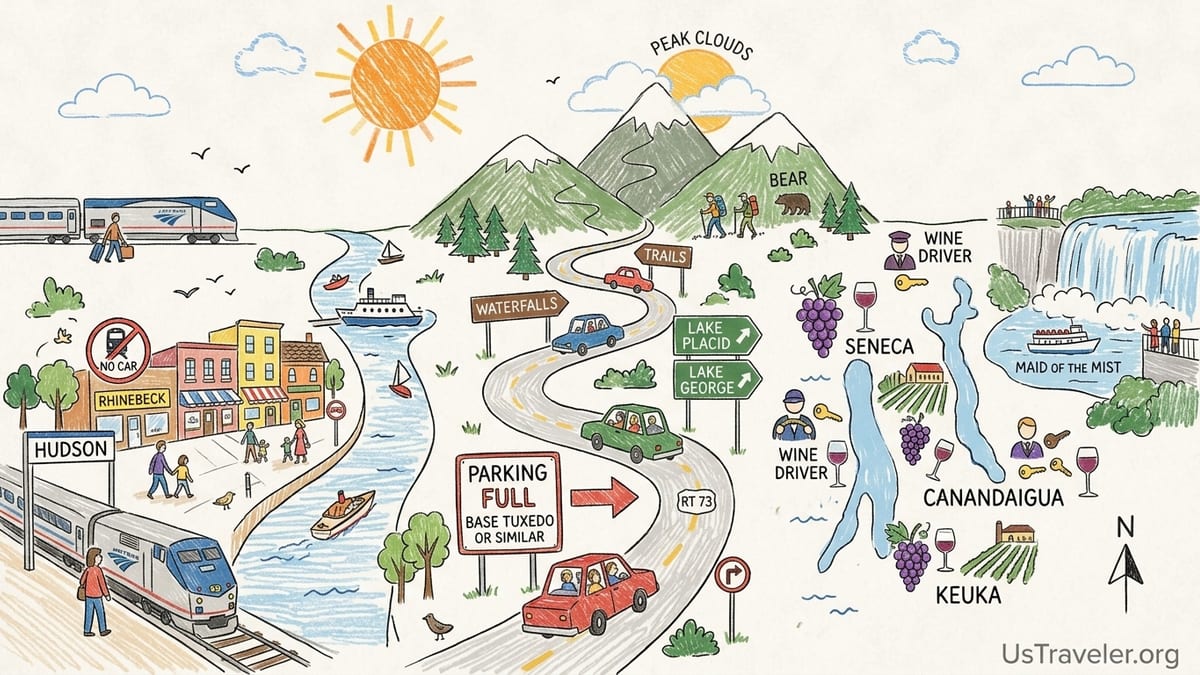
How I Pick A Base Now: The 5 Questions That Decide Everything
I start every New York State itinerary with five blunt questions: Will I have a car? What will I want to do after dark? How much time do I want to spend circling for parking? Do I want to walk to water or trails, or am I fine driving? And will I be tasting wine or beer most days, meaning I need a plan that keeps driving safe?
In practice, those questions decide whether you should stay in a town that is charming but spread out (great with a car), or a compact, walkable village that still has food late (valuable even if you drive). They also decide whether you can realistically base outside New York City without a car. Some regions cooperate with rail and local taxis. Others assume you’re driving, and the trip gets complicated fast without wheels.
The final check is a “penalty test”: if I choose Base A, how many extra hours will it add compared with Base B when I stack my top three day trips? In New York State, marketing regions can hide real distances. The state’s I LOVE NY travel-time guidance, for example, notes that Lake Placid and Lake George are about 1 hour and 20 minutes apart by car even though both are promoted under the Adirondacks umbrella. That is a big difference if you’re planning early hikes or trying to make dinner without a late-night drive.
Hudson Valley: Hudson Or Rhinebeck, And The No-Car Reality Check
If you want a base that can work with minimal driving, the Hudson Valley is where New York State is most forgiving. You have rail options, towns built on walkable “main streets,” and enough restaurants that you are not stuck eating in your room after 8 p.m. The big decision is whether you want the train to drop you closer to your bed, or closer to the kind of town you actually want to spend your evenings in.
Rhinebeck is a classic choice for a reason, but the rail reality matters: Amtrak stops at Rhinecliff (Rhinecliff station is on a bluff above the Hudson River and was built in 1914), and from there you still need a taxi or rideshare to get into Rhinebeck proper. Hudson, by contrast, has an Amtrak station right in town, and you can step off the train and be closer to dinner without arranging a pickup. That sounds small until you arrive hungry, it’s dark early, and you do not want to negotiate a long wait for a car.
If you are trying to do the Hudson Valley without a car, I’d be honest about what “no car” means here. You can pull it off if your plan is built around one town, good meals, and one or two pre-booked experiences (a specific museum time slot, a specific winery driver, or a specific tour). But the minute your itinerary becomes “a little of everything,” the gaps show. Even in train-friendly places, the last mile between stations, villages, and trailheads adds up.
Parking, on the other hand, is one reason to base in a Hudson Valley town rather than deeper in the countryside. If you drive, you can often keep the car parked and still walk to coffee and dinner in the evening, which is not true everywhere upstate. The goal is a base where you can choose to drive for day trips but not be forced to drive for every single meal after dark.
The Catskills: Woodstock Versus A Quieter Base (And Why Nights Matter)
The Catskills can feel close to New York City on a map, but the base you choose decides whether you spend your nights strolling to dinner or scanning Google for “open now” options at 8:30 p.m. Woodstock makes a practical base because it has a real village center: you can have a day on trails or at swimming holes, then come back and still find a lively dinner scene rather than a silent strip of closed storefronts.
The tradeoff is that a “famous” Catskills base often comes with busier weekends, and with that, more parking friction. The experience changes seasonally too. Summer weekends can feel like a series of peak-hour moments: a line for brunch, a crowded trailhead, a full lot at a popular swimming spot. Fall brings a different kind of pressure: leaf-peeper traffic that turns short drives into slow crawls, especially when everyone is aiming for the same viewpoints.
If you are considering Woodstock versus a quieter Catskills base, I treat it like this: if you care about restaurants after dark and want to avoid driving at night on winding roads, pay for the convenience of a town with nightlife. If you care more about waking up to quiet and being first on a trail, pick a calmer base closer to your planned hikes, but accept that dinner may require planning and earlier hours.
This is also where choosing the wrong base can quietly add time. I LOVE NY’s travel-time tool shows, for example, that Woodstock and Hunter are about 40 minutes apart by car, while Woodstock to Roscoe is about 1 hour and 30 minutes. That difference matters if you’re mixing waterfalls, fishing towns, and ski areas across different parts of the Catskills. Pick the village that matches the cluster of activities you actually plan to do, not just the one that looks cutest on social media.
The Adirondacks: Lake Placid Versus Lake George Is Not A Small Choice
It is tempting to book “the Adirondacks” as if it is one destination. In reality, your base changes the entire trip. Lake Placid feels like a mountain town built for early starts and crisp air: you can structure days around hikes, paddling, and village dinners that happen early because tomorrow starts at dawn. Lake George feels more like a lake resort corridor with a different rhythm, especially in summer when the waterfront energy and family attractions become the main event.
The distance is the first practical reality check. The state’s I LOVE NY travel-time guidance lists Lake Placid and Lake George as about 1 hour and 20 minutes apart by car. That is not a quick hop. If you choose Lake George but dream of Lake Placid hikes, you are effectively adding nearly three hours of driving roundtrip on the day you do it. That is the kind of mistake that steals your best daylight.
Trail access is the second reality check, because in busy Adirondack corridors, access can come down to a parking plan. The New York State Department of Environmental Conservation and the Adirondack Mountain Reserve have repeatedly used a seasonal parking reservation system for the Route 73 corridor, with reservations required during the May through October season. If your trip is built around those trailheads, your “base” is not just a town name, it’s also the plan you have for securing legal, safe access without starting the day stressed.
Seasonal atmosphere matters more here than almost anywhere else in the state. In shoulder season, a village can feel calm, and parking can feel easy. In peak summer and foliage season, the same base can feel like an exercise in patience. In winter, Lake Placid’s identity shifts again: the village is compact, walkable, and built around cold-weather days, but you will still want a car for most trailheads and for moving between lakes and ski areas.
Finger Lakes: Geneva, Canandaigua, Or Watkins Glen, And How To Drink Responsibly
In the Finger Lakes, choosing a base is really choosing a lake, because each lake’s wineries and viewpoints form their own loop. Geneva sits at the north end of Seneca Lake, Watkins Glen anchors the south end, and Canandaigua works best if your plan leans toward Canandaigua Lake and nearby towns rather than a full Seneca-centered itinerary. If you pick the wrong one, you do not just add minutes, you add repetition: driving the same stretches again and again because your lodging is on the “wrong” end for the tastings you booked.
Watkins Glen has a strong advantage if your priority is the gorge and you want to wake up close to the action. It also makes it easier to commit to an evening vibe where you can park once and be done. Geneva can be a better all-around hub if you want more of a town feel at night, with a broader spread of restaurants and an easier time finding a casual bite without turning it into a major plan.
Now the most important practical issue: winery driving. The Finger Lakes are not a place where you should improvise “just one more tasting” and then drive yourselves around the lake roads. The good news is that this region has built a real ecosystem of solutions, including companies that provide a designated driver who drives your own car. For example, Seneca Lake Wine Driver advertises service out of Watkins Glen with hourly pricing, and Finger Lakes Designated Drivers lists a published hourly rate with a minimum. Schuyler County’s tourism site also points visitors to local options such as Main Street Drivers and a trolley-style operator for Seneca Lake exploring.
The base decision affects this too. If you are staying in a walkable village area, you can do a tasting day with a driver, then still walk to dinner after dark without negotiating a long ride back to a rural rental. If you choose a beautiful, isolated lake house, you may gain sunset views but you also create a late-night transportation problem. In this region, I try to avoid plans where the only safe way to end the night is for someone to stay sober and drive a long, dark loop road home.
Niagara Falls Versus Buffalo: Same Trip, Completely Different Stay
Niagara Falls is one of the easiest New York State destinations to understand and one of the easiest places to mis-plan. The waterfalls are the point, but the decision is whether you want to sleep steps away from the roar or prefer a city base with more dining neighborhoods after dark. In other words: do you want maximum proximity or maximum variety?
If you stay at the Falls, you can treat the park like an early-morning and late-evening experience, which is when it can feel most magical and least crowded. Driving and parking, however, are part of the equation. Niagara Falls State Park publishes a clear vehicle use fee schedule with different prices by season and day of week, and it notes you can always walk in for free. That means a smart base can be one where you park once, then explore on foot and avoid moving the car during peak congestion.
If you stay in Buffalo, you gain restaurants, neighborhoods, and a more “real city” evening, plus local transit options like NFTA Metro Rail within Buffalo. But you also commit yourself to commuting to the Falls, and Western New York public transit between the two is not the kind of frictionless, tourist-first system that replaces a car. For travelers who want to see the Falls and then have a food-focused weekend, Buffalo can be the better base. For travelers who want sunrise views and quick access to attractions, Niagara Falls wins.
One practical detail I consider here is how you want your day to end. After-dark dining near the Falls can be hit-or-miss depending on season, and the vibe can tilt heavily tourist-focused. In Buffalo, late-night food is simply easier, and you are less likely to feel like the only option is a hotel restaurant. Your base should match whether you want to “do the Falls and collapse” or “do the Falls then go out.”
Car-Light New York: Saratoga Springs And Long Island (North Fork Versus Montauk)
If you want a New York State trip where a car is helpful but not mandatory, Saratoga Springs is one of the most practical bases to consider. It is compact, it has a built-in evening scene, and it is the kind of place where you can realistically walk between hotels, restaurants, and some attractions once you arrive. If you are connecting by rail, it also has an Amtrak station in town, which keeps arrival day simple.
Long Island is a different car-light challenge. You can reach a lot of the island by Long Island Rail Road, and the MTA has emphasized summer schedule adjustments and seasonal options, including service on branches used for beach and Hamptons trips. In other words, it is possible to build a rail-first Long Island plan, but where you stay decides whether you spend your time walking the town or constantly hunting for a ride.
Montauk can work surprisingly well without a car if your goal is a classic “arrive, drop bags, walk everywhere” beach town weekend. Once you are there, you can structure your trip around walking and local rides, and you are not trying to crisscross the fork. The North Fork is different. The charm is spread out: farm stands, tasting rooms, beaches, and small towns separated by stretches of road. Without a car, it is harder to string together a day that includes multiple wineries or multiple villages without turning the entire day into a logistics exercise.
This is where I draw a firm line: staying outside NYC without a car makes sense when the base is a true walkable destination and the trip is about that place, not about sampling the entire region. A car becomes close to essential when the experiences you want are naturally dispersed: wine country loops, trailhead hopping, lake-to-lake driving, or beach and farm stand combinations on the North Fork. The more your itinerary looks like “three stops before lunch,” the more you should assume you need wheels or a hired driver plan.
The Takeaway
Choosing where to stay in New York State is less about picking the prettiest hotel and more about picking the base that matches your transportation reality and your nights. The wrong base does not just cost money, it costs daylight and energy. In the Hudson Valley, you can build a train-first weekend if you choose a town that is walkable from the station, and you accept that farther afield adventures require planning. In the Catskills and Adirondacks, a car shifts from “nice” to “necessary” fast, and the base you choose dictates whether you can start early and eat well after dark without long drives.
In the Finger Lakes, the base should match the lake you plan to explore, and the smartest plan for winery days often includes a designated-driver or tour service rather than improvising. In Niagara, your stay should match your priority: proximity and dawn views at the Falls, or better dining variety with a Buffalo base and a commute. On Long Island, Montauk can be a walk-first weekend if you keep it simple, while the North Fork is far easier with a car because the best stops are not clustered in one walkable downtown.
If you remember one thing, make it this: “Upstate” is not one destination. Even within the same marketed region, towns can be far apart, as the state’s own travel-time guidance highlights in the Adirondacks. Pick the base that minimizes repeat driving, fits your after-dark habits, and lets you do the thing you came for without spending the trip watching New York State pass by through a windshield.
FAQ
Q1. How do I choose between Hudson and Rhinebeck as a Hudson Valley base?
Pick Hudson if you want to arrive by Amtrak and be close to town immediately; pick Rhinebeck if you prefer its village vibe and can arrange the Rhinecliff station transfer.
Q2. Can I do the Hudson Valley without a car?
Yes for a town-focused weekend, especially if you stay walkable to the station and pre-book any out-of-town experiences. It gets harder for trailheads and scattered attractions.
Q3. Is Woodstock the best Catskills base for first-timers?
It’s one of the easiest for evenings because it has a real village center with dining. A quieter base can work better for early trail access but needs more planning after dark.
Q4. How different are Lake Placid and Lake George, really?
They’re marketed in the same Adirondacks region, but I LOVE NY’s travel-time guidance lists them at roughly 1 hour and 20 minutes apart by car, so your base choice shapes the whole itinerary.
Q5. Do I need to plan ahead for Adirondack trailhead parking?
In certain busy corridors, yes. For example, the DEC and Adirondack Mountain Reserve have used a seasonal parking reservation system for Route 73 access in the May through October season.
Q6. Which Finger Lakes base is best for wineries: Geneva, Canandaigua, or Watkins Glen?
Choose the town that matches the lake you’ll explore most. Watkins Glen is great for the gorge and south Seneca access; Geneva suits north Seneca and a town feel; Canandaigua works best when your plans cluster around that lake.
Q7. What’s the safest way to handle winery days in the Finger Lakes?
Use a tour operator or a designated-driver service that drives your vehicle. The region promotes multiple options, including services based around Watkins Glen and Seneca Lake.
Q8. Should I stay in Niagara Falls or Buffalo?
Stay at the Falls for early and late access and minimal commuting. Stay in Buffalo if you want more neighborhood dining after dark and don’t mind commuting to the waterfalls.
Q9. Is Niagara Falls State Park parking predictable?
Yes. The park publishes a seasonal vehicle use fee schedule, and it also notes the park is always free to enter on foot.
Q10. Can I visit Montauk or the North Fork without a car?
Montauk can work rail-first if you keep the trip centered on town and beach time. The North Fork is much easier with a car because wineries, farm stands, and beaches are spread out.