


I keep hearing “Upstate” used like it is one place, one vibe, one kind of weekend. After spending meaningful time in the Adirondacks, the Catskills, and the Finger Lakes, I stopped saying that. These three regions may share New York plates and familiar road-trip rituals, but they deliver completely different holidays once you are actually there. The Adirondacks feel like a wilderness trip that happens to have a real town attached. The Catskills feel like a short, style-forward escape where the lodging is part of the point. And the Finger Lakes feel like a roaming, lakeside food-and-wine trip, with waterfalls as your midday palate cleanser.
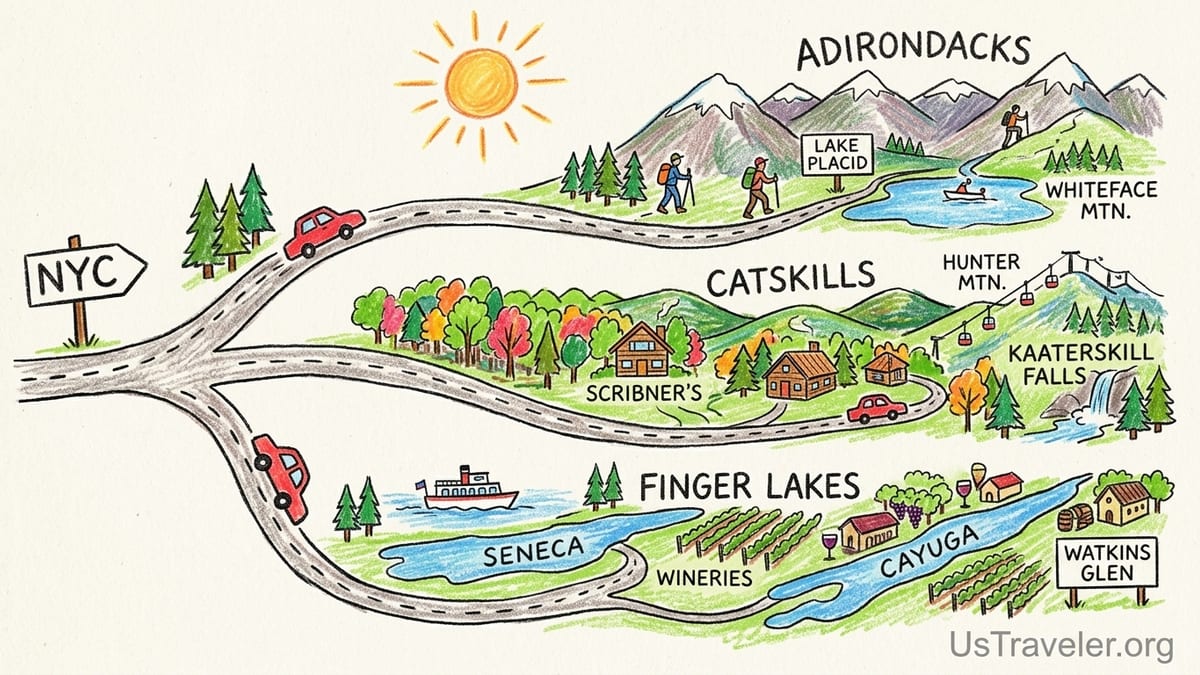
The drive from NYC sets the tone before you even arrive
If I am leaving New York City after work, the Catskills are the easiest “I just need out” move. Towns like Hunter sit at a very doable drive distance from the city. Hunter Mountain Resort positions itself as about 2.5 hours northwest of NYC, which matches what my own weekends have felt like when traffic behaves. You can still have dinner at your hotel bar the night you leave, and you do not arrive depleted.
The Adirondacks require a mental shift. Lake Placid’s official visitor information lists the drive from NYC at about five hours, and that time feels honest. I have learned not to pretend I am doing it casually. When I go north, I pack snacks, plan a real stop, and treat it like a true travel day. The reward is that when you finally crest into the Lake Placid area, it feels like you have gone somewhere far, not just “up.”
The Finger Lakes from NYC land in a different category again: not as far as the Adirondacks in pure psychological distance, but far enough that it becomes a long-weekend or “take a day off” trip for me. The real twist is that once you get there, you are driving constantly, because the fun is scattered around long shorelines. Unlike the Catskills, where I can base in one village and do short hops, the Finger Lakes are a loop-and-wander trip by nature.
Where I stay changes the whole holiday: basecamp lodge, design hotel, or lakeside hub
In the Adirondacks, I book for function first and vibe second, because my days revolve around trailheads and weather. I like staying in or near Lake Placid so I can walk to dinner and still be close enough to early starts. One of my favorite simple rituals is walking Lake Placid’s Main Street early, when storefronts are waking up and you can feel the Olympic-town energy without the midday crowds. From there, it is an easy pivot into big terrain: drive, park, hike, and come back hungry.
In the Catskills, I do the opposite. Here, the lodging often is the destination. I have stayed in design-oriented Catskills hotels where the interiors feel as curated as a city boutique stay, and I actually build in time to be on property. Scribner’s Catskill Lodge in Hunter is a good example of what I mean: it is positioned as a thoughtful, renovated lodge on a mountainside site near Hunter Mountain, and it leans into that “basecamp, but make it stylish” identity. In the Catskills, I find myself lingering with coffee, taking a slow walk on the grounds, and treating the hotel bar or restaurant as my evening plan, not an afterthought.
In the Finger Lakes, the best stays are the ones that make driving the loops feel easy. I usually choose a practical hub like Geneva, Ithaca, or somewhere near the middle of Seneca or Cayuga so I can do a day on one lake and a day on the other without constant backtracking. The vibe is less “resort” and more “home base for roaming,” because I know I will be in the car between tastings, trailheads, and dinner reservations.
Towns and main streets: Lake Placid feels like a real destination, the Catskills feel like a cluster, the Finger Lakes feel like a circuit
Lake Placid is the upstate town I can describe without hesitating, because it is cohesive. When I say I am going to Lake Placid, I mean a place with a recognizable center, a walkable strip, and an identity that is more than “near some hikes.” I can pop into shops, grab a coffee, and then drive out toward trailheads with the feeling that I am doing both a town trip and a wilderness trip in the same weekend.
The Catskills, for me, are less about one main street and more about hopping between small towns, each with its own mood. You can spend part of a day around Hunter and Tannersville, then wind your way to another pocket for a brewery or a general store. The scale feels closer and more stitched together than the Adirondacks. Even the drives are part of the charm, especially on the scenic roads that cut through clove views and wooded valleys, where you can pull off, breathe, and still make dinner back at your lodge.
The Finger Lakes are a circuit. Even the best towns there can feel like “a stop on the loop,” because the lakes pull you outward. I have had entire days built around driving the rim of Seneca or Cayuga, stopping at wineries, then detouring to a waterfall or state park. The towns matter, but the shoreline is the headline.
Hiking and waterfalls: big-mountain commitment vs accessible peaks vs gorge drama
If I am choosing purely for serious hiking, I personally pick the Adirondacks every time. The scale of the landscape encourages full-day plans and early starts, and it is the region where I feel the most “in it.” A small but perfect example is Mount Jo, which starts from the Adirondack Mountain Club’s Heart Lake Program Center at the Adirondak Loj. I have used Mount Jo as a first-day calibrator: you get a real summit feeling and sweeping High Peaks views for a comparatively manageable effort, and it helps me decide whether I am ready for bigger mileage the next day.
The Adirondacks also come with logistics that make it feel like a real wilderness destination, not just a pretty place. Certain popular access points, like the Adirondack Mountain Reserve, require a parking reservation during the core season (May 1 through October 31, per guidance repeated by Adirondack Mountain Club). That detail changes your whole trip planning style. When I am doing the Adirondacks right, I am thinking ahead about trailhead access, start times, and backup hikes, the way I would for a national park trip.
The Catskills are where I go when I want a satisfying hike that still leaves room for a lazy lunch and an early cocktail. Kaaterskill Falls is a classic, and New York’s Department of Environmental Conservation has very specific visitor guidance about accessing the falls, including recommended parking areas like Laurel House Road, Scutt Road, or South Lake. In the Catskills, the hikes feel more modular. I can stack a waterfall, a short summit, and a scenic drive in one day without it becoming an expedition.
The Finger Lakes deliver the most theatrical waterfalls with the least “mountain suffering.” Watkins Glen State Park is the kind of place where the landscape does the work for you: stone bridges, gorge walls, and that continuous waterfall rhythm that makes you forget you are climbing stairs until your calves remind you. The Finger Lakes are also where I can sandwich a gorge walk between a morning tasting and an afternoon lakefront stop, and it feels normal, not rushed.
Lakes, boats, and summer energy: Adirondack lake towns vs Finger Lakes shorelines
In summer, Adirondack lakes feel like they belong to the mountain trip. Even if you spend an afternoon on the water, the background is always peaks. When I do a Lake Placid summer itinerary, I like to pair a morning hike with a later, slower lake hour: sit by the shore, rent a paddleboard, or just do the easiest pleasure in town, which is walking and snacking and letting the day cool down.
The Finger Lakes are where I go for a lake-focused summer trip, because the lakes are the entire structure of the vacation. You drive with the water in view, you pick wineries based on which side of which lake you are on, and you end up planning golden hour around a west-facing overlook. When I am there, I do not just “visit a lake,” I spend days orbiting one. That is the magic: the shoreline becomes your itinerary.
The Catskills can do lakes and swimming holes, but in my experience it reads more as “bonus water” than “lake country.” I still love a warm-weather Catskills weekend, but the highlight tends to be the mountain air, the forest shade, and the feeling of a quick reset rather than a true shoreline vacation.
Food and drink: Olympic-town dinners, Catskills lodge meals, and Finger Lakes tasting days
Lake Placid’s food scene feels like it exists to refuel you after real effort. I tend to eat early there, because I have started early. The best Adirondack meals on my trips have been the ones where everyone at the next table looks like they have been outside all day too. The town has enough choice that you do not feel stuck, but it does not distract you from why you came.
In the Catskills, the restaurant inside the hotel can be the evening centerpiece. This is the region where I am most likely to plan my day around being back on property at a certain time. When I stay somewhere design-minded, I want to be in the lounge, by the fireplace, or on a deck with a view. The Catskills excel at the “country lodging” feeling, where you can hike in the morning and then have a legitimately good dinner without getting back in the car.
The Finger Lakes are built for tasting-day logistics. This is where I start thinking about pacing, reservations, and who is driving. It is also where I find the most “vacation structure” in the form of wine trails. The Seneca Lake Wine Trail, for example, runs organized event weekends and publishes clear ticket prices for some of them, like a 2026 Wine and Brunch ticket priced at $65 that includes pairings and a souvenir glass. That kind of programming nudges your trip into an itinerary with set stops, which is part of the fun.
One practical detail I always keep in mind in the Finger Lakes is group-size rules at popular wine-trail times. The Seneca Lake Wine Trail’s event FAQs spell out that event weekends and tasting passes cap group size at six people. Even if you are not attending an official event, that rule reflects a broader truth: the Finger Lakes reward smaller groups that can move easily and fit at bars, patios, and smaller tasting rooms without stress.
Fall foliage and winter travel: when each region shines, and what I plan around
Fall is the only season when I feel pulled equally toward all three regions. The Catskills are my easiest fall hit, especially for a two-night foliage reset. You can leave NYC late, arrive to crisp air, and spend the next day stacking short hikes and roadside views. It is also the best region for the “come back and get cozy” vibe: hot shower, good dinner, and a drink somewhere that looks like it was designed to photograph well but still feels relaxed.
The Adirondacks in fall feel more like a full commitment, but the payoff is that everything looks bigger and wilder. If I am chasing peak color and I want the trip to feel like a real escape, I go north. I plan more nights, I plan earlier mornings, and I build in one easy town day so I am not only grinding miles.
Winter is where the Adirondacks and Catskills separate most clearly in my mind. The Catskills can be a quick ski or snow weekend near NYC, and Hunter Mountain is often the anchor for that. You can realistically leave Friday evening, ski Saturday, and be home Sunday without feeling like you burned the whole weekend in the car.
The Adirondacks are where I go for winter when I want it to feel like a winter destination, not a convenient snow fix. Whiteface Mountain outside Lake Placid is the obvious draw, and its calendar includes seasonal events like Oktoberfest (listed for late September 2026) that show how the mountain area leans into shoulder seasons too. When I am in Lake Placid in colder months, I also love the Olympic legacy sites element, because it gives you a non-ski option that still feels local to the place.
Cost and how many nights I would actually book in each place
I have learned that the biggest cost mistake is trying to compress the Adirondacks into a quick weekend. Because the drive from NYC to Lake Placid is about five hours, I prefer three nights if I can swing it, or at minimum a long weekend where I can start early on day one. Two nights can work, but it often feels like I arrived, hiked once, and immediately had to leave. The other hidden “cost” here is planning friction: if you are aiming for popular trailheads with reservation systems in peak season, last-minute spontaneity can be expensive in the form of lost time and plan changes.
The Catskills are the best value for a short NYC weekend, not necessarily because the hotels are always cheap, but because the trip uses fewer vacation hours. I can book two nights and still feel like I had a full holiday: one real hike day, one slower morning, and enough time to enjoy the lodging. This is also where I find myself splurging intentionally on the hotel because I know I will actually be there using the property.
The Finger Lakes sit in the middle, and I think they need at least two full days on the ground. If you are going for wineries and waterfalls, you want time to split lakes or split themes. My default is three nights, because it lets you do one day focused on Seneca, one on Cayuga or a different lake, and one mixed day for a state park, a town, and a long dinner. If you try to do it in two nights from NYC, the driving can start to feel like you are just checking boxes.
On pricing, I rely on what I can verify in official materials and what I can observe in my own bookings, and I avoid pretending there is one universal budget level. What I can say concretely is that organized tastings and events in the Finger Lakes publish set ticket prices, which can help you forecast costs more precisely than a pure hiking trip. Meanwhile, ski weekends in either the Catskills or Adirondacks can swing widely based on dates, and I always price out lodging before I commit, because “peak foliage” and “holiday snow” weekends can change the math fast.
The Takeaway
After experiencing all three, I do not see the Adirondacks, Catskills, and Finger Lakes as competitors. I see them as three different answers to three different travel cravings. When I want serious hiking and a trip that feels like I left my normal life far behind, I choose the Adirondacks and I build time around trailheads, early starts, and a real town like Lake Placid to recharge at night. When I want a short NYC weekend that still feels special, I choose the Catskills, pick a design-forward hotel, and let the lodging and a couple of satisfying hikes do the heavy lifting. When I want wine, waterfalls, and a lake-focused summer rhythm, I choose the Finger Lakes and commit to the loop: drive the shores, taste thoughtfully, and let the scenery and food set the pace.
If you are planning your first “Upstate” trip, my strongest advice is to pick the region that matches how you actually like to vacation, not the one that sounds most impressive. The Adirondacks reward commitment. The Catskills reward spontaneity and good taste in lodging. The Finger Lakes reward curiosity, pacing, and a willingness to roam.
FAQ
Q1. How long is the drive from NYC to Lake Placid in the Adirondacks?
Lake Placid tourism information lists the drive from New York City as about five hours, and it is best to budget extra time for traffic and weather.
Q2. How long does it take to reach Hunter in the Catskills from NYC?
Hunter Mountain describes itself as about 2.5 hours northwest of New York City, making it one of the most convenient mountain bases for a weekend.
Q3. Which region would you choose for serious hiking?
I would choose the Adirondacks, because the trail network and High Peaks culture support full-day hikes and multi-day hiking-focused itineraries.
Q4. Which region is best for a short NYC weekend?
I would choose the Catskills for a two-night reset, because the drive is manageable and the region excels at lodging-centered weekends with easy-to-stack hikes and waterfalls.
Q5. Which region is best for wine-focused travel?
I would choose the Finger Lakes, especially the Seneca and Cayuga Lake areas, because tasting rooms, wine trails, and lake drives are central to the experience.
Q6. Are there any hiking access rules I should know for the Adirondacks?
Yes. Some popular areas such as the Adirondack Mountain Reserve use a seasonal parking reservation system during May 1 through October 31, so you may need to plan ahead.
Q7. What is a good “first Adirondacks summit” if I want big views without a huge day?
Mount Jo is a classic introduction because it starts from the Adirondack Mountain Club’s Heart Lake area and delivers High Peaks views for a relatively short outing.
Q8. What is the most iconic waterfall-style hike for a first Finger Lakes trip?
Watkins Glen State Park is the signature gorge-and-waterfalls experience, and it is ideal if you want dramatic scenery without a mountain-style trek.
Q9. How many nights do you recommend for each region?
I like three nights for the Adirondacks, two nights for the Catskills, and three nights for the Finger Lakes if wineries and waterfalls are a priority.
Q10. Which region would you pick for winter sports?
For a quick ski weekend near NYC, I pick the Catskills. For a winter trip that feels like a full destination with Olympic history nearby, I pick the Lake Placid and Whiteface area in the Adirondacks.