

I came to the Finger Lakes with a simple goal: taste serious Riesling without doing math at every stop. Not alcohol math, not parking math, not “who’s the designated driver” math. The region’s lake roads are gorgeous, but they are also narrow, curvy, and deceptively time-consuming when you are hopping between tasting rooms spread across miles of shoreline. So I booked a private chauffeured wine day around Seneca Lake, set up a tight, three-winery arc with lunch in the middle, and let someone else worry about turnouts, cyclists, and the occasional tractor. What I got was the best kind of wine day: unhurried, genuinely educational, and just structured enough that I never felt rushed, even with reservations and closing times ticking in the background.
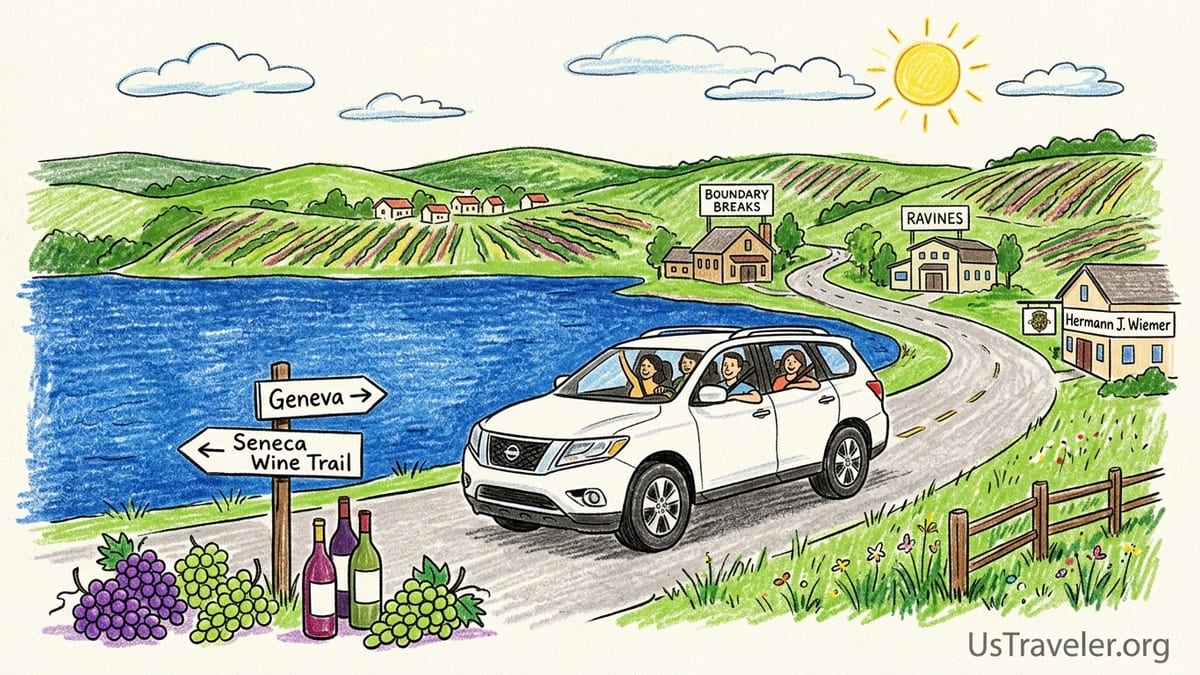
Why I Based in Geneva (And Why Pickup Logistics Matter Here)
For this trip, I based myself in Geneva, New York, at the north end of Seneca Lake. It is not the only place to stay, but it is one of the most practical if you want to tour without a car because it sits at a natural pivot point: you can commit to the east shore, the west shore, or pivot toward Canandaigua or Cayuga without losing a full hour just getting oriented.
My driver was FLX Chauffeur, booked as a private Seneca Lake tour. Their current published pricing is $349 for up to four guests and $499 for up to six guests for a six-hour private tour, with pickup and drop-off from your lodging, Airbnb, or hotel. Tasting fees are extra, which I prefer because it keeps the tour flexible and lets you choose experiences in the moment rather than paying for a preset lineup you may not love.
We were a group of four, which turned out to be the sweet spot for the Finger Lakes. It is small enough to be seated almost anywhere without complicated group policies, but large enough to split bottles at lunch and compare notes out loud. We agreed ahead of time that we wanted a Riesling-forward day with at least one stop that felt “classic Seneca,” one stop that leaned modern and polished, and one place where the wines came with context rather than just a pour.
Meet the Vehicle: Comfort Changes Your Palate
Our touring vehicle was a clean, comfortable SUV sized for a small private group. That detail sounds mundane until you spend a day climbing in and out with purchases. A private tour is not glamorous in the limousine sense. It is practical: room for a case or two, space to stretch out between stops, and a temperature-controlled reset after a warm tasting room or a sunny patio.
We started with an agreed-on first pour time and worked backward from winery hours. In the Finger Lakes, most tasting rooms run on a “last tasting” cutoff that arrives earlier than you expect, especially when you add a lunch stop and lake-road travel. The advantage of a chauffeur is that you can plan a loop and then keep your attention where it belongs: tasting, asking questions, and actually noticing the scenery.
That scenery is not background noise here. Seneca Lake is long, and its wineries are spread out along more than 70 miles of tasting opportunities. Even when two spots look close on a map, the shore road can turn a short distance into a longer drive because of curves, slow-moving traffic, and limited passing. Our driver built in cushions between appointments, and that pacing ended up being the difference between a relaxed day and a frantic one.
Stop 1: Boundary Breaks (East Shore, Seneca Lake)
We began on the east side of Seneca at Boundary Breaks, which is open daily from 11 a.m. to 5 p.m. and does not require reservations for parties of six or fewer. That “no reservation required” line is a gift on a touring day because it gives you options if you are running late or feeling fast. It is also a reminder to keep your group small, because Boundary Breaks does not split larger parties, and larger-than-six visits require contacting them in advance.
The tasting experience here is intentionally focused. You come for Riesling, and then you come back for more Riesling. What I loved about starting at Boundary Breaks is how it sets your calibration point. The wines are clean and precise, and the whole first stop felt like a palate warm-up: bright acidity, lake air, and that feeling of being somewhere that is serious about one grape and unembarrassed by it.
Because our tour pricing did not include tastings, we paid tasting fees directly at each winery. Along Seneca Lake, tasting fees often land in the $10 to $15 range per person at many properties, and it is wise to budget that way even if the exact fee differs by winery and experience. The upside is that you can choose a classic five-pour flight, a by-the-glass approach, or a focused Riesling lineup depending on your energy level.
By the time we left Boundary Breaks, the day already felt different than a self-drive. No one was clock-watching for sobriety. No one was second-guessing whether to spit. We could all taste seriously and still treat it as a vacation.
Stop 2: Ravines Wine Cellars (Geneva) For A Seated Flight
From there, we headed toward Geneva for a reserved seated tasting at Ravines Wine Cellars. Ravines offers bookings for tastings, and their published tasting fee is $15 per person. Their Geneva tasting room is open daily from 10 a.m. to 5 p.m., and the standard flight format is five wines per flight. That matters on a touring day because it gives you a predictable tasting length and a clear sense of pacing before lunch.
Ravines felt like a deliberate contrast to our first stop. The experience was more structured, the setting more polished, and the tasting itself felt like a guided reminder that the Finger Lakes is not only about casual pours at a bar. It is also about technique: balance, texture, and how a cool-climate region can build intensity without heaviness.
As a mid-morning stop, Ravines also functioned as a pacing tool. A seated flight slows the day down in a good way. It keeps you from stacking tastings too quickly, and it encourages conversation. In our group of four, we each called out what we were tasting, compared sweetness perception, and argued amicably about what “minerality” means when you are staring at a lake that looks like it should be the definition of the word.
We also used this stop to make a practical decision: if we were buying bottles, we would buy the heavy ones earlier so they could ride comfortably in the vehicle all day. With a chauffeur, purchases are easy. With self-driving, purchases can become a game of Tetris in a trunk you keep reopening.
Lunch Break: A Real Meal Changes The Second Half Of The Day
After two tastings, we stopped for lunch rather than forcing a third winery before food. In the Finger Lakes, that decision is not just about comfort, it is about safety and palate. Riesling is thrilling, but it is also acidic, and a string of bright pours without a meal can turn your afternoon into a blur of lemon and alcohol warmth.
One reason Seneca itineraries are different than Cayuga or Keuka itineraries is that Seneca has more member wineries spread along a long, continuous loop, which makes it tempting to keep driving and “fit one more in.” The smarter move is to build a reset into your day. We wanted a lunch that did not feel like an afterthought, and we kept the stop timed so we could still make our final winery comfortably before late-afternoon cutoffs.
On a chauffeured day, lunch is also where you feel the benefit of leaving the car behind. You can order a glass if you want it. You can linger. You can decide, calmly, whether you want a third full tasting or whether you would rather finish the day with a glass-and-view format. Self-driving encourages you to keep moving because you are always aware of the road waiting outside.
Stop 3: Hermann J. Wiemer Vineyard (Dundee) To End On High Notes
For our final stop, we went to Hermann J. Wiemer Vineyard, one of the names that comes up again and again when serious wine travelers talk about the Finger Lakes. Their tasting room hours are published as Monday through Saturday 10:30 a.m. to 5 p.m. and Sunday 11 a.m. to 5 p.m., with the last seated tasting reservation beginning at 4 p.m. Reservations are recommended for a guided tasting, though walk-ins are welcomed if space allows.
Ending here worked for two reasons. First, it gave us a destination stop with a clear time boundary. “Last seated tasting at 4” is the kind of detail that shapes your whole afternoon, and it is one of the most common ways self-drivers accidentally compress their final stop. Second, it was the kind of place where questions are rewarded. We asked about styles, about what makes a wine taste dry even when it carries fruit, and about why Seneca’s Riesling conversation keeps drawing national attention.
Wiemer also clarified something I only half understood before this trip: not every Finger Lakes wine day is a “trail day” in the casual sense. Some wineries are built for drop-in flights, patio bottles, and a gift shop browse. Others are best approached as appointments, where you show up on time, sit down, and treat the hour like a guided tasting rather than a quick sample.
By late afternoon, the lake roads were doing their thing. We hit pockets of slow traffic and a few stretches where passing was not realistic, and the time cushion our driver built in became the quiet hero of the day. It meant we arrived with enough margin to settle in rather than sprinting to a host stand.
How The Lake Roads Shape A Tour (And Why Seneca, Cayuga, Keuka, And Canandaigua Feel Different)
On paper, the Finger Lakes region is a patchwork of short distances. In practice, each lake produces a different touring personality because the roads, town anchors, and density of wineries influence how your day unfolds. Seneca is the giant: the Seneca Lake Wine Trail has dozens of member wineries and a long shoreline. That scale is a gift if you have multiple days, but it is also why a one-day self-drive can easily turn into a rushed, zigzagging itinerary if you try to “do both sides.”
Keuka feels different because it is shaped differently. Its famous “Y” geometry changes routing logic. You can have a day that feels compact, but you can also lose time if you try to bounce between arms of the lake without thinking through the drive. Cayuga, meanwhile, often lends itself to itineraries that pair wineries with stops in Ithaca or along the lake’s north and east edges, and it can be easier to stitch in non-wine moments like waterfalls, parks, or a quick downtown stroll.
Canandaigua tends to read as the easiest “day trip” lake from a travel-time perspective because the distances can feel more manageable, and you can pair wine with a quick town-based weekend. If you are traveling with a mixed group of tasters and non-tasters, that can be the most diplomatic choice because there are more obvious detours for shopping, lakeside walks, and dinner that is not centered on a winery schedule.
If I had to choose one lake for a first car-free tasting day, I would still choose Seneca because of the sheer depth of options and the way the drive itself becomes part of the pleasure. Next time, though, I would choose Keuka for a different reason: I want a day that feels more intimate and less linear, with fewer miles between stops and more time lingering at each place.
Guided Touring Versus Self-Driving: What I’ve Actually Learned The Hard Way
I have done wine days both ways. Self-driving can be perfectly enjoyable if you keep the itinerary light, choose wineries close together, and commit to a true designated driver who is comfortable with the responsibility. The problem is that self-driving tempts you into compromises: skipping pours, rushing tastings, or cutting a stop short because you feel the travel time stacking up.
With a chauffeur, the day becomes more like a curated tasting experience and less like a logistics exercise. You can plan three stops instead of five and still feel like you tasted deeply. You can buy bottles without worrying about trunk space or temperature swings. Most importantly, everyone in the group gets to be present, including the person who would otherwise be stuck drinking water and staring at the road.
For pricing, a private chauffeur can be surprisingly rational when split among friends. A six-hour private Seneca Lake tour priced at $349 for up to four guests lands at a per-person transportation cost that often feels worth it the moment you realize you are not hunting for parking or squinting at a map while trying to be polite in a tasting room. If your group is larger, the up-to-six option at $499 keeps the math manageable.
The final advantage is subtle: the pace becomes kinder. Many wineries in the region encourage groups to allow roughly 45 minutes to an hour per stop once you include travel, tastings, restrooms, and browsing. A driver who understands the shore roads will protect your timing in a way a first-time visitor simply cannot, even with the best intentions.
The Takeaway
My ideal Finger Lakes day is no longer a checklist. It is three wineries, one real lunch, and enough windshield time to appreciate why these lakes create a wine region that feels unlike anywhere else in the United States. On this trip, Boundary Breaks set the Riesling tone, Ravines gave us a seated, structured flight at a clear $15 per person, and Hermann J. Wiemer delivered the kind of finish that reminds you why you traveled in the first place.
Seneca’s scale makes it the most tempting place to overbook yourself, and it is also the lake where leaving the car behind makes the biggest difference. The shoreline is long, the stops are spread out, and the road conditions can quietly steal time. A chauffeur did not just keep us safe. It made the wines taste better because we were never rushing and never negotiating who could taste what.
Next time, I would do Keuka with the same “less but better” philosophy: build a loop that respects the road, choose one seated tasting experience, and end at a place where you can linger with a final glass. But if you are coming for Riesling, lake roads, and that specific Finger Lakes feeling of blue water beside green vines, Seneca is still the day I would recommend first.
FAQ
Q1. Do I need reservations for Finger Lakes tastings?
It depends on the winery and your group size. Some places welcome walk-ins for small groups, while others recommend reservations for guided seated tastings, especially on weekends.
Q2. How much are tasting fees around Seneca Lake?
Many Seneca Lake stops land in the roughly $10 to $15 per person range, but fees vary by winery and by experience type, so budget extra beyond your tour price.
Q3. How much does a private chauffeured wine tour cost on Seneca Lake?
FLX Chauffeur lists a six-hour private Seneca Lake tour at $349 for up to four guests and $499 for up to six guests, with tasting fees paid separately at each stop.
Q4. Where is the best place to stay for a car-free Seneca Lake wine day?
Geneva and Watkins Glen are common base towns because they sit at the north and south ends of the lake and make pickup and routing straightforward.
Q5. How many wineries should I do in one day?
For a relaxed day, three wineries plus lunch is ideal. Four can work if the stops are close and at least one is a quicker flight-style tasting rather than fully seated.
Q6. What are Ravines Wine Cellars tasting details in Geneva?
Ravines lists tastings at $15 per person, with five wines per flight, and the Geneva tasting room is open daily 10 a.m. to 5 p.m.
Q7. What are Hermann J. Wiemer Vineyard’s current tasting room hours?
Hermann J. Wiemer lists tasting room hours as Monday to Saturday 10:30 a.m. to 5 p.m. and Sunday 11 a.m. to 5 p.m., with the last seated tasting reservation beginning at 4 p.m.
Q8. Are Boundary Breaks tastings reservation-only?
Boundary Breaks states that parties of six or fewer do not need reservations and are handled first-come, first-served, while larger parties should contact them in advance.
Q9. Why do different Finger Lakes produce different itineraries?
Each lake’s shape, road layout, and winery density change how you route stops. Seneca is long and spread out, Keuka’s shape affects routing, and Cayuga and Canandaigua often pair more naturally with town stops.
Q10. Is leaving the car behind worth it in the Finger Lakes?
If you plan to taste seriously, yes. A chauffeur reduces stress, improves pacing, and lets everyone in your group participate fully without worrying about driving after tastings.