


I used to think “New York” meant one trip: a few dense neighborhoods, a show, a museum marathon, maybe a day trip if I was feeling ambitious. Then I started traveling the state the way New Yorkers actually talk about it, as a set of regions that can feel like entirely different states stitched together by rivers, ridgelines, vineyards, and long highway miles. The first time I tried to “just add” the Adirondacks after the Hudson Valley, I learned the hard way that the map lies when you’re staring at it from a Manhattan hotel room.
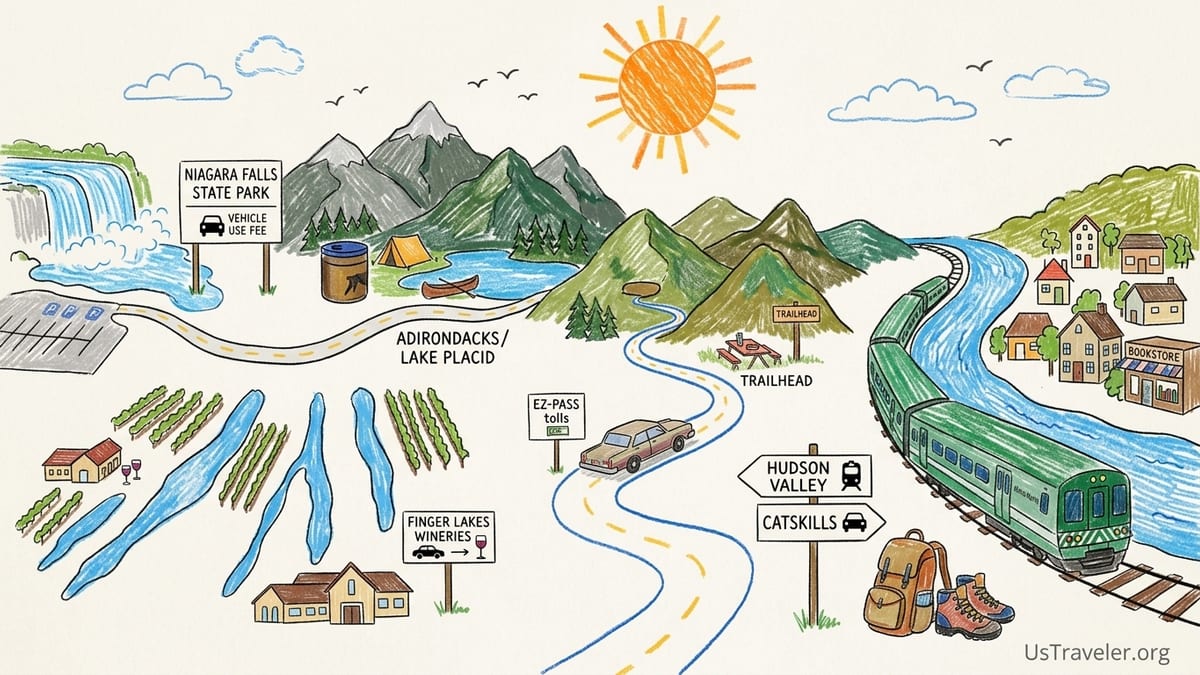
Before I Left: The Mindset Shift That Made New York State Make Sense
On my earliest statewide loop, my biggest mistake was treating New York like a day-trip state. I planned “NYC plus a little nature,” then kept tacking on extra pins: a lake here, a waterfall there, “Niagara if we’re already upstate.” I underestimated how long it takes to cross New York, how many places are best with a car even if you arrive by train, and how quickly weather flips when you leave the city’s heat island.
What finally clicked for me was building the trip around the state’s regions, not around attractions. New York State is a handful of trips, not one trip. I LOVE NY’s own transportation guidance mirrors what I experienced: the Hudson Valley and Long Island are the easiest extensions from New York City without a car, while the Catskills, Finger Lakes, Adirondacks, and Niagara are bigger commitments that reward slower planning.
I also stopped assuming I could “wing it” everywhere. In the Adirondacks, rules and access can change with slide closures, reservation systems, and backcountry requirements. In wine country, a last-minute weekend can mean tasting rooms that require reservations and routes that demand a designated driver. On Long Island, beach and park details matter more than I expected, especially when you’re timing a lighthouse visit around seasonal hours and daylight.
Hudson Valley: My Favorite Low-Stress Escape From NYC (And Why I Didn’t Need a Car at First)
My easiest “I can’t believe this isn’t the city” escape has consistently been the Hudson Valley, because I can start the day at Moynihan Train Hall or Grand Central and be on the river before my coffee wears off. I’ve ridden Metro-North’s Hudson Line north from Grand Central when I wanted flexibility and frequent departures. The ride itself is part of the point: the train hugs the river for long stretches, and the scenery changes fast once you pass the Bronx and the Palisades start to feel real.
I based myself in a walkable river town on one trip and only rented a car later, after I’d done my car-free “river mode.” That split approach saved me money and stress. Car-free days meant I could do slow mornings and dinners without thinking about parking, tolls, or who’s driving back from a brewery. When I did rent a car, I picked it up near the train station, loaded my hiking shoes, and shifted into “trailhead mode” for the less transit-friendly spots.
The Hudson Valley is also where I first noticed how New York’s tolling reality affects itineraries. The New York State Thruway is cashless, which means you either need an E-ZPass or you’re dealing with tolls by mail. I learned to keep my rental car plate and paperwork organized and to ask the rental counter how they handle toll billing, because a casual bridge crossing can turn into annoying admin later if you’re not paying attention.
One of my most vivid Hudson Valley days wasn’t a museum or a marquee attraction. It was a weather day: low clouds, on-and-off drizzle, wet leaves underfoot. I’d planned a big hike, but instead I did a shorter loop and leaned into the region’s cozy strengths: warm lunch, a bookstore stop, and a slow drive along the river once the clouds lifted. That day taught me that the Hudson Valley is the ideal “buffer region” in a New York State itinerary, because it works in imperfect weather and it doesn’t punish you for going at human pace.
The Catskills: Where My Itinerary Started to Break (And What I’d Do Differently)
The Catskills were the first place I felt the consequences of over-combining regions. From the city, it’s tempting to see the Catskills as “close enough” to stack with the Hudson Valley and still keep moving. But once I actually did it, I wished I’d given the Catskills their own rhythm. The driving isn’t hard, but it’s not fast. Roads twist. Small towns are spread out. And my “we’ll just do a quick hike” mindset didn’t match how much time I spent simply getting from one valley to the next.
I’ve done Catskills hikes in two moods: bright summer days when everything is green and humid, and shoulder-season days when wind picks up on open viewpoints and I’m grateful I packed an extra layer. Either way, I learned to start earlier than I thought I needed to. A trail that looks modest on paper can still take a chunk out of the day once you include driving, parking, re-fueling, and the reality that you’ll want to stop for views.
Food became my pacing tool here. In the Catskills, I plan one “destination meal” per day rather than trying to do everything. If I’m hiking, I eat something filling afterward and treat it as part of the recovery, not just a refuel. I also started booking accommodations with easier parking and straightforward check-in, because arriving tired and then hunting for a tricky property after dark is not the vibe.
If you want my candid correction: the Catskills needed one more night than I gave them the first time. I shorted them to squeeze in another region, and it weakened the trip. The Catskills are where I began to see the state’s scale in a physical way, through tired legs and longer-than-expected transfers between trailheads and towns.
The Adirondacks and Lake Placid: My “New York Isn’t One Place” Wake-Up Call
The Adirondacks changed my mental map of New York State. I arrived thinking “upstate mountains,” and left feeling like I’d visited a different kind of American landscape: big water, deep forest, and a sense of distance that doesn’t exist in the Hudson Valley. Lake Placid made a natural base for me because it’s compact enough to feel walkable once you park, but close enough to trailheads and lakes that I could plan early starts.
This is also where I felt the state’s rules and logistics most acutely. New York’s environmental regulations are not theoretical here. NYSDEC requires bear-resistant canisters for overnight users in the Eastern High Peaks Wilderness between April 1 and November 30, and I treated that as a serious planning line, not a footnote. Even when I wasn’t backpacking, I noticed how many hikers around me had real backcountry systems, and it reminded me not to import casual day-trip habits into a place that demands respect.
Access and closures are real, too. I check NYSDEC’s Adirondack backcountry notices before I go, because trail and area statuses can change. On one planning cycle, I had to reroute around a closure notice and it completely reshaped my “quick scenic stop” plan. The Adirondacks punish last-minute assumptions in a way the Hudson Valley often doesn’t.
Driving up also recalibrated what “nearby” means. If you are thinking you’ll do Lake Placid as an add-on after a few Hudson Valley nights, be honest with yourself about the transfer day. It’s not just hours on a highway. It’s the way you arrive: later than you want, a little stiff, needing groceries and a calm dinner, not a heroic hike. The Adirondacks are where I most regretted trying to squeeze in too much, because the best moments were the quiet ones: a lake at dusk, a simple breakfast before an early start, and the feeling of being far from the city without leaving the state.
Finger Lakes: How I Learned to Plan Wine Country Like a Driver, Not a Dreamer
The Finger Lakes were the part of the state I romanticized most and, initially, planned worst. In my head, it was “vineyards and a lake, easy.” In practice, the Finger Lakes are spread out and lake-to-lake distances add up. I needed a car here, full stop. On my first visit, I underestimated how long it takes to drive around a lake versus across it, and I built days that looked elegant on a map but felt rushed on the road.
I also learned to treat tastings like reservations first and spontaneity second. Some wineries and tasting rooms, especially on weekends and during peak fall color, may require reservations or strongly recommend them. My best day in the Finger Lakes was the one I simplified: I chose one lake to focus on, picked a tight cluster of stops, and left time for the unplanned, like pulling over at a viewpoint or lingering over lunch without watching the clock.
This is where “real-world” planning details mattered. If I knew I wanted tastings, I booked a base with easy parking and a straightforward route back. I also watched the weather like a hawk. Lake effect can mean sudden changes, and rainy days shift the experience from “patio with a view” to “cozy tasting room and wet shoes by the door.” Both are good, but only if you aren’t trying to do too much.
If I were advising my past self, I’d say: the Finger Lakes are a full trip, not an overnight detour. The region rewards anyone who’s willing to slow down, stay put, and repeat a road at different times of day when the light changes on the water.
Niagara Falls: What Surprised Me Most About Timing, Parking, and the “Free” Part
Niagara Falls was my classic “we should see it once” stop that turned into a full-day logistics puzzle. The first surprise was that Niagara Falls State Park is free to walk into, but charges a vehicle use fee for cars at certain times of year. The second surprise was parking behavior: lots fill early on weekends and holidays, and traffic builds as people circle for spaces. The park’s own parking guidance is blunt about it, and I felt it on a sunny day when I arrived later than I should have.
I’ve approached Niagara two ways: by rail and by car. By rail, I used Amtrak’s Empire Service corridor conceptually as my spine when I was linking western New York stops. By car, I felt the sheer mileage. This is where New York State’s size is not philosophical. It’s physical. A day that looks like “just drive west” becomes a long stretch that affects everything from meal timing to hotel check-in.
Weather changes how Niagara feels. Mist is part of the experience, and on cooler days I was grateful for a light waterproof layer. I also learned not to stack Niagara with too many other far-flung regions in the same week. Niagara is not a quick tag-on after the Finger Lakes unless you’re willing to sacrifice downtime. I made that mistake once, and it turned two iconic regions into a blur of late arrivals and early departures.
My most grounded Niagara moment wasn’t a photo. It was standing there realizing I’d spent years thinking of Niagara as “an attraction,” when it’s also a place with real planning considerations: seasonal parking fee windows, crowds that change the feel of the paths, and a townscape that can be hit-or-miss depending on where you stay. It deserves its own dedicated day, and ideally a night on either side so you’re not doing the falls on the tail end of a marathon drive.
The Takeaway: My Practical, Lived-It Rule for Planning New York State Beyond NYC
If I could distill my New York State travel learning into one sentence, it would be this: pick fewer regions, stay longer, and let transfer days be transfer days. Every time I tried to treat a three-hour drive like a quick hop, I paid for it in tired hikes, skipped meals, and that nagging feeling of always leaving as soon as I arrived.
My best trips followed a simple structure: start with a car-free extension (Hudson Valley or Long Island), then commit to one “big trip” region (Catskills or Adirondacks or Finger Lakes), and only then consider pushing farther west to Niagara. That order matched what I LOVE NY emphasizes about ease of access from the city, and it matched my lived reality when I stopped trying to force the whole state into one itinerary.
I also learned to plan seasonally instead of fighting the calendar. I check the I LOVE NY fall foliage report when I’m timing autumn travel because it’s updated as the season evolves. For parks and outdoors planning, I pay attention to vehicle use fees at many state parks (often posted in the single digits per carload) and I treat NYSDEC rules as trip-defining, especially in the Adirondacks. In winter, I assume mountain roads can be a different game than coastal or city roads and I build in flexibility rather than promising myself a perfect loop.
New York State, beyond NYC, felt to me like a series of distinct worlds connected by trains, toll gantries, and long, beautiful stretches of highway. The moment you accept that it is larger than your first instinct, you stop chasing the state and start actually being in it.
FAQ
Q1. What’s the easiest first trip beyond NYC without renting a car?
Hudson Valley or Long Island, because you can reach both by commuter rail and build a weekend around walkable towns and short rideshares.
Q2. Do I need an E‑ZPass for a New York State road trip?
It helps. The New York State Thruway is cashless, so an E‑ZPass typically keeps toll billing simpler than tolls by mail, especially in a rental car.
Q3. Can I realistically combine the Hudson Valley and the Adirondacks in one long weekend?
I wouldn’t. It’s doable on paper, but you’ll lose too much time to transfer days and arrive too late to enjoy the Adirondacks at their best.
Q4. What’s my biggest timing mistake to avoid in the Catskills?
Starting hikes too late. Driving between valleys and finding parking can eat time, and you’ll want margin for weather shifts.
Q5. Are bear canisters actually required in the Adirondacks?
Yes for certain areas and dates. NYSDEC requires bear-resistant canisters for overnight users in the Eastern High Peaks Wilderness between April 1 and November 30.
Q6. How should I plan Finger Lakes wineries if I’m visiting on a weekend?
Assume you may need reservations at some tasting rooms, choose one lake per day, and plan for a designated driver so you’re not rushing.
Q7. Is Niagara Falls State Park free?
It’s free to walk in, but there are vehicle fees for cars in certain seasons and time windows, so check the current park details before you drive in.
Q8. What’s the most reliable way to track fall color timing statewide?
I use the I LOVE NY fall foliage report, because it updates as the season develops and helps you choose regions week by week.
Q9. Where did I most underestimate New York State’s size?
Western New York. The push to Niagara can feel like “just keep going,” but it’s a real long-haul day that affects everything else you try to do.
Q10. If I only have one week, what’s the best planning rule?
Pick one easy extension from NYC (Hudson Valley or Long Island) and one big region (Catskills, Adirondacks, or Finger Lakes). Save Niagara for a separate trip unless you add nights.