


New York State is one of those places where you can absolutely self-drive and piece together a great day. But after a season of mixing independent exploring with paid, bookable experiences across the state, I kept running into the same truth: the tours that “added something” were the ones that removed friction you actually feel on the ground, like parking and lines at Niagara, tasting-room logistics in the Finger Lakes, or the quiet intimidation factor of Adirondack terrain when the weather shifts. What follows is a practical, been-there comparison of guided experiences I genuinely took versus the same regions I also explored on my own, with the real-world details travelers care about: pickup, group size, waiting, activity time, what the guide did that a GPS never will, and the moments when self-driving was clearly the smarter move.
Niagara Falls: The Two Paid Experiences That Changed the Day
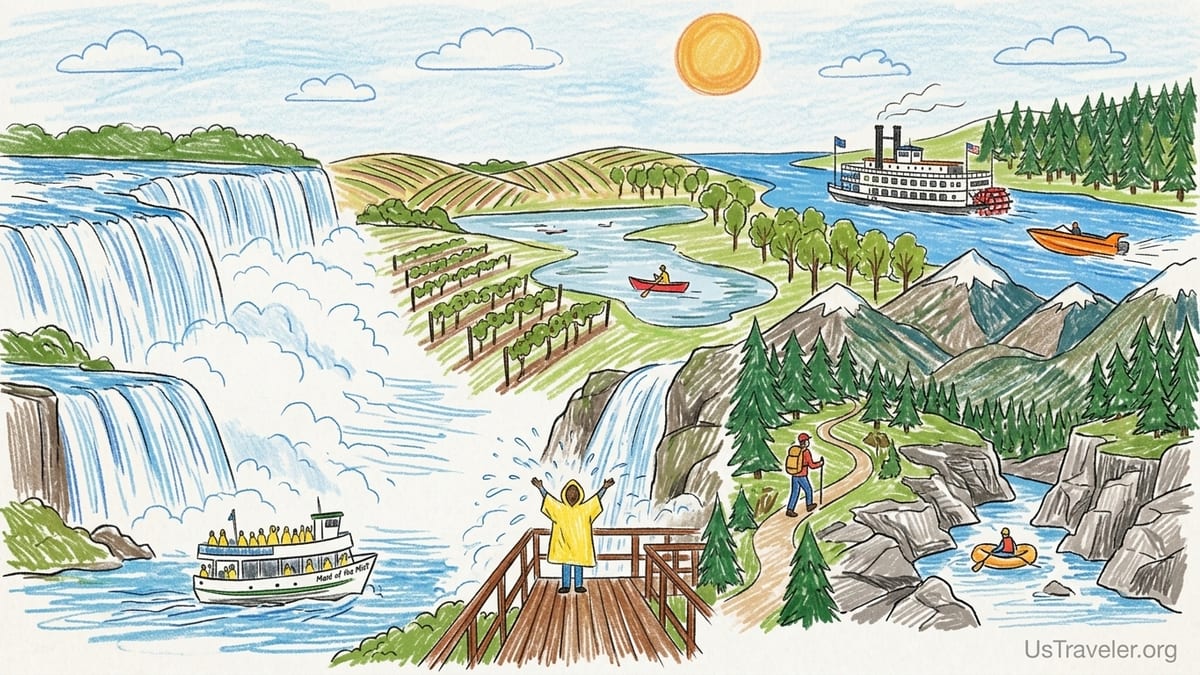
Niagara Falls is the rare destination where the biggest sights are free, but the two paid experiences that matter most are worth treating like anchors: the Maid of the Mist boat ride and Cave of the Winds. I did both on the same trip, and then returned another day to walk the park independently without tickets, which made the value difference obvious. On foot, Niagara Falls State Park is scenic and straightforward, but you still end up watching other people do the iconic things while you stand at railings thinking, “So this is it.” The paid experiences are what turn the visit from a pretty overlook into a full-body memory.
Maid of the Mist was the classic friction-remover. I bought my ticket in advance and showed up early enough to beat the thickest mid-day wave. Even when it is busy, the process is intuitive: you move through a controlled queue, down to the boarding area, and then the “activity time” is exactly what you came for, roughly a half hour on the water once you are on. The ticket includes the signature poncho, which sounds minor until the first wall of spray hits and you realize everyone is getting equally soaked. The price point is also refreshingly clear for a major attraction: adults are priced at $30.25 and kids (6 to 12) at $19.75, with children under 5 free. That transparency matters when you are budgeting a family trip and trying not to get upsold all day.
Cave of the Winds was the more physically intense counterpart, and also the one where paying saved me the most time-related frustration. The experience is built around timed entry, which changes everything at Niagara because it lets you structure the rest of your day around a slot rather than hovering near the entrance. Once you are in, it is a short orientation, the provided footwear cover, then the walkways and platforms that bring you startlingly close to Bridal Veil Falls. The “activity” portion feels longer than the boat because you move at your own pace on the platforms, but the real value is that the state park is doing the hard work of keeping a potentially chaotic scene safe and flowing. Independently, I could have walked Goat Island and the overlooks with zero planning, but I could not have manufactured that drenched, front-row perspective without the ticketed infrastructure.
Where self-driving was clearly easier in Niagara was everything around the edges: sunrise overlooks, Goat Island wandering, and quick food stops. If you have a car, the independent version of Niagara is easy to execute in the sense that you can park, walk, and keep moving. What is not easy to execute independently is the core “I went to Niagara Falls” checklist in a way that feels complete. My best day in Niagara was the one where I treated Maid of the Mist and Cave of the Winds as non-negotiable paid building blocks and then used the rest of the time for unstructured exploring.
Niagara’s Whirlpool Jet Boats: A Thrill Ride That Solves a Different Problem
A common mistake is to treat the Whirlpool jet boat as an alternative to the Maid of the Mist. It is not. I booked Whirlpool Jet Boat Tours out of Lewiston on the U.S. side, and it delivered exactly what it promises: speed, whitewater, and a different view of the river corridor, not a close-up of the Falls themselves. The practical detail travelers care about is that the ride is marketed in wet and dry variations, and the “dry” option is still the same high-energy route, just under a dome. Their published pricing puts the dry ride at $73 for about 45 minutes, which is a very specific transaction: you are paying for adrenaline and a tight schedule, not for a sightseeing cruise.
Logistically, this was one of the smoother paid experiences I did in New York State because it behaves like an efficient adventure operator. You arrive, check in, get the safety talk, and go. The waiting is mostly about loading and timing, and the “actual activity time” is close to what is advertised once the boat launches. This is also a tour where the guide component is less about storytelling and more about safety, timing, and the choreography of the rapids. If you love the feeling of a professional crew running a tight operation, it is satisfying.
The hidden benefit here is geographic: Lewiston is a pleasant add-on town that many Niagara visitors do not meaningfully experience when they stay glued to the State Park overlooks. Doing the jet boat nudged me into spending extra time in the riverfront area instead of fighting for space at the most crowded viewpoints. It also gave my day a second “peak moment” after the Falls, which matters if you are traveling with teens or anyone who rates a day by its excitement curve.
Where self-driving was easier is obvious: you can drive to Lewiston without a guide, and you can explore the riverfront independently. The paid part only makes sense if you genuinely want the rapids experience. If your goal is the Falls, put your money toward Maid of the Mist and Cave of the Winds first, then treat the jet boat as a separate adventure day or an add-on if you have extra time.
Finger Lakes Wine Touring: The Tour Bus Earned Its Keep, But DIY Was Better for Two Stops
The Finger Lakes is where “tour value” gets nuanced. I did a guided wine day with a dedicated driver, then later returned to do the region independently with a car and a loose plan. The guided day was better for exactly one reason: it removed the problem nobody wants to talk about, which is the reality of tasting multiple wineries responsibly while also navigating rural roads, limited ride-share coverage, and the temptation to squeeze in “just one more stop.” On my guided day, the biggest luxury was not the wine education. It was not having to think about driving.
The best part of a well-run Finger Lakes wine tour is pacing. A good operator spaces tastings to avoid palate fatigue, builds in water and food, and knows which tasting rooms can handle a group without turning it into a cattle call. On my tour day, the guide’s contribution was mostly invisible in the moment: pre-arranged arrival times, staff expecting us, and a route that did not waste half the afternoon backtracking around the lake. It also removed the friction of “Who is paying where?” and “Do we need reservations?” which can quietly consume a DIY day, especially in peak season.
That said, the DIY version of the Finger Lakes won in two scenarios. First: if you are only visiting one or two wineries and you care about lingering. When I visited on my own, I could stop at a tasting room that offered a structured on-site tour and tasting without needing a tour bus. Pindar Vineyards on Long Island is the obvious example of how clear, on-menu winery tours can be, but the Finger Lakes has plenty of tasting rooms where you can build your own day just by booking ahead and driving carefully. Second: if your goal is a specific hike or a single signature attraction such as a gorge walk, you can get more done by controlling your own clock rather than staying with a group’s schedule.
Price transparency is where Finger Lakes tours can be tricky compared with Niagara. Some shared-seat options marketed online can climb into the mid-hundreds per person once you add fees and the fact that many tastings are paid separately. I found the best “value per stress removed” was booking a private driver day for a small group and treating it like a safety and logistics purchase rather than a bargain. It is not the cheapest way to see wineries, but it is the most relaxing way to do a real tasting day, and it let me enjoy the wine without doing math every time we approached a turn.
Finger Lakes on the Water: Guided Paddling That Turned a Pretty Lake Into a Real Experience
I love the Finger Lakes from the roadside, but the day I remembered most vividly was a guided paddle. I booked a flat-water outing on Seneca Lake that was designed for beginners and focused on scenery rather than athletic challenge. The reason this category earns its keep is simple: a first-time visitor does not always know where to launch, where wind becomes a safety issue, or how to time a route so it feels like a journey rather than “we paddled around for a bit.” A good paddling operator removes that uncertainty.
On my guided outing, the “pickup” was essentially a meet-on-site check-in at the launch area, which is typical for lake paddling tours. Group size was small enough to feel personal, and the guide’s value was in micro-coaching and route choice. We did not waste the first thirty minutes fumbling with gear. We were on the water quickly, and the bulk of the session was actual paddling, not briefing. That is the kind of tour design that makes the cost feel justified.
The hidden stop factor for paddling is not a secret waterfall or a surprise snack. It is the quiet cove you would not choose on your own because it looks like nothing on a map. On this trip, the guide steered us toward calmer water and timed the route around conditions, which is not just about comfort. It is about safety. The Finger Lakes can feel gentle until the wind picks up, and a guided tour is a sensible way to get a “best of” lake experience without learning that lesson the hard way.
Where self-driving was easier is also clear: if you already paddle confidently and you are comfortable assessing conditions, renting your own kayak can be simpler and cheaper. The guided experience makes the most sense for first-timers, mixed-ability groups, or anyone trying to turn a short visit into something that feels intentionally planned rather than improvised.
Hudson River and the Hudson Highlands: The Cruise That Replaced a Car Day
The Hudson Valley is easy to visit by car, and I did that too: pulled off for viewpoints, stopped in riverside towns, and built my own mini itinerary. But I also booked a full-day Hudson River cruise up to Bear Mountain, and that paid experience delivered a very specific form of value: it replaced a stressful driving day with an on-the-water day where the scenery comes to you. If you live in or are visiting New York City, it is one of the simplest “leave the city, feel the season” day trips you can book.
The trip I took was structured like a true day trip rather than a short sightseeing loop: morning departure, several hours of cruising, then time on land at Bear Mountain State Park, followed by a return cruise. The “actual activity time” is the cruising itself, and that is the point. Instead of watching the Hudson through a windshield and fighting weekend traffic, you get a narrated ride upriver with a seat, restrooms, and food available for purchase. The best cruises also have enough indoor space that weather does not ruin the day.
This is also a category where timing matters more than most travelers realize. Fall foliage dates and special event cruises book up because they compress the experience into a handful of peak weekends. One operator that spells out the 2026 season dates clearly is Seastreak, with scheduled Bear Mountain foliage cruises listed across early October into early November. That kind of specificity is exactly what you want when you are planning around a tight calendar and do not want to gamble on whether a cruise is running on your chosen weekend.
Where self-driving was clearly easier is if you are already staying in the Hudson Valley and want a flexible day with multiple stops. A cruise is a commitment: you are on their clock, and your time on land is defined by the schedule. If your dream day is wineries plus a hike plus a museum, drive yourself. If your dream day is to sit with a coffee, watch the Hudson Highlands slide by, and arrive somewhere that feels like a state-park reset, the boat day earns the price.
Lake George Cruises: The Paid Day That Felt Like a Vacation Shortcut
Lake George has plenty you can do independently: swim, shop around the village, drive to viewpoints, or simply park yourself on a beach. But I booked a Lake George Steamboat Company cruise because I wanted the classic “lake day” without needing a boat, a captain, or a plan. In practice, it functioned as a vacation shortcut: you show up, board, and the lake delivers its best angles without any work from you.
What I appreciated most was how the cruise product fits different traveler types. If you want nostalgia, the Minne-Ha-Ha is a sternwheeler style experience. If you want a larger flagship feel, there is the Lac du Saint Sacrement. If you want a piece of living history, the Mohican II is often discussed as a long-running vessel. That range matters because it lets you choose the vibe of your day, not just the route.
The friction the cruise removed was the same one that makes many lakes frustrating in summer: access. Without a boat, you are stuck seeing the lake from shore. With a ticket, you are suddenly in motion, seeing islands, shoreline homes, and mountain backdrops in a way that feels expansive. Waiting was mostly boarding line and departure timing, and “activity time” was essentially the whole cruise. Food and drinks are typically available for purchase, and that matters because it turns the boat into a contained half-day plan instead of another stop you have to sandwich between meals.
Where self-driving was easier is if you already have your own boat, or if you are trying to do a lot of hiking in one day. A cruise is a commitment, and it can be the centerpiece of a day rather than something you squeeze in. I liked it best as the main event: cruise first, then wander the village afterward without trying to force a packed itinerary.
Adirondack Guides and Ausable Chasm: Paying for Safety, Access, and a Better Story
The Adirondacks are where I most strongly recommend paying for a guide if you are not already confident in backcountry navigation and decision-making. I did a guided half-day outing with an Adirondack guide service and then also spent time self-driving the region, stopping at trailheads and scenic pull-offs. The difference was not that the guide showed me a prettier forest. The difference was that I stopped worrying about whether I had chosen the right trail for the conditions, whether the turnaround time was realistic, and whether my gear choices were smart.
Guide pricing in the Adirondacks varies widely, but the most reputable operators are very explicit about what they do: custom-designed hikes, paddles, and seasonal outings with small groups. One example of transparent guide-rate publishing is Adirondack All Seasons Guide Service, which lists half-day trips (about three hours) beginning at $150 for two people, with additional per-person pricing up to a small group cap. That kind of structure makes it easier to see the value: if you are two people, a half-day guide can be comparable to what you might spend on a couple of attraction tickets elsewhere, but it buys expertise and risk management.
Ausable Chasm is a separate, very bookable category that sits at the intersection of “outdoor attraction” and “guided adventure.” I booked an Ausable Chasm experience because it is one of those places where the infrastructure is the point: established routes, staff, safety systems, and a menu of ways to experience the gorge. Their public information spells out real operational rules that matter for families, including minimum requirements for certain river activities. That is exactly the kind of detail you want confirmed before you drive hours with kids expecting to raft, only to find out a height or weight requirement blocks you at check-in.
Where self-driving was easier in the Adirondacks is everything that is purely scenic and low-commitment: lake overlooks, casual short walks, and town-to-town exploring. The Adirondacks are huge, and a car is freedom. But if you want to do something that has consequences if you misjudge weather or ability, paying for a guide is not indulgent. It is a practical purchase that can turn “We might be in over our heads” into “We had the perfect day for our level.”
The Takeaway
The paid experiences that truly added something in New York State were the ones that either delivered access you cannot replicate independently (Maid of the Mist and Cave of the Winds), replaced an exhausting logistics day with an enjoyable one (Hudson River cruises and Lake George cruises), or converted uncertainty into confidence (Adirondack guides and structured outdoor attractions such as Ausable Chasm). When a tour is mainly transportation to something you can easily do on your own, I found self-driving wins. When the tour is the experience, or when it removes a safety or responsibility burden, the price starts to feel like a fair trade.
If you are planning your own mix-and-match itinerary, a good rule is to pick one “signature paid anchor” per region, then build the rest with independent time. In Niagara, anchor with the boat and Cave of the Winds. In the Finger Lakes, anchor with a driver-led wine day or a guided paddle, then do your extra stops yourself. In the Hudson Valley, anchor with a foliage cruise if you want a no-car reset. In the Adirondacks, anchor with a guide if you are stepping beyond casual trails. Do that, and you will spend less time troubleshooting and more time actually having the day you came for.
FAQ
Q1. What are the two must-book paid experiences at Niagara Falls on the New York side?
Maid of the Mist for the boat ride into the mist zone, and Cave of the Winds for the close-up platforms near Bridal Veil Falls.
Q2. How much does Maid of the Mist cost right now?
Published pricing lists $30.25 per adult, $19.75 for children ages 6 to 12, and free for children under 5.
Q3. Is the Whirlpool jet boat tour a substitute for Maid of the Mist?
No. The jet boat is a rapids and speed experience on the river, while Maid of the Mist is the iconic close-up boat ride at the Falls.
Q4. When does paying for a Finger Lakes wine tour make the most sense?
When you want to visit multiple wineries in one day and do not want anyone in your group to be responsible for driving after tastings.
Q5. When is a self-drive Finger Lakes day clearly better?
If you only want one or two wineries and prefer to linger, or if your day includes a hike or attraction that does not fit a group schedule.
Q6. What is the biggest benefit of a guided paddling tour in the Finger Lakes?
It removes uncertainty around launch points, route choice, wind and conditions, and it gets you on the water quickly with the right gear.
Q7. Why do a Hudson River cruise to Bear Mountain instead of driving?
It replaces traffic and parking stress with a scenic ride where the Hudson Highlands are the main event, plus built-in time at Bear Mountain.
Q8. Are Lake George cruises worth it if you do not have a boat?
Yes. A ticketed cruise is one of the simplest ways to experience the lake from the water without renting or piloting a boat.
Q9. What does hiring an Adirondack guide really buy you?
Route planning, pacing, local conditions knowledge, and safety decisions, especially valuable for visitors unfamiliar with Adirondack terrain and weather.
Q10. What is a smart way to budget tours across New York State?
Choose one signature paid “anchor” experience per region, then keep the rest of your time flexible and independent to avoid over-scheduling.