

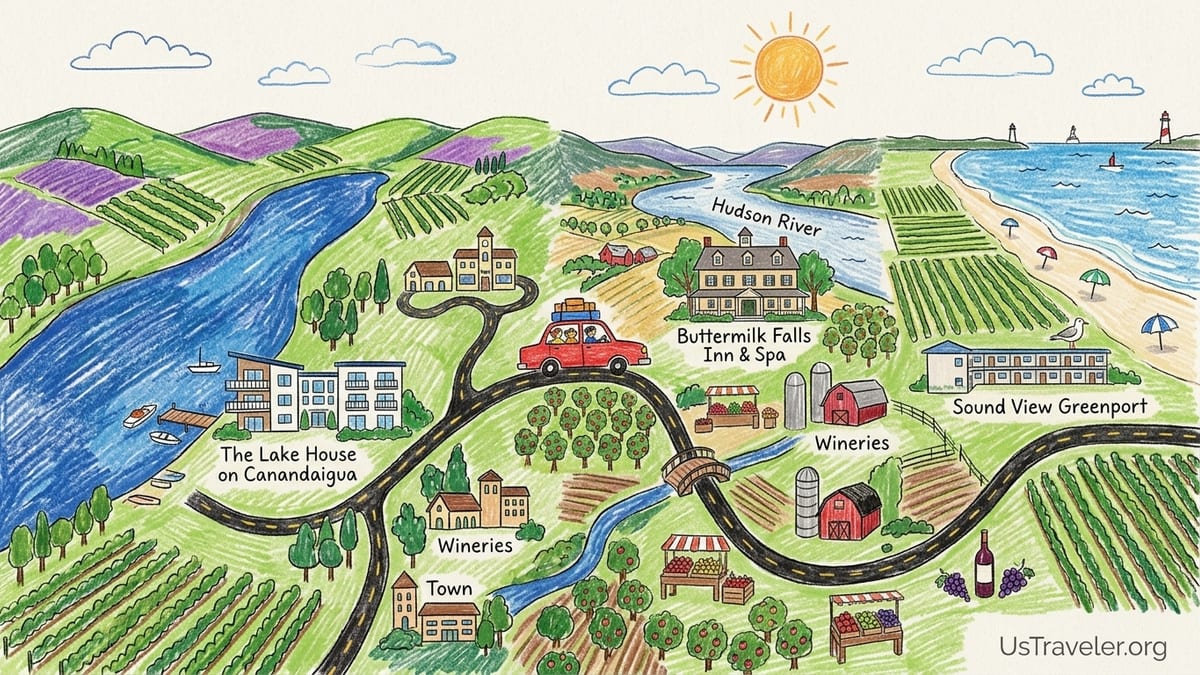
Wine country in New York is not a single destination. It’s a set of very different landscapes and logistics, and once you stop trying to “do it in a day,” the state’s best bottles taste better simply because you are not rushing. On my most recent New York wine swing, I built the trip around three distinct regions and three specific hotels: The Lake House on Canandaigua in the Finger Lakes, Buttermilk Falls Inn & Spa in the Hudson Valley, and Sound View Greenport on Long Island’s North Fork. Each stay rewired the pace of tasting in a different way, from lakeside mornings that made 11 a.m. reservations feel civilized to coastal sunsets that turned “one more glass” into an easy yes because the room key was the only thing I needed to carry home.
New York Wine Country Is Bigger Than One Map Pin
New York wines are often introduced through the Finger Lakes, but the state’s wine identity stretches from the Hudson Valley to Long Island, with additional production areas such as Niagara and Lake Erie also recognized in statewide wine conversations and reporting. For travelers, that matters because “wine country” is not one set of hotel options and one set of tasting room norms. It is three different weekend playbooks: a lakes-and-vineyards road trip in the Finger Lakes, a river-and-farmstand escape in the Hudson Valley, and a beach-meets-bordeaux coastal drive on the North Fork.
Long Island’s North Fork alone is frequently described by New York tourism outlets as having more than 60 wineries, and that density creates a very different lodging question than the Finger Lakes, where wineries can be spread along long lake roads. In the Hudson Valley, the twist is that tasting rooms may be close to New York City, but they are not always close to one another, and the region’s hotel scene can be as destination-focused as the wineries themselves. Booking the right base becomes the difference between a trip that feels like a constant car shuffle and one that feels like a proper getaway.
Before you fall for a photo of a vineyard pergola, it’s worth separating two kinds of “wine trips.” One is a day of tastings with a long drive home. The other is sleeping nearby, which makes tastings safer, dinners less stressful, and mornings more enjoyable. The hotels below are not just places to sleep. They are the reason I could slow down, taste more thoughtfully, and stop checking my watch like I was trying to beat traffic back to the city.
Finger Lakes Stay: The Lake House on Canandaigua (Where I Actually Slept)
I stayed at The Lake House on Canandaigua, a lakefront resort on Canandaigua Lake that leans into the idea that wine country should feel restorative. This is the Finger Lakes with a polished, modern resort wrapper: lakeside balconies, a walkable downtown edge, and the kind of property where you can come back from a tasting and still feel like the day is unfolding rather than ending.
Proximity is the hidden luxury here. Canandaigua is not on Seneca Lake, which is where many first-timers aim because of the well-known winery clusters. But staying at The Lake House made the broader Finger Lakes feel manageable because I stopped trying to “cover everything.” Instead, I treated my tastings like appointments, not a scavenger hunt. The hotel’s location also made it easier to build in non-wine breaks: a lakefront coffee, a shoreline walk, a quick reset at the property, then back out.
Views are a big part of why the stay works. Many rooms advertise lake views and balconies, and the vibe is unmistakably water-forward rather than vineyard-forward. That distinction matters if you’re choosing between “wake up to vines” and “wake up to a lake.” At The Lake House, mornings felt like a calm prelude to tasting: a quiet lake, then a day of Riesling and Cabernet Franc without the sense that I had already burned energy just getting to my first stop.
Food and drink availability on-site shaped the rhythm of the trip. The Lake House promotes breakfast at Rose Tavern and runs packages that tie directly into winery touring, which signals what the property expects guests to be doing. On a practical level, it meant I could keep dinner close if I wanted to avoid another drive after a day of tastings. That one choice changed the entire feel of the evening: instead of negotiating who was okay to drive farther, I could have a final glass with dinner and still be back in my room quickly.
Finger Lakes Reality Check: Winery Hours, Reservations, and the No-Long-Drive Advantage
The Finger Lakes can look compact on a map, but the drives add up fast once you start hopping between lake corridors. Staying in the region, rather than commuting in, is what made tastings feel relaxed. One example: Fox Run Vineyards on Seneca Lake publishes tasting room hours that generally run Monday through Saturday from 10 a.m. to 6 p.m. and Sunday from 11 a.m. to 6 p.m., and it emphasizes that reservations are not required for smaller groups, while larger parties have different requirements. It also notes that guided tours run on the hour starting at 10 a.m. with the last at 4 p.m., and that tours do not require reservations. Those details are easy to ignore when you are day-tripping. When you’re sleeping nearby, they become an itinerary advantage.
What changed most for me in the Finger Lakes was not just the ability to taste without racing, but the ability to time tastings well. With a hotel base, I could aim for an earlier start without a punishing morning drive, and I could end the day without calculating whether sunset traffic plus a last tasting would push me into a late-night haul. Even if you still choose to drive between wineries, sleeping in-region reduces the total time behind the wheel and gives you more flexibility if a tasting runs long or a table opens up unexpectedly.
Walkability to tastings is not the default in the Finger Lakes the way it can be in urban tasting-room districts. Many properties are scenic but not connected by sidewalks, and wineries often sit on roads built for cars. So “walkable tastings” is the wrong goal here. The right goal is short, low-stress drives and a home base that makes one-lake-per-day realistic. That is the pace shift: you stop trying to sample the entire region and start enjoying the part of it you are actually in.
Taxi and ride-share reality in the Finger Lakes is highly situational. In and around towns, you may find options, but you should not assume the kind of instant availability you get in larger cities, especially late. That’s another reason I liked having dinner and a nightcap option close to the hotel. Sleeping near the lake did not magically remove the need to plan rides, but it reduced the number of times I needed one, and that alone made the trip feel more comfortable.
Hudson Valley Stay: Buttermilk Falls Inn & Spa (Where I Actually Slept)
I stayed at Buttermilk Falls Inn & Spa in Milton, a Hudson Valley property that feels like a countryside retreat first and a wine-country base second. That is not a drawback. It is the point. The Hudson Valley is a region where your wine itinerary often shares the calendar with farm markets, hikes, historic towns, and restaurants that are a destination in their own right. Buttermilk Falls matched that multi-activity energy, and it made the trip feel like a proper escape rather than a tasting sprint.
The room experience here leans into scenery. The inn describes room types that include private balconies with Hudson River views, and that river-and-grounds setting makes mornings feel unhurried. It is the opposite of “wake up, grab keys, drive.” I spent more time on-property than I usually do on wine trips, partly because it rewards lingering. That ended up improving the tasting day, because starting from a calm place changed how I approached appointments.
Breakfast matters more than people admit on a wine weekend. A substantial breakfast sets you up to taste responsibly, and it reduces the temptation to treat the first tasting room as an early lunch stop. Buttermilk Falls has long positioned breakfast as part of the stay, and the property’s broader setup encourages a slower start: coffee, a look at the river, then a late-morning tasting rather than an anxious dash out the door.
Dinner availability is also part of the safety equation. If a hotel has a real dinner option, you can end the day without adding another drive. If it doesn’t, you need a plan. At Buttermilk Falls, the overall structure of the property is built around staying put when you want to. That made it easier to plan my wine day around a clear finish line: back to the inn, no extra mileage required, and no last-minute debates about where to eat.
Hudson Valley Tasting Logistics: Shorter Distances Than Upstate, But Not Effortless
The Hudson Valley’s advantage is that it can be easier to reach from the New York City area than the Finger Lakes. The catch is that winery clusters are not always as concentrated as visitors expect, and tasting room norms can vary widely. Whitecliff Vineyard & Winery, for example, publishes hours and notes that tastings are generally first come, first served, with an exception for larger groups that must request availability. It also lists service windows by day, which is exactly the kind of detail that can quietly make or break a one-day plan.
Another Hudson Valley quirk is that some wineries operate multiple tasting rooms or have separate experiences that change the reservation conversation. Whitecliff, for instance, has a Gardiner location and a Hudson tasting room, and that can be useful if you are trying to pair a wine stop with time in a town. Meanwhile, other Hudson Valley stops can feel more estate-like and may layer food service, events, or structured experiences into the day. The benefit of sleeping nearby is that you can choose one or two places and give them the time they deserve, instead of trying to stack four tastings into a short window.
Reservations can also extend beyond tastings. Some winery restaurants and on-site dining options require bookings. Millbrook Winery’s published event and restaurant messaging, for example, points out that bookings are essential for its restaurant and that its cellar door visiting days are limited to a Thursday-to-Monday schedule with set hours. Even if you do not plan to dine at a winery, that kind of limited schedule influences where you should sleep. Staying in the Hudson Valley means you can pivot. If one place is closed or full, you can reroute without turning the day into a long-distance drive.
Ride-share in the Hudson Valley is also not guaranteed in the way it is in Manhattan. In some towns you may have service, but you should not treat it as your only plan. The best workaround I found was not a perfect taxi network, but a shorter list of wineries. Staying at a retreat-style property made it easier to embrace that approach: fewer tastings, more time, and a safer end to the day.
Long Island North Fork Stay: Sound View Greenport (Where I Actually Slept)
I stayed at Sound View Greenport, and it delivered the clearest example of how sleeping near the vines changes the pace because the North Fork’s vibe is built for lingering. You are not just tasting. You are also watching the light change over the water, stopping at farm stands, and thinking about dinner while you’re still holding a tasting glass. Sound View’s identity is tied to that coastal rhythm, and it made my North Fork day feel less like an itinerary and more like a long, enjoyable afternoon.
The property leans into on-site food, which matters on the North Fork where popular restaurants can book up and driving after tastings is the last thing you want to do. Sound View publishes clear breakfast hours, and it operates multiple food and drink options on the property, including The Halyard and additional seasonal outlets. On my stay, the ability to keep dinner in-house meant I could treat the late afternoon tasting as truly late afternoon, not a last stop I had to cut short to make a reservation across the peninsula.
Views here are water-forward, not vineyard-forward, and that is a real choice on the North Fork. Many wineries have beautiful grounds, but your hotel may deliver the best “sit and stare” moment of the day. I liked ending tastings with the knowledge that sunset would be waiting at the hotel. That changed how I tasted: I did not feel pressure to chase the next stop for scenery because the scenery was built into the stay.
What about proximity to wineries? The North Fork’s advantage is density. New York tourism sources frequently describe the area as having more than 60 wineries, and the region’s main roads make it easy to string together tastings without the long lake-circumnavigation drives you can face upstate. That does not mean tastings were walkable from my hotel, but it did mean the drives were shorter and the day felt less like a road trip. Sleeping in Greenport also made it easier to treat the night like a night out rather than a careful retreat back west.
Long Island Logistics: Shuttles, Reservations, and Why the North Fork Rewards Sleeping Over Commuting
The North Fork is the region where “don’t drink and drive” planning becomes both easier and more complex. Easier because distances between wineries can be short. More complex because traffic, limited ride-share pockets, and weekend crowds can create friction. One of the best practical moves is choosing a hotel that offers transportation help. For example, Hotel Indigo Long Island - East End notes that it offers a complimentary local area shuttle, which is the kind of amenity that can turn a two-winery day into a three-winery day without turning someone in your group into the permanent designated driver.
On the North Fork, tastings often come with time limits, walk-in rules, or group-size restrictions. It is common for wineries to ask for reservations for seated tastings or to have specific policies for larger parties, especially on weekends. Even when walk-ins are accepted, the quality of your experience can depend on arriving at the right time. Sleeping nearby means you can go earlier, or go later, without the stress of a long drive home at the end of the day.
There is also a very real “after” to North Fork tasting: dinner, a second location for drinks, or simply sitting by the water with a bottle you bought earlier. Sound View publishes that its beach bar is seasonal and that some outlets run on specific day schedules, which is a reminder that even at hotels, food availability can be day-dependent. Sleeping on the North Fork keeps you flexible. If one plan doesn’t work, you are still in the center of the action rather than an hour or two away.
The biggest pace shift for me on the North Fork was psychological. Because I was sleeping nearby, I stopped treating each tasting as a must-maximize event. I tasted more slowly, bought fewer but better bottles, and I was more likely to say yes to an extra flight because I was not calculating a long-distance drive. That is the entire thesis of sleeping near the vineyards: the wine doesn’t just taste like grapes and soil, it tastes like time you actually had.
The Takeaway
If you want a New York wine trip that feels like a vacation instead of a checklist, pick one region and sleep there. In the Finger Lakes, a lakefront base like The Lake House on Canandaigua turns the trip into an unrushed, water-and-wine weekend where tastings fit around downtime rather than replacing it. In the Hudson Valley, a retreat-style stay like Buttermilk Falls Inn & Spa makes it easier to balance tastings with the region’s broader appeal: farms, towns, restaurants, and scenery. On the North Fork, Sound View Greenport made the case for coastal wine country at its best: short drives, dense winery options, and an end-of-day atmosphere that rewards lingering.
The practical benefits are just as important as the romantic ones. Sleeping nearby reduces long drives between tastings, makes it easier to align with winery schedules and reservation rules, and lowers the pressure to squeeze everything into a single afternoon. It also changes what you can responsibly do at dinner, because “one more glass” stops being a problem you have to solve. The common thread across all three regions was simple: once I stopped commuting to wine country, I started tasting like I belonged there.
FAQ
Q1. Which New York wine region is best for a first trip?
Finger Lakes is often the easiest first pick because it has a large concentration of wineries and classic lake scenery, but the best choice depends on how far you want to drive and whether you want lakes, river towns, or beaches.
Q2. Where did the author actually stay on this trip?
I stayed at The Lake House on Canandaigua (Finger Lakes), Buttermilk Falls Inn & Spa (Hudson Valley), and Sound View Greenport (Long Island North Fork).
Q3. Are tastings walkable from most New York wine country hotels?
Usually not. In all three regions, most tastings required a short drive, and the better goal was minimizing drive time rather than expecting to walk between wineries.
Q4. Do Finger Lakes wineries require reservations?
Some do and some don’t. Policies vary by winery, day, and group size. Fox Run Vineyards, for example, states reservations are not required for smaller groups, while larger groups have different requirements.
Q5. Is ride-share reliable in the Finger Lakes?
It can be limited, especially late or outside towns. Plan as if you may need to drive, book a car service in advance, or choose a hotel with dining so you reduce the need for rides at night.
Q6. What’s the lodging advantage of the North Fork versus the Finger Lakes?
The North Fork’s winery density means shorter hops between tastings, and you can pair wine with coastal downtime. It still helps to plan transportation carefully because weekends can be busy.
Q7. Does Sound View Greenport serve breakfast?
Yes. Sound View’s published guest information includes continental breakfast hours, and the property also operates multiple food and drink venues on-site.
Q8. Are there hotels on the North Fork with shuttles?
Yes. Some properties advertise local shuttles, such as Hotel Indigo Long Island - East End, which states it offers a complimentary local area shuttle.
Q9. Is the Hudson Valley a good wine weekend without taking time off work?
It can be, particularly if you’re coming from downstate, because the drive is typically shorter than going to the Finger Lakes. Just remember winery hours and restaurant bookings can be limited on certain days.
Q10. How did staying near the vineyards change the pace of the trip?
It reduced total driving, made winery schedules easier to hit, and made dinner safer and more enjoyable because I wasn’t planning a long drive after tastings.