


I built my Cooperstown day around one simple goal: spend enough time at the National Baseball Hall of Fame and Museum to feel like I truly saw it, without turning it into an endurance test for the one non-baseball superfan in my group. I went in late September, when the village is calmer than peak summer, the museum is back on its regular hours, and paid parking is still a factor downtown. What follows is a practical, first-person account of exactly how the day worked in real life: where I parked, what I paid, how long the walk felt, how ticketing and entry went, what I actually looked at inside, and how long the Hall kept our attention before we were ready for fresh air.
Parking In Cooperstown: What I Did, What It Cost, And How Far It Felt
I drove into Cooperstown with a realistic expectation: in a village this small, parking is part of the plan, not something you “figure out when you get there.” In late September, the seasonal village trolley is not running (it ends September 6, 2026), so I treated the car as my base for the day and assumed I would be walking.
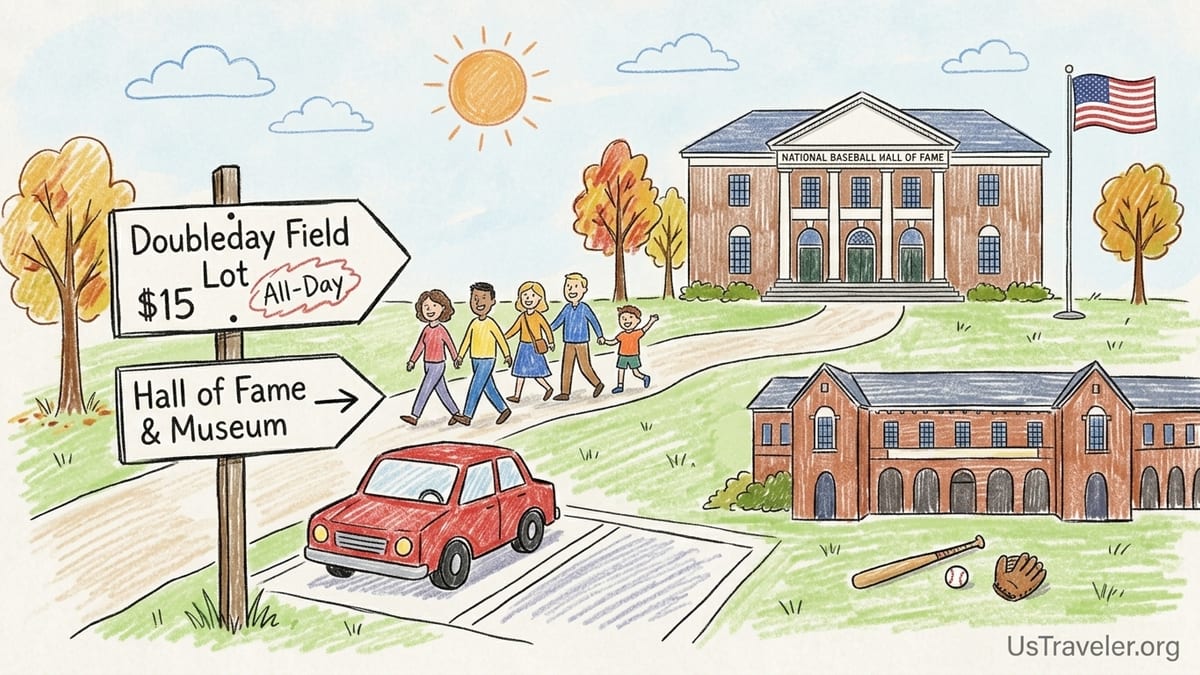
I chose the Doubleday Field all-day lot specifically because it’s straightforward. I paid $15 for the day, which lined up with what I’d seen posted for the all-day option there, and I liked not having to watch a meter. From that lot, the walk to the Hall of Fame felt like a real, normal stroll through town rather than a “schlep.” It’s close enough that nobody in our group complained, but far enough that you’ll be glad you wore comfortable shoes. If you have someone who moves slowly or tires easily, I’d still call it manageable.
On the way in, I also noticed downtown street parking where the going rate is commonly $2.50 per hour. That can make sense if you are only popping into the museum for an hour or two, but for a full museum day it adds a mental tax: you’ll keep doing math and checking time. Because paid parking remains in effect through Columbus Day, late-September visitors should assume they’ll pay something unless they get lucky with a free spot outside the paid zone.
Tickets And Entry: Buying Admission And What The Price Really Means
I bought tickets directly from the Hall of Fame’s official online ticketing flow before arriving. For my visit date, I wanted the certainty of walking up and going straight inside, and I also wanted to reduce the “decision friction” at the front door. Current daily admission is $35 for adults, $29 for seniors (65+), and $26 for children ages 7 to 12, with children six and under free. If you’re traveling with a family, those numbers add up fast enough that it’s worth running the total before you go, especially if you are also budgeting for the museum store.
When we arrived, the entry process felt efficient. Late September is not induction-weekend chaos, and we didn’t face a long queue. There was a brief moment of waiting at the front, but it was the kind of wait you barely remember, more like a pause to get oriented than a line that eats your day. If you’re traveling with kids who are impatient, this is the kind of entry you want: no extended corral, no drawn-out security bottleneck, and no sense that the building is already overwhelmed.
One practical note: those ticket prices buy you a lot of time. This is not a “quick lap” museum unless you force it to be. Even if you’re not the kind of person who reads every label, you’ll likely spend longer than you expect, because the exhibits have a way of turning into small rabbit holes: a photo, then a uniform, then a plaque, then you’re suddenly debating baseball history with someone you came with.
Timing The Visit: Arrival Time, Museum Hours, And Crowd Reality After Labor Day
After Labor Day, the Hall’s current museum hours are 9 a.m. to 5 p.m. That earlier closing time matters. If you show up at 3 p.m. thinking you’ll “just see the highlights,” you may end up rushing through the parts that actually make the museum special, like the plaque gallery and the deeper era-by-era storytelling exhibits.
I aimed to arrive not long after opening, and I’m glad I did. In practice, that gave us the quietest galleries of the day and the best experience in the most contemplative spaces. The plaque gallery especially benefits from a calmer moment. You can actually stand in front of the names and take your time without feeling like you’re clogging traffic.
By late morning, the building felt busier, but not unmanageable. That’s the sweet spot for many travelers: enough other visitors that the energy feels lively, but not so many that you’re shoulder-to-shoulder. If you’re visiting with a mixed group, including at least one non-baseball fan, an early start also helps because it reduces fatigue. You can give the museum your best attention first, then let the afternoon be more flexible.
Inside The Hall: The Route I Took And The Floors That Actually Held My Attention
I treated the museum like a series of chapters rather than a single continuous story. Instead of trying to read every panel, I focused on a practical route: start with the iconic core, then move through the larger exhibits, and finish with the spaces that reward lingering. The museum is the kind of place where “doing it all” can accidentally mean doing none of it deeply. So I picked a pace that felt like we were absorbing what we saw.
The plaque gallery was the emotional anchor of the visit. Even for people who don’t obsess over baseball stats, the presentation of the plaques has a quiet gravity to it. It’s also a natural place to split up briefly: the superfan can linger on certain careers, while others can wander, read a handful of inscriptions, and still feel like they experienced the heart of the Hall.
After that, we moved through broader historical exhibits and the artifact-heavy galleries, which are where the museum becomes less about “names you recognize” and more about tangible objects that make baseball feel real and lived-in. I’m careful about promising that any specific artifact will be on view on a given day because displays can rotate, but what stood out consistently was how much the museum leans on authentic material culture: uniforms with visible wear, equipment that looks genuinely used, and exhibit choices that connect iconic moments to physical objects.
In real time, we spent the most minutes in spaces that mix visuals, artifacts, and concise storytelling. The least time went to any areas that were text-heavy without as many objects. That’s not a criticism; it’s just how museum attention works for most groups, especially when you have a range of interest levels.
Artifacts That Stopped Me: The Moments That Felt “Worth The Trip”
There were a few times I caught myself doing that museum thing where you unexpectedly slow down and stand still. Some of it was because an object carried a story you already knew. Some of it was the opposite: you see a name you barely remember, then an artifact makes you curious, and suddenly you’re reading more closely. That is the Hall at its best, when it turns you from a passive fan into an active observer.
For me, the most memorable moments were the ones that made baseball feel personal rather than distant. A well-worn uniform can do that. So can a bat, glove, or piece of game-used equipment that clearly lived a life before it arrived under museum lighting. Even if you’ve watched baseball your whole life, there is something different about being within a few feet of an object that actually took part in the game’s history. It’s not abstract anymore.
I also appreciated that the museum doesn’t require you to be a walking encyclopedia. If someone in your group knows the history cold, they’ll be thrilled. But if someone only recognizes a handful of legends, the Hall still gives them enough context to enjoy themselves. That mattered for my group. The non-superfan wasn’t bored; they were more like pleasantly surprised that the museum experience wasn’t just “walls of stats.”
How Long To Budget: My Realistic Time Spent, Breaks, And Re-Entry Strategy
In a single day, the Hall genuinely held our attention for several hours. Not the kind of “we are forcing ourselves to finish” time, but actual engaged time. If I had to plan it again for a typical traveler, I would budget about three to four hours inside as a comfortable baseline. That’s enough to do the essential galleries well, linger where you want, and still have time afterward to enjoy Cooperstown itself.
If you are a serious baseball fan, you can absolutely spend longer. If you love reading every label, comparing eras, and debating players, five hours can disappear, especially with breaks. But for mixed-interest groups or families, three to four hours is the sweet spot where attention remains high and frustration remains low.
We took at least one real break. That’s another reason I liked having the car parked in a predictable place. In a small town, it’s easy to step outside, reset, and decide what you want to do next without losing half an hour. As for leaving and re-entering the museum the same day, I planned the day so we didn’t need to. I prefer not to assume re-entry policies without double-checking at the door on the day of a visit, because rules can change. If you think you’ll want to leave for a long lunch and come back, confirm re-entry at the admissions desk when you arrive and keep whatever proof they recommend.
One family-specific note: if you have children, the Hall can be great, but it’s still a museum. Plan for movement and variety. We did best when we alternated between “big visual” galleries and quieter reading moments, and when we agreed in advance that we didn’t need to see every single thing to call it a successful visit.
The Takeaway
A day at the National Baseball Hall of Fame and Museum is most enjoyable when you treat it like a real outing rather than a quick stop. In late September, the practical details matter: the museum is open 9 a.m. to 5 p.m. after Labor Day, the seasonal village trolley has already ended for 2026, and paid parking in Cooperstown remains a reality through Columbus Day. Once you’ve handled those logistics, the museum itself delivers what you came for: a deeply tangible walk through baseball history, with enough iconic core content for superfans and enough visual storytelling for the people who are simply along for the ride.
If you’re deciding how to structure your day, my strongest recommendation is simple: arrive close to opening, budget at least three to four hours inside, and don’t underestimate how much time you’ll want in the plaque gallery. If you do it that way, you’ll leave feeling like you saw the Hall, not like you sprinted through it.
FAQ
Q1. What are the current ticket prices for the National Baseball Hall of Fame and Museum?
Adults are $35, seniors (65+) are $29, children ages 7–12 are $26, and children six and under are free.
Q2. What are the museum hours after Labor Day?
After Labor Day, the museum’s regular hours are 9 a.m. to 5 p.m.
Q3. Is the Cooperstown village trolley running in late September 2026?
No. The seasonal village trolley ends September 6, 2026, so late-September visitors should not plan on using it.
Q4. How much is parking at the Doubleday Field all-day lot?
The Doubleday Field lot is currently $15 for an all-day option during the paid parking season.
Q5. What does downtown street parking usually cost in Cooperstown during the paid season?
Downtown on-street parking is commonly $2.50 per hour during the paid season, with pay rules applying during posted hours.
Q6. How much time should I budget inside the Hall of Fame?
Plan for about three to four hours for a satisfying visit, and longer if you like reading every label or traveling with a die-hard fan.
Q7. Is the Hall of Fame worth it if I’m not a huge baseball fan?
Yes, especially if you enjoy American history, design, photography, or museums with real artifacts. Non-fans in my group still found plenty to engage with.
Q8. What should families with kids know before going?
It’s a museum experience first, so kids do best with breaks and a flexible pace. The biggest wins come from mixing iconic highlights with shorter gallery stretches.
Q9. Should I buy tickets online or at the door?
Buying online can make arrival smoother and reduce time at the counter, especially on weekends or during busier seasons.
Q10. Can I leave the museum and come back the same day?
Policies can vary, so confirm re-entry at the admissions desk when you arrive if you think you’ll want to leave and return later.