


I came to Herkimer expecting a pleasant history cruise and a photo-op with a lock. What I didn’t expect was how physical the Erie Canal would feel from the waterline: the sudden hush as the lock gates close, the first restless swirl of water against the hull, and then that unmistakable sensation of the entire boat rising like a slow elevator while the stone and concrete walls slide past at arm’s length. On paper, this narrated sightseeing trip is a 90-minute outing. In reality, it’s a compact, surprisingly immersive way to understand how the canal still works, and why the Mohawk Valley’s “flat” landscape has always been a story of engineered elevation.
Arriving in Herkimer: Parking, Check-In, And What It’s Actually Like To Start Here
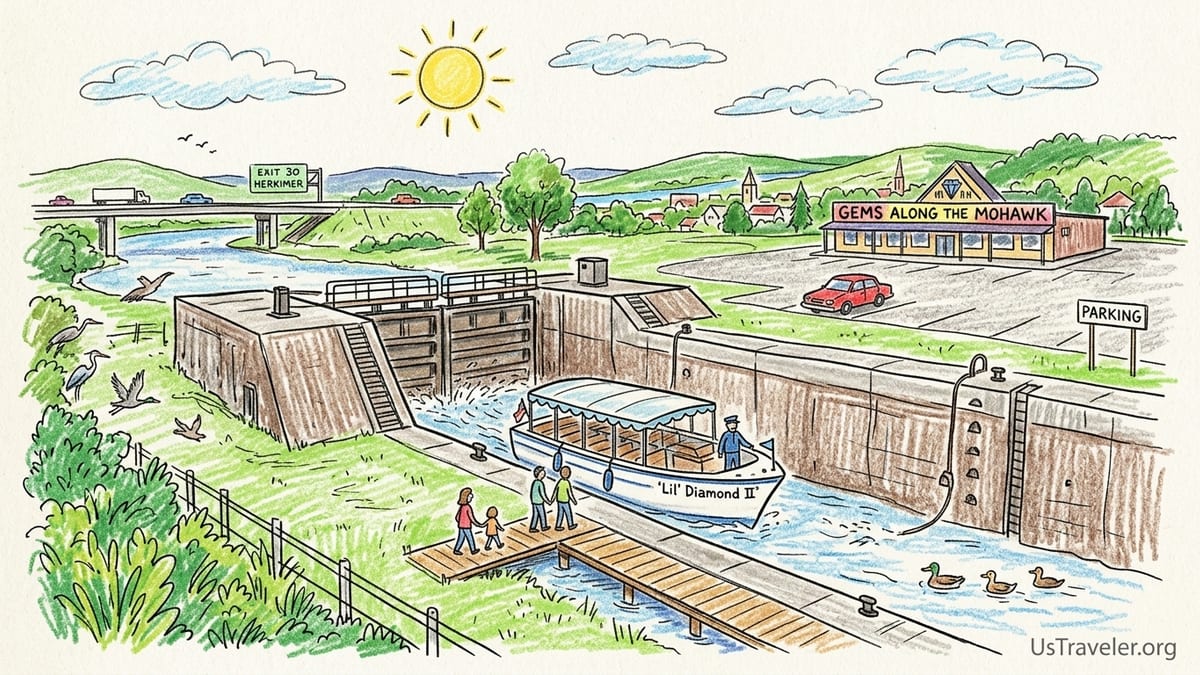
The biggest logistical relief of this cruise is how straightforward the arrival is. Erie Canal Cruises operates out of Gems Along the Mohawk at 800 Mohawk Street in Herkimer, directly across from Exit 30 of the New York State Thruway. Coming off the toll booth, the directions are simple: stay left and continue straight across Mohawk Street into the parking lot. It sounds like the kind of instruction you’ll forget in the moment, but in practice it’s exactly what you do, and it cuts the stress that often comes with finding “the dock” in an unfamiliar town.
I arrived earlier than I thought I needed because the operator asks guests to show up about 30 minutes before departure, with boarding generally beginning 15 to 30 minutes prior. That extra buffer turned out to be useful, not just for tickets, but for settling into the place. Gems Along the Mohawk functions as a visitor center style complex, and it feels like a purposeful staging area rather than a random parking lot by the water. It’s also close enough to the highway that it works well for travelers who are threading this cruise into a larger day.
For 2026, the published sightseeing season runs from May 22 through October 12, with departures generally at 1 p.m. and/or 3 p.m. daily, and occasional 10:30 a.m. cruises on select days. Prices are listed at $29 for adults and $20 for kids ages 4 to 12, with infants 3 and under free. There are a couple of practical notes worth taking seriously: advance purchase is recommended because cruises can sell out, and the company explicitly notes it may cancel for low passenger counts or adjust schedules and vessels. The lock passage is also subject to lock availability, which is a reminder that you’re riding a working waterway, not a theme park ride.
Boarding The Boat: Seating, Shade, And The Quiet Comfort Of A Purpose-Built Tour Vessel
Boarding happens at the home docks by Gems Along the Mohawk, using a dock-and-ramp setup that feels typical of small tour boats. The operator notes that getting on requires mobility on a wide floating dock and a metal ramp, and that crew can help guests navigate the dock and vessel if needed. That description matched what I experienced: the walk isn’t long, but it is a transition from solid ground to a floating surface, and you notice it if you’re balancing a coffee, a camera, and a light jacket.
The tour boat used for these cruises is a U.S. Coast Guard certified vessel called Lil’ Diamond II. In the most practical sense, what matters is that it’s stable, and it’s designed for sightseeing in a way that makes the 90 minutes comfortable. There’s a weather-protected setup that helps when skies change, and the crew’s own guidance is that they operate rain or shine at the captain’s discretion. That “protected” detail matters in Upstate New York, where a sunny morning can turn into a breezy afternoon without warning.
Seating felt like what you want on a narrated cruise: you can sit and listen without feeling locked into one view. I gravitated toward a spot where I could look ahead when we were underway, then pivot toward the lock wall when we approached Lock 18. If you’re the type who wants the best angle for photos, plan for the lock moment first. That’s the part you can’t re-create later by walking along a canal path.
Weather On The Water: Why The Erie Canal Feels Cooler, And What I Was Glad I Packed
Even on a fair-weather day, the canal has its own microclimate. The water softens the heat, and the breeze can feel stronger than it did at the parking lot. The ride is described as smooth and gentle, and that’s accurate: this is calm water cruising rather than open-lake chop. Still, I found the air on the canal cooler than the air by the buildings, especially when the boat turned and the wind found us broadside.
I was glad to have sunglasses and something light I could put on without thinking. If you’re coming from Cooperstown or a museum morning in Utica, it’s easy to assume you’ll dress the same way you did indoors. On the canal, you’re exposed for long stretches, and sunburn can sneak up on you even when temperatures feel mild. The flip side is that it’s one of the most pleasant ways to spend a warm afternoon in the Mohawk Valley because you’re not walking on asphalt or bouncing between hot parking lots.
A practical detail that surprised some passengers near me: outside food and drinks are not permitted onboard, according to the operator’s rules. Onboard, they note they sell soda, water, and bagged snacks for cash. If you want a fuller meal, the Waterfront Grille at the same location is mentioned as a nearby option. My takeaway is simple: eat right before you board, or plan to eat immediately after. Ninety minutes isn’t long, but if you’ve been driving since morning, it helps to treat this like a scheduled event, not a casual “we’ll see when we’re hungry” stop.
The Narration: History That Actually Helps You See What You’re Passing
Some narrated cruises can feel like a memorized script delivered to a captive audience. This one worked better than that because the narration is anchored to visible, physical things: the canal’s edges, the lock infrastructure, the bridge crossings, and the practical mechanics of modern navigation. Instead of grand, abstract history, the on-board story tends to connect what you’re seeing to how the canal operates today and how the region developed because of it.
I also appreciated that the narration didn’t have to manufacture drama. The lock itself provides the climax. The captain can set the scene, explain what’s about to happen, and then let the system do what it has done for generations: open gates, move water, and change elevation in a controlled, almost meditative way. When the story is about engineering, it’s powerful to watch the engineering happen in real time.
Because cruises can be subject to lock availability, the narration also carries an implicit sense of “today’s conditions matter.” If you’ve traveled around New York’s canal towns, you know the canal is not a static museum. It’s a maintained, managed system with alerts, closures, and adjustments. That reality is part of the experience, and it gives the trip a grounded authenticity.
Wildlife And Scenery: What I Noticed From A Moving Boat In The Mohawk Valley
I’m cautious about promising wildlife on any specific day because nature doesn’t take reservations. Still, being on the canal increases your chances of noticing things you would miss from a roadside pull-off. From the water, the shoreline reads differently: reeds and grasses become habitat, not just greenery, and you see the canal as a corridor where birds follow the edges and fish break the surface in quick, silver flashes.
On my cruise, the most consistent “sightings” were the everyday, believable ones: birds working the banks, sudden ripples in calm water, and the occasional moment of stillness where the canal looks like polished glass. The boat’s slow pace gives you time to actually watch, rather than glance. It’s a subtle benefit, but it’s one of the reasons the experience feels restorative rather than rushed.
The Mohawk Valley scenery itself is the other half of the draw. You’re not here for dramatic cliffs. You’re here for a landscape shaped by transportation: a waterway that looks placid on the surface and intensely intentional up close. From the boat, you can sense the canal’s purpose as a route, and you can imagine what it meant when moving goods this way changed the economics of the state.
Lock 18 From The Boat: The Moment The Gates Close And The Water Starts To Move
The approach to Lock 18 is the part that made the cruise feel singular. You can read that the vessel changes elevation by more than 20 feet, but that fact doesn’t prepare you for the close-quarters experience of entering a lock chamber. The walls rise beside you, and the space narrows visually even if you know there’s plenty of clearance. The sound changes, too: the open-water hush becomes a contained, echoing quiet as the boat settles into position.
Then the gates close. There’s a heavy, deliberate finality to it, a mechanical “you are now in the system” feeling. You can see the seams, the hardware, and the surfaces that have been wet for decades. When the lock begins to do its work, the first sensation is not the lift itself. It’s the water. You feel the current start to swirl, the boat nudges slightly as the flow equalizes, and the motion underfoot becomes more noticeable even though you aren’t traveling forward.
The lift is slow enough that your brain has time to catch up. You look at a line on the wall, then realize it’s drifting downward relative to you, and that’s when it clicks: the boat is rising. Lock E18 is documented as having a 20-foot lift, and that “more than 20 feet” claim matches the lived sensation of gaining height in a confined chamber. It feels like an elevator that isn’t perfectly silent. You hear water, you sense the mass of it moving, and you watch the world shift level by level until the upper gates become your new horizon.
What surprised me most was how physical the end of the lockage feels. As the levels equalize, the water calms again, and the boat’s posture changes from gently restless to settled. The upper gates open, daylight and open space return, and you move out of the chamber with a new vantage point. It’s not thrilling in an amusement-park sense. It’s absorbing in a “wow, this still works exactly as designed” way.
Does 90 Minutes Feel Right, And Is This Worth Adding To A Cooperstown Or Utica Itinerary?
The 90-minute duration felt just about right for what this cruise is trying to do. It’s long enough to include meaningful narration, time on open water, and the lock passage without feeling like a rushed demonstration. But it’s not so long that you start checking your watch or wishing for a full meal service. It’s the kind of experience you can slot into a day without sacrificing everything else you wanted to do.
Logistically, Herkimer makes sense as a stop if you’re coming from Utica or headed toward Cooperstown. The operator even provides approximate driving times, listing Utica at about 15 minutes and Cooperstown at about 30 minutes. That checks out with how the region feels on a map: Herkimer is a natural connector point in the Mohawk Valley, especially for travelers who are already using the Thruway.
Was it worth the ticket price? At $29 for adults and $20 for kids ages 4 to 12, I’d call it a good-value, memory-making activity if you care about the Erie Canal beyond seeing a sign for it. The lock experience is the value proposition. You can stand near a lock from shore and watch a boat go through, but being inside the chamber is different. You feel the water move. You watch the wall slide by at close range. You understand, in your body, what “changing elevation” really means.
I’ll also say this: if your Cooperstown plan is already packed with the National Baseball Hall of Fame and Museum and you’re debating whether you have room for one more thing, this cruise is a strong counterbalance to indoor time. It’s fresh air and moving scenery. For Utica-based travelers, it makes an easy afternoon outing that doesn’t require committing to a full day trip. And because departures are generally at 1 p.m. and/or 3 p.m. during the 2026 season, it’s realistic to do lunch, cruise, and still be back for dinner.
The Takeaway
The Erie Canal sightseeing cruise in Herkimer delivers exactly what it promises, and the lock passage is the moment that turns a pleasant boat ride into a true Erie Canal experience. The practical setup at Gems Along the Mohawk makes arrival easy, the narrated format helps you understand what you’re seeing, and the 90-minute length feels tuned to modern travel attention spans. Most importantly, Lock 18 isn’t just something you look at; it’s something you feel, from the first swirl of water to the steady, unmistakable rise.
If you’re building a Mohawk Valley itinerary around Cooperstown, Utica, or a broader Erie Canal road trip, this is one of the simplest ways to add a hands-on canal memory without overplanning. It’s a contained adventure with a clear beginning and end, and it leaves you with a deeper appreciation for a waterway that still shapes New York, one controlled, 20-foot lift at a time.
FAQ
Q1. What are the 2026 operating dates for Erie Canal sightseeing cruises in Herkimer?
For 2026, the sightseeing season is listed as May 22 through October 12.
Q2. What time do the Herkimer sightseeing cruises usually depart?
Departures are generally scheduled for 1 p.m. and/or 3 p.m., with some select days offering a 10:30 a.m. cruise.
Q3. How much do tickets cost in 2026?
Tickets are listed at $29 for adults and $20 for children ages 4 to 12, with infants age 3 and under free.
Q4. How long is the narrated sightseeing cruise?
The narrated sightseeing trip is described as a 90-minute cruise.
Q5. Where do cruises depart from in Herkimer?
Cruises depart from Gems Along the Mohawk at 800 Mohawk Street in Herkimer, New York.
Q6. How early should you arrive for parking and boarding?
The operator asks guests to arrive about 30 minutes prior to departure, with boarding typically starting 15 to 30 minutes before the scheduled time.
Q7. Does the cruise go through a lock, and how big is the elevation change?
Yes. The cruise passes through Lock 18, where the boat changes elevation by more than 20 feet.
Q8. Can cruises be canceled or changed?
Yes. The operator notes cruises may be canceled, schedules or routes may change, and vessels may be substituted; lock cruises are also subject to lock availability.
Q9. Can you bring outside food and drinks onboard?
No. Outside food and drinks are not permitted onboard; the boat offers water, soda, and bagged snacks for purchase.
Q10. Is the Herkimer cruise worth adding to a Cooperstown or Utica trip?
For many travelers, yes. It’s a manageable 90-minute outing with a memorable lock experience, and it fits well as an afternoon activity when you’re already driving through the Mohawk Valley.