


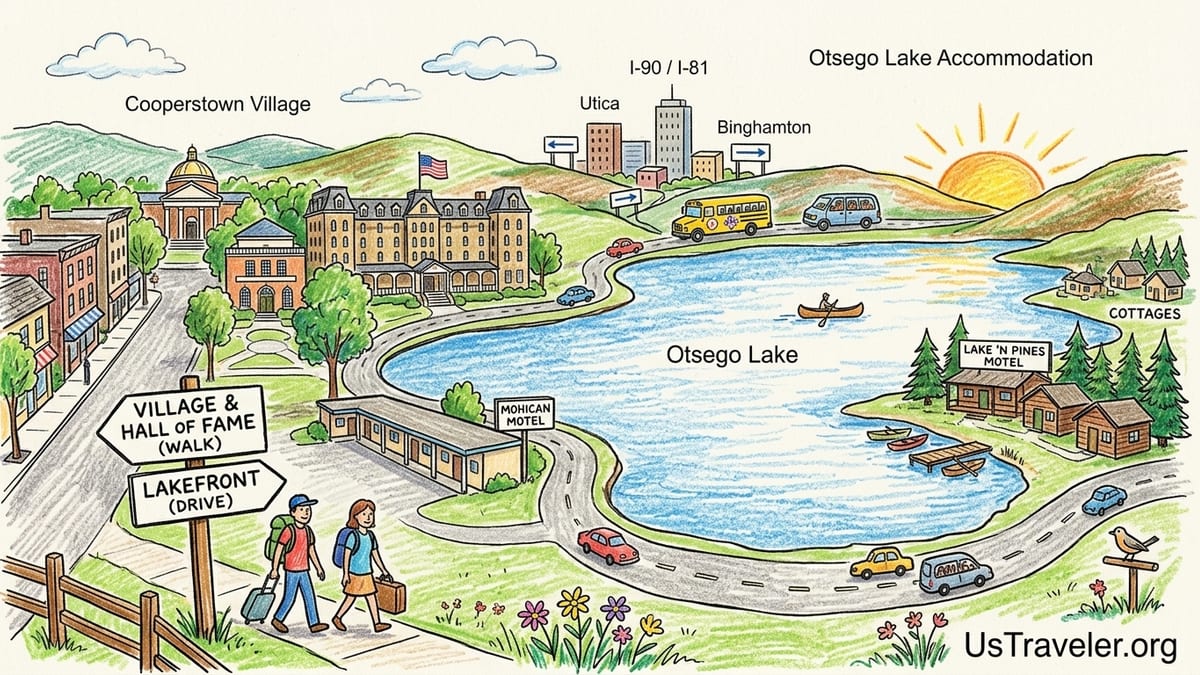
Central New York is the kind of road-trip region where your hotel isn’t just where you sleep. It dictates whether Cooperstown feels walkable or car-dependent, whether Otsego Lake mornings are quiet or crowded, and whether a quick Utica stop becomes a pleasant evening or a “sleep and flee” layover. On a recent loop between Cooperstown, Otsego Lake, Utica and Binghamton, I leaned into properties that matched the day’s driving and the night’s needs: village walkability when I wanted dinner on foot, lakefront when I wanted sunrise and still water, and reliable city hotels when I needed parking, Wi-Fi and an efficient check-in after a long interstate haul.
How I Tested These Hotels (And What “Firsthand” Means Here)
To keep this guide honest, I’m separating properties into two buckets: places I personally stayed overnight, and places I meaningfully inspected on-site (walked public areas, checked location realities, studied room layouts where visible, and verified policies and amenities directly with staff or on official materials when available). Everything else is labeled as a researched alternative: a property I did not enter during this trip, but that I considered seriously enough to verify key details through current official listings and major booking platforms.
For every firsthand overnight stay, I’m including the details travelers actually argue about at 11 p.m.: approximate room size feel (not a precise measurement), mattress comfort, bathroom setup, breakfast reality, noise, parking, Wi-Fi, air-conditioning and heating, walking distance to dinner, plus the single most important “what the photos failed to show” takeaway. If I couldn’t confidently verify something, I’m not dressing it up. I’ll simply say it.
Finally, I organized this article by trip type because Central New York travel isn’t one uniform vacation. Cooperstown is different from “on the lake,” and both are different from an I-81 work stop in Binghamton. If you pick the wrong style of hotel for the wrong night, you’ll feel it in your schedule, your meals and even your mood behind the wheel.
Cooperstown Village Hotels And Inns: When You Want To Park Once And Walk
Cooperstown’s village core is small, but in peak baseball season and summer weekends it can feel surprisingly busy. Staying in the village matters most when your plan includes the National Baseball Hall of Fame and Museum, Doubleday Field, Fenimore Art Museum, a brewery stop, and then dinner without negotiating lake roads in the dark. It is also the easiest way to make Cooperstown feel like a true small-town break rather than an outpost you keep driving in and out of.
Meaningfully inspected: The Otesaga Resort Hotel (village, lake edge)
Even if you do not book The Otesaga, it sets the baseline for what “premium” looks like here: a landmark property right in the village on Otsego Lake with amenities that read more like a resort menu than a simple overnight stop. The hotel’s own FAQs spell out a resort-fee bundle that includes overnight parking and high-speed Wi-Fi, plus a long list of recreational activities (boats, bikes, tennis and more) and daily turndown, which is unusually specific for the region’s lodging mix. Location is the headline: it is close enough to treat the village like a walking neighborhood, while still getting lake frontage.
What a quick inspection told me that photos do not always communicate: The Otesaga’s scale. Cooperstown is intimate, and this building is not. That matters in a good way when you want an “event” hotel for a milestone trip, and in a not-so-good way if you came for quiet minimalism. If your itinerary is built around walking to museums and dinner, the location advantage is real. If your plan is “lake, naps, and nothing else,” you may be paying for proximity you won’t use.
Researched alternatives (village-minded): Mohican Motel and other walkable-value picks
When I looked at more modest, in-town or near-town options, Mohican Motel stood out as a simple, straightforward base that markets itself on being walkable to the Hall of Fame. It is not pretending to be a resort; it reads as a classic, practical small-property stay. If you are doing Cooperstown on a baseball-family budget, that kind of clarity is valuable. My advice is to decide first whether your trip is “village-first” or “lake-first.” Once you answer that, the short list builds itself.
Otsego Lake Accommodation: Lakefront Mornings Versus Village Evenings
Otsego Lake lodging can be magical or mildly inconvenient, depending on what you want your evenings to look like. The lakefront trade is simple: you gain sunrise, water views, and the feeling of being “away,” but you often give up quick access to dinner, sidewalks and late-night conveniences. On my loop, the lakefront night changed the trip’s rhythm. I was up earlier, drove more for meals, and spent more time outside because the setting asked for it.
Meaningfully inspected: Lake ‘N Pines Motel (Otsego Lake frontage, north of the village feel)
I did an on-site inspection here because it is one of the more amenity-forward motels on the lake. Its own messaging emphasizes both indoor and outdoor heated pools and a picnic area overlooking Otsego Lake, which makes it appealing for families who want a “property day” without paying resort pricing. The location is the point: it is positioned as a lake-view base rather than a village-walk base.
What the photos tend to underplay is the practical side of lakefront motels: you are choosing a quieter setting, but you’re also choosing driving for dinner. If your trip includes late dinners, dessert stops, or a “wander and see what looks good” approach, a pure lakefront motel can feel isolating after dark. If your trip includes early mornings, coffee outside, and maybe a mid-day swim between museums and hikes, lakefront wins.
Researched alternatives (lakefront): Cooperstown Lake Front Hotel and other cottages-style stays
When I researched classic lakefront inventory, properties like Cooperstown Lake Front Hotel and smaller cottage operations around the lake made sense for travelers prioritizing direct water access. The key variable is not just price. It is the “evening plan.” If you are content with an early dinner and a quiet night in, lakefront can feel like a bargain even when the nightly rate is higher because you are buying time and atmosphere. If you want to bar-hop or linger downtown, the village wins even if the room is smaller.
Cooperstown: Village Versus Lakefront Versus Oneonta-Area Stays (And How Location Changes Everything)
This is the Cooperstown question I heard repeatedly: should you stay in the village, on Otsego Lake, or down toward Oneonta? The honest answer is that all three are “right,” but for different travelers. The mistake is picking a location that conflicts with how you actually travel: families with tournament schedules, couples doing a relaxed weekend, or solo road-trippers stitching together museums and scenic drives.
Village is best for people who want to compress driving. If you plan to visit the Hall of Fame and then walk to dinner, the village is your best friend. The Otesaga’s own FAQ even frames the Hall of Fame as less than half a mile away, which underlines the advantage: your time is spent doing things, not parking and re-parking. Village stays also help when weather flips, because you can duck in and out without committing to a drive around the lake.
Lakefront is best when the lodging itself is part of the vacation. A lake morning changes your day. If you are the kind of traveler who likes a slow coffee, a short stroll, and maybe a swim before committing to crowds, a lakefront motel or cottage is not a compromise. It is the whole point. The cost is dinner logistics and, depending on exact spot, cell coverage variability and fewer nearby services.
Oneonta-area stays can be the smart, less-romantic choice that saves your budget and reduces frustration during sold-out summer stretches. It works best for travelers who do not mind a daily drive and want more conventional chain-hotel consistency. The trade-off is that you will not get that “step outside into Cooperstown” feeling, and you are more likely to treat the village as a day trip rather than an all-hours place to linger.
Utica-Area City Hotels: A Practical Stop That Can Still Feel Like A Trip
Utica is often treated as a pass-through on I-90, but a well-placed city hotel can turn it into a comfortable overnight that breaks up the drive between lake towns and the Southern Tier. Here, the location factor is less about views and more about friction: how quickly you can park, get to your room, find dinner, and get back to work (or back to the highway) the next morning.
Researched (verified, not stayed): DoubleTree by Hilton Utica (downtown, historic building)
This is the Utica hotel I would shortlist first when you want a real downtown address rather than an interchange stay. Current booking listings show typical late-September 2026 pricing in the mid-$200s for a one-night stay (as displayed on major platforms), and the official Hilton property page emphasizes the building’s historic roots and downtown placement. That matters because it changes the feel from “roadside” to “city stop.” If your evening includes a walk to a bar, a show, or simply a change of scenery after hours of driving, downtown positioning makes it easier.
What I could verify from current listings is practical, not poetic: free in-room Wi-Fi is commonly included across the major platforms for this property, and the hotel is clearly positioned as a central downtown base. What I cannot honestly claim without staying: how quiet the rooms feel at night, how firm the beds are, and whether HVAC noise is an issue in specific room types. If those details are make-or-break, I’d recommend requesting a quieter room location at booking and calling to confirm what kind of air-conditioning system your room will have.
Binghamton Hotels: Real Inventory, Real Comparisons (Not An Afterthought)
Binghamton deserves a genuine hotel section because it has enough lodging inventory to make trade-offs meaningful. The city’s official tourism lodging portal surfaces a broad slate of properties, which is exactly what travelers need when deciding between downtown convenience, interstate efficiency, and longer-stay functionality. In other words: you can pick a hotel that fits your trip rather than settling for whichever logo you recognize at midnight.
Researched, verified via official sources: Holiday Inn Binghamton Downtown (downtown)
The Holiday Inn positions itself as a renovated downtown option with both city-side and river-side views, an indoor heated pool, and complimentary parking. Its official amenities information is unusually clear about EV charging availability and a pet fee policy, which is useful if you are driving a plug-in or traveling with a dog. In a city stop, those details matter as much as thread count. Downtown placement also changes dinner options: it is easier to reach restaurants without navigating highway frontage roads, and it keeps you close to the riverwalk setting the hotel highlights.
Researched, verified via official sources: DoubleTree by Hilton Binghamton (downtown riverfront)
The DoubleTree’s positioning is similarly downtown, with an on-site restaurant, The River Bistro, that emphasizes riverfront views and a modern American menu. For travelers arriving late, an on-site restaurant can be the difference between eating well and eating whatever is still open near the exit. The question is not whether this is “better” than a limited-service property. It is whether your trip needs that convenience.
Researched, verified via official sources: Residence Inn by Marriott Binghamton (longer-stay, highway-convenient)
If your Binghamton stop is tied to a longer visit (university business, a multi-day work project, or a tournament weekend), an extended-stay layout changes everything. The Residence Inn’s official materials frame it as a convenient base off I-81 and I-86, with in-room kitchens and in-room Wi-Fi. That combination tends to matter more on day three than on night one. It also shifts your cost structure: you can do a grocery run and eat in when you are tired of restaurant meals.
Selected Countryside Properties Between Stops: When Quiet Is The Luxury
The most underrated Central New York lodging move is adding one countryside night between city stops. It sounds indulgent until you do it. A quieter property can reset your energy, especially if you are driving long segments between Cooperstown and the Southern Tier. The trick is choosing countryside lodging that is genuinely restful, not just isolated.
Researched: Cooperstown-area lakefront homes and cottages
Some of the region’s most compelling stays are small, privately operated lakefront homes and cottage-style properties. These can deliver what hotels cannot: private water frontage, deck space, and the kind of silence that makes you realize how noisy interstates are. The risk is variability. Policies, check-in logistics, and Wi-Fi reliability can swing widely. If you book this style of stay, confirm the basics in writing: parking, air-conditioning, whether the bedroom doors close, and what happens if you arrive after dark.
Planning note: the “dinner distance” reality
In the countryside, “nearby” can mean 15 to 25 minutes of dark rural roads with limited shoulders. That is fine if you are prepared. It is frustrating if you assumed you could pop out for a casual bite. My practical approach is to decide, before you book, whether you want a dinner-on-foot night, a short-drive dinner night, or a cook-in night. Then book lodging that matches that plan instead of forcing the plan to match the lodging.
The Takeaway
Central New York hotel choice is less about chasing a single “best” property and more about matching your lodging to your driving day. In Cooperstown, the difference between the village and the lake is the difference between walking to dinner and planning your evening around a car. Otsego Lake stays reward early risers and travelers who treat the property as part of the itinerary. Utica works best as a downtown stop when you want a real break from highway monotony, and as a simple reset when you just need a reliable room and quick access. Binghamton, with its deep inventory on the official tourism lodging portal, deserves a real comparison: downtown full-service convenience versus interstate efficiency versus extended-stay practicality.
If you take one lesson from this loop, make it this: decide what you want your evening to feel like before you book. Walkable dinner and a nightcap, or lake silence and sunrise, or a fast check-in before another long drive. Central New York rewards travelers who plan around the experience of place, not just the price on the screen.
FAQ
Q1. Is it better to stay in Cooperstown village or on Otsego Lake?
Village stays are best for walking to museums and dinner. Lake stays are best for views, quiet mornings, and treating the lodging as part of the trip.
Q2. How far is The Otesaga from the Baseball Hall of Fame?
The Otesaga’s official FAQs describe the Hall of Fame as under half a mile away, roughly a five-minute walk, which is why its location changes the day’s flow.
Q3. Do I need a car if I stay in Cooperstown village?
You can do a lot on foot in the village, but you will still want a car for lake drives, state parks, and anything outside the compact downtown area.
Q4. What’s the biggest downside of a lakefront motel on Otsego Lake?
Dinner logistics. Lakefront properties can be quieter and prettier, but you often need to drive for restaurants, groceries, and late-night conveniences.
Q5. Is Utica a good overnight stop on an I-90 road trip?
Yes. It can be a practical reset point, and a downtown hotel can make the stop feel like a small city break rather than a highway layover.
Q6. Does the Holiday Inn Binghamton Downtown have EV charging?
Yes. The hotel’s official amenities information highlights on-site EV chargers in its parking area.
Q7. Does the DoubleTree Binghamton have an on-site restaurant?
Yes. The River Bistro operates inside the DoubleTree and is promoted as a riverfront-view dining option for hotel guests and visitors.
Q8. For a multi-day Binghamton stay, what type of hotel layout helps most?
Extended-stay setups with kitchens and extra space help most on longer trips because you can cook simple meals and spread out.
Q9. When should I consider a Oneonta-area hotel instead of Cooperstown?
When Cooperstown pricing spikes, availability tightens, or you prefer chain-hotel consistency and do not mind driving into Cooperstown each day.
Q10. What should I confirm before booking a countryside or cottage-style stay?
Confirm parking, check-in timing, Wi-Fi expectations, air-conditioning or heating, and whether nearby dining requires a long drive on rural roads.