

I first went to Central New York because of baseball and swore I would never do it again in peak summer. Cooperstown in July is loud, booked solid, and relentlessly scheduled. Then I returned for opera season at Glimmerglass, came back again for apples and peak-season hikes, and eventually learned to love the region in winter, when lake-effect snow remakes the hills and the same streets that were shoulder-to-shoulder in July suddenly feel like you have them to yourself. After enough trips across enough months, “best time to visit” stopped being a single answer and became a set of choices: atmosphere versus elbow room, warm evenings versus crisp mornings, guaranteed events versus flexible days.
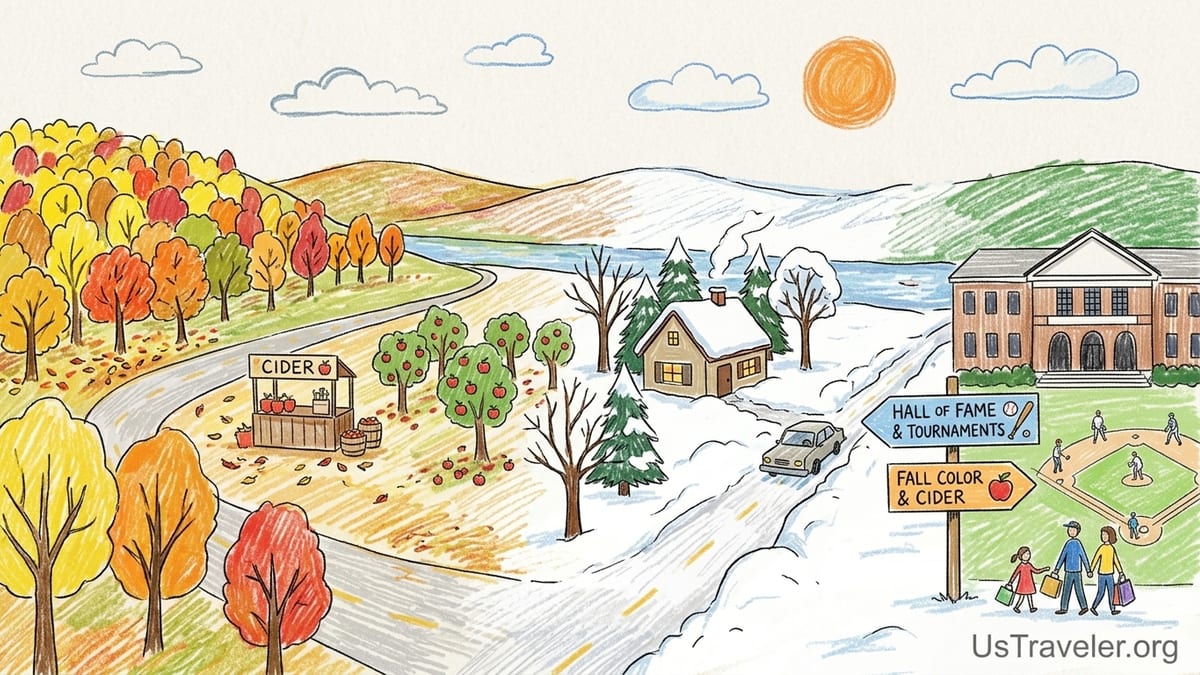
Central New York’s seasons are the trip: what surprised me most
Central New York looks compact on a map, but it behaves like a patchwork of microclimates and event calendars. On one trip you can be in Utica for dinner, in Cooperstown for a museum morning, and in Cherry Valley for a farm stop, yet the weather and the crowds will feel like three different weekends. I learned that the rhythm here is less about one “perfect week” and more about matching your priorities to the season that actually delivers them.
My first big surprise was how differently the region can progress even within one foliage report cycle. For the week of September 23–29, 2026, I LOVE NY’s Fall Foliage Report showed roughly 30% change around Utica, 20% around Cooperstown, 30–35% around Cherry Valley, and 25% around Binghamton. Those numbers were a reality check: if you set your heart on a fixed peak date, you can miss it by simply choosing the wrong town, the wrong elevation, or the wrong side of the hills.
The second surprise was how strongly baseball season shapes summer travel even for people who never attend a game. Between the National Baseball Hall of Fame and tournament traffic, Cooperstown’s “busy” season is not an abstract concept. On my baseball-week trip, the town’s energy was real and contagious, but so were the packed sidewalks, the limited dinner reservations, and the sense that every lodging option within a reasonable drive had already been spoken for.
Finally, winter changed my perception of distance. In summer I measured drives by minutes. In winter I measured them by plow timing, snowbank height, and whether a two-lane road was going to feel stressful after dark. Yet winter also delivered the most relaxing version of the region I have experienced: quieter main streets, easier parking, and an almost Scandinavian feeling of earning your cozy meal after a cold walk.
Cooperstown’s busy baseball summer: worth it or not?
If your Cooperstown dream is pure baseball atmosphere, then yes, the busiest period can be worth the hassle. When I visited during peak baseball summer, the town felt like a moving parade of uniforms and souvenir bags, with families comparing bracket schedules over ice cream, and kids treating Main Street like their own victory lap. You do not have to know anyone on a roster to feel the communal excitement, and that energy is hard to replicate in the shoulder seasons.
But the same intensity that makes it electric also makes it logistically unforgiving. In my experience, you should plan for real crowd friction: longer waits for casual meals, limited last-minute tables, and a general sense that your schedule is being set by other people’s tournaments. If you are the kind of traveler who likes spontaneous detours, peak baseball summer can feel like driving through a small town hosting a perpetual major event, because in some weeks it essentially is.
One week that truly amplifies the pressure is Hall of Fame Weekend. The National Baseball Hall of Fame has promoted Hall of Fame Weekend 2026 as running July 24–27, 2026, with the Induction Ceremony on Sunday, July 26, 2026. That is the moment when Cooperstown stops being “busy” and becomes “national stage,” and on my own crowded summer visits I learned to treat it like a festival city: you either plan around it, or you commit fully and embrace the chaos.
So did the busiest period improve the atmosphere enough to justify the crowd and hotel pressure? For me, it depended on the goal. If baseball is the purpose, the extra noise, bustle, and spontaneous conversations absolutely enhanced the feeling of being in the capital of the sport. If baseball is only a side interest, I would not repeat that same peak-week approach; I would come earlier, later, or midweek, and I would treat the Hall of Fame as the centerpiece rather than trying to “do everything” while the town is at its most saturated.
Separating Cooperstown’s baseball summer from Glimmerglass Festival season
Here is the mistake I made once and will not repeat: assuming Cooperstown’s summer crowds are one single thing. The area’s summer has at least two distinct gears. Baseball season creates a family-heavy, daytime-busy, schedule-driven pulse. Glimmerglass Festival season, by contrast, brings a different crowd pattern: evening arrivals, dressier dinners, and a more performance-centered rhythm.
The Glimmerglass Festival’s 2026 season ran July 10 to August 17, and the already announced 2027 season is scheduled for July 12 to August 22. That window overlaps with the heart of summer, but in a different way than tournament travel does. On my Glimmerglass trip, I noticed how the region feels calmer in the late morning and then gradually “puts on a jacket” as evening approaches, with diners lingering longer and conversations turning to what is on stage rather than who is up next on Field 3.
Weather-wise, this is also when Central New York can feel its most like true summer: warm afternoons, sun that lingers, and a level of humidity that can make you grateful for lake breezes near Otsego. I packed for heat and still ended up buying an extra layer on one trip, because nights can cool quickly once you are out by the water. The practical lesson: plan outfits like you are traveling between two seasons in one day.
If you are choosing between the two, pick the crowd you want. Baseball weeks deliver high-volume family energy and a constant sense of motion. Glimmerglass season feels like a regional arts event: it still fills rooms and restaurants, but it does it in waves, and the vibe is more “summer evening outing” than “tournament logistics.” In my own travel planning, I now treat them as separate experiences and avoid stacking them unless I truly want a maximized, high-demand week.
Fall color, cider, and orchards: plan dynamically, not by a fixed peak date
My favorite Central New York trip so far has been the one that was the least rigid. I came for foliage and had to let the landscape tell me where to go, rather than insisting that one town had to be “the peak.” The region’s hills and valleys change at different speeds, and even within a short drive you can move from mostly green to noticeably transformed.
The most useful habit I have adopted is checking the I LOVE NY Fall Foliage Report as a moving snapshot rather than a promise. For September 23–29, 2026, the report showed how uneven the change can be within the same week: around 30% changed near Utica, about 20% around Cooperstown, about 30–35% around Cherry Valley, and about 25% near Binghamton. That spread is exactly why my best foliage day came from adjusting on the fly: I chased more color where it was developing faster and saved greener areas for later.
In practical travel terms, fall also shifts the crowd profile. The summer crush softens, but weekends can still fill up quickly, especially when the leaves start popping and cider season is in full swing. On my foliage trip, I found it easier to book a comfortable room midweek than on a Saturday, and easier still once I accepted that staying 20 to 40 minutes outside the most photographed downtowns could buy me more space and quieter nights.
Fall weather in Central New York is when you feel the first real edge to the air: mornings that make a warm drink feel necessary, afternoons that can still be pleasantly mild, and nights that remind you the region is building toward snow season. It is also when rain can roll through and instantly change your itinerary. I now travel with a waterproof layer and a plan for “rain wins” activities, like a longer museum visit in Cooperstown or a slower lunch in a smaller town, because fall’s beauty comes with a higher chance of damp surprises.
Winter weekends: snow, resorts, and the version of the region I didn’t expect to love
I did not expect winter to be the season that made me nostalgic for Central New York, but it did. The same roads that feel crowded in summer suddenly feel open. Parking becomes easy. And the region’s small-town texture stands out when you are not navigating around peak-season foot traffic. My winter trips have been the most restful, even though the weather demands more planning.
The biggest difference is that winter travel here is shaped by snow reality, not just cold. Central New York sits in the broader snowbelt influence, and lake-effect systems can turn a casual weekend into a “check the forecast twice” situation. When I visited in winter, I built in extra buffer time for drives after dark and made sure my lodging had straightforward access, because the last thing you want is arriving late to an unplowed incline with tired passengers.
What you get in exchange is the kind of trip where you can plan around comfort: a morning outdoors, an afternoon warming up, and an evening that feels earned. I leaned into winter-friendly routines: longer breakfasts, earlier dinners, and choosing accommodations where the room itself was part of the experience, not just a place to sleep. Winter is also when Central New York’s indoor attractions feel like a secret weapon, because you can spend unhurried time in museums and shops that are packed in July.
If you are considering a winter weekend but you are nervous about conditions, my personal rule is to treat the first and last miles of the trip as the “real” challenge. Highways may be clear while smaller roads feel slick or narrowed by snowbanks. Choosing lodging with reliable year-round access and having a flexible check-in plan made winter feel safe and fun rather than stressful.
Quiet spring visits: value, flexibility, and a different kind of beauty
Spring is the season I recommend to travelers who want Central New York without the lines. The landscape is not trying to impress you with fall fireworks or deep winter snow drama; instead, it feels local and lived-in. On my spring visit, the biggest luxury was flexibility. I could change plans midday without worrying that every restaurant would be booked or that every room would be sold out.
Spring weather is also the most variable in a single day. I have had crisp mornings that felt like late winter and afternoons that hinted at summer, all in one trip. The region can be wet in spring, too, which means you should build your itinerary with a mix of outdoor and indoor options. When rain showed up, it did not ruin the trip because I had already prioritized attractions that are rewarding at a slower pace.
Accommodation availability, in my experience, feels noticeably better in spring than during baseball and festival season. That does not mean everything is empty, but it does mean you can more often choose the place you want rather than the last place left. For travelers who dislike planning far in advance, spring is the season that offers the best odds of a comfortable, last-minute weekend.
If your goal is to understand the region rather than chase a single marquee event, spring is ideal. You will see more locals than visitors, hear less “tournament talk,” and get a clearer sense of what these towns feel like on ordinary days. That ordinary feeling is exactly what made me want to return again, this time by choice rather than by calendar pressure.
The Takeaway
The best time to visit Central New York depends on what you want the trip to feel like. If you want maximum baseball energy and that once-in-a-lifetime Cooperstown buzz, summer delivers, especially around major baseball weekends, but you will pay for it in crowds and lodging pressure. If you want a more curated summer experience, align your trip with the Glimmerglass Festival’s run and treat evenings as the main event.
If you want the most beautiful driving days and a travel story that changes by the hour, fall is unmatched, but you need to plan dynamically and follow current foliage conditions rather than chasing a fixed peak date. For a cozy, low-crowd reset, winter is surprisingly rewarding as long as you respect snow and driving time. And if you want value, flexibility, and space to explore at your own pace, spring is the season that most travelers overlook and most consistently enjoy once they try it.
If I had to choose one approach that worked every time, it would be this: pick your anchor, then build the rest of the trip around the season that supports it. In Central New York, the calendar is not just a backdrop. It is the experience.
FAQ
Q1. What is the best month to visit Cooperstown if I want the fewest crowds?
Late fall, winter, and early spring generally feel much quieter than July and August, with easier parking and more flexible dining and lodging.
Q2. Is Cooperstown worth visiting during peak summer even if I am not attending a tournament?
It can be, because the town’s baseball atmosphere is at its liveliest, but expect heavier crowds, longer waits, and tighter lodging availability than in shoulder seasons.
Q3. When is Hall of Fame Weekend in 2026?
Hall of Fame Weekend 2026 is scheduled for July 24–27, 2026, with the Induction Ceremony on July 26, 2026.
Q4. How do Glimmerglass Festival dates compare year to year?
The 2026 season ran July 10 through August 17, and the already announced 2027 season is scheduled for July 12 through August 22.
Q5. Should I choose Glimmerglass season or baseball season for summer travel?
Choose baseball season for high-energy, family-packed daytime crowds, and choose Glimmerglass season if you prefer performance-centered evenings and a calmer daytime rhythm.
Q6. How should I plan for fall foliage in Central New York?
Plan dynamically by checking current conditions and being willing to change towns or routes, because nearby areas can show noticeably different color progress in the same week.
Q7. What does the September 23–29, 2026 foliage snapshot show?
It shows uneven progress within the region: roughly 30% changed near Utica, 20% around Cooperstown, 30–35% around Cherry Valley, and 25% around Binghamton.
Q8. Is winter travel in Central New York realistic for a quick weekend?
Yes, but build in extra driving time and pick lodging with straightforward access, since lake-effect snow and plowing timing can affect smaller roads.
Q9. What is the main advantage of a spring visit?
Spring offers flexibility and value, with lighter crowds and generally better odds of booking the lodging you actually want.
Q10. If I can only visit once, what season gives the best overall experience?
For many travelers, early-to-mid fall offers the best balance of scenery and manageable crowds, as long as you follow current foliage conditions instead of a fixed peak date.