


Central New York rewards travelers who stop for experiences, not checklists. On my latest swing through the region, I built days around places that had a strong sense of setting: the hush of a museum gallery before a crowd arrives, the cool breath of a cavern, the thump of a lock gate on an Erie Canal cruise, the sudden roar of a waterfall you can feel in your chest. Some stops were slam dunks worth a long detour. Others were better as add-ons if you are already passing through. Below are the places that gave my trip its character, written the way I actually traveled them: how long it took, where I parked, what I walked, what I tasted, what surprised me, and what I would do differently next time.
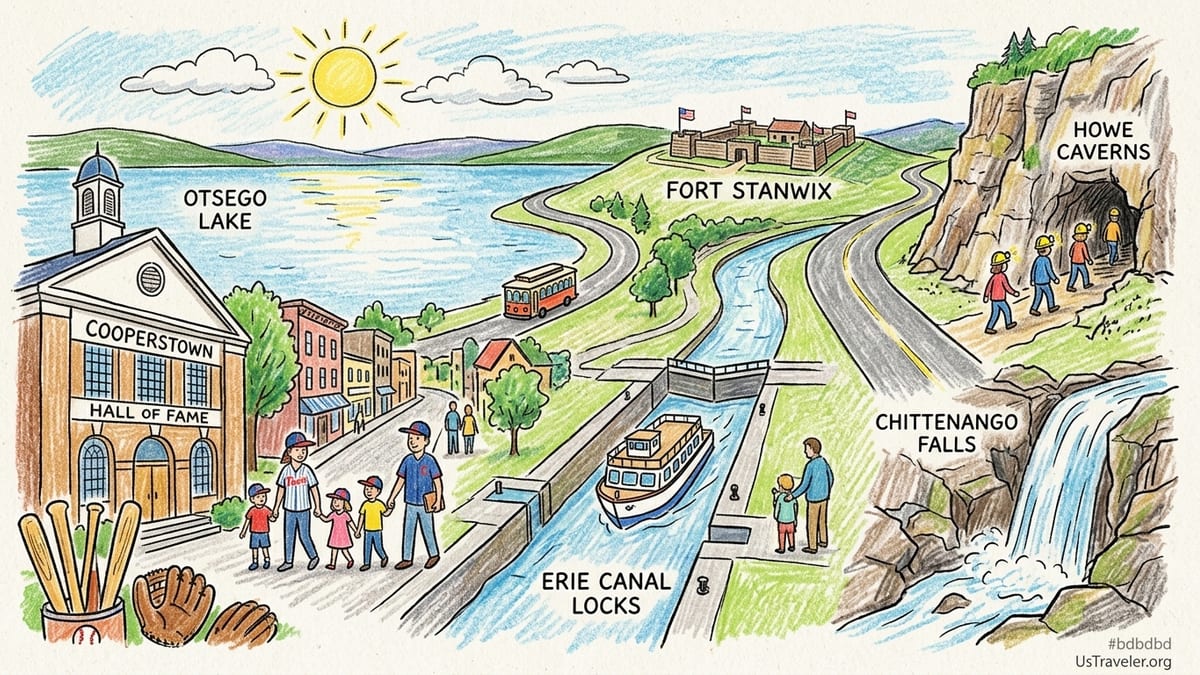
Cooperstown: The Hall of Fame Visit That Stretched Into Half a Day
I planned to “pop into” the National Baseball Hall of Fame and Museum and quickly learned that Cooperstown does not do quick. I arrived mid-morning and aimed for a weekday window to dodge the heaviest crowds, but even then Main Street had that classic small-town tourism hum: families in team caps, a steady line of people drifting between souvenir shops and lunch spots, and a noticeable uptick whenever a trolley pulled up. I parked once and stayed put, because the village center is the kind of place where moving the car feels like a mistake. From the museum, it was easy to walk a few blocks for coffee or to reset my feet, then return for a second lap through exhibits.
Inside, what hit me first was the pace the building encourages. The plaque gallery is not a fast photo stop; it is a low, reverent room where people actually read. I watched visitors trace names with their fingers, then quietly step aside so someone else could linger. That slowed my whole visit down in the best way. I spent a long stretch just moving plaque to plaque, then drifted upstairs into the larger story-driven exhibits, where you can sink time into artifacts without realizing an hour passed. Even if you do not consider yourself a baseball historian, the museum’s strength is that it makes the sport feel like a mirror for American life: labor, identity, celebrity, and nostalgia, all channeled through uniforms, bats, and game-used equipment.
Logistics are friendly but you need a plan. The Hall is open year-round seven days a week except major holidays, and Cooperstown’s seasonal transportation changes how the day feels. The official visitor information for the 2026 season notes village trolleys operating in the peak summer window, with service from Saturday, June 20 through Sunday, September 6, running 8:30 a.m. to 6:30 p.m. That matters if you are staying outside the center and want to avoid the most stressful part of Cooperstown, which is parking when the village is busy. For tickets, I relied on current published adult pricing of $35, with child pricing and free admission for young kids listed by Cooperstown lodging and tourism sources that track museum rates closely. If you are visiting in the induction-weekend orbit, build extra time and patience into the day, because Cooperstown crowd patterns change completely around that event.
Was it worth building the itinerary around? Yes, if you are even mildly interested in baseball, museums, or Americana. My total time on site, including a small break outside and a second loop through favorite rooms, landed around four hours. I left with that rare feeling you get from a great museum: mental fatigue, a full camera roll, and a desire to come back with more time. If you only have one anchor attraction in Central New York, this is the one that reliably earns it.
Otsego Lake and the Cooperstown Reset: A Scenic Pause That Made the Day Work
After the museum, I needed a different tempo. Otsego Lake is Cooperstown’s pressure release valve, and the smartest way I experienced it was not as a long, structured activity but as an intentional reset: a slow shoreline drive, a short walk to open up the view, and time to sit still long enough that the day stopped feeling scheduled. In practice, this was a one to two hour intermission that made the rest of Cooperstown feel less crowded, even if the village itself stayed busy.
What you actually “do” here depends on your energy and season. For me it was a low-commitment afternoon: comfortable shoes, a light jacket for the lake breeze, and a stroll that stayed easy on the knees. The weather was typical for a Central New York shoulder-season day, with sun that came and went behind thin clouds and just enough chill near the water that I was glad I did not pack only a T-shirt. The best part was how quickly the lake changed my headspace after indoor time. It is the kind of place where you can stand quietly and still feel like you got something for your travel day.
In itinerary terms, Otsego Lake works best when you treat it as a buffer. If you are driving from the Thruway corridor toward Cooperstown, arriving early, doing the Hall of Fame, then taking a lake break before dinner keeps the day from feeling like one long line. If you are traveling with kids, it is also a good decompression zone before asking them to focus on a second museum or a sit-down meal. I would absolutely repeat this pairing: Hall of Fame first, lake second, then an evening meal in town.
Worth the detour? If you are already in Cooperstown, yes, because it is not really a detour. If you are debating whether to add Cooperstown to a broader Central New York loop, the lake is part of what makes Cooperstown feel like a destination rather than a single building.
Howe Caverns: The Cool-Air Detour That Delivered a Physical Experience
Howe Caverns was the stop that most changed my sensory world. After a few hours of daylight driving, the transition into the cave environment felt like stepping into a different calendar. The air cooled immediately, the soundscape tightened, and the group pace became deliberate. This is not a place you “see” from a distance; it is a place you move through with your body. You follow a guided route, adjust your steps for damp ground, and feel the scale of chambers as your eyes adjust to dim light.
My visit took roughly two hours door-to-door, including check-in, a short wait for the next tour slot, and the full route underground. The official pricing page highlights multiple experiences, including a longer 2.5 hour exploration-style tour on select schedules, but I chose the standard experience for a first visit because I wanted a reliable time block that still let me keep driving that day. What I remember most vividly was not a single formation but the rhythm: narrow passages opening into broader rooms, guide narration echoing, then the occasional pause where the group stood still long enough to notice water sounds and the sheer dampness of the stone. If you have claustrophobia, it is worth researching the tour style in advance and being honest about what you can handle, because the physical environment is part of the point.
Parking was straightforward and close, and I appreciated that I did not have to hike from a remote lot before even starting the attraction. Crowds were moderate: enough people to make the tour feel social, not so many that I felt packed in. The walk is not an athletic trek, but it is sustained, and the surface can be slick in spots, so shoes with grip matter more than fashion. I also recommend bringing a light layer even in summer. Caves do not care about heat waves.
Did it justify the detour? Yes, especially if your Central New York route includes a mix of towns and highways. The caverns break up windshield time with an experience that feels genuinely different from museums and historic sites. If you only have time for one “physical landscape” stop, this is a strong candidate because it is immersive, guided, and memorable.
Erie Canal Cruises in Herkimer: The Moment Central New York Started to Feel Like a Story
The Erie Canal can be a history lesson from a car window, or it can be a lived experience with wind on your face and lock walls sliding past at arm’s length. I chose the latter with a sightseeing cruise out of Herkimer, where Erie Canal Cruises operates near the Thruway Exit 30 area. This was the stop that made Central New York’s geography click: why towns sit where they do, how the canal shaped movement, and what it feels like to travel at water speed instead of highway speed.
My total time commitment was about three hours including arrival, boarding, the cruise itself, and a slow walk afterward to shake out my legs. The boat experience is simple in the best way. You sit, you watch the banks drift by, you listen to narration, and you wait for the lock sequence that everyone comes for. When the lock gates close and the water level shifts, it is surprisingly visceral. People stop chatting. Phones come out. You feel the boat change position as the canal does its quiet work. Even if you have seen photos of canal locks your whole life, watching the process from inside the chamber is different. It turns infrastructure into theater.
Practical notes: arrive early enough that you are not rushing from the parking area to the dock. The crowd mix on my trip leaned multigenerational, with grandparents, kids, and couples who looked like they planned their day around the cruise. Weather mattered. I picked a day that was dry with mild wind, and I was glad I brought sunglasses and a light layer. On a hot day, the sun exposure can be relentless on open decks, and on a cool day the wind can make it feel colder than you expect. Check the current schedule and rates before you go, because the operator publishes a season schedule for 2026 and notes that changes and cancellations can happen.
Was it worth building an itinerary around? If you like experiences that are both relaxing and specific to place, yes. This was not an “if we have time” add-on for me; it was a cornerstone. I would choose it again, especially paired with another Mohawk Valley stop like Fort Stanwix, because the two together turn the region from a pass-through into a narrative.
Fort Stanwix: The Reconstructed-Fort Visit That Feels Like Walking Into a Diagram
Fort Stanwix in Rome is where I most appreciated a reconstructed historic site done at full scale. The important thing to understand before you go is that the draw is not only the Revolutionary War context. The draw is the reconstructed fort itself, because it lets you physically understand the geometry of defense: angles, walls, interior spaces, lines of sight. I arrived expecting “a quick NPS stop,” and ended up staying longer because I kept wandering back to vantage points to re-see how the fort is laid out.
The experience on the ground is hands-on in the way a fort should be. You enter and move through enclosed rooms, open courtyards, and elevated positions that change what you can see. Even without a special program running, the building itself does the teaching. You notice how thick walls and narrow openings frame the outside world. You step into darker interior spaces and your eyes adjust. You walk along sections that feel built for movement and command. It is much more tactile than reading a plaque at a roadside pull-off.
From a traveler’s perspective, the best practical detail is also the simplest: admission is free, as the National Park Service notes in its basic visitor information. That makes this a high-value stop in a region where costs can add up quickly if you are stacking museums, tours, and tastings. I found parking manageable, and the overall visit, including the visitor center orientation, fort exploration, and time for photos, landed around 90 minutes. Crowds were light to moderate when I was there, and the site never felt like it required elbowing for space, which is not always true at major summer attractions.
Did it justify the detour? Yes, particularly if you are traveling the Thruway corridor or pairing Rome with canal experiences. Fort Stanwix works best as a planned stop, not a rushed one. Give it at least an hour, and more if you want to slow-walk the fort and actually absorb what you are seeing rather than sprinting room to room.
Chittenango Falls and the Craft Beverage Loop: Two Different Ways to End a Day
Chittenango Falls State Park is the kind of waterfall stop that feels designed for regular people, not only hardcore hikers. I visited for the physical experience: the sound gets louder as you approach, then suddenly the falls are there with real force, throwing mist and filling the air with that clean, wet-rock smell. It is not an abstract “scenic spot.” It is a place where your body reacts. I timed it for a day when I could handle the chance of damp shoes and a little mud, because waterfall viewpoints tend to reward travelers who do not mind getting close enough to feel it.
My visit took about an hour and a half, including parking, walking to viewpoints, and lingering long enough to watch the falls in changing light. The park’s official visitor information notes that many New York State Parks charge a vehicle use fee, so I treated the visit like a paid attraction and arrived ready with a card and patience at the entrance. Crowds were noticeable but manageable, the kind where you might wait briefly for a clear photo but you are not stuck in a long line. The walking was moderate and family-friendly, though I still recommend shoes with traction because mist and spray can slick up surfaces near viewpoints.
Later that day, I switched modes completely with a craft beverage stop. Central New York does “destination beverages” well, and the best ones feel like a place, not just a tasting room. In the Cooperstown area, Brewery Ommegang is one of the names travelers build around, and Cooperstown Distillery offers tours that include a behind-the-scenes component with a guided walk-through, tastings, and an on-site discount. I did a distillery-style tasting on this trip because it fit my timing better than a full brewery hang. The value was in the structure: a short tour, a flight that let me compare styles rather than taking a random shot, and the ability to buy a bottle without hunting it down later.
Worth building an itinerary around? The waterfall, yes, if you want at least one natural “wow” that is easy to access. The craft beverage loop depends on your travel style. If you love tasting rooms, make it a pillar and build in a slow afternoon. If you are more outdoors or museum-focused, treat it as an evening cap. Either way, pairing a waterfall with a tasting is an excellent Central New York one-two punch: adrenaline and mist first, then a seated reset with something local in your glass.
Selected Binghamton Attractions: Worth It If You’re Overnighting, Not If You’re Rushing
Binghamton makes the most sense when you treat it as an overnight city rather than a quick detour. On this trip, I used it as a practical stop to break up driving and to sample attractions that are easy to fit into a half day without stress. The one I would most confidently recommend to broad audiences is the Ross Park Zoo, because it is straightforward and reliably open. The zoo publishes hours clearly: open daily from 10 a.m. to 4 p.m., with last admission at 3 p.m. That kind of clarity matters when you are fitting attractions between check-in, meals, and highway time.
My zoo visit was about 90 minutes, which felt right. Parking was close, the entry process was quick, and the experience was the opposite of a sprawling big-city zoo day. This is a smaller, human-scale loop where you can see a lot without committing half your daylight. The best part for me was that it felt like a calm walk in a wooded setting with animals as the anchors, not a marathon across acres of concrete. Crowds were light when I visited, which made it an easy add-on after a long drive.
I also researched the Roberson Museum and Science Center as a strong indoor option, especially for travelers who want a museum day in the Southern Tier. The institution publishes visitor information, and local tourism material describes it as a major year-round attraction, but I did not visit on this particular trip. If you are building a rainy-day plan around Binghamton, Roberson is the place I would look at first because it combines art, history, and science programming in one stop, which is efficient for families and mixed-interest groups.
Would I build a Central New York itinerary around Binghamton alone? No. But would I build a sensible driving loop that uses Binghamton as a rest point with one well-chosen attraction? Absolutely. If your trip includes Cooperstown and you are heading toward Pennsylvania or back toward the Hudson Valley later, Binghamton can be the difference between a frantic drive day and a trip that still has room for something fun.
The Takeaway
If you want Central New York with character, pick anchors that force you to slow down. For me, that meant building around the National Baseball Hall of Fame and Museum, then layering in experiences that feel physical and place-specific: a cave tour where the air changes, a canal cruise where infrastructure becomes motion, a reconstructed fort you can walk like a blueprint, and a waterfall that makes you linger because it is loud and alive. Those are itinerary-makers, not just time-fillers.
Then, use the region’s “supporting cast” the way locals do: as flexible additions that match your energy. Otsego Lake is a reset, not a checklist. Craft beverage stops are best as an unhurried capstone, not a rushed pit stop. Binghamton is a smart overnight that can still deliver a memorable hour and a half at a zoo, or a researched museum plan when the weather turns. The trick is to be honest about time. Central New York is not short on attractions. The best trip comes from choosing the few that truly deserve your daylight and letting the rest wait for another pass.
FAQ
Q1. How many days do I need for a character-filled Central New York trip?
Two full days is the minimum if you want Cooperstown plus one major experience like Howe Caverns or an Erie Canal cruise without rushing.
Q2. Is the National Baseball Hall of Fame worth it if I’m not a hardcore baseball fan?
Yes, especially if you like Americana and museum storytelling. Plan several hours so it does not feel like a quick walk-through.
Q3. When do Cooperstown village trolleys run in 2026?
The Hall of Fame’s visitor information lists 2026 trolley service from June 20 through September 6, running 8:30 a.m. to 6:30 p.m.
Q4. How long should I plan for Howe Caverns?
Plan around two hours for a standard visit including check-in and the underground tour, and longer if you book an extended exploration-style tour.
Q5. Is an Erie Canal cruise actually interesting if I’ve already seen canal history exhibits?
Yes. Seeing a lock sequence from inside the chamber is a physical experience that feels different from reading about the canal.
Q6. How long does Fort Stanwix take, and is it free?
A focused visit can fit in 60 to 90 minutes, and the National Park Service lists admission as free.
Q7. Do I need hiking boots for Chittenango Falls State Park?
Not usually, but traction helps. Expect damp areas near viewpoints from mist, and wear shoes you do not mind getting a little dirty.
Q8. Do New York State Parks charge a vehicle entry fee at Chittenango Falls?
The park’s official visitor information notes that many New York State Parks charge a vehicle use fee, so arrive prepared for a paid entry.
Q9. What’s the easiest Binghamton attraction to fit into a travel day?
Ross Park Zoo is simple to schedule. It lists daily hours of 10 a.m. to 4 p.m., with last admission at 3 p.m.
Q10. Which stops are best to build an itinerary around versus treating as add-ons?
Build around the Hall of Fame, an Erie Canal cruise, and either Howe Caverns or a waterfall. Use Otsego Lake, tastings, and Binghamton stops as flexible add-ons.