


Howe Caverns sells its Traditional Tour like a classic: a 156-foot descent, 90 minutes underground, about 1.25 miles on foot, 139 stairs, and a calm quarter-mile boat ride at the end. Those numbers sound tidy on a screen. In practice, the tour feels less like “an attraction” and more like committing your whole body to a cool, damp microclimate where your breathing changes, your calves start negotiating with you, and the sound of your own footsteps becomes part of the scenery. If you are considering buying Howe Caverns tickets for the flagship Traditional Tour, here is what it is really like to book it, show up, go down, move through the narrowest sections, ride the subterranean boat, and walk back out feeling the aftereffects in your legs and shoulders.
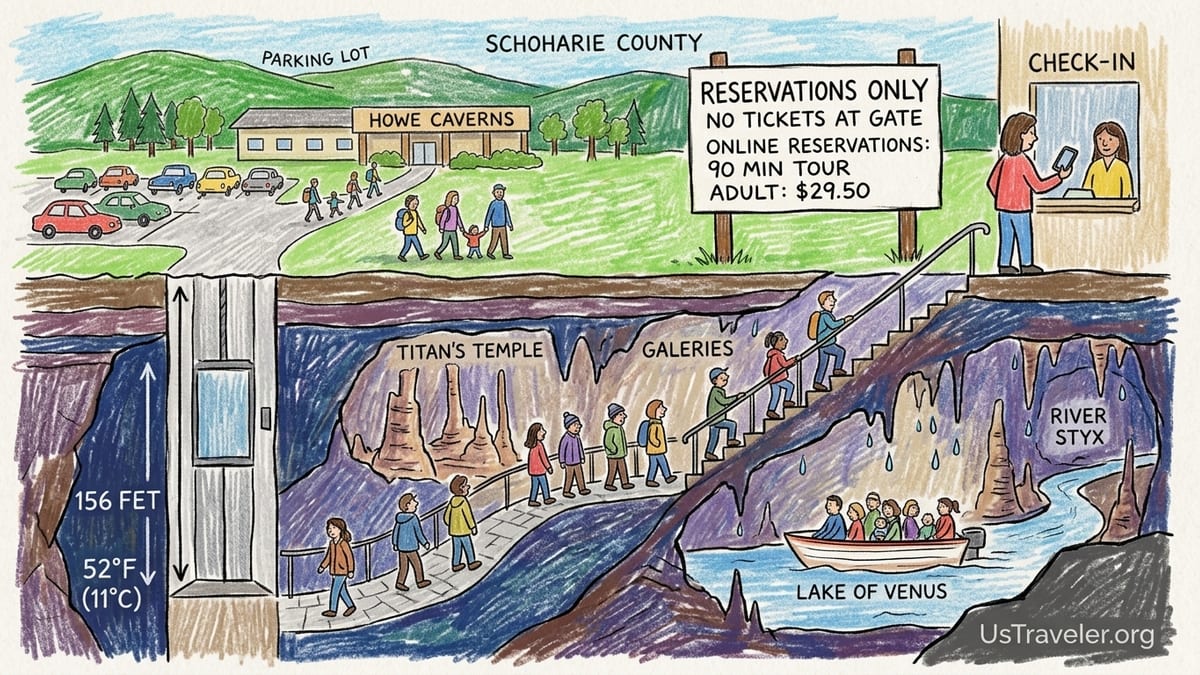
Booking Howe Caverns Tickets Online: What “Reservations Required” Actually Means
The first thing to know is that Howe Caverns currently positions official online tickets as the correct purchase channel for the Traditional Tour, and it explicitly frames the Traditional Tour as “Online Tickets ONLY” with reservations required. Practically, that means you are not just buying admission. You are selecting a specific tour time, and the entire group needs to be on the same reservation time slot. If you split purchase times because one person books first and another follows later, the attraction warns those tickets cannot be combined into a single group.
As of publication, the posted online price for the Traditional 90-minute tour is $29.50 for adults (ages 13 to 64), $26.50 for seniors (65+), $19.50 for children (ages 5 to 12), and free for ages 4 and under. Taxes and fees are listed as not included in the displayed price, which is worth remembering if you are mentally tallying a family total at checkout.
Howe Caverns also states that all ticket sales are nonrefundable and may not be exchanged. That is not unusual for timed-entry attractions, but it changes how you should plan the day: build in extra driving buffer, and do not book the tightest possible schedule if you are coming from Albany, the Capital Region, the Hudson Valley, or anywhere around New York City. The stress of a late arrival is amplified when your purchase is tied to a specific start time.
Arrival in Schoharie County: Parking, Check-In, and the “No Bags” Reality Check
Howe Caverns is in Howes Cave, New York, in Schoharie County, with the property address posted as 255 Discovery Drive. Arrival feels like pulling into a long-running roadside institution: there is a defined complex of buildings and activities above ground, and you can tell quickly that the cave operation is built around tour waves. The attraction advises arriving 15 to 30 minutes early, specifically calling out restroom time before you descend. Take that advice seriously. Once your group is moving with a guide, the tour is continuous, and “I’ll just run back to the car” is not really a thing you can do midstream.
Before you even think about the descent, you will want to do a personal inventory because Howe Caverns is strict about what goes underground. The attraction’s current Traditional Tour rules state that food, beverages, strollers, or bags of any kind are not permitted in the cave. Not “large bags.” Not “backpacks.” Bags of any kind. That includes the everyday shoulder tote many travelers treat like an extension of their body. If you typically carry a water bottle, a camera pouch, snacks, or a baby bag, plan to leave it behind. The policy forces a mental shift: you go underground with your hands free and your pockets responsible for everything you truly need.
There are a couple of notable exceptions the attraction spells out. Wearable carriers are permitted for infants and toddlers, but only front-wearing or unframed back carriers. ADA-compliant service animals are permitted, but the attraction asks guests to call and notify the business office to be accommodated for the boat ride portion. The presence of the boat segment changes the logistics of anything that must board with you, including service animals.
The 156-Foot Descent: Elevator Down, Temperature Shift First
The Traditional Tour begins with the descent that Howe Caverns highlights in its official description: 156 feet below the surface. In the abstract, 156 feet is the height of a tall building. In your body, it is the moment you notice the air turn steady and cool and the humidity settle on your skin. Howe Caverns lists the cave temperature at about 52°F (11°C), and that figure is not a throwaway detail. It is the baseline condition for the entire tour, and your comfort depends on how you dress for it.
Even if you arrive on a warm New York summer day, the cave air reads like a different season. A light jacket or sweatshirt is not a “nice to have,” it is what keeps your forearms and shoulders from spending the next 90 minutes bracing against the cold. You do not need a parka, but you do want a layer you would be happy wearing on a 52-degree evening while standing still. The cold is less punishing when you are moving; it becomes more noticeable whenever the group stops to listen to the guide and the airflow catches up with you.
The descent itself is also when you should decide how you are going to handle moisture. The cave environment is damp. Even without obvious dripping, humidity clings to handrails and makes stone surfaces look darker. If you wear a slick rain shell, you may appreciate the way it blocks cool air. If you wear cotton only, you may feel chilled whenever you pause. The experience is not extreme, but it is persistent.
Clothing and Footwear: Why Closed-Toe Shoes Are Non-Negotiable Here
Howe Caverns recommends closed-toed comfortable walking shoes for the Traditional Tour and explicitly states that flip flops are not permitted in the cave. That rule is easy to underestimate until you see the walking surfaces. This is not a manicured indoor attraction floor. It is an engineered pathway through a cave, which means you are dealing with dampness, changing textures, and occasional unevenness that demands attention.
A good way to picture the ideal footwear is what you would wear to a long museum day that includes outdoor steps and wet pavement: supportive sneakers with tread, or light hikers that do not feel clunky on stairs. Avoid anything you do not trust on slick concrete. Avoid shoes you would not want to get a little dirty. The cave is kept accessible through lighting and walkways, but it is still a cave, and your shoes will notice first.
For clothing, think in layers and think about your extremities. A sweatshirt or light insulated jacket keeps you comfortable during stops. Long pants are not required, but many travelers prefer them simply because the cool air can make bare legs feel exposed, especially if you tend to run cold. If you bring a hat, remember the “no bags” policy: it has to fit in a pocket or be worn the entire time.
One more practical consideration: because strollers are not permitted in the cave, families with very young children need to decide in the parking lot whether a wearable carrier is realistic for them for about 1.25 miles of walking plus stairs. It is doable for many parents, but it is not effortless. Your shoulders will do work.
Walking the 1.25-Mile Route: Stairs, Narrow Passages, and the Sound of the Cave
The Traditional Tour is listed as about 1.25 miles of walking with 139 stairs throughout. Those numbers translate into a physical rhythm: extended flat sections where you can settle into a pace, interrupted by stair clusters that arrive just often enough to keep your legs from fully forgetting they are exercising. Most stairways are manageable at a normal pace, but the count adds up because the tour is long enough that you can feel the cumulative effect by the final third.
The cave is also not marketed as handicap accessible, and the attraction states wheelchairs and other wheeled devices are not permitted in the cave. That is an important planning point for anyone traveling with a less-mobile family member. Even if someone can do “some stairs,” this is a tour where the stairs are embedded in the route rather than optional. The tour also expects guests to be physically capable of completing the route as part of its safety policy.
In terms of tightness, Howe Caverns is not an extreme crawl cave on the Traditional Tour, but there are places where corridors narrow and the ceiling feels closer than you expect. In those moments, you become conscious of your posture. You roll your shoulders forward slightly. You watch where your hands are. If you are tall, you pay closer attention to overhead rock contours even with good lighting. The design is clearly meant for public tours, yet it still delivers that visceral cave sensation of moving through ancient space that was never “built” for humans.
Acoustics are part of the physical experience. Voices carry differently underground. When the guide speaks, the sound can feel rounded and amplified in open chambers, then suddenly muted in narrower passages. Your own footsteps become a metronome. You hear the scrape of shoe soles, a cough traveling farther than you expected, the small chatter of families ricocheting softly off stone. For travelers used to loud attractions, the cave’s soundscape is one of its quiet thrills.
The Guide and the Lighting: How the Tour Feels When You Stop Moving
Howe Caverns frames the Traditional Tour as a guided journey that begins in Lester Howe’s above-ground study, then moves into the main cavern, past galleries and massive boulders, alongside the River Styx, and toward features named Titan’s Temple, the Giant Formation, and the Lake of Venus. Whether you are a geology person or not, the naming helps you mentally map the route. It gives the walk a story structure: entry, galleries, river, lake, finale.
Lighting is functional and theatrical at the same time. Walkways are visible, edges are defined, and you do not feel like you are stumbling in the dark. But lights also direct attention: a formation catches a warm glow, a section of ceiling gets highlighted, then the group moves on. The effect is that your eyes keep adjusting between well-lit points and dimmer in-between stretches, which can make the cave feel deeper and larger than a fully illuminated space would.
Pay attention to how your body reacts during the guide’s longer explanations. When you stop walking in 52°F air, the cold becomes more present, especially if you sweat even a little on stair sections. This is where a jacket earns its keep. It is also when hands can get cold if you tend to run chilly, because you are no longer generating warmth through movement.
Because the attraction’s rules prohibit food and beverages in the cave, you cannot casually sip water when you pause. That rule makes the tour feel more “contained” and old-school. It is 90 minutes of full attention to walking, looking, listening, and managing your comfort without the usual modern crutches.
The Underground Boat Ride: The Quarter-Mile That Changes the Whole Tour
The Traditional Tour’s boat segment is one of the reasons Howe Caverns stands out among Northeast show caves, and it is explicitly listed as about a 0.25-mile ride. It arrives after you have already put real time into walking and stairs, which makes it feel like a reward: your legs get a break, your breathing slows, and the cave’s moisture and cool air feel more enveloping because you are no longer generating heat through movement.
The boarding process is also a reminder that this is a cave, not a theme park set. You step carefully, you listen to instructions, and you become aware of balance in a way you might not on a normal dock. For families, this is the moment where very young kids often go from “bored of walking” to “fully awake,” because boats trigger a different kind of attention.
On the water, the acoustics shift again. Sound travels low and smooth across the surface, and the quiet can feel thicker. If the cave lighting is more subdued on the river, your eyes adjust to the darker palette and you start noticing reflective highlights: a glint on the waterline, a bright spot where a light hits rock, a soft shimmer that makes the space feel alive. This is also where the cave’s temperature reads coldest for many people, because you are seated and exposed to damp air, sometimes with a slight moving breeze as the boat progresses.
The boat ride is not long in minutes, but it is long enough to reset you. When you stand back up after sitting, you feel the difference in your knees and hips. And when you start walking again, the tour’s final stretch feels more manageable because the boat has broken the route into chapters.
The Takeaway: Was the 90-Minute Traditional Tour Worth the Drive?
Whether the Traditional Tour justifies a drive into Schoharie County depends on what you value in a day trip. If you want a quick, low-effort attraction where you can snack as you go and carry a bag, the rules and the physical route may feel strict. But if you want a real cave experience that stays comfortable and accessible for most reasonably fit travelers, Howe Caverns delivers something unusually complete: a significant descent, sustained walking, and a boat ride that is not a gimmick but a genuine change in how the cave feels.
From a pure value standpoint, the adult online ticket price of $29.50 for a 90-minute guided tour is competitive for a major show cave experience, especially given that the Traditional Tour combines multiple “modes” of experience in one ticket: the descent, the galleries, the named formations, the river corridor, and the boat segment. Add in the consistent 52°F temperature, and it becomes one of those attractions where you feel like you went somewhere, not just looked at something.
The physical experience is real. By the time you return to daylight, your calves have done repeated stair work, your shoulders may feel it if you carried a small child in a permitted wearable carrier, and your core will have made small balance adjustments on damp walkways and during the boat boarding. The fatigue is not punishing, but it is satisfying in the way a long museum day is satisfying, except instead of sore feet on marble floors you feel a steadier, outdoor-hike kind of tired.
One important limitation: without firsthand observation of your specific group, it is not responsible to claim that children or less-mobile members of your party will find the 139 stairs “easy.” The attraction itself warns that the cave is not handicap accessible and that guests must be physically capable of completing the tour, which is a clear signal to take mobility concerns seriously. If you are traveling with someone who struggles with stairs or cannot walk 1.25 miles continuously, the safest approach is to contact Howe Caverns before purchasing nonrefundable tickets and ask directly about what to expect for their specific needs.
FAQ
Q1. How much are Howe Caverns Traditional Tour tickets right now?
Adults (13 to 64) are listed at $29.50 online. Seniors (65+) are $26.50, children (5 to 12) are $19.50, and ages 4 and under are free. Taxes and fees are listed as not included in the posted price.
Q2. Do you have to reserve ahead for the Traditional Tour?
Yes. The attraction currently lists the Traditional Tour as reservations required and “Online Tickets ONLY,” meaning you should book a specific tour time in advance through the official ticketing system.
Q3. How long is the Traditional Tour and how far do you walk?
The Traditional Tour is posted as about 90 minutes and includes roughly 1.25 miles of walking, plus a quarter-mile underground boat ride.
Q4. How cold is Howe Caverns, and what should you wear?
The cave is posted as about 52°F (11°C). A jacket or sweatshirt is recommended, especially because the chill is more noticeable when you stop to listen to the guide.
Q5. What shoes should you wear, and are flip flops allowed?
Closed-toed, comfortable walking shoes are recommended. Flip flops are explicitly not permitted in the cave.
Q6. How many stairs are on the Traditional Tour?
The attraction currently lists 139 stairs throughout the tour, with the overall route built around both walking sections and stair clusters.
Q7. Is Howe Caverns wheelchair accessible?
No. Howe Caverns states the Traditional Tour route is not handicap accessible, and wheelchairs and other wheeled devices are not permitted in the cave.
Q8. Can you bring a backpack, stroller, snacks, or water into the cave?
No. The posted rules state that food, beverages, strollers, or bags of any kind are not permitted in the cave. Wearable carriers are permitted for infants and toddlers under specific conditions.
Q9. Are service animals allowed on the tour?
ADA-compliant service animals are listed as permitted, but Howe Caverns asks guests to call and notify the business office to be accommodated for the boat ride portion.
Q10. Is the underground boat ride included with the Traditional Tour ticket?
Yes. The Traditional Tour description includes a serene boat ride on the Lake of Venus and lists the boat portion as about a quarter-mile ride.