


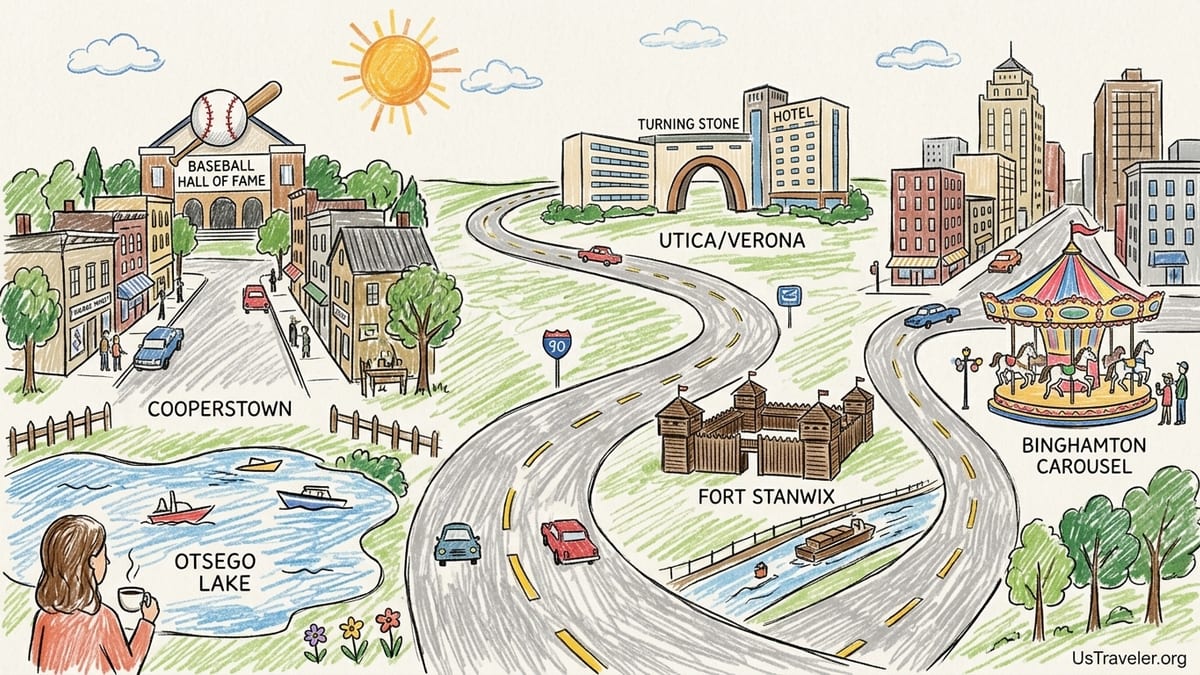
I didn’t expect “where you sleep” to reshape a Central New York trip as much as it did, but after using Cooperstown, the Utica/Verona corridor, and Binghamton as separate bases across different weekends, I started to feel like I was traveling three different regions. One base made it easy to stroll to the Baseball Hall of Fame between coffee and lunch. Another made it simple to string together an Erie Canal stop, a casino dinner, and a next-day detour without thinking too hard. The third surprised me by behaving like a real small city after dark, with restaurants you can actually choose between, not just settle for.
How I Framed the Comparison (And What I Actually Did)
I’m writing this as a first-person comparison because I’ve meaningfully stayed in each area as a home base, not as a quick day trip. I’m also going to be very explicit about what’s “me, on the ground” versus what’s researched, because a planning piece like this is only useful if readers know what’s lived experience and what’s verified logistics.
My on-the-ground lens is simple: What did mornings feel like, where did I end up for dinner without a ton of planning, how annoying was parking, and how much “windshield time” did I rack up to do the same caliber of sightseeing. Central New York is not huge, but once you’re driving two-lane roads at night after a long museum day, fifteen extra minutes starts to matter.
Researched side: I LOVE NY’s Central New York materials treat Cooperstown, the Utica and Rome area, and Greater Binghamton as substantially different experiences, which matches what I felt in real time. The same region label can hide very different travel rhythms, and these three bases prove it.
Cooperstown: Baseball Pilgrimage Energy, Lake Mornings, And Summer Crowds
Cooperstown is the base that changed my trip the fastest, because it compressed everything. On my first morning, I left my room with a coffee and just walked. No “Where’s the lot?” moment, no parallel-parking anxiety, no checking my phone every block for a garage entrance. I was simply in the village, moving at village speed, and it made even a packed itinerary feel calmer.
The Hall of Fame is the gravitational pull, and it behaves like one. My lived takeaway is that Cooperstown rewards the kind of travel where you like popping in and out. I found myself planning my day around the idea that I could do an hour in the museum, take a break for lunch, then go back for another hour. Researched side: the National Baseball Hall of Fame and Museum is right on Main Street, and their published museum ticket pricing has recently listed adults at $25, seniors at $20, and juniors (ages 7 to 12) at $15, with children 6 and under free. They also note the Village Trolley service window for the 2026 season and other access details for visiting days when you don’t want to drive in and out.
Otsego Lake is the other anchor, and it’s a different kind of magnet. My favorite Cooperstown moments weren’t “big attractions,” they were early-day lake moments before the crowds stacked up. I had one morning where I drove a short hop to the lakeshore, grabbed something simple, and just watched the water with that upstate stillness you can’t manufacture. Researched side: businesses like Sam Smith’s Boatyard and the Blue Mingo Grill explicitly position themselves as a lake day headquarters with boat rentals and food on Otsego Lake, which matches the vibe I felt: you can build a full day around the water without needing a complicated plan.
Now the honest part: summer crowds are real, and they’re not theoretical. The village is small, and small means the same streets do everything: pedestrian strolling, deliveries, rideshares, and visitors circling for parking. On a peak-feeling afternoon, I remember creeping behind a line of cars that were all clearly doing the same slow hunt I was, each driver doing that half-hopeful glance toward a just-occupied curb space. It wasn’t miserable, but it did mean I started walking more than I intended simply to avoid moving my car again.
Craft beverages are one of Cooperstown’s underappreciated trip-shapers because they influence your evening choices. I had nights where I didn’t want a long sit-down meal, just a good drink in a place with personality. Researched side: Brewery Ommegang continues to be a major draw near Cooperstown with an active events calendar and on-site experiences. In practice, for me, it became the “after museum” button: when you want a change of scenery that still feels tied to the Cooperstown identity.
Utica/Verona: Central Road Access, Easy Detours, And The Turning Stone Effect
Using Utica/Verona as a base feels like unlocking a different kind of Central New York trip: one built on road logic. My mornings here started with engines warming up, not walking out the door into an attraction. But in exchange, I got flexibility. This base is where I could decide at 9:30 a.m. that I wanted a history stop, a brewery stop, and a late dinner, and it all stayed reasonable without feeling like I was crossing the state.
Turning Stone changes the entire “where should I stay” conversation because it functions like a self-contained resort. My lived experience was that a Turning Stone night has a specific rhythm: you park once, you don’t think about the weather, you can move from dinner to entertainment to a nightcap without driving. That’s a very different feeling from Cooperstown, where you’re part of a small village ecosystem, or Binghamton, where you’re navigating an actual city grid.
Researched side: Turning Stone’s own published materials and pages highlight hotel deals, golf, and spa offerings. Their golf rates and the way they package amenities signal what you feel on site: it’s designed to keep you there, in a good way, if what you want is a true resort getaway rather than a “drive somewhere after dinner” kind of night.
What surprised me most about basing here was how much the broader convenience mattered. Utica gave me the kind of “real-life” restaurant access that makes travel smoother: you can choose dinner based on appetite and timing, not just on what’s open within a tiny radius. I remember one evening when I wanted a proper sit-down meal but didn’t want to overthink it, and it was easy to pivot. Researched side: The Tailor and the Cook, now on Main Street in Utica, publicly states it’s open seven days a week for dinner service and also offers Sunday brunch. Even if you don’t choose that exact restaurant, that kind of schedule signals a base with more consistent dining options.
For history, this base makes the Rome area feel like a casual add-on instead of a special expedition. Fort Stanwix is the standout because it’s substantial, it’s centrally positioned, and you can pair it with other Mohawk Valley and Erie Canal context in the same day. Researched side: Fort Stanwix National Monument is run by the National Park Service, and NPS materials state there is no cost to enter. They also publish operating hours that vary by season, including standard hours and winter closure windows, which matters because this is not a “show up anytime” attraction year-round.
The Erie Canal And Fort Stanwix: Why This Base Makes History Feel Effortless
My most vivid Utica/Verona-based day wasn’t a single attraction, it was the way stops stacked without stress. I started with a simple breakfast, drove to Rome, and suddenly I was walking through an interpretive space that connected Revolutionary history and the geography that made the Erie Canal era possible. It’s the kind of day where you get back to your room feeling like you learned something, not just saw something.
Driving and parking here felt the least dramatic of the three bases. That sounds like faint praise, but it’s not. It’s the difference between “I’ll just go” and “Do I really want to deal with that lot again?” In this corridor, I could usually find straightforward parking near where I needed to be and keep moving.
Researched side: NPS also highlights nearby Erie Canal-related sites, including parks and interpretive points in the Rome area tied to where canal digging began. When you base in Utica/Verona, you’re essentially choosing to make these heritage stops part of your trip texture rather than a special long drive from somewhere else.
My practical note: this base is not about strolling out for a lakefront sunset. It’s about building a route. If you like ending your day with a plan for tomorrow that includes “and then we’ll swing by that other thing,” Utica/Verona is the base that keeps saying yes.
Binghamton: Restaurants, Nightlife, Museums, And A Different Kind Of “Base Camp”
Binghamton felt like the most “normal city” base of the three, and I mean that as a compliment. After two trips where evenings often narrowed into a couple obvious choices, Binghamton gave me the pleasant problem of options. The energy is different: you can have a proper dinner in a downtown dining room, then decide whether the night continues or ends, without it feeling like you’ve “missed your window.”
My most specific Binghamton memory is a dinner night downtown where parking was easy enough that I didn’t think about it again until I was leaving. That’s rare for me in unfamiliar cities. I remember pulling into a spot, checking the street signs twice out of habit, and realizing I could relax. Then it was an easy walk to a meal that felt like a city meal, not a “we’re on vacation so this is what’s available” meal.
Researched side: downtown Binghamton’s Court Street corridor has a concentration of restaurants and bars, and several establishments maintain active presences and updated details. PS Restaurant, for example, lists its Court Street address publicly, and other venues in the area underscore that this is a walkable dinner district once you’re parked.
Museums helped round out my daytime hours here. When the weather didn’t cooperate, I didn’t feel boxed in. Researched side: the Roberson Museum and Science Center publishes visiting information and directions, and it’s the kind of attraction that fits Binghamton’s strength as a base: you can do culture in the afternoon and still have a nightlife-oriented evening without driving back to a quiet village.
And then there are the carousels. They sound like a small thing until you realize they’re an easy family-friendly win that doesn’t require an all-day commitment. Researched side: the City of Binghamton describes its carousel program as free or available for the “one piece of litter” tradition during the operating season. That’s not just cute. It’s a built-in activity that feels uniquely local and works as a low-cost reset between bigger ticket items.
Driving, Parking, And The Feel Of A Day: What Changed Most Between Bases
Cooperstown made me drive less, but stress more about when to move the car. My best Cooperstown days were the ones where I parked, committed to walking, and treated my car like it was staying put until tomorrow. If you try to do a lot of short drives within the village core at peak times, you can end up spending more time negotiating than traveling.
Utica/Verona made me drive the most, but think the least about it. Roads felt like the trip’s framework, not its obstacle. This is where I was most willing to tack on “one more stop,” because it rarely felt like a major ordeal to do so, especially if I was using a bigger property like Turning Stone as my end-of-day landing zone.
Binghamton made me feel like I was navigating a city, but in a manageable way. There’s grid logic, there are downtown streets, and it rewards you for doing what you’d do in any small city: park once, walk for dinner, and don’t overcomplicate the route. If your goal is to actually go out at night, Binghamton’s layout supports it in a way the other bases, by nature, can’t match.
One more real-world difference: the sound of mornings. Cooperstown mornings felt like birds and lake air. Utica/Verona mornings felt like “coffee, check maps, go.” Binghamton mornings felt like a city waking up: traffic building, people heading to work, and a pace that nudged me into doing more in a single day.
The Takeaway: The Best Base Depends On The Trip You Want
For a baseball weekend, especially if the Hall of Fame is the main purpose, Cooperstown is the base that feels like the point. It’s not just proximity, it’s the ability to turn baseball into a full-day rhythm: museum time, a walk, a meal, then back again. Researched side: the Hall of Fame publishes extensive planning guidance for big weekends, including Hall of Fame Weekend programming and seasonal transportation details, which is your signal that timing and crowds are part of the experience, not an afterthought.
For a resort getaway, Utica/Verona, and specifically a Turning Stone-centered stay, is the cleanest fit. You’re not chasing charm block by block. You’re choosing a contained experience where dining, entertainment, and amenities live under one umbrella, and you can still day-trip to canal history or nearby towns without packing up your whole trip.
For a classic road trip through Central New York, Utica/Verona is the base I’d pick because it keeps your route flexible. You can build days around the Erie Canal corridor, Rome’s Fort Stanwix, and the broader Mohawk Valley, and still pivot based on weather or cravings. It’s the “I want to see a lot” base.
For families, I’d split it this way: Cooperstown works if your family likes walking, lakeside downtime, and a baseball-forward theme. Binghamton works if your family wants variety and backup plans: museums for rainy hours, low-cost carousel fun in season, and enough restaurant choice that picky eaters don’t take over the trip. Utica/Verona works if you want straightforward logistics, bigger-hotel convenience, and the option to mix history stops with a resort-style night.
For a broader Central New York itinerary, I don’t think one base wins universally. Instead, the best move is to match your base to your “evening identity.” If your evenings are about strolling and popping into shops, Cooperstown makes the whole trip feel cohesive. If your evenings are about amenities and an easy on-property night, Utica/Verona fits. If your evenings are about dinner reservations, cocktails, and having a real choice after 9 p.m., Binghamton is the base that changes your trip.
FAQ
Q1. Which base is best if the Baseball Hall of Fame is my main reason for going?
Cooperstown, because you can walk to the museum area and build your day around repeat visits without constant driving.
Q2. Is Cooperstown still worth using as a base if I’m not a huge baseball fan?
Yes, especially for Otsego Lake time, walkable village days, and nearby museums, but it will feel quieter at night than the other two bases.
Q3. Which base makes it easiest to combine multiple towns and attractions in one day?
Utica/Verona, because it’s a practical road-access hub for Rome, Erie Canal-related stops, and other Central New York day trips.
Q4. What’s the best base for a resort-style weekend with minimal driving at night?
Utica/Verona if you stay at a resort property like Turning Stone, where dining and entertainment are on site.
Q5. Which base has the strongest nightlife and late-evening dining feel?
Binghamton, particularly downtown near Court Street, where multiple restaurants and bars cluster close together.
Q6. What’s the most walkable base overall?
Cooperstown, because the core attractions, shops, and the Hall of Fame area are concentrated in a compact village layout.
Q7. Which base is best for families with mixed ages and weather-proof options?
Binghamton, because it pairs museums with seasonal carousel rides and a wider range of restaurant choices.
Q8. Is Fort Stanwix a good add-on if I’m staying in Utica/Verona?
Yes, it’s a natural day-trip pairing with Rome and Erie Canal history, and it’s easy to fit into a half-day plan.
Q9. Which base is least stressful for parking and quick in-and-out stops?
Utica/Verona overall, because it’s set up for driving days and tends to feel less compressed than Cooperstown in peak season.
Q10. If I only have one long weekend, should I pick one base or split stays?
If baseball is the centerpiece, keep one base in Cooperstown. If you want variety, splitting between Utica/Verona and Binghamton can cover more dining and history without overloading any one drive day.