


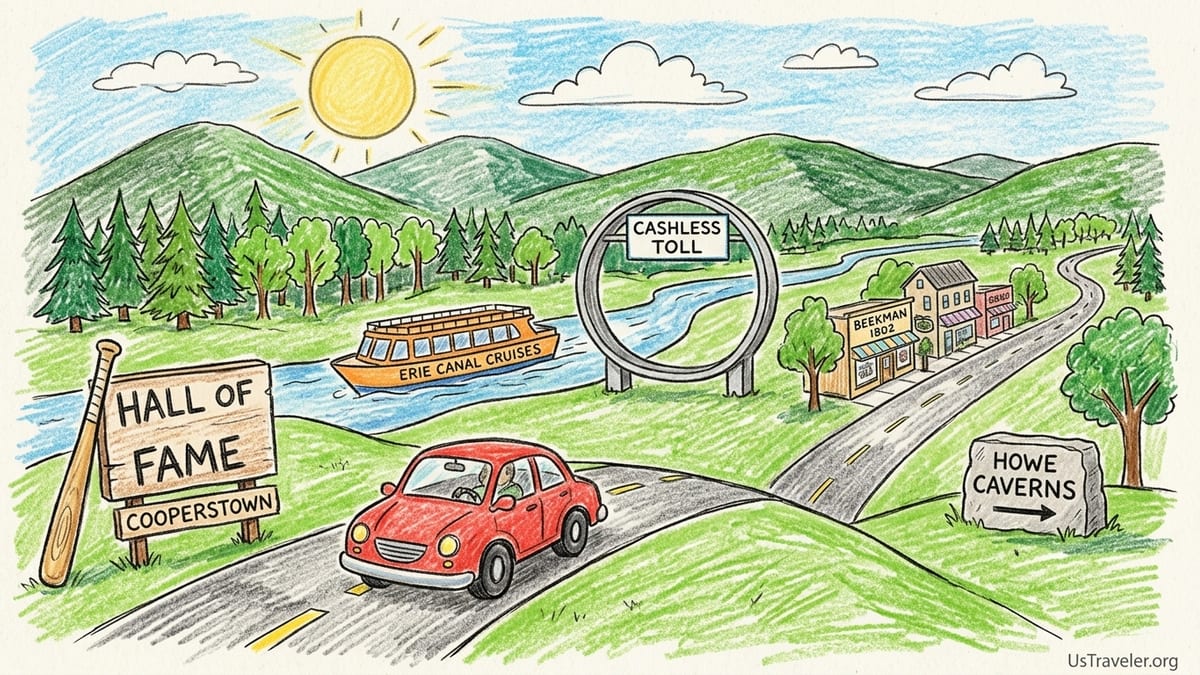
I planned this Central New York road trip the way I actually travel: fewer big-ticket stops, more time on the roads in between, and no magical thinking about squeezing “everything Upstate” into one weekend. The spine of my drive connected Cooperstown to Howe Caverns and nearby Sharon Springs, then tracked east-west along the Mohawk Valley through Herkimer’s Erie Canal docks to Utica, Verona, and Rome. I treated Binghamton the right way too: as a separate southern extension, not a detour that turns a pleasant loop into a windshield marathon.
Picking Up The Car And Setting Expectations For Central New York Roads
I started with a rental-car pickup in the Syracuse area, because it puts you within an easy hour of Utica and Rome, and it’s a straightforward on-ramp to I-90. At the counter, I asked two practical questions I now ask everywhere: whether the car’s plate is enrolled in E-ZPass, and what the agency does with tolls if it is not. New York’s Thruway is cashless, so you are going through open-road gantries rather than handing cash to a human. That’s great for flow, but it also means toll charges can show up later, either on your own transponder account or as a bill that gets passed through the rental agency with added administrative fees. I prefer to know the toll plan before I put the car in Drive.
With the logistics handled, I reminded myself what makes this region feel different from a Hudson Valley or Finger Lakes loop. Distances are deceptively short, but two-lane rural highways can slow you down in ways the map app does not always telegraph: farm equipment, a sudden 35 mph village main street, a school zone, a tractor-trailer easing onto a shoulder, or just the reality that you’ll want to pull over for a view. This is also an area where you can go from Thruway cruising to narrow, tree-lined county roads in minutes, which is part of the fun if you plan with cushion.
Fuel and food are easy along I-90 and the larger state routes, but I still topped off before leaving the highway for the more rural Cooperstown side roads. My rule on trips like this is simple: don’t let the gas gauge become an itinerary decision-maker. Central New York is not remote wilderness, but it’s rural enough that you don’t want your best photo stop of the day to be the one where you are also sweating a low-fuel warning.
Cooperstown: Where Parking Strategy Matters As Much As Museum Time
My first big anchor was Cooperstown, and I built the day around the reality that the village is small and beloved for a reason. The National Baseball Hall of Fame and Museum is the headline, but the most important planning detail I leaned on was not about baseball at all. Cooperstown’s official guidance is blunt: parking is limited, and paid parking is in effect from Memorial Day weekend through Columbus Day. The Doubleday Field lot is an all-day paid option, and on-street spots downtown are metered with time limits. If you roll in midday on a sunny summer Saturday, you feel every word of that immediately.
I found it easiest to treat Cooperstown like a park-and-walk destination. Once I had a spot, I stayed put and walked, rather than moving the car every time I wanted to pivot from the Hall of Fame to lunch or a lakefront pause. If you’re visiting in the peak season window, Cooperstown also runs a Village Trolley system. The daily individual pass price is low enough that it can be a sanity-saver, and the trolley operates in a defined summer season with specific dates and hours. In my case, it was less about avoiding a long walk and more about avoiding extra driving in the most congested blocks.
The Hall of Fame itself is one of those attractions where the admission price shapes the day. Adult single tickets are priced at a premium, with discounted categories for seniors, juniors, and veterans, plus free admission for very young kids and for active or career-retired military. That pushed me to commit to a real visit rather than a rushed pop-in. I didn’t want to pay full fare only to speed-run plaques and leave. Door-to-door, I planned for a half-day in Cooperstown, because between parking, walking, entry, and browsing the store, it’s very easy to under-budget time.
This is also where I started noticing the “official time estimates vs. real time” tension that defines the whole route. Current official information commonly puts Cooperstown about one hour from Utica, which is a solid planning number. In practice, I treated it as a minimum, not a promise, because leaving Cooperstown can include slow village streets and a few miles of two-lane road before you’re truly moving. I built my afternoon so that if I arrived later than hoped, the trip still worked without skipping dinner.
Cooperstown To Howe Caverns And Sharon Springs: The Scenic Middle That Actually Fits
The best-feeling transition of the entire trip was Cooperstown to Howe Caverns with Sharon Springs layered in. It’s an easy “change of scenery” day: baseball heritage and lake country in the morning, then underground geology and a small village main street in the afternoon. Howe Caverns is far enough from Cooperstown to feel like you’ve gone somewhere, but close enough that you are not sacrificing the whole day to the drive.
At Howe Caverns, I planned around tour timing rather than showing up and hoping. The signature experience is the traditional guided cavern tour, which is about 90 minutes. That length is long enough that you should think about it the way you’d think about a showtime: arrive early, use the restroom, don’t cut it too close with lunch. Howe Caverns also publishes a pricing page that covers multiple options, including longer specialty tours. Because those specialty tours can be significantly longer than the standard walk-and-boat format, I treated them as “choose one” activities, not add-ons you tack onto an already full day.
One of the most useful things I did was pair Howe Caverns with Sharon Springs, because the village stop works as a natural decompression after being underground. Sharon Springs is the kind of place where you can park once, wander, browse, and grab a snack without needing a major plan. For travelers who like a concrete errand-style stop, the Beekman 1802 Kindness Shop has clearly posted days and hours and sits right on Main Street, which makes it easy to build into a road-trip rhythm: stretch your legs, pick up something small, and get back on the road.
This is also where I learned what not to combine. It is tempting to treat Howe Caverns as a quick roadside attraction and then continue all the way to Utica for a late dinner, but once you factor in tour duration, the time you spend waiting for your group, and the very normal desire to linger in Sharon Springs, it starts to feel cramped. If I were repeating this as a two-day trip, I’d either sleep nearer the caverns and Mohawk Valley corridor or I’d accept that dinner might happen earlier and closer to where I am rather than forcing a late-night push.
Herkimer And The Erie Canal: Why The Canal Cruise Is The Day’s Time Anchor
Herkimer is where the trip stops being a set of separate attractions and starts feeling like one connected story. The Erie Canal is not just a history lesson here; it’s physically present and easy to access. I centered my Herkimer time on Erie Canal Cruises, which operates from the dock at 800 Mohawk Street in Herkimer. The location is about as road-trip-friendly as it gets: it’s directly across from the New York State Thruway Exit 30, and the cruise operator’s directions make it clear how to pull into the lot without second-guessing lane choices right after the exit.
The cruise schedule is what made this stop the most “real life” of the trip. Erie Canal Cruises posts a defined 2026 season for daily sightseeing cruises, running from May 22 through October 12, with common departure times in the early afternoon and additional morning cruises on select days. Ticket prices are straightforward and published: adults at $29, children ages 4 to 12 at $20, and infants 3 and under free. They also recommend arriving early and boarding before departure, which I took seriously because missing a set sailing time is the kind of mistake that turns a relaxed afternoon into stressful backtracking.
On the water, the cruise gives you the Erie Canal experience without requiring you to become a cyclist or paddler for the day. I like those options too, but for this specific route, the cruise was the cleanest way to absorb the canal and still make it to Utica on the same day. A practical detail I appreciated: the operator is explicit that cruises can be altered or canceled due to weather, operations, or low reservations. That’s not a negative; it’s a reminder to book ahead and have a Plan B, especially in shoulder season when a cold rain can thin out crowds.
Those distance estimates I mentioned earlier become useful here because Herkimer is a natural connector between everything. Erie Canal Cruises’ own visitor-facing information places Cooperstown roughly 30 minutes away, Utica around 15 minutes, and Turning Stone around 40 minutes from its dock. Even if your exact drive varies, the takeaway is planning clarity: Herkimer can be the hub day where you sleep in one place and spin out to multiple stops without constantly packing and unpacking.
Utica, Verona, And Rome: A Mohawk Valley Evening That Doesn’t Feel Rushed
After Herkimer, Utica made sense as an evening base because the drive is short and the city has the kind of services road-trippers actually use: reliable hotel inventory, late food, and parking that is less of a puzzle than in a tiny village center. I also liked Utica as a psychological reset. After two-lane roads and small towns, sliding back onto city streets felt like returning to “infrastructure,” which is not a glamorous travel goal but absolutely a practical one.
Verona is where I went when I wanted a low-effort night option that didn’t require a museum schedule. Turning Stone Resort Casino is the obvious anchor there, and the reason it works so well on this itinerary is that it’s close enough to feel like part of the same Mohawk Valley corridor rather than a detour. If you do go, pay attention to how you park. Turning Stone publishes that valet parking is available for a set fee for day guests, and that valet is complimentary for registered overnight guests at certain properties. That kind of detail matters because casino resorts can either simplify your evening or create surprise add-ons if you assume everything is free.
Rome is the next clean step on the same line. Fort Stanwix National Monument is one of the best “high value” stops in the region because it doesn’t require a big-ticket admission and it pairs naturally with a drive along the corridor. The National Park Service is explicit that there is no cost to enter Fort Stanwix, and you don’t need a pass to enter. That made it an easy add-on the morning after a Turning Stone night, when I wanted something meaningful but didn’t want another long drive to chase a checklist.
I treated Utica, Verona, and Rome as a choose-your-own-evening sequence rather than three mandatory stops. The corridor is compact, yes, but the real trick is energy. If you do the canal cruise and then try to force a full casino evening and a late-night drive, the day stops being fun. My best version was canal in the afternoon, Utica as the practical base, and then either a relaxed dinner or a short hop to Verona, not both plus extra miles.
What Worked, What Backtracked, And What I’d Cut From A Two- Or Three-Day Trip
The most natural combinations were the ones that followed the geography without forcing it. Cooperstown paired beautifully with either a dedicated half-day at the Hall of Fame or as the first night’s base if you want a lake-town feel. Howe Caverns and Sharon Springs worked as a single “middle day” block because you can transition from an appointment-style tour to an unstructured stroll without feeling like you’re wasting time. Herkimer’s canal docks then acted like the hinge that let me turn west toward Utica and Rome without doubling back.
The combinations that created too much backtracking were the ones that ignored where the Thruway actually helps. For example, trying to do Cooperstown in the morning, race to Herkimer for an afternoon cruise, and then detour south toward Binghamton the same night is the kind of plan that looks fine on a map and feels awful in the driver’s seat. Binghamton can be worth it, but it is better handled as a separate southern extension: either before you head up to Cooperstown, or after you finish the Mohawk Valley corridor, not as a zigzag in the middle.
If I only had two days, I would remove Rome or Verona rather than pretending I could do everything well. My clean two-day version would be Day 1 in Cooperstown with the Hall of Fame as the core and a calm evening. Day 2 would be Howe Caverns plus Sharon Springs, then an afternoon Erie Canal cruise out of Herkimer and dinner in Utica. That gives you a satisfying narrative arc without late-night driving, and it respects the reality that tours have start times and villages have parking limits.
With three days, I would keep the same first two days and add one extra corridor day, but I would still avoid turning it into a scavenger hunt. On Day 3, I would choose either a Rome history morning at Fort Stanwix or a Verona resort morning for a slower pace, depending on what kind of traveler you are. What I would not do is bolt on Binghamton “because it’s on the way.” In this region, “on the way” is how you accidentally spend your best hours in the car.
The Takeaway
Central New York rewarded me most when I treated it like a set of connected corridors rather than a list of counties to collect. Cooperstown was the emotional anchor, but Herkimer was the structural one: the Erie Canal docks made the whole route click, and the official drive-time estimates from that hub helped me plan days that felt human. Howe Caverns and Sharon Springs gave me the best kind of road-trip contrast, and Utica gave me the easiest base when I wanted to stop thinking and just eat, park, and sleep.
If you build this trip around what you can truly drive in a day, the region feels generous rather than scattered. Plan Cooperstown with parking in mind, treat the cavern tour as a timed event, and let the canal cruise set the pace for the Mohawk Valley. Then cut one stop on purpose so you can enjoy what you keep. That’s the difference between a weekend you remember and a route you merely survive.
FAQ
Q1. Is Cooperstown really about an hour from Utica?
Yes. Current official trip-planning guidance commonly places Cooperstown about one hour from Utica, but I still budgeted extra time for village traffic and two-lane roads.
Q2. How close is Cooperstown to Erie Canal Cruises in Herkimer?
Erie Canal Cruises’ visitor information places Cooperstown at roughly 30 minutes from its Herkimer dock, making it a realistic same-day pairing with a cruise departure time.
Q3. What are Erie Canal Cruises’ 2026 season dates and ticket prices?
The posted 2026 daily sightseeing season runs May 22 through October 12, with adult tickets at $29, children ages 4 to 12 at $20, and infants 3 and under free.
Q4. Where do Erie Canal Cruises boats depart from?
They depart from Gems Along the Mohawk at 800 Mohawk Street in Herkimer, with parking accessed right near NYS Thruway Exit 30.
Q5. How do NYS Thruway tolls work on a road trip?
The Thruway uses cashless tolling system-wide, so tolls are collected electronically. With a rental car, it’s important to ask how tolls are billed and whether added fees apply.
Q6. What is the easiest parking approach for visiting Cooperstown in summer?
Because downtown parking is limited and paid parking is in effect from Memorial Day weekend through Columbus Day, I parked once and walked, and used the trolley concept as a backup.
Q7. What does the Cooperstown Village Trolley cost in 2026?
Cooperstown publishes a daily individual trolley pass at $2.50, with children under 5 free, and it notes the 2026 operating dates and hours for the summer season.
Q8. Can I combine Cooperstown, Howe Caverns, and an Erie Canal cruise in one day?
It’s technically possible only if your timing lines up, but I found it felt rushed. The cavern tour and the canal cruise both work better when you treat them as timed anchors.
Q9. Is Fort Stanwix in Rome free to enter?
Yes. The National Park Service states there is no cost to enter Fort Stanwix National Monument and you do not need a pass to enter the park.
Q10. Should I include Binghamton on this same loop?
I would not force it. Binghamton works best as a separate southern extension before or after the Cooperstown-to-Mohawk Valley route, not as a mid-loop detour.