


I bought the Lake Placid Olympic Legacy Sites Passport for the same reason most travelers do: I wanted to see the headline Olympic venues without spending my entire long weekend doing ticket math. The promise is simple. Pay one bundled price, pick any order, and cash in one admission at each participating site between mid-May and October 31. The reality, at least in summer 2026, is more interesting: the Passport can be a genuine deal, but only if you’re realistic about drive times, opening hours, and how long it takes to park, queue, and actually do each experience.
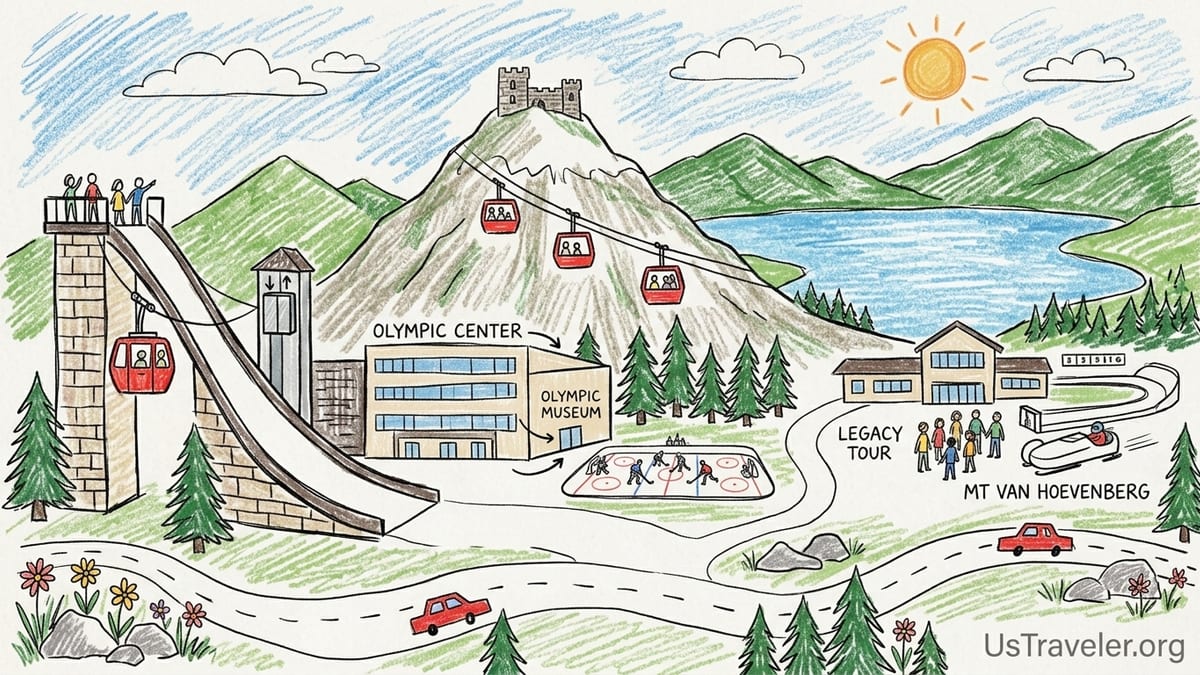
What the Olympic Legacy Sites Passport includes in summer 2026 (and what it costs)
I purchased the Summer 2026 Lake Placid Legacy Sites Passport right before this trip and treated it like a value test, not a souvenir. The published price for summer 2026 is $69 for adults and $59 for juniors (ages 7 to 19), seniors (65+), and military. The same bundle is advertised as $125 and $99 respectively if you buy the included activities separately. The Passport is valid through October 31, 2026, and it’s designed to be used in any order across the four venues.
In practice, you are getting one admission each to the included activities at Whiteface, Mt Van Hoevenberg, the Olympic Jumping Complex, and the Olympic Center. The inclusions that mattered for my trip were the Whiteface Veterans’ Memorial Highway and Cloudsplitter Gondola at Whiteface, the Skyride Experience at the Olympic Jumping Complex, the Legacy Tour at Mt Van Hoevenberg, and admission to the Lake Placid Olympic Museum at the Olympic Center. The Passport also comes with a 10% discount on shopping and dining at Legacy Sites locations, which is nice, but I did not build my “savings” around it because a coffee and snack discount is hard to quantify on one quick trip.
The other critical detail is that the venues operate on seasonal schedules that do not always line up perfectly. For example, the Passport is valid through October 31, but some activities run only through early or mid-October. If you’re arriving late in the season, you need to confirm what is still operating that week before you assume you can redeem every benefit.
Trip setup: where I stayed, my timing strategy, and how I avoided a rushed day
I based myself in the Village of Lake Placid, because it’s the most practical hub for the Olympic Center (in town) and the two nearby venues (Mt Van Hoevenberg and the Olympic Jumping Complex). Whiteface is farther, near Wilmington, and the drive time is real. My goal was to see how much of the Passport I could genuinely use without turning the trip into a stopwatch marathon.
The key planning choice I made was to split the Passport into two days, even though it is possible to attempt it in one. The reason is not physical difficulty, it’s operating windows. Several activities have “last ticket sold” cutoffs or scheduled tour times, and you lose time every time you move the car, re-park, and re-orient yourself. On paper, you might imagine four quick stops. In reality, each venue has its own rhythm: ticketing, scanning, restrooms, and the inevitable “wait, which building is the entrance?” moment.
I also planned around the one activity with the most constraint: the Mt Van Hoevenberg Legacy Tour runs at set times and lasts about an hour once you’re actually on the tour. If you miss your preferred departure time, the next slot can push your entire day later, which matters when other venues have afternoon cutoffs. So I built Day 1 around that tour, then kept the Olympic Museum as a flexible indoor block I could slide earlier or later depending on weather.
Day 1, stop-by-stop: Olympic Center Museum first, then Mt Van Hoevenberg Legacy Tour
I started in the village at the Olympic Center for the Lake Placid Olympic Museum. This was the easiest “logistics win” of the Passport because it’s right in town, it’s indoors, and it does not require perfect weather. I arrived in the morning when the building felt calm and the check-in process was fast: present the Passport credential, get scanned, and you’re in. If you are trying to do the Passport in a tight window, the museum is the experience I’d place early, because it soaks up time in a predictable way.
Time spent: I budgeted around 60 to 90 minutes and that’s what it took for a satisfying visit without reading every panel. You can do it faster if you’re skimming, or longer if you want the full deep-dive. The museum visit is self-paced, so there’s no pressure once you’re inside. What surprised me is how much the museum functions as a “context setter.” After seeing it first, every venue later in the trip felt more meaningful because I understood what I was looking at and why Lake Placid’s Olympic footprint is so spread out.
From there, I drove out to Mt Van Hoevenberg. Travel time depends on traffic leaving the village, but on a normal summer day it felt like a short hop rather than a road trip. Parking at Mt Van Hoevenberg was straightforward in my experience, but it’s a venue that can feel busy even when it is not crowded because people are arriving for multiple activities: tours, the coaster, and whatever else is running that day. I gave myself a buffer to find the right building for tour check-in and use the restroom before the start time.
The Legacy Tour itself is the most structured experience in the Passport bundle: it’s guided, it’s about an hour, and it involves walking. I treated it like a true appointment and arrived early enough that I wasn’t sprinting from the parking lot. Once the tour begins, the time commitment feels honest: it’s not a 10-minute taste. You get a real orientation to the venue and its Olympic purpose, and for first-timers it’s the best “what am I looking at here?” interpretation you’ll get without booking something bigger.
Day 1 reality check: did two Passport redemptions feel rushed?
Two redemptions in one day did not feel rushed. It felt like a properly paced travel day with enough time to enjoy each place instead of hunting for the next scan point. The museum is low-stress and flexible, while the Mt Van Hoevenberg tour is fixed-time and benefits from a buffer. Doing them together worked well because I had one indoor block and one outdoor block, which also meant a weather shift would not have ruined the day.
What did take time, and what most itineraries ignore, were the “micro-delays” that add up: walking from parking to the right entry, figuring out where to line up, and waiting for a staff member to finish helping the family in front of you. None of that was painful. It’s just real. If you’re trying to squeeze four venues into one day, those micro-delays become the difference between making a tour or missing it.
If I had forced the Olympic Jumping Complex Skyride onto Day 1 as well, I could have done it, but it would have turned the afternoon into a sequence of clocks: drive, park, scan, ride, drive again. This is exactly why I recommend thinking of the Passport as a one-and-a-half to two-day product if you want to enjoy it, not just complete it.
Day 2, stop-by-stop: Olympic Jumping Complex Skyride, then Whiteface Highway and Gondola
Day 2 was my “views and vertical” day. I started at the Olympic Jumping Complex for the Skyride Experience. This is the redemption that feels most like a classic tourist attraction: you arrive, get scanned, join a queue, ride up, take photos, and cycle back down. The Skyride combines a gondola ride and then an elevator up the jump tower to an observation deck. The whole thing is designed to be approachable for non-athletes, and it works even if you’re not a ski-jumping superfan.
Time spent: including parking, ticket scan, the ride up, time on the deck, and the return, I would plan about 60 minutes if it’s not slammed. If you want a slower experience with extra time for photos, add more buffer. The Skyride is also one of the Passport inclusions I would have seriously considered paying for individually anyway, simply because it’s a distinctive Lake Placid viewpoint you can’t replicate with a casual scenic pull-off.
From the Jumping Complex, I headed to Whiteface. This leg is where the Passport starts to test your patience if you’re trying to do everything quickly. Whiteface is not “in town.” It’s a separate destination with its own timing, and then the mountain itself adds more time once you’re there. I planned to arrive with enough margin that I wasn’t stressing about entry cutoffs and last rides.
At Whiteface, I redeemed both included admissions: the Whiteface Veterans’ Memorial Highway and the Cloudsplitter Gondola. This is the single biggest reason the Passport can feel like a deal: you can stack two Whiteface experiences in one visit instead of choosing between them. But it is also where you need to be realistic about time. The highway is not just a quick drive up and down if you’re actually stopping to look around, visit the castle area near the top, and factor in crowds at popular photo points.
Whiteface details that matter: tollhouse flow, summit parking, and how long it really takes
The Whiteface Veterans’ Memorial Highway operates as a toll road with a Toll House stop, and all traffic must stop there. That detail sounds minor, but on a busy day the Toll House is a natural choke point, and it’s where your time can evaporate if you arrive in the middle of a rush. The highway’s published operating day is long enough for most visitors, but the practical issue is that entry lines and summit parking behavior can make everything slower on peak afternoons.
Time spent on the highway portion: I would budget at least 90 minutes if you want to do more than drive up, take one photo, and drive down. That time includes the stop at the Toll House, the uphill drive, a few stops at viewpoints, time at the summit area, and the descent. If you like to linger, eat something at altitude, or wait your turn for a clear photo at the most popular overlooks, it can become a two-hour block without you noticing.
Then there is the Cloudsplitter Gondola, which is a separate included admission on the Passport. The ride up is quick, but the total time is not just the ride. You have to park for the gondola, walk to the loading area, queue, ride up, spend time at the top, and then ride down and unload. In summer 2026, this gondola is a major draw and it’s easy to underestimate how many families are doing the same thing.
Time spent on the gondola portion: I would plan roughly an hour, assuming moderate lines and a reasonable amount of time enjoying the top. If it’s busy and you’re in a slow-moving queue, it can run longer. If you’re trying to do Whiteface after several other venues in one day, this is where the “one-day Passport challenge” starts to fall apart, because you cannot control the line pace.
Did the Passport feel worth it for my trip? What I would pay for anyway, and what felt like a bonus
For my specific use pattern, the Passport felt like real value, because I actually redeemed the big-ticket experiences rather than buying the pass and then running out of time. The published comparison for summer 2026 is $69 versus $125 for adults, and that framing held up for me in a practical sense: I used enough inclusions that I did not feel like I was forcing it. If you only plan to do two small things, the Passport becomes less compelling. If you plan to do three or more of the included admissions, it quickly swings into “why not?” territory.
Which experiences would I have paid for individually anyway? The top two for me were Whiteface and the Olympic Jumping Complex Skyride. Whiteface is a unique Adirondack experience even if you do not care about Olympic history, and the Skyride is a signature viewpoint with a specific Lake Placid identity. The museum is the easiest add-on, and I liked it enough that I would have paid its standard admission if I had skipped the Passport, especially on a rainy afternoon.
What felt more like a bonus was the Mt Van Hoevenberg Legacy Tour, not because it was weak, but because it’s the kind of activity many travelers skip without realizing it’s included. When it’s part of your bundle, you’re more likely to try it, and it adds depth to the “Olympic sites” concept. It’s also the inclusion that most benefits from a two-day plan, because you need to match your arrival to tour times.
Could you do the Passport in one day? Yes, but I would only recommend it if you are comfortable with a long, tightly sequenced day and you accept that you may have to cut corners: shorter museum visit, fewer Whiteface stops, and little flexibility if a line is longer than expected. Over two days, the Passport felt like a vacation. In one day, it risks feeling like a checklist.
The Takeaway
The Lake Placid Olympic Legacy Sites Passport is not just a discount, it’s a time management challenge. In summer 2026, the pricing makes sense on paper, but the real test is whether you can actually redeem enough included admissions before you run out of daylight, patience, or operating hours. I managed to use the Passport across two days without feeling rushed, and I finished the four core redemptions that most travelers want: the Olympic Museum, Mt Van Hoevenberg Legacy Tour, Olympic Jumping Complex Skyride, and a full Whiteface visit that included both the Veterans’ Memorial Highway and the Cloudsplitter Gondola.
If you only have one day in the region, I’d skip the “do everything” mentality and pick the two experiences you care about most, then decide whether buying the Passport still makes sense. If you have two days, the Passport becomes a practical way to build a well-rounded Lake Placid itinerary: one day anchored in the village and nearby venues, and one day dedicated to views and elevation at Whiteface.
Most importantly, treat the Passport like a bundle of real appointments, not a set of coupons you can magically redeem in passing. Build in buffers for parking, queues, and the simple fact that you’ll want to linger once you get to the decks, summits, and viewpoints that made you come to Lake Placid in the first place.
FAQ
Q1. How much is the Lake Placid Olympic Legacy Sites Passport in summer 2026?
Adults are $69, and juniors (ages 7 to 19), seniors (65+), and military are $59.
Q2. How long is the Passport valid?
The Summer Passport is valid through October 31, 2026, but specific activities may have shorter seasonal operating dates.
Q3. What’s included with the Passport?
It includes one admission each to the listed Legacy Sites activities, including Whiteface Veterans’ Memorial Highway, Cloudsplitter Gondola, Olympic Jumping Complex Skyride, Mt Van Hoevenberg Legacy Tour, and the Lake Placid Olympic Museum, plus a 10% shopping and dining discount at the venues.
Q4. Can I realistically use the Passport in one day?
It is possible, but it can feel rushed once you factor in drive time, parking, queues, and fixed tour schedules. Two days feels far more comfortable.
Q5. What order works best for two days?
A practical approach is Day 1 in and near the village (Olympic Museum, then Mt Van Hoevenberg), and Day 2 for the Jumping Complex and Whiteface.
Q6. How long should I budget for the Olympic Jumping Complex Skyride?
Plan about an hour including parking, scanning, the rides, and time on the observation deck, with extra buffer on busy days.
Q7. How long does the Mt Van Hoevenberg Legacy Tour take?
The tour itself is about one hour, and you should arrive early for check-in since tours run at set times.
Q8. How much time should I allow for Whiteface if I’m doing both the Highway and Gondola?
Budget a half day if you want to stop at viewpoints, spend time at the summit area, and factor in gondola lines.
Q9. Is the Passport worth it if I only want Whiteface?
If you only plan to do one venue, buying individual tickets may make more sense. The Passport shines when you plan to do three or more included admissions.
Q10. What’s the biggest mistake people make with the Passport?
Underestimating how long it takes to move between venues and complete each experience once you include parking, queues, and operating-hour cutoffs.