


I arrived in the Adirondacks thinking I was coming to a single, postcard mountain town. By the end of my trip, I realized how wrong that mental map was. The Adirondacks are a six-million-acre patchwork of public and private land with wilderness, lakes, working communities, and resort villages inside the same blue line. That scale is not trivia, it is the entire travel strategy. Once I started driving between Lake Placid, Saranac Lake, Tupper Lake, the High Peaks trailheads, Whiteface, and then all the way down toward Lake George, the park’s size stopped being an abstract fact and became the thing that shaped every morning, every meal, every parking plan, and every hotel change I regretted.
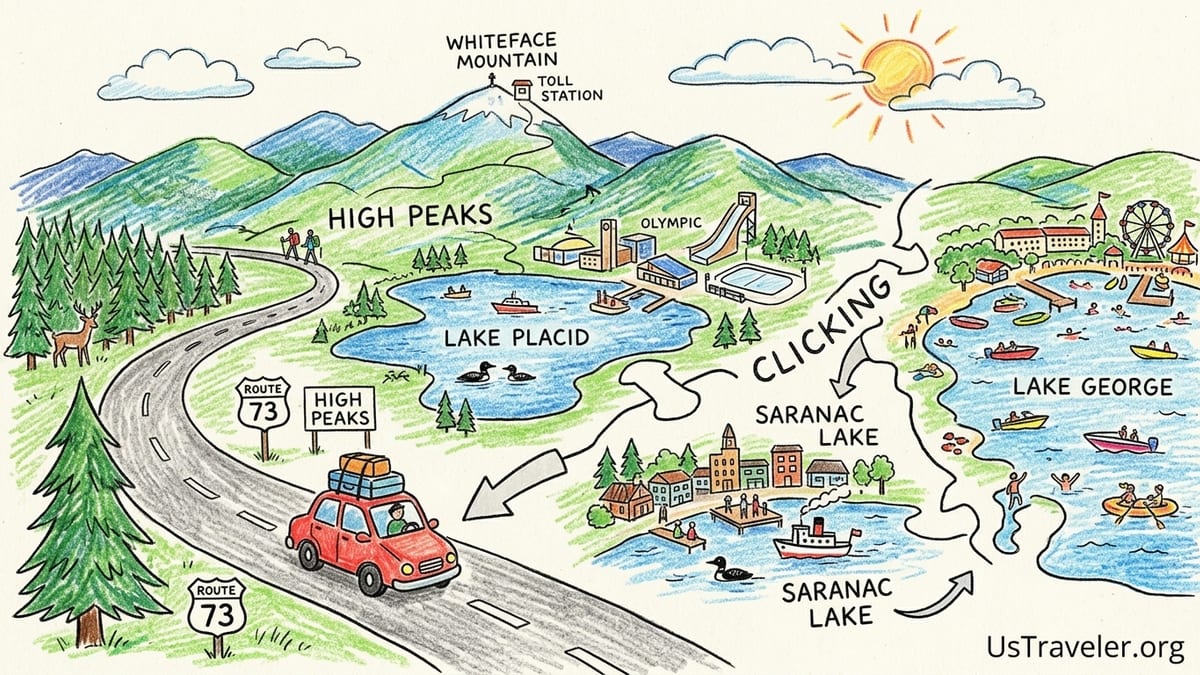
The Route I Actually Used, and the Moment the Map Finally Clicked
I based my trip in the northeastern Adirondacks first, then worked west and south in a slow loop that looked easy on a screen and proved humbling in real life. I picked up a rental car and built my days around driving corridors rather than trying to “see the Adirondacks” as one place. My rough route was: arrive into the Lake Placid area, day-trip the High Peaks corridor on Route 73, climb and drive Whiteface from Wilmington, shift to Saranac Lake for a different vibe and easier evenings, move to Tupper Lake for The Wild Center and a deeper, quieter central-park feel, then finish with a very different, busier lake scene down at Lake George.
That order matters because the Adirondacks do not unfold like a single destination. Lake Placid feels like a self-contained resort village with Olympic infrastructure, walkable blocks, and a steady hum of visitors. Saranac Lake feels more like a lived-in Adirondack town where I could park, browse, eat, and still be on a lakefront in minutes. Tupper Lake felt like the Adirondacks turning the volume down. And Lake George, at the southern edge, felt like summer vacation energy on full blast, closer in spirit to a classic American lake resort strip than the quieter backcountry towns farther north.
The first real surprise was how often I caught myself saying, “It’s only 40 miles.” In the Adirondacks, 40 miles is not a throwaway. It is real time. Roads are often two-lane, winding, dark at night, and shared with trucks, cyclists, and wildlife. Between trailhead mornings, afternoon thunderstorms, and the simple need to eat and refuel, I learned to plan fewer moves per day and to treat distance as a decision, not an afterthought.
Why I Changed Hotels Too Often, and How I’d Base Yourself Instead
I made a classic Adirondacks mistake: I moved lodging too frequently because I thought each new lake demanded an immediate hotel shift. The result was a trip that felt like constant check-ins, unpacking, repacking, and recalculating drive times. If I could redo it, I would pick two bases for a first trip, not four. One base in the Lake Placid or Saranac Lake orbit for the High Peaks, Olympic sites, and Whiteface. A second base either in Tupper Lake for a central Adirondacks reset or down in Lake George if your trip leans more toward cruises, swimming, and the southern end’s amenities.
The northeastern hub is powerful because so many “iconic” Adirondack experiences radiate from it. Even when I slept in Saranac Lake, I could still be at a Route 73 trailhead early enough to beat the tightest parking. Staying near Lake Placid also made it easier to enjoy evenings without driving long distances on pitch-dark roads after dinner. That was another surprise: the Adirondacks at night feel genuinely dark, the kind of darkness where your headlights carve a small tunnel and you suddenly understand why locals talk about deer like it is a daily condition, not a rare sighting.
Tupper Lake was my reset button. The pace felt calmer, and the crowds thinned. But it also made me realize something else about scale: a “central Adirondacks” stay can mean more driving to reach the marquee High Peaks trailheads. That does not make it worse, it just changes your priorities. In Tupper Lake I planned shorter hikes, more water time, and one anchor attraction rather than trying to do everything people associate with the Adirondacks in one burst.
High Peaks Reality: Trail Access, Parking Rules, and My Plan-B Mindset
The High Peaks are where Adirondack logistics become real. I built one full day around the Route 73 corridor and learned quickly that access is its own skill. Some trailheads are simple DEC pull-ins, but others come with specific systems and fees. The biggest planning point for many first-timers is the Adirondack Mountain Reserve access on Route 73, where reservations are required during the main season from May 1 through October 31 to use that lot and access trails on AMR property. I treated that reservation like a timed ticket, because in practice it is. When I did not get the day and time I wanted on my first attempt, I pivoted.
That pivot mindset saved my trip. Instead of spiraling, I used a Plan B trailhead and let the day be what it was. In the High Peaks region, popular trailheads can fill early, and the difference between arriving at dawn versus mid-morning can mean the difference between hiking and driving around stressed out. I also paid attention to up-to-date conditions before committing. On this trip, the High Peaks conditions report I checked called for mostly sunny weather with highs in the mid-60s at lower elevations, which sounded gentle until I remembered how quickly it cools with wind and elevation.
I also treated regulations like part of the packing list. If you are camping overnight in the Eastern Zone of the High Peaks Wilderness, bear canisters are required, and that is not the kind of rule you want to learn from a sign at dusk. Even as a day hiker, I carried food in a way that would not invite trouble at trailheads. The Adirondacks have wildlife, and the most practical thing I can say is this: secure your snacks and trash like you mean it, because it is not just about bears, it is about keeping the whole system functional for everyone.
Lake Placid and Whiteface: Olympic Energy, Big Views, and Weather Whiplash
Lake Placid was where I felt the Adirondacks flex its “this is a real place with real infrastructure” side. I spent one afternoon at the Lake Placid Olympic Museum and appreciated that it is integrated into a working venue area rather than isolated as a dusty attraction. Parking was also less intimidating than I expected: the museum’s visitor information spells out a simple downtown reality, with a municipal lot priced at $2 per hour during open hours. It was the kind of concrete detail that made my day smoother, because it let me decide how long to linger without guessing what the meter would do to my budget.
When the weather cooperated, I made Whiteface the next morning. The drive to Wilmington was easy, but the mountain itself reminded me again that Adirondack plans should stay flexible. Whiteface’s Veterans’ Memorial Highway is a paved toll road that climbs dramatically in a short distance, and it is the kind of road where you want to take your time, not rush. Up top, the air felt sharper and colder than town, and the wind turned my “light layer” into a necessary layer. Even in a mild forecast window, the mountain can make you feel underdressed in minutes.
I also learned to double-check seasonal operations before building a day around a specific ride, elevator, or shuttle. Whiteface posts seasonal operational notes and schedules, and Lake Placid Legacy Sites publish passport windows for summer operations. These things change year to year, and the Adirondacks punish assumptions. I learned to treat every attraction like a trailhead: confirm the current season, the hours, and what is actually running the day you plan to go.
Saranac Lake and the Adirondack Rail Trail: A Different Kind of Adirondack Day
After the High Peaks intensity, Saranac Lake felt like exhaling. I used it as a base for a quieter day that still felt distinctly Adirondack: lake edges, town streets, and a ride on the Adirondack Rail Trail rather than another summit push. The rail trail surprised me because it is not just a “maybe someday” project. Segments are open, and the experience is different from hiking. It is steady, accessible, and easy to fit into a day when you still want dinner downtown without collapsing afterward.
I treated the rail trail like a real transportation corridor for recreation rather than a novelty. I packed water, a light layer, and bug spray, because the Adirondacks do not stop being the Adirondacks just because the grade is gentler. Mosquitoes were not a horror-movie situation on my trip, but they were present enough that I did not regret having a strong repellent in the car. If you are sensitive, you will want to plan around dawn and dusk, and you will want sleeves available even on a warm day.
That night in Saranac Lake, the Adirondacks felt quieter in the best way. The downtown energy was calmer than Lake Placid’s, and I slept better because I was not trying to force one more attraction into the day. The park is huge, and Saranac Lake was where I started behaving like I understood that.
Tupper Lake and the Central Adirondacks: The Wild Center, Water Time, and the Park’s Quieter Scale
Tupper Lake was my deliberate shift into what I think of as the central Adirondacks mood: fewer “must-do” checkboxes, more time letting the landscape set the pace. The anchor experience for me was The Wild Center. I planned my whole day around its seasonal operations, because it is not open the same way year-round. For the 2026 season, the center has described a schedule that includes daily opening starting on Memorial Day, and general hours that sit nicely in the middle of the day, which makes it perfect for travelers who want a morning paddle or a late-afternoon lake sit without trying to cram a museum into the margins.
Inside, I liked that it is not only indoor exhibits. It feels like a bridge between learning and being outside, which matched how I was traveling. I drove in with a coffee, parked without drama, and stayed long enough that I was glad I had not scheduled a long hike afterward. It is one of those places where “just an hour” is unrealistic if you actually want to engage with it.
This was also where I felt the Adirondack distances in a different way. In the High Peaks corridor, distance is about reaching trailheads before they fill. In the central Adirondacks, distance is more about services. I paid closer attention to gas stations, grocery stops, and dinner timing. Some evenings I ate earlier than I would at home because I did not want to be searching for food after dark on unfamiliar roads. The nighttime atmosphere here was my favorite kind of quiet: loons on the water, a few porch lights, and long stretches of road where my headlights found nothing but trees.
Lake George: A Different Adirondacks, Built Around the Lake Itself
When I drove down to Lake George, I felt like I had entered a different Adirondacks, even though I was still inside the park’s broader identity. The lake is big, the shoreline is busy, and the experience is built around the water in a more front-and-center, vacation-resort way. The shift was not bad, it was just different, and it helped me understand why visitors talk past each other when they say “I love the Adirondacks.” They might be describing completely different corners of a six-million-acre place.
I made time for an on-the-water experience rather than only scenic overlooks. The Lake George Steamboat Company publishes schedules by date, and that structure influenced how I planned my day. Instead of showing up and hoping, I treated the cruise like an appointment. In peak season, that mindset matters, because some of the most popular departures can sell out ahead of time. On the day I went, the whole scene felt more like a classic summer destination: families, couples, ice cream lines, and that end-of-day glow when the lake reflects the light and everyone slows down at once.
Logistically, Lake George was also where I felt the benefit of more concentrated services. After days of Adirondack-style planning, it was easy to find dinner, grab last-minute supplies, and make spontaneous choices. But if you are coming for wilderness solitude, this is not the corner of the park that feels most remote. I liked ending here because it felt like a decompression: a place to sit by the water, watch boats return, and let the trip settle.
The Takeaway
The biggest Adirondacks surprise was not a view, a summit, or a museum. It was geography. Once I accepted that the Adirondacks are not one mountain town but a six-million-acre mix of public and private land, lakes, wilderness, and communities, the trip got easier. I stopped trying to “do the Adirondacks” and started traveling region by region.
If you take one practical lesson from my route, let it be this: base yourself strategically, confirm what is operating in the season you are visiting, and build your days around distances that look small but act big. In the Adirondacks, the drive is part of the experience, darkness arrives with real weight, one lake region can feel nothing like the next, and the best moments tend to happen when you stop trying to conquer the map.
FAQ
Q1. Is Adirondack Park really one park, or lots of separate parks?
It is one enormous park boundary with a mix of public Forest Preserve lands and private lands, plus towns, lakes, and working communities inside it.
Q2. Do I need a car in the Adirondacks?
I strongly recommend a car for a first trip because distances are real and many trailheads, lakes, and small towns are not connected by frequent public transit.
Q3. What surprised you most about driving in the Adirondacks?
How long “short” drives feel on two-lane roads, and how dark it gets at night outside of village centers. I stopped planning late-night drives after long hikes.
Q4. Do I need a reservation for the Indian Head area?
Yes during the main season: access through the Adirondack Mountain Reserve on Route 73 requires reservations from May 1 through October 31 for that lot and trail access.
Q5. What’s the simplest way to plan High Peaks hiking without parking stress?
I planned one primary trailhead and one backup, checked current conditions the night before, and arrived very early. That combination kept my day from turning into a parking scavenger hunt.
Q6. Are bear canisters required in the High Peaks?
Bear canisters are required for overnight camping in the Eastern Zone of the High Peaks Wilderness. For day hikes, I still stored food carefully and packed out trash.
Q7. What’s the best base town: Lake Placid or Saranac Lake?
For my trip, Lake Placid was best for Olympic-site energy and walkability, while Saranac Lake felt calmer and more lived-in. They are close enough that I chose based on the evening vibe I wanted.
Q8. Is The Wild Center worth building a day around?
Yes. I treated it as my main Tupper Lake anchor. It is not a quick stop if you want to do it properly, and seasonal hours matter.
Q9. How different is Lake George from the High Peaks region?
It felt like a different Adirondacks: more lake-resort energy, more concentrated services, and more structured activities like cruises. It was a great finish, but not a solitude-first base.
Q10. What would you do differently on your next Adirondacks trip?
I would switch hotels less, choose two base areas, and leave more blank space for weather shifts, mosquitoes, and the simple reality that the park is huge.