


I launched my kayak into Morro Bay just after 9 a.m., the morning fog still hanging in a thin veil over the water and Morro Rock looming ahead like a muted silhouette. Fishing boats hummed out of the harbor, sea lions barked somewhere near the rock, and the clink of halyards against masts echoed from the marina. Within minutes of pushing off from the dock, I understood why locals say the best way to meet Morro Bay is at water level, with a paddle in your hands and sea otters floating in the kelp a respectful distance away.
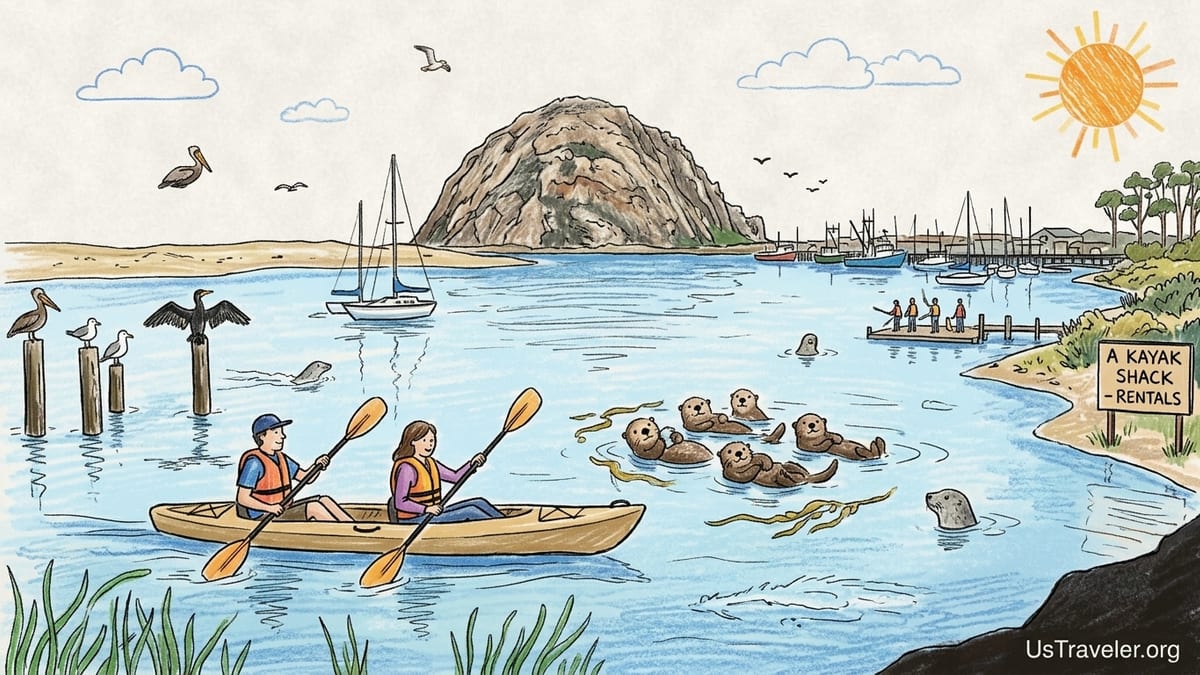
Launching From the South Bay and First Glimpse of Morro Rock
For this paddle I chose to launch from the south side of the bay, near Morro Bay State Park Marina along State Park Road. Several operators work out of this quiet corner of the harbor, but I rented from A Kayak Shack, which has a small dock tucked beside the marina and the Bayside Café. From the parking lot I could already see Morro Rock framed at the mouth of the bay, its volcanic bulk rising beyond the moored sailboats. It felt nicely removed from the bustle of the Embarcadero but still close to the working harbor.
Even before I stepped into the kayak, the waterfront activity set the tone. Charter boats and commercial fishing vessels were idling in and out of the main harbor channel, while a couple of stand-up paddleboarders glided past the marina slips. The air smelled like eucalyptus and salt with a faint hint of diesel from the fishing fleet. Across the way, the low shoreline of the Morro Bay sandspit ran like a tan ribbon between the bay and the open Pacific, protecting the estuary from big ocean swell.
As I slid away from the dock, Morro Rock shifted from a distant backdrop to a constant reference point. The more I paddled north, the more the rock dominated my field of view, with the harborfront businesses, seafood restaurants, and gift shops along the Embarcadero lining the right-hand shore. It was a reminder that Morro Bay is both a commercial harbor and a protected estuary, and that any paddle here means sharing space with working boats, wildlife, and other visitors.
The water in the marina basin was glassy, disturbed only by the V-shaped wakes of harbor seals surfacing between the moored boats. A light northwest breeze rippled the surface just enough to break the reflection of the masts, but inside this south-bay pocket I felt almost entirely sheltered. This is the heart of the estuary: shallow, calm water that makes an ideal starting point for beginners or anyone who wants to focus on wildlife rather than fighting wind and current.
Why I Chose Kayaking and The Rental Details
I picked kayaking over a motorized wildlife cruise for two reasons. First, kayaks move quietly and let you hear the sounds of the estuary: the clatter of shorebirds on the mudflats, the puff of a harbor seal breathing beside you, the gentle splash of your paddle. Second, paddling your own boat means you control your route and pace, lingering where you notice something interesting and slipping into shallow channels that larger boats cannot enter. I also liked that kayaks have a smaller footprint in sensitive habitat when used responsibly.
For this trip, I rented a tandem sit-on-top kayak from A Kayak Shack, partly to share the experience with a partner and partly for stability. At the time of my visit in 2026, their posted pricing for a standard tandem sit-on-top was in the ballpark of 35 to 40 dollars for the first two hours, with roughly 10 to 15 dollars per additional hour. Single kayaks ran slightly cheaper per person, and stand-up paddleboards were similar or a bit more for solo paddlers. Rates can shift by season, but these figures give a realistic sense of current costs for planning a morning on the water.
The rental package included paddles, life jackets, and a basic orientation talk about tide, wind, boat traffic patterns, and wildlife etiquette. They offered both unguided rentals and guided natural-history tours. I opted for an independent paddle to shape my own route, but I watched a guided group depart just ahead of us. They launched in a compact cluster, their guide setting the tone with reminders about keeping safe distances from otters and harbor seals, staying out of the main shipping channel whenever possible, and using the sandspit as a windbreak if conditions picked up.
For those interested in a more structured experience, Central Coast Outdoors runs guided kayak tours on Morro Bay, often departing from this same south-bay area and paddling across to the sandspit for a beach stop. Their classic three-hour natural history tour for adults is typically priced around 75 to 95 dollars per person, including all gear and guiding, with private or family options available at higher per-person rates. Morro Bay Paddlesports, headquartered closer to the Embarcadero, lists guided tours and lessons in a similar general price range for two to three hours on the water, with the exact rate depending on season and group size.
The Route: Sheltered Estuary vs Exposed Waters Near Morro Rock
Once we cleared the marina dock, our loose plan was to make a wide loop: paddling north along the eastern side of the bay toward the Embarcadero and Harbor Walk, crossing the main channel toward the sandspit, then turning south into more secluded estuary channels before returning down the sheltered back bay to the launch. The whole circuit would keep us mostly inside the protected Morro Bay National Estuary and only briefly skirt more exposed water near Morro Rock.
The first leg kept us in a narrow, sheltered band of water along the state park shore. Water depth here at mid-tide hovered in the three to six foot range, and eelgrass beds swayed beneath the hull. The wind was a light five to eight knots from the northwest, barely noticeable in the lee of the marina and headland. We could see whitecaps forming closer to the mouth of the bay near Morro Rock, but down in the estuary the surface still looked mostly smooth with gentle cat’s paws of breeze.
As we approached the busier harborfront near the Embarcadero, the character of the water changed. We had to cross the main boat channel where tour boats, commercial fishing vessels, and harbor patrol weave constantly through. The current here ran a bit stronger, tugging us seaward by perhaps half a knot as the tide ebbed. Traffic includes wildlife cruises, small electric boats from Estero Adventures near the Embarcadero, and whale watching and glass-bottom excursions from outfits like Sub Sea Tours and Kayaks. Crossing required timing, awareness, and a firm, straight paddle to the other side between traffic, something a first-time paddler might find intimidating without a guide.
Near the base of Morro Rock itself, the difference between the sheltered estuary and the more exposed outer harbor became obvious. Even though the sandspit blocks ocean swell, the area close to the harbor mouth is more open to wind and tidal flow. Small whitecaps slapped the bow, and the chop was enough to rock our kayak but not to threaten a capsize. The water was noticeably colder against my fingertips, a reminder that this is Pacific Ocean water cycling in and out of the bay. We did not push all the way to the outside of the rock where bigger swell and stronger currents can develop. Instead, we lingered just inside the harbor mouth where sea lions were hauled out on docks and navigation buoys, then turned back toward the relative calm of the estuary.
Conditions on the Water: Tide, Wind, Temperature and Boat Traffic
Morro Bay is a classic example of how tide and wind shape an estuary paddle. On this morning the tide was on a moderate ebb when we launched, scheduled to bottom out around midday. That meant the first part of our route generally flowed seaward, giving us a subtle boost as we headed toward Morro Rock but promising more resistance on the way back. Our rental staff advised us to do most of our “against the current” paddling earlier in the trip to avoid grinding back to the marina at dead low tide.
Wind is the other key ingredient. Summer and early fall afternoons often see northwest wind in the 10 to 20 knot range, which can pile up short, choppy waves near the harbor mouth and across the wider parts of the bay. By launching around 9 a.m., we benefited from the quieter morning pattern: light breeze under 10 knots and relatively flat water in the back bay. As we approached noon, I could feel the wind freshen on my cheeks and watch ripples darken the center of the bay, but the sandspit and surrounding low hills still sheltered the inner channels.
Water temperature in Morro Bay is cool year-round, loosely tracking nearshore Pacific temperatures. During my visit, local reports pegged water temperatures in the mid-50s Fahrenheit. That is cold enough that a full immersion without thermal protection would quickly become uncomfortable. While a wetsuit is not mandatory for an estuary paddle in stable kayaks, I wore synthetic layers and a windproof shell, planning around the possibility of splashes and fog. The air started in the mid-50s as well, nudging into the 60s once the sun burned through the marine layer.
Boat traffic ebbed and flowed with the time of day. Fishing boats left early and returned in mid to late morning, while wildlife cruises and electric rental boats increased by late morning and early afternoon. In the narrowest part of the harbor channel near the Embarcadero, we encountered a mix of commercial vessels, sailing yachts under power, Coast Guard activity, and rental skiffs. Outside those chokepoints, however, the estuary still offered long stretches where we paddled in near silence, sharing space mostly with other kayakers and paddleboarders and the occasional party canoe ambled by a group that had clearly decided paddling was secondary to sunbathing.
Wildlife I Actually Saw: Sea Otters, Seals, Sea Lions and Birds
The headline act for many visitors to Morro Bay is the southern sea otter, and they were the animal I most hoped to see. We spotted our first raft of otters near the South T-Pier area, not from land but as we paddled in a gentle arc along the east side of the harbor, parallel to the Harbor Walk. A cluster of brown shapes floated among the kelp, some rolled on their backs with paws in the air, others grooming or diving. Counting heads is tricky when they dive frequently, but we estimated at least a dozen individuals, including a few smaller shapes that may have been pups riding on mothers’ chests.
We kept our distance, hovering at least four or five kayak lengths away, which translates to roughly 50 to 80 feet depending on the kayak. That buffer was enough that we could see their faces and hear the occasional soft chirp without causing them to raise their heads or shift position. When another pair of kayakers drifted a bit closer, one otter rolled to look at them and then slowly paddled farther from the kayaks, a subtle but clear behavioral change that reinforced the importance of not edging too near. We backed off slightly ourselves, letting the ebb tide carry us past at a slow drift instead of actively paddling toward them.
Closer to the base of Morro Rock, sea lions added a louder soundtrack. Several hauled out on floating docks barked continuously, and we watched a few large adults porpoise through the channel around a tour boat. Here again, it was easy to get closer than necessary, especially when a curious animal surfaced near the kayak. Our goal was to keep a generous buffer, avoiding cutting between animals and their haul-outs or lingering directly in their travel path. Harbor seals were subtler: rounded heads that appeared silently nearby, exhaled with a soft “pfssst,” and then slipped below the surface again. Many kept their distance naturally, but once or twice a seal surfaced within two kayak lengths. In those cases we simply paused paddling until they chose their direction and then angled slowly away.
Birdlife filled in the quieter spaces of the trip. On the sandspit side of the bay, we watched brown pelicans glide in tight formation just above the water’s surface, folding their wings at the last moment before plunging for fish. Double-crested cormorants stood on old pilings with wings spread to dry. In the shallow back-bay channels closer to Morro Bay State Park, long-legged waders hunted along the edge of the marsh: snowy egrets in bright white, great blue herons moving with slow, deliberate steps, and flocks of shorebirds shifting like a single mind when disturbed.
What we did not see are sometimes as important to mention as what we did. On this particular paddle, we did not spot any dolphins, whales, or unusual bird species, nor did we witness dramatic predator-prey scenes. The wildlife encounters were more low-key: the steady presence of otters in known nursery areas, the reliable silhouettes of sea lions near the rock, and a rich but subtle bird community working the mudflats at low tide. It felt like an honest snapshot of everyday life in the estuary rather than a highlight reel designed for social media.
Responsible Wildlife Viewing and Sanctuary Guidance
Morro Bay’s waters fall within a network of marine protected areas, including the Morro Bay State Marine Recreational Management Area and Morro Bay State Marine Reserve. The California Department of Fish and Wildlife and local partners emphasize a few key principles that shaped how I approached wildlife from the kayak. One core idea is simple: if an animal changes its behavior because of you, you are too close. That might mean an otter raising its head from rest to look directly at you, a bird taking flight off a roost, or a seal or sea lion slipping off a haul-out into the water as you approach.
For sea otters in particular, federal guidelines and local outreach programs often recommend staying at least five kayak lengths or about 50 to 60 feet away. Guides in Morro Bay tend to use this simple visual rule on tours, asking guests to imagine stacking their own kayaks end to end between themselves and the animals. On our paddle, this guideline kept us from drifting into the middle of a resting raft or trying to circle them for better photographs. When you consider that otters rely on undisturbed rest to maintain body temperature in cold water and to care for pups, keeping that buffer feels less like a rule and more like basic respect.
The same ethos applies to birds on the mudflats and marsh edges. It can be tempting to chase flocks for dramatic takeoff photos, but repeated disturbance forces birds to burn energy they need for migration, feeding, or breeding. Instead, I tried to paddle parallel to the shore at a distance that did not cause flocks to flush. When they did, I took it as feedback to alter my line rather than an opportunity for another pass. California State Parks materials for Morro Bay State Park echo this advice, reminding paddlers to give wildlife space and to back away if animals notice you.
Tour operators such as Central Coast Outdoors and Morro Bay Paddlesports build these guidelines into their briefings and on-water coaching. Watching one group from a distance, I noticed their guide physically placing their own kayak between the group and an otter raft, signaling with hand gestures when it was time to back paddle or sidle away on an angle instead of pointing bows directly at the animals. That is one of the unsung benefits of joining a guided tour, especially for first-time visitors who may not be familiar with local regulations and best practices.
At the most basic level, responsible wildlife viewing in Morro Bay comes down to patience and letting animals set the terms of any encounter. Some otters will drift closer on their own, curiously watching kayaks; others will choose to move away. By resisting the urge to chase, cluster around, or split a group of animals, you give them room to make those choices. Your photos might be less “up close,” but the experience feels more in line with the idea of visiting a functioning estuary rather than treating it as a backdrop.
Fog, Wind, Gear Quirks and the Less-Perfect Moments
It would be easy to write only about the serene parts of paddling Morro Bay, but the less graceful moments are part of the story. The day started in typical Central Coast fashion with patchy fog. Visibility at launch was roughly half a mile, enough to see Morro Rock but with its top shrouded. The fog made the harbor feel cozy but also slightly disorienting; sound carried strangely across the water, and it was harder to gauge distance to other boats. I found myself checking over my shoulder more often than I would on a clear day and leaning on fixed landmarks like the Embarcadero docks and navigation markers.
Wind also tested my patience on the return leg. By the time we turned back from the vicinity of Morro Rock and crossed again toward the sandspit, the northwest breeze had freshened to perhaps 12 to 15 knots. Our broadside crossing felt wobbly as the kayak rode sideways against low chop, and we had to coordinate strokes closely to keep the bow from weathercocking into the wind. It was not unsafe for reasonably fit adults in a stable tandem, but I could easily imagine how a nervous beginner might freeze up or switch to an uncomfortable death grip on the paddle.
Then there was the gear. Sit-on-top tandems are chosen for their stability and simplicity, not speed or ergonomic perfection. With two adults and a dry bag on board, our boat rode deep in the water and responded sluggishly to gentle strokes. The molded plastic seats, while padded, still left my lower back sore after nearly three hours, and we ended up improvising extra lumbar support with rolled-up jackets. Getting in and out from the floating dock was straightforward, but we watched more than one first-timer wobble alarmingly during their first attempt to sit down.
Finally, expectations about wildlife distance needed adjustment. Friends had returned from Morro Bay with photos that seemed to show otters almost at arm’s length, which can create unrealistic standards. On our paddle, most otters we saw remained at least 50 or more feet away, which is entirely appropriate given the viewing guidelines. My longest lens was back on land, so our on-water photos are small shapes on a big backdrop of water and rock. They are not poster-worthy, but they feel more honest to how a respectful encounter looks from a kayak.
Alternatives for Non-Paddlers: Harbor Walk, South T-Pier and Cruises
Not everyone in our group wanted to paddle, so we built the day around options that worked for both paddlers and non-paddlers. The Harbor Walk that runs from the Embarcadero out toward Morro Rock is one of the best no-boat ways to experience the bay. From this path you can often see the same otter rafts that kayakers drift near, especially around areas known locally as otter nurseries. There are interpretive signs along the railings and enough benches to sit and watch the water for as long as you like.
The South T-Pier may be the single most reliable land-based spot we found for seeing sea otters and harbor seals. From the pier we watched several otters grooming and napping well within naked-eye view, with additional animals popping up under the pier pilings. Harbor seals occasionally hauled out on nearby rocks or buoys, and seabirds cruised by at close range. For visitors who do not want to get on the water at all, this pier alone can offer a very satisfying wildlife fix, especially in the calm morning hours.
For a more structured, seated experience, wildlife cruises and electric boat rentals are good options. Sub Sea Tours and Kayaks, based along the Embarcadero, runs narrated harbor and wildlife cruises on small vessels, often including a look at sea lions hauled out near Morro Rock and chances to spot otters and harbor seals along the way. Estero Adventures, also operating from the Embarcadero, rents small electric boats that you pilot yourself within the sheltered bay, as well as kayaks for those who want a simpler paddle starting closer to town.
All of these alternatives pair easily with an afternoon of browsing Embarcadero shops, sampling clam chowder or fresh fish tacos, or visiting the Morro Bay Estuary Nature Center and the Morro Bay State Park Museum of Natural History. It is entirely possible for one part of a group to head out in kayaks while others walk the Harbor Walk, photograph birds at the South T-Pier, or relax on a harbor cruise, then reconvene for lunch with a shared view of Morro Rock.
A Realistic 2–3 Hour Plan and Total Cost for Two Adults
Looking back on the day, the sweet spot for a first-time paddle in Morro Bay seems to be a two to three hour window built around morning conditions. Here is how our independent route actually broke down. We launched from the State Park Marina side around 9 a.m., after a short safety and orientation chat that took about 15 minutes. The first 30 to 40 minutes were spent paddling steadily but unhurriedly toward the Embarcadero side, skirting the harbor channel and getting used to the feel of the boat. We paused occasionally to photograph shorebirds and orient ourselves in the maze of moored boats.
Our next 45 minutes unfolded in the heart of the wildlife viewing area. We drifted near South T-Pier, keeping our distance from two different otter rafts while letting the ebb tide carry us slowly along. This is where we saw the greatest concentration of otters and harbor seals, along with pelicans and cormorants working the pilings. We then crossed the harbor channel in a deliberate, straight sprint to the sandspit side and landed briefly on a stretch of sandy beach for a snack and leg stretch.
The final hour was a slow, meandering return through the quieter back bay channels south of the main harbor. With the tide lower, eelgrass beds and mudflats emerged, attracting more wading birds. We hugged the state park shoreline back to the marina, arriving just under the three hour mark. In total, it felt like a full, satisfying outing without pushing into the four to five hour zone that would have demanded more endurance and navigation attention.
In terms of cost, our tandem kayak rental for three hours fell in the range of 60 to 70 dollars total for the boat, including life jackets and paddles. If we had each rented single kayaks instead, the combined cost would likely have been similar or slightly higher for the same duration, perhaps around 70 to 80 dollars total at current rates from outfits like A Kayak Shack or Morro Bay Paddlesports. Parking was either free or low-cost in the nearby lots, and we packed our own snacks and water, so there were no additional on-water expenses.
By comparison, a guided three hour nature tour with a company such as Central Coast Outdoors would likely have cost in the ballpark of 150 to 190 dollars total for two adults, depending on the specific tour and season. That higher price reflects the value of a naturalist guide, arranged timing with tide and wind, safety oversight, and the convenience of having someone else manage logistics and route planning. For travelers budgeting a full day in Morro Bay, one workable plan might be a morning guided tour followed by a self-directed paddle on a second day, but even within a single visit, choosing one or the other depends on comfort level and priorities.
The Takeaway
My Morro Bay kayaking experience delivered on its promise of quiet estuary water, close but respectful wildlife encounters, and a new perspective on the harbor dominated by Morro Rock. Starting from the State Park Marina area with A Kayak Shack kept the launch simple and the first miles sheltered. The route we followed offered a good mix of environments: boat-filled harbor, otter-rich sections near the South T-Pier, sandy landings on the sandspit, and bird-heavy channels in the back bay. It felt varied without ever straying into truly rough or technical water.
The trade-offs were honest ones. Fog limited long views early on, wind made the return leg choppier than I would have liked, and our stable tandem kayak was more barge than sports car. Wildlife stayed at respectful distances rather than posing close to the hull. But those same limitations were reminders that this is a real working estuary and harbor, not a theme park. The animals are not there for our entertainment, and the weather does not bend around a booking schedule.
If I were planning a similar two to three hour outing for two adults, I would still lean toward an independent rental if both people are reasonably fit, comfortable around boats, and willing to read up on wildlife etiquette and basic marine safety. For roughly 70 dollars in shared rental costs, you can tailor your own pace and linger wherever the day draws you. However, if even one person in the group feels uncertain about navigation, wind, or reading animal behavior, the extra cost of a guided nature tour from operators such as Central Coast Outdoors or Morro Bay Paddlesports is money well spent.
On my next visit, I will likely book a guided tour timed around favorable tides, both to deepen my understanding of the estuary’s ecology and to let someone else handle the route decisions so I can focus entirely on the experience. Then, armed with that knowledge, I would happily rent again on my own for a shorter follow-up paddle. In a place as layered as Morro Bay, there is room for both approaches, as long as each stroke of the paddle keeps the needs of the wildlife and the rhythm of the harbor in mind.
FAQ
Q1. Do I need prior kayaking experience to paddle in Morro Bay?
Basic fitness and comfort on the water are usually enough for the protected estuary areas, especially on calm mornings. If you are brand new to kayaking or uneasy about wind, currents, and boat traffic, booking a guided tour is a smart way to learn in a controlled setting.
Q2. How close can I safely get to sea otters in a kayak?
Local guidance and federal recommendations suggest staying at least four to five kayak lengths away, roughly 50 to 60 feet. If an otter lifts its head to watch you, changes position, or swims away, you should back off and give it more space rather than closing the distance for a photo.
Q3. What time of day is best for kayaking in Morro Bay?
Morning is generally best. Winds are often lighter before midday, fog tends to thin as the sun rises, and boat traffic is lighter than in the afternoon. Launching between about 8 and 10 a.m. usually offers the calmest and most wildlife-friendly conditions.
Q4. What should I wear for a Morro Bay kayak trip?
The water is cold, often in the mid-50s Fahrenheit, so dress in quick-drying synthetic or wool layers, avoid cotton, and add a windproof outer shell. In cooler months or for longer trips, some paddlers wear a light wetsuit. Always layer so you can adjust as the fog lifts or the wind picks up.
Q5. Are guided tours worth the extra cost compared to rentals?
For many visitors, yes. Guided tours typically cost more than renting a kayak independently, but they include local natural history interpretation, route planning around tides and wind, built-in safety support, and clear coaching on wildlife etiquette. For confident paddlers on a budget, rentals can still be a good option.
Q6. Can non-paddlers still see sea otters and other wildlife?
Absolutely. The Harbor Walk, South T-Pier, and viewpoints near Morro Rock all offer excellent chances to see sea otters, harbor seals, sea lions, and seabirds from shore. Wildlife cruises and electric boat rentals provide additional options to experience the bay without paddling.
Q7. How long should a first-time kayaking trip in Morro Bay last?
A two to three hour trip is ideal for most first-time or occasional paddlers. It allows enough time to reach good wildlife areas, land briefly on the sandspit, and return without rushing or battling fatigue. Longer outings are possible but demand more stamina and planning.
Q8. Is it safe to kayak all the way out around Morro Rock?
The inner harbor side of Morro Rock can be approachable in stable conditions, but the outer ocean-exposed side is much more challenging, with stronger swell and currents. Most casual paddlers should stay inside the bay and within the protected estuary. If you want to approach the rock more closely, consider going with an experienced guide.
Q9. What happens if the wind or fog get worse during my paddle?
If conditions deteriorate, it is best to shorten your route, hug the more sheltered shoreline, and avoid crossing wide, exposed sections of the bay. Guided tours will typically adjust plans or turn back early if needed. Rental staff can advise you on safe return routes, but it is your responsibility to monitor weather and err on the side of caution.
Q10. How much should two adults budget for a Morro Bay kayaking experience?
For an independent two to three hour tandem kayak rental, two adults can expect to pay roughly 60 to 80 dollars total, depending on the operator and season. A guided nature tour of similar length usually runs around 150 to 190 dollars for two adults. Add parking, snacks, and a post-paddle meal along the Embarcadero to round out the day’s costs.