


Ichetucknee Springs State Park is one of Florida’s classic summer escapes, a spring-fed river where travelers drift past cypress knees and waving eelgrass in crystal-clear, 72-degree water. For visitors who are already set on going, the real challenge is practical: understanding how tube rentals, kayaks and paddleboards, shuttles, parking and launch rules all fit together, especially on busy weekends when the park can hit capacity and close its gates for hours. This guide focuses on the logistical details that matter once you have decided to float the Ichetucknee.
How Tubing Works at Ichetucknee Right Now
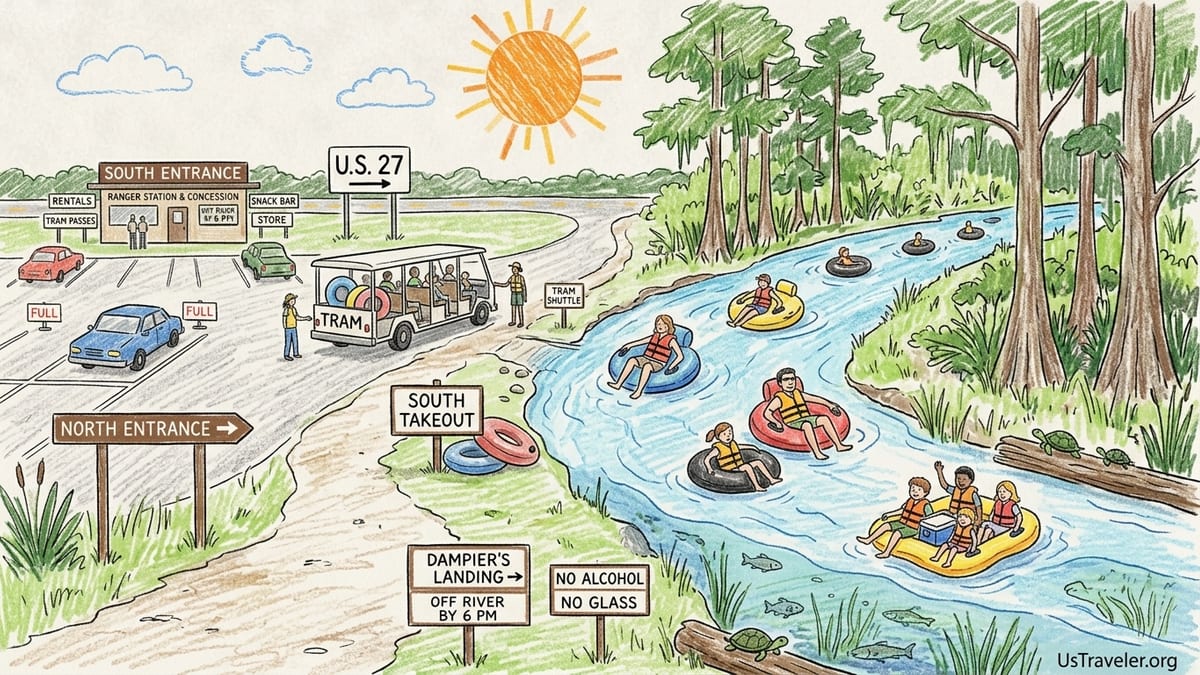
As of late summer 2026, all public tubing at Ichetucknee Springs State Park is operated from the south entrance off U.S. 27. Florida State Parks has closed the shallow, environmentally sensitive north section of the river to tubing, and the current primary tube run is from Dampier’s Landing in the interior of the park down to the south takeout near the park boundary. That float usually takes around 45 minutes to 1 hour at a relaxed pace, depending on water level and how often you hang back to swim.
The Midpoint Tube Launch, which historically allowed a longer float, has been intermittently closed in recent years and has often remained unavailable for tubing. Travelers should check the park’s official updates just before their trip, but plan their day assuming that the reliable option is the shorter Dampier’s Landing to south takeout route. The state park requires all tubers to be off the river by 6 p.m., and the concession typically cuts off rentals and tram sales in the late afternoon to allow enough time to float out.
Parking, check-in and all tube rentals are based around the south entrance hub. Here you will find the main ranger station where you pay the standard state park vehicle fee, plus the concession area with the general store, snack bar and rental counter. On a typical summer Saturday, that south entrance area starts to get busy by mid-morning and often reaches parking capacity before noon, at which point rangers temporarily close the gate until enough vehicles leave.
For travelers who remember tubing from the north entrance in previous years, it is important to reset expectations. Today, the north entrance focuses on swimming at the headspring and Blue Hole, picnicking and trails. You can no longer start a tube float from the headspring, and you must enter through the south entrance to rent tubes, access tram service and float the river.
Tube Rental Options, Prices and Practical Tips
The park’s authorized concessionaire, Ichetucknee Springs Tube & Water Sports, operates the tube rentals out of the general store at the south entrance. Inventory changes slightly year to year, but in practice you will see a mix of single-person tubes with headrests, open-center tubes, kid-size tubes and a small selection of multi-person rafts suitable for families with young children. Expect pricing to be on a per-person or per-tube basis plus sales tax, with simple single tubes generally the most economical option.
Recent visitor reports describe typical rental prices in the range of a modest day-use treat rather than a major expense, but the key thing to remember is that tube rental fees do not include your park entrance fee or the cost of tram transportation back from the takeout. If you are budgeting for a family of four, plan on the vehicle entrance fee, four individual tubes and four tram wristbands. It adds up to what many travelers compare to a casual theme-park afternoon rather than a bare-bones budget outing.
Reservations for tube rentals through the concession are strongly encouraged during peak season. While a reservation generally allows you to secure equipment and an approximate time window, it does not override the park’s capacity limits. If the south entrance parking lot is full when you arrive, rangers can temporarily close access even for visitors who pre-booked tubes. This is why experienced repeat visitors prioritize arrival time more than reservations, especially on holiday weekends.
Travelers who own their own inflatables are welcome to bring them, provided they meet park rules. In practice, that means no disposable plastic pool toys, no giant novelty floats that are hard to control, and no glass or alcohol on the river. Many local visitors bring their own traditional black-rubber-style tubes or heavy-duty vinyl tubes and use the concession’s air pumps for a small fee before heading to the launch. Bringing your own gear can make sense if you float here regularly, but first-timers often find it simpler to rent from the concession and avoid packing, inflating and drying their own equipment.
Kayaks, Canoes and Stand-Up Paddleboards
In addition to tube rentals, Ichetucknee Springs Tube & Water Sports offers kayaks, canoes and stand-up paddleboards suitable for both first-time paddlers and more experienced guests. Most on-site rentals are sit-on-top single and tandem kayaks, with a smaller number of canoes for families who prefer more open space. Stand-up paddleboards are available in both standard opaque and clear-bottom styles on certain guided trips, allowing visitors to look directly down at the eelgrass and fish in the river beneath them.
Paddling rentals are more flexible than tubing in terms of where you can go. While the north section is closed to tubing, it remains open to nonmotorized paddlecraft within state park rules. Many visitors book a kayak at the south entrance and use shuttle service to reach a northern launch, then paddle downstream back toward the south area. Others launch their own paddleboards or kayaks at Dampier’s Landing and paddle upstream, using the clear, slow-moving water and mild current to turn the trip into an out-and-back without shuttle logistics.
Pricing for kayaks, canoes and SUPs is usually structured by half-day or full-day rental, with guided options costing more but including instruction and a naturalist-style overview of the springs ecosystem. For example, travelers might book a half-day, nine-mile kayak trip that starts inside the state park and continues downstream onto the Santa Fe River, ending at an out-of-park landing where a shuttle driver meets the group. These longer paddling routes are popular with visitors who want a more active day than a single short tube float.
Because kayak and SUP capacity is limited and trips are longer, advance reservations are more critical than for simple in-park tube runs. Many outfitters recommend booking at least a weekend or two ahead during summer, particularly if you need multiple tandem kayaks for a family group. If you are planning to paddle and also want to squeeze in a tube run, a common strategy is to start your day with an early-morning tubing lap from Dampier’s Landing, then switch to kayaks for a mid-morning or early afternoon downstream trip.
Tram, Shuttle and Parking Logistics
The tram system is central to how tubing works at Ichetucknee’s south entrance. After you park and rent a tube, you either walk or are transported to the tubing launch, then float downriver to the south takeout. From that takeout, you ride the tram back to the south entrance parking lot. Tram service runs continuously in season, but lines build quickly on busy days, and there is a cutoff in the late afternoon to ensure the last riders return before the river closes.
Tram wristbands are sold through the concession at the south entrance and are valid for the day. The fee is per person, not per tube, which is important to remember if you plan to do multiple tube runs. A practical strategy used by many repeat visitors is to pay for a tram wristband once, complete a run, walk the relatively short trail from the south takeout back to Dampier’s Landing carrying their tube, then finish the day with a final float and tram ride up from the takeout when everyone is tired.
Separate shuttle vans or buses are used for some paddling itineraries, especially those that start at the north boat launch or outside the park and end back near the south entrance. For example, a nine-mile kayak rental might have you park and check in at the south entrance, then ride a shuttle with your boat to a put-in upriver. At the end of the paddle, staff meet you at the takeout, load boats and return you to your vehicle at the park. These shuttles are normally bundled into the price of the rental or trip, but always confirm when booking.
Parking capacity is one of the biggest constraints on any visit. The south entrance lot is not huge, and once it fills, rangers close the gate and establish a one-in, one-out system. On hot summer Saturdays, it is not unusual for vehicles to be queued along U.S. 27 by opening time, and visitors arriving at 11 a.m. or later may spend a long time waiting or be turned away until mid-afternoon. On the other hand, weekday mornings outside peak holidays are often dramatically quieter, with travelers reporting quick entry even without a reservation.
Launch Rules, What You Can Bring and What to Leave Behind
Florida State Parks and the park concession enforce a set of rules intended to protect the river’s clarity and wildlife. Alcohol is prohibited anywhere in the park, including on the river and at the launch and takeout points. Glass containers are also banned. Soft drinks, water and snacks must be in non-glass containers, and any food should be packed in a small, secure bag or cooler that fits inside your tube or paddlecraft without dragging in the water.
The park discourages single-use, flimsy pool floats because they tend to tear and become litter. Solid-bottom tubes and rafts that are easy to control are preferred. Life jackets are required for children and strongly recommended for poor swimmers of any age, even though the river depth averages around 5 to 6 feet in the tubing section and the current is generally gentle. You may bring your own life jacket as long as it is in good condition and properly fits.
Coolers, speakers and large bags are heavily regulated. Rangers often ask visitors to open coolers during busy summer days to confirm there is no alcohol, and oversize hard coolers that cannot be firmly secured inside a tube or raft may be turned away. Small soft-sided coolers are widely used by regulars, who strap them into the middle of a multi-person raft or keep them on a kayak. To protect the underwater vegetation, you may not drag coolers or any other object behind you in the water on a rope.
Wildlife protection is another priority. Visitors are not permitted to stand or walk on the river bottom outside designated areas, as bare feet can damage fragile seagrasses and stir up sediment. Feeding wildlife is prohibited, and touching or chasing turtles, fish and otters is not allowed. These rules can feel strict in the moment, but they are the reason the water here remains remarkably clear despite heavy seasonal use.
When to Arrive and How to Plan Busy Weekend Visits
Ichetucknee is particularly popular on summer weekends and holidays, and in recent years the park has frequently reached daily capacity, especially from late May through early September. Once both the south entrance parking lot and any tubing capacity limits are reached, rangers temporarily close entry. Visitors already inside the park can finish their float, but no one else may enter until enough vehicles leave, sometimes not until mid-afternoon.
If you want to tube on a Saturday or Sunday between Memorial Day and Labor Day, plan on arriving very early. Regulars often target the park gate before or right at opening time, and some line up even earlier on major holiday weekends. A practical rule of thumb is to aim to be at the south entrance gate around opening if tubing is the centerpiece of your day. Arriving by mid-morning is still workable many days, but the risk of closures climbs quickly late in the morning when the weather is hot.
Weekdays during summer and virtually any day outside peak season are noticeably calmer. Travelers report cruising through the entrance in early afternoon on weekdays in late August or September once local schools are back in session, even on warm days. If your travel schedule is flexible and you prefer to avoid crowds, planning your Ichetucknee visit for a Tuesday or Wednesday and targeting late morning or early afternoon can dramatically simplify your logistics while still leaving plenty of time for a tube run and perhaps a kayak outing.
In all seasons, sudden closures due to storms or water quality issues are possible. Strong thunderstorms are common on summer afternoons, and if lightning is detected nearby, rangers may temporarily halt use of the river until it is safe to resume. Checking park advisories the night before and the morning of your visit, and building some flexibility into your plans, will help you avoid disappointment.
Sample One-Day Itineraries for Tubers and Paddlers
For travelers whose main goal is tubing, a simple and effective one-day plan is to arrive at the south entrance shortly after opening, pay the vehicle fee, park, and head straight to the concession to secure tubes and tram wristbands. Start with a first float from Dampier’s Landing to the south takeout while the river is relatively quiet. After riding the tram back, take a break at the picnic tables, grab a snack from the general store, then decide whether to do a second tube run before lunchtime.
Families that want to mix tubing and paddling can adjust that plan by booking a late-morning or early afternoon kayak rental in advance. After an early tube run or two, return your tubes and check in for your kayak, canoe or SUP. A common approach is to choose an out-and-back paddle starting at Dampier’s Landing, heading upstream toward the north section for an hour or two, then drifting back down with the current. This avoids complex shuttle logistics and lets different members of the group switch between paddling and swimming as they wish.
More ambitious travelers might plan a full-day outing that includes both in-park tubing and a longer downstream paddle to the Santa Fe River. In that scenario, you would book a morning shuttle to a northern launch with your kayak or canoe, paddle downstream through the state park and onto the Santa Fe, then meet a pickup vehicle at a takeout several miles downstream. After returning to the south entrance mid-afternoon, some visitors still squeeze in a short tube float if time and river hours allow.
Whatever itinerary you choose, the most consistent advice from frequent visitors is to build in unstructured time. The calmest, most memorable moments often happen when you pause in a shady bend, listen for birds in the cypress canopy and watch the light ripple through the submerged grasses below, rather than racing from one scheduled activity to another.
The Takeaway
For travelers already committed to visiting Ichetucknee Springs, the difference between a stressful, crowded day and a relaxed river float usually comes down to logistics. Understanding that tubing is now centered on the south entrance, that the primary public tube run is from Dampier’s Landing to the south takeout, and that park capacity limits can close the gate even to visitors with reservations sets your expectations in a realistic way.
Plan to arrive early on summer weekends, budget separately for park entry, tube rentals and tram wristbands, and decide in advance whether you will bring your own gear or rely on the concession. If you want to add kayaks, canoes or stand-up paddleboards, book ahead and think carefully about how shuttle timings match your tubing plans. With that groundwork in place, you will be free to enjoy what draws visitors back to Ichetucknee year after year: cold, glass-clear water, gently moving current and a rare feeling of wild Florida that is still accessible for families and first-time river travelers.
FAQ
Q1. Do I need a reservation to tube at Ichetucknee Springs?
Reservations for tube rentals through the park concession are strongly recommended during peak season, but they are not strictly required. The more important factor is arriving early, especially on summer weekends. Be aware that even with a reservation, you can be turned away temporarily if the park reaches parking or tubing capacity before you arrive.
Q2. What time should I arrive on busy summer weekends?
If tubing is a priority on a Saturday or holiday between late May and early September, aim to be at the south entrance around opening time. By mid-morning, parking can fill and rangers may close the gate until enough visitors leave. Weekdays and shoulder seasons are generally more forgiving, but earlier is still better.
Q3. Can I still tube from the north entrance or headspring?
No. The shallow north section of the river is closed to tubing to protect the ecosystem. The north entrance is now focused on swimming at the headspring and Blue Hole, picnicking and trails. All public tubing operations take place from the south entrance, using the Dampier’s Landing to south takeout route.
Q4. Is it cheaper to bring my own tube instead of renting?
Bringing your own tube can save money if you visit regularly, as you will avoid per-tube rental fees. However, you will still pay the vehicle entrance fee and tram cost if you use the shuttle. First-time visitors and travelers flying into Florida often find it more convenient to rent tubes on-site and use the concession’s air pumps rather than packing and drying their own inflatables.
Q5. Are kayaks and paddleboards suitable for beginners here?
Yes. The Ichetucknee’s clear, slow-moving water and generally gentle current make it a beginner-friendly river, especially for sit-on-top kayaks and stable stand-up paddleboards. Outfitters provide basic instruction, and guided trips are available for those who want extra support or a more interpretive experience focused on wildlife and springs.
Q6. What can I bring on the river, and what is prohibited?
You may bring non-glass drink containers, small snacks, a compact soft-sided cooler, sunscreen, a hat, and a properly fitting life jacket. Alcohol, glass containers, large hard coolers that cannot be secured, drag-behind coolers, oversized novelty floats and anything likely to become litter are prohibited. Rangers may check coolers at the entrance or launch.
Q7. Is the tram included in the tube rental price?
No. Tube rental fees cover the use of the equipment but not tram transportation or the park entrance fee. Tram wristbands are sold separately on a per-person basis. When budgeting, plan for your vehicle entry, individual tubes and tram passes for everyone who will ride back from the takeout.
Q8. How cold is the water, and do I need a wetsuit?
The Ichetucknee’s springs flow at a nearly constant temperature of around the low 70s Fahrenheit year-round. In summer heat, that feels refreshing rather than cold, and most visitors are comfortable in regular swimwear. In cooler months, some paddlers and tubers choose to wear a thin wetsuit or rash guard, but it is not required.
Q9. Can I combine tubing and a long kayak trip in one day?
Yes, if you plan carefully. A common approach is to arrive early, complete a tube run or two in the morning, then switch to a pre-booked kayak, canoe or SUP rental for a longer paddle in late morning or early afternoon. Make sure shuttle schedules and river closing times line up so you are off the water by the required hour.
Q10. What happens if the park reaches capacity while I am on the road?
When Ichetucknee reaches entrance or tubing capacity, rangers temporarily close the gate and may post signage or staff at the entrance. If this happens while you are driving in, you may be asked to wait in line along the road until enough vehicles leave, or to return later in the day. This is another reason to arrive early and to have a backup plan, such as visiting another nearby spring or exploring the surrounding small towns, if the park remains closed longer than you wish to wait.