


North Central Florida hides some of the state’s most atmospheric places to stay: riverfront cabins shaded by cypress trees, modest Gulf-front cottages at the edge of Cedar Key, and simple family houses tucked into the pine woods of the Ocala National Forest. If you are planning spring-hopping on the Santa Fe, paddling the Suwannee or trading Gainesville traffic for a quiet weekend by the water, choosing the right base can make or break the trip. This guide looks at how the region’s cabins and vacation rentals compare, when a cabin makes more sense than a Gainesville hotel, and which areas work best for paddlers, families, wildlife lovers and anyone who just wants an Old Florida porch with a breeze.
How the Region Breaks Down for Cabin and Cottage Stays
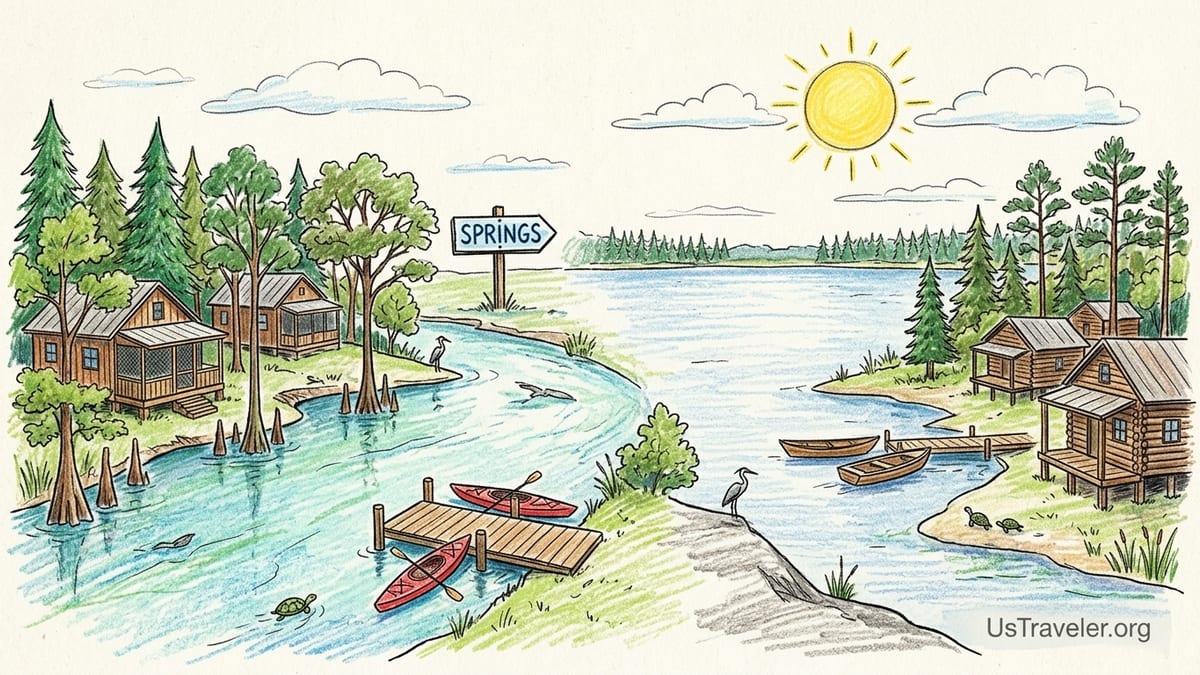
For cabin hunters, the most useful way to think about North Central Florida is by water. Around High Springs and Fort White, rental cabins and small houses cluster along the spring‑fed Santa Fe River and its side creeks. This is where people base themselves for Gilchrist Blue, Ginnie, Poe and Rum Island springs, all within a roughly 10 to 25 minute drive of most riverfront rentals. South and east, the Ocala National Forest is a different experience entirely: pine flatwoods, big lakes like Bryant, Kerr and George, and scattered clusters of rustic and more modern cabins close to trailheads and boat ramps. West on the Gulf, Cedar Key is a compact island village where almost every cottage feels close to the water, even if it is not technically waterfront.
In the High Springs and Fort White area, commercial cabin inventory is limited but well developed enough for a long weekend. You will find simple one and two‑bedroom riverfront places with docks, mid‑range family homes on a few wooded acres, and a handful of small compounds where several cabins share river access, ideal for groups that want to spread out. Minimum stays in this area are often two or three nights on weekends, stretching to three or four nights in spring and early summer when the springs are busiest.
By contrast, the Ocala National Forest skews toward campgrounds with a few fixed cabins or park model units mixed in, along with independent lakefront resorts that rent small cottages. A property on Lake Bryant, for example, offers compact cabins with full kitchens and screened porches steps from the water, pairing quiet lake views with easy access to hiking and off‑highway vehicle trails in the surrounding forest. Nightly rates there and at similar lakeside spots typically run in the low to mid‑hundreds per night for a couple, with discounts for longer stays outside peak holidays.
Cedar Key rounds out the picture with a dense stock of privately owned condos, stilt houses and classic ground‑level cottages, many of them directly on the Gulf or overlooking marsh and back bays. A dedicated local management company lists one to three‑bedroom waterfront homes and condos that commonly range from roughly 125 to 250 dollars per night depending on season, size and view. Here it is less about wilderness solitude and more about walking out your door to a dock, a kayak launch or Dock Street’s restaurants within a few minutes.
Riverfront Cabins vs Forest Hideaways
If your priority is swimming in clear springs or spending most of your days in a kayak, a riverfront cabin near High Springs or Fort White usually beats a forest hideaway. Many Santa Fe River rentals sit directly on the riverbank or on side channels, with wooden steps or a small floating dock that let you launch a canoe or paddleboard right from the property. In practical terms, this means you can paddle from your back door to spots like Poe or Rum Island Springs in under an hour, rather than loading boats on a car after every outing. Several listings explicitly advertise that kayaks or canoes are included, saving around 40 to 60 dollars per boat per day compared with local outfitters.
Forest cabins in the Ocala National Forest trade that direct current for quiet lakes and wider skies. Lakeside properties near Lake Bryant or Lake Kerr typically come with a shared or private dock, basic jon boat or canoe, and space for fishing and evening fires. Instead of the constant movement of the Santa Fe or Suwannee, you get flatwater paddling and sunrise reflections, plus dark skies for stargazing that are rare closer to Gainesville or the I‑75 corridor. For hikers and off‑road enthusiasts, staying in the forest can mean driving 10 to 20 minutes less each way to popular trailheads and designated OHV areas.
That said, riverfront and forest cabins share certain traits: both are usually self‑catering, with full kitchens, charcoal or gas grills, and outdoor seating areas that function as the real living room. When comparing options, pay close attention to how far “waterfront” actually is. On the Santa Fe, genuinely riverfront cabins will show direct steps to the water or a dock, while some “river access” homes are set back across a small road or share a community access point that might be a few minutes’ walk away. In Ocala, a “lake view” might mean a partial glimpse through the trees rather than direct shoreline.
Remote forest cabins are best if you value seclusion over quick access to restaurants. It is common for Ocala properties to be 20 to 40 minutes’ drive from the nearest full supermarket. By contrast, High Springs cabins are usually within 10 to 15 minutes of groceries and casual dining in town, and Cedar Key rentals put you within a couple of minutes’ walk or drive of seafood shacks and cafes.
Cabins with Kayaks, Docks and Easy Spring Access
One of the most useful filters for this region is whether a cabin includes kayaks or canoes, and whether there is a private dock. On the Santa Fe and Suwannee, cabins that offer at least two sit‑on‑top kayaks and basic paddling gear often cost slightly more per night but can save a family of four well over 150 dollars across a long weekend compared with picking up boats from outfitters each day. Listings near Fort White and along the lower Santa Fe commonly highlight this as a selling point, especially those within a 15 to 20 minute paddle of popular springs.
Look closely at how each rental describes its water access. A small riverfront cabin might promise “private dock with ladder into the Santa Fe,” which is ideal for strong swimmers comfortable with current, while another home might emphasize a gently sloping sand or limestone entry more suitable for small children. On the Suwannee, some larger houses sit above tannic but slow‑moving water, better for leisurely afternoon paddles than spring‑to‑spring runs. Photos that show the dock at both low and high water are useful, since river levels can vary noticeably after heavy rain.
In Cedar Key, most vacation rentals classed as “waterfront” or “Gulf‑front” provide some combination of a shared pool, fishing pier or small dock rather than direct swimming from the property, due to shallow, marshy shorelines. A three‑bedroom house like Flamingo House, marketed through a local rental company, is a typical example: a stilted waterfront home sleeping six, with full kitchen, Wi‑Fi and space to park a boat trailer, set at the edge of the bay. Smaller one‑bedroom condos in developments such as Island Place or Old Fenimore Mill typically share a pier, pool and hot tub, pairing sunrise or sunset balcony views with easy walks to kayak outfitters.
Around the Ocala National Forest’s lakes, private docks become the main amenity. Cabins at lakefront resorts near Lake Bryant, for example, may include a small dock steps from the porch, a swimming area and on‑site boat ramp. Here, instead of spring runs, paddlers explore cypress‑lined shorelines and birdlife. When booking, ask whether motorized boats frequent the lake and where cabins sit relative to the busiest stretches; families seeking quiet swimming should favor smaller coves or lakes with lower horsepower limits.
Space, Kitchens and Fire Pits: Matching Rentals to Group Size
Choosing between a snug one‑room cabin and a larger family house in this region usually comes down to how much time you plan to spend inside and whether you expect afternoon storms. High Springs and Fort White rentals aimed at couples or solo travelers might be 400 to 600 square feet, essentially a studio or one‑bedroom with a compact but full kitchen. These are ideal for long weekends focused on being outside at the springs and on the river, using the cabin primarily as a quiet place to cook, sleep and drink coffee on a porch swing.
Larger family houses, both along the rivers and around Ocala’s lakes, often offer three or more bedrooms, two baths and indoor living rooms big enough for a group to spread out during rainy afternoons. When you compare these with similarly priced Gainesville hotels or short‑term rentals, the equation usually tips toward the cabin once you are traveling with more than four people. Being able to cook full meals in a proper kitchen, rinse gear in a laundry area and let children run around a yard or down to the water without crossing busy streets is a different experience than staying in town.
Fire pits are another small but important differentiator. Many riverfront and forest properties include simple fire rings with seating, and some Cedar Key cottages provide portable fire pits on shell or sand yards. In cooler months between roughly November and March, evenings around a fire by the river or bay can be the highlight of a trip. Before you count on this, confirm whether wood fires are allowed during your dates; during dry spells, county burn bans occasionally restrict open fires even on private land, and some property owners enforce their own rules regardless of county status.
Kitchen setups vary more than you might expect. Older mom‑and‑pop resorts in Ocala or Cedar Key sometimes offer small kitchenette units with apartment‑size stoves and limited counter space, which are fine for simple breakfasts and grilling dinners outside but frustrating if you plan elaborate cooking. Newer river houses around High Springs and Fort White are more likely to have full‑size refrigerators, dishwashers and islands or big dining tables where groups can gather. If you are choosing between two options at similar price points, detailed kitchen photos are often a tiebreaker.
Pet‑Friendly Options and When to Choose Cedar Key
Pet‑friendly policies are a major factor in this region, where many travelers road‑trip from elsewhere in Florida or the Southeast with dogs. Around High Springs and Fort White, a notable share of cabins and small houses allow pets, usually with a per‑stay fee or modest nightly surcharge and basic rules about leashes and keeping animals off furniture. Fenced yards are less common along the immediate riverfront due to flood considerations, so if you rely on a fully fenced outdoor space, look for houses set slightly back from the water or in small neighborhoods outside the floodplain.
In Cedar Key, pet‑friendly cottages and condos are widely available but more varied in terms of rules. A local management company lists several one to four‑bedroom waterfront homes and stilt houses that accept dogs, often with size limits and a cleaning fee. Some ground‑level vintage cottages on the island’s edges also welcome pets, particularly those that have shell or gravel yards rather than manicured lawns. When traveling with dogs in summer, it is worth noting that Cedar Key’s compact layout and limited shade can make midday walks hot; look for rentals with breezy porches and easy early‑morning access to the waterfront park or quieter side streets.
Choosing Cedar Key over an inland base makes the most sense if your priority is slow, salty air rather than springs. The island is roughly 45 to 60 minutes’ drive from the nearest major springs, so it is not ideal as a daily spring‑hopping base. Instead, think of Cedar Key as a separate coastal leg: two or three nights in a waterfront condo or cottage to kayak among mangrove islands, watch shorebirds on the tidal flats and eat seafood on Dock Street. For that, a small one‑bedroom condo above the water, with balcony and shared pool, might be perfect for couples, while a three‑bedroom stilt house with parking for a skiff suits anglers and families.
For strictly spring‑focused trips, staying inland around High Springs or Fort White almost always beats Cedar Key or Gainesville, both for driving time and for the feel of waking up near the river. You can still add a day trip to the Gulf if you do not mind a longer drive, but if you expect to swim at multiple springs on consecutive mornings, an inland cabin will give you far more time in the water and less time on two‑lane highways.
When a Cabin Beats Staying in Gainesville
Gainesville will always be the practical choice for travelers focused on the University of Florida, downtown dining or medical appointments, but for nature‑centric trips, cabins and vacation rentals in High Springs, Fort White, along the Suwannee or in the Ocala National Forest increasingly make more sense. Driving from central Gainesville to Gilchrist Blue Spring, for instance, typically takes around 35 to 45 minutes one way. Stay at a cabin west of High Springs instead and that drops to roughly 15 to 20 minutes, with several other springs even closer. Over a three‑day weekend, that can translate into several extra hours of water time.
Cost is another factor. A clean mid‑range Gainesville hotel can easily reach or exceed 150 dollars per night once taxes and parking are factored in, especially on football or graduation weekends. By comparison, a simple one‑bedroom river cabin or Ocala lake cottage in shoulder season often falls in a similar range, but includes a kitchen, private outdoor space and direct access to swimming or paddling. For two couples or a small family sharing a two or three‑bedroom house, nightly costs per person generally undercut multiple hotel rooms.
Where Gainesville still wins is spontaneity and services. If you are unsure about weather, or you want same‑day walkable dining options, booking a last‑minute hotel in Gainesville may be easier than finding an available river house, particularly during spring break and early summer. The city offers far more restaurants open late, backup indoor activities and ride‑share coverage. By contrast, cabins and cottages typically require booking at least several weeks in advance for peak Friday and Saturday nights, especially those with river frontage or Gulf views.
In the end, a useful rule of thumb is this: if your trip revolves around events, dining or work in Gainesville with only one side trip to a spring or the forest, stay in town. If the springs, rivers and forest are the main attraction, treat Gainesville as your airport or grocery stop and sleep closer to the water, even if that means a slightly earlier booking commitment.
Minimum Stays, Seasons and Booking Strategy
Minimum stays can catch travelers by surprise in this part of Florida, particularly for waterfront properties. Santa Fe and Suwannee riverfront houses commonly require a two‑night minimum on weekends year‑round, with three nights or more during popular windows such as March and April spring break, early summer and long holiday weekends. Some larger family houses along the rivers or in Ocala’s lake communities set four‑night minimums for holiday weeks like the Fourth of July. Cedar Key condos and cottages also tend to a two‑night minimum, though short gaps between longer bookings may be offered for single‑night stays.
Seasonally, spring and early summer are busiest near the springs, while fall and winter see more traffic in the Ocala forest and Cedar Key from hikers, anglers and snowbirds. Water clarity at springs is relatively stable year‑round, but river levels and temperatures change. Winter and early spring stays may mean crisp mornings, cooler water and campfires; midsummer brings warm river temperatures but also higher humidity and more afternoon storms. On the Gulf, Cedar Key’s quieter months outside major holidays and scalloping season can offer good value on waterfront condos, especially midweek.
From a booking perspective, travelers flexible on exact location often do best. Instead of insisting on one particular spring or lake, search for a cluster of options within a 20 to 30 mile radius that match your priorities: pet‑friendly, kayaks included, full kitchen, private dock, or walkability to restaurants. It is worth reading recent reviews for comments on things like road noise, river access during low water, and any ongoing construction or storm recovery on the Gulf coast that might affect views or amenities.
Finally, remember that many of the region’s most atmospheric cabins and cottages are independently owned and managed, not part of large chains. Communication is often direct with an owner or a small local company. Clear questions about bed layouts, staircases, parking, boat trailer space and local rules around fires or quiet hours will help ensure the place you book aligns with your expectations when you arrive down that last sandy lane.
The Takeaway
North Central Florida’s cabins and vacation rentals offer markedly different experiences within a relatively compact area. Riverfront cabins on the Santa Fe and Suwannee put you closest to the famous clear springs and current, ideal for paddlers and swimmers who want to launch from their own dock. Ocala National Forest cabins and lakeside cottages favor travelers seeking pine woods, dark skies and flatwater paddling, with trailheads and OHV areas outside the door. Cedar Key’s waterfront cottages and condos, meanwhile, deliver low‑key Gulf views, walkable seafood dinners and island sunrises framed by salt marsh.
Across all three areas, details matter: whether kayaks are included, how many nights you must stay, what the kitchen really looks like, and how far you will actually be from the nearest spring or boat ramp. For many visitors, especially families and small groups, these rentals increasingly beat a hotel in Gainesville when the goal is to spend long, unhurried days in and on the water, and quiet nights around a fire pit or on a porch instead of in a parking‑lot‑facing room.
By weighing your priorities carefully and reading the fine print on each listing, you can match your base to your trip: a modest one‑bedroom cabin for two on a shaded bend of the Santa Fe, a larger family house on a Suwannee bluff, a pet‑friendly lakeside cottage in the Ocala National Forest or a stilted condo above the tides in Cedar Key. Each puts a different version of Old Florida at your doorstep, and any one of them can make a simple weekend feel like a much longer escape.
FAQ
Q1. Is it better to stay in High Springs or Gainesville for visiting the springs?
For trips centered on multiple springs, staying in or near High Springs or Fort White usually makes more sense than Gainesville, since drive times to Gilchrist Blue, Ginnie and nearby parks are often 15 to 25 minutes instead of 35 to 45 minutes from the city.
Q2. Do most riverfront cabins on the Santa Fe and Suwannee include kayaks?
Not all do, but many mid‑range riverfront cabins and houses now offer at least two kayaks or a canoe. Always confirm the exact number and condition of boats, and whether paddles and life jackets are provided.
Q3. How many nights do I need to book for a typical cabin stay?
Two‑night minimums are common for weekends across the region, and some riverfront and lakefront properties require three or more nights during busy spring, early summer and holiday periods.
Q4. Are pets allowed at most cabins and cottages?
A significant share of rentals around High Springs, Fort White, the Suwannee, Ocala National Forest and Cedar Key are pet‑friendly, but policies, fees and size limits vary widely, so check each listing carefully.
Q5. What is the main difference between staying on the Santa Fe River and in the Ocala National Forest?
Santa Fe River cabins focus on moving water and quick access to multiple clear springs, while Ocala National Forest cabins emphasize quiet lakes, pine woods, hiking and off‑highway vehicle trails.
Q6. Is Cedar Key a good base for spring‑hopping?
Cedar Key is best treated as a separate coastal stop. It is roughly 45 to 60 minutes’ drive from major springs, so it works better for Gulf kayaking and island time than for daily spring visits.
Q7. Do cabins and cottages usually have full kitchens?
Most riverfront houses, family cabins and many Cedar Key condos have full kitchens, while some older mom‑and‑pop units in Ocala or on the Gulf offer smaller kitchenettes better suited to simple meals.
Q8. Are fire pits common at these rentals?
Yes, many riverfront and forest cabins include basic fire rings or portable fire pits, and some coastal cottages do as well, but use can be restricted during burn bans or dry spells.
Q9. When is the best time of year to rent a cabin for springs and rivers?
Spring and early summer are most popular for swimming and paddling, with clear water and warm temperatures, while fall and winter bring cooler air, fewer crowds and better conditions for hiking and campfires.
Q10. How far in advance should I book a waterfront cabin or cottage?
For peak weekends between roughly March and August, it is wise to book several months ahead for the most desirable riverfront and Gulf‑front properties; shoulder‑season midweek stays can often be secured closer to your travel dates.