


Cedar Key sits quietly on Florida’s Nature Coast, a low-key island town ringed by grass flats, oyster bars and a scatter of protected islands. It feels far from the theme-park side of Florida, yet the booking pages for “Cedar Key fishing charters” and “boat tours” now stretch to dozens of operators, resellers and specialty marketplaces. For visitors, the challenge is less finding a boat than choosing the right kind of water experience: serious inshore fishing, easy-going flats trips, dolphin and wildlife tours, island excursions, or self-powered kayaking. This guide breaks down what is on offer in Cedar Key today, how trips are priced and structured, what species and seasons to expect, and when you are better off booking a sightseeing or wildlife cruise instead of fishing.
Cedar Key on the Nature Coast: What Makes It Different
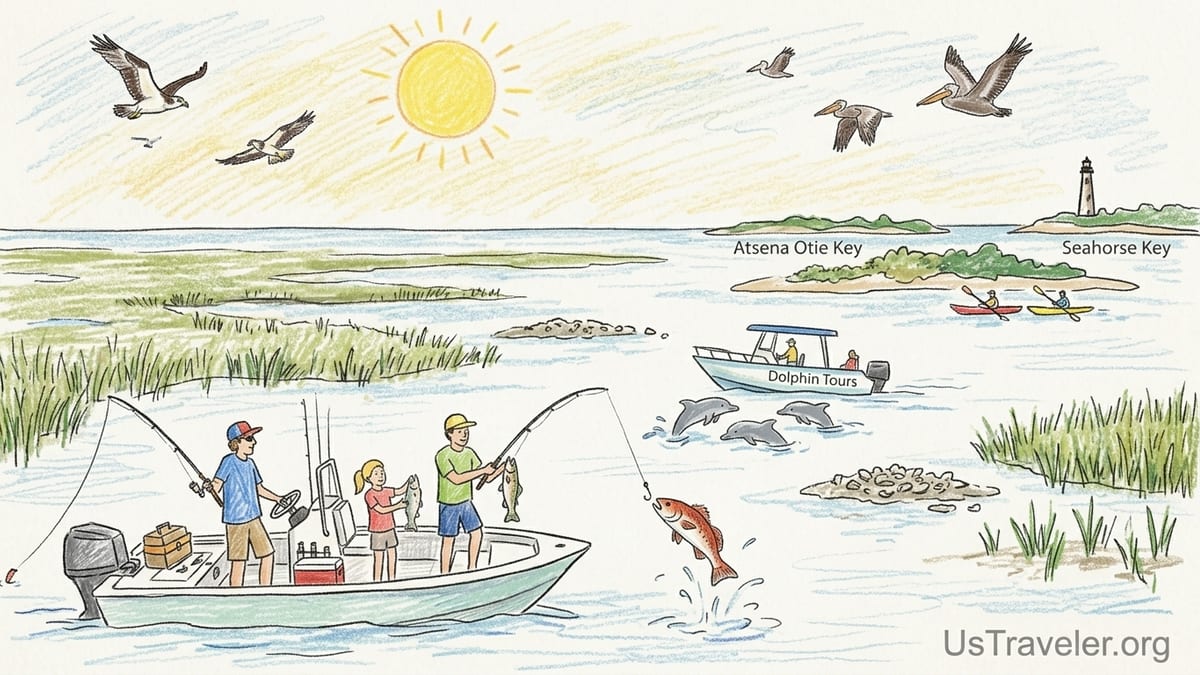
Cedar Key is set at the western end of State Road 24, surrounded by the Cedar Keys National Wildlife Refuge and a maze of shallow grass flats and oyster bars. Unlike busier hubs such as Clearwater or Destin, this is a working-waterfront town where small-boat guides, clam farmers and birders share the same channels. The surrounding refuge includes 13 offshore islands, including Atsena Otie Key and Seahorse Key, which you can only reach by boat. That combination of skinny water and protected islands shapes nearly every charter and tour offered out of Cedar Key.
The fishing here is classically “Big Bend” rather than blue-water. You are targeting inshore and nearshore species on relatively shallow, hard-bottom structure: redfish tailing on oyster bars, spotted seatrout over turtle grass, sheepshead on rocky edges, and seasonal runs of cobia, Spanish mackerel and, in the warm months, tarpon rolling along the bars. Offshore grouper and snapper exist, but most Cedar Key guides promote inshore trips that keep you close enough to land to still see the islands on the horizon.
Because of the geography, many captains operate hybrid businesses. A single small operation might run a four-hour flats charter one morning, a two-hour dolphin and birding cruise that afternoon, and an island taxi run to Atsena Otie at sunset. That is why the search results can feel overwhelming: the same five or six core captains may appear under “fishing charters,” “dolphin tours,” “island excursions” and “sunset cruises,” each presented as a separate product on different booking sites.
For travelers, this means you do not need to lock yourself into a single type of trip. It is possible to book a morning of casting for trout and redfish followed by a family-friendly island or lighthouse cruise in the same weekend, often with the same operator and sometimes even on a custom, combined itinerary.
Comparing Inshore & Flats Fishing Charters
Inshore and flats charters are the backbone of Cedar Key’s marine tourism. Typical trips run four to eight hours aboard shallow-draft bay boats in the 20 to 24 foot range, with capacity for two to four anglers comfortably. Many independent captains advertise through major marketplaces that aggregate more than a hundred “Cedar Key” options, but when you click through, you will often see the same guide’s name on multiple listings for half-day, three-quarter and full-day trips.
Prices in late 2026 for a private half-day inshore charter commonly start in the low- to mid-400-dollar range for up to two or three anglers, with a small surcharge for a fourth passenger. One Cedar Key-based operator, for example, advertises a four-hour inshore trip targeting redfish, seatrout and black drum at around 450 dollars for up to four people, including rods, reels, bait and ice. Another captain lists a similar four to five hour trip at a flat 500 dollars for five passengers, positioning it as a “family fun” outing that mixes fishing and beach time on a nearby island.
Full-day trips, typically seven to eight hours, climb into the 700 to 900 dollar range depending on how far you run and whether you are targeting nearshore species like cobia and gag grouper around outer structure. Some guides offer a stepped option: five hours of focused fishing, followed by one to two hours on an island sandbar or shell beach where kids can swim and shell-hunt while adults relax under a T-top shade.
Species expectations on these trips vary by season but are generally consistent with Nature Coast patterns. Redfish and seatrout are available year-round, with fall and early winter often producing steady action on the flats. Sheepshead gather around rocky shorelines and structure in the cooler months. Cobia tend to appear in spring and early summer, shadowing rays and cruising near markers, while tarpon become a realistic but still challenging target as waters warm in late spring and early summer. Guides will nearly always tailor the day to whatever is biting best when you visit, so it pays to ask specifically what your captain has been catching in the week or two before your trip.
Private vs Shared Charters, Half-Day vs Full-Day
The current Cedar Key booking landscape is heavily weighted toward private trips rather than shared “party boat” charters. Most Nature Coast captains price per boat, not per person. That means a family of four paying 500 dollars for a half-day is effectively paying about 125 dollars per person, while a couple on the same boat would pay 250 dollars each. Unlike some South Florida and Keys operations, genuine shared-boat seats where the operator matches you with strangers at a per-person rate remain relatively rare around Cedar Key.
Private charters make sense if you value control over the day. You can decide whether to focus on redfish on the edges, drift for trout, or cut the fishing short to run over to an island for shelling. Families also appreciate the ability to slow down for a seasick child, return to port early if weather builds, or adjust for nap times without worrying about disappointing unrelated anglers. The trade-off is cost: a couple on a tight budget may find the per-person price of a private charter steep compared with larger-boat options in big cities.
Half-day versus full-day is another key decision. For most first-time visitors, a four- to five-hour trip is genuinely sufficient, especially in warm months when midday heat and afternoon storms are common. Shorter trips allow you to fish a falling or rising tide window and be back at the dock before the worst of the heat. Full days make sense for more committed anglers or those targeting a specific species such as cobia or tarpon, where covering more water and fishing multiple tide stages increases your odds.
If you see operators offering hybrid “family fun” or “fish and island” packages, look closely at the breakdown. Some list four hours of fishing plus one or two hours of island time for only a modest premium over a standard half-day. If your group includes both anglers and non-anglers, that kind of package can effectively replace booking a separate wildlife or island tour, delivering both experiences in one transaction.
Wildlife, Dolphin & Island Boat Tours
Not everyone comes to Cedar Key to hold a rod. A sizable share of the more than one hundred tours in today’s search results fall into the wildlife, dolphin and island excursion category. These trips run on similar boats to fishing charters but focus on scenery and wildlife rather than catching fish. A typical two-hour dolphin and coastal wildlife cruise will idle along the channels outside town, scanning for resident bottlenose dolphins, ospreys, brown pelicans and seasonal migratory birds gathered on sandbars.
Operators that specialize in island and coastal tours often run set routes into the Cedar Keys National Wildlife Refuge, passing landmarks like the old cemetery on Atsena Otie Key or the lighthouse on Seahorse Key on days when refuge access rules allow closer approaches. One island tour company based on Dock Street caps capacity at six passengers per tour, which keeps the atmosphere informal and allows the captain to tuck into shallower spots where larger tour boats cannot safely go.
Sunset cruises are especially popular on weekends and during winter visitor season. These usually last 90 minutes to two hours and run at gentler speeds, timing the outward leg to catch golden light on the salt marsh and the return as the sun drops behind the outer islands. Pricing for dolphin, wildlife and sunset tours in late 2026 commonly ranges from roughly 35 to 60 dollars per adult for shared scheduled departures, with discounted rates for children. Some fishing charter captains will also convert their boats into sunset or dolphin tour vessels in the evening, offering private non-fishing cruises for small groups at flat rates around 200 to 350 dollars depending on group size and duration.
If you are mainly interested in photography, birding or simply being on the water, these wildlife and island tours often represent better value and a more relaxed experience than a fishing charter. The captain is free to stay with a pod of dolphins or circle a rookery for as long as conditions allow, instead of pushing to the next fishing spot. Seasick-prone travelers also tend to fare better at the slower, steadier pace typical of sightseeing cruises.
Kayaking, DIY Exploration & Seasonal Water Experiences
Cedar Key is well-suited to kayaking thanks to its shallow, mostly protected waters. Several outfitters in town rent sit-on-top and touring kayaks by the half or full day, with 2024 and 2025 rate sheets showing solo kayaks commonly priced at roughly 40 to 60 dollars for a half-day and 60 to 90 dollars for a full day, including basic gear and a simple chart. Some operations also offer guided paddle tours into the salt marshes and mangrove creeks, combining light paddling with birdwatching and interpretation of the local ecology.
Kayak fishing is popular among experienced anglers who are comfortable reading tides and navigating around oyster bars. Paddlers commonly launch near the main public ramps or at spots on the edge of town and then work out toward the grass flats between the mainland and islands like Atsena Otie and Snake Key. It is important to understand that currents and winds can be stronger than they look from shore, and extra caution is needed around boat channels. For visiting paddlers, joining a guided kayak tour or hiring a guide for a kayak fishing session can be a smart way to orient yourself before exploring solo.
Seasonal experiences also shape the water calendar on this stretch of the Nature Coast. Scallop season, for example, turns areas to the north around Steinhatchee and Crystal River into snorkel-and-scallop hotspots in mid to late summer. A few Cedar Key charter businesses advertise scalloping trips in nearby waters during the open season, typically structured as half-day snorkeling outings for families, with all gear provided. In the hottest months, when inshore fishing can be sluggish under bright midday sun, many operators pivot marketing toward early-morning fishing followed by time in the water or toward cooler sunset cruises rather than midday charters.
Winter and early spring are generally comfortable times for both paddling and wildlife tours, with lower humidity, more stable weather and migratory bird concentrations around the refuge islands. Summer can still be beautiful, but visitors should plan for strong sun, higher water temperatures and a greater chance of afternoon thunderstorms. That may influence whether you book a morning inshore trip, an evening dolphin cruise or a mid-day paddle.
Licenses, Tackle, Weather and Tides
One of the main advantages of booking a licensed Cedar Key charter is that you do not need to secure your own saltwater fishing license in most cases. In Florida, charter vessels with the appropriate permits can cover their paying customers under the boat’s license. That means visitors can step aboard and fish legally without stopping at a tackle shop or navigating state licensing websites, provided they are fishing under the supervision of the charter captain. Independent DIY anglers fishing from shore, kayaks or private boats will still need to obtain the proper recreational saltwater license before casting a line.
Charters nearly always provide rods, reels, tackle and bait in the trip price. Inshore Cedar Key trips typically use light to medium spinning outfits, popping corks and soft plastics for trout, or live or cut bait around oyster bars and edges for redfish and drum. Guides will also carry heavier setups if there is a chance of hooking cobia or tarpon. If you have a favorite rod or lure, most captains are happy for you to bring it along, but there is no need to pack a full tackle box for a standard charter.
Weather and tides are more than background details here; they drive the schedule. The grass flats outside Cedar Key can be extremely shallow at low tide, especially on winter morning lows. Captains plan trip departures around tide height and movement, often recommending early-morning or late-afternoon windows where there is enough water under the hull and some current to stir feeding activity. When browsing booking platforms, pay attention to notes about “exact departure time to be confirmed” or “time may vary with tides,” which signal a guide’s willingness to optimize around conditions instead of rigidly sticking to the clock.
Summer visitors should also be aware of Florida’s daily thunderstorm cycle. Many Cedar Key captains prefer to run morning trips to avoid the highest chance of lightning and gusty outflows, which typically build after lunch. If your schedule is flexible, ask your chosen operator which day of your stay offers the best combination of tides and forecast. They may advise moving a trip earlier in the week if a front or prolonged storm pattern is approaching.
When a Sightseeing Boat Tour Makes More Sense Than Fishing
While the idea of “going fishing in Florida” has understandable appeal, it is not always the right fit for every Cedar Key visitor. Certain situations lend themselves far better to a wildlife or island boat tour than to a dedicated fishing charter. If your group is mostly non-anglers, or includes toddlers, older relatives with limited mobility, or anyone anxious about handling fish and hooks, a dolphin and island cruise will usually deliver more smiles for less stress.
Budget is another factor. Because inshore charters are priced per boat, couples or solo travelers can face relatively high per-person rates for a private outing. In contrast, scheduled dolphin or sunset cruises that charge per seat spread costs across a full roster, so a couple might pay under 100 to 120 dollars total for a two-hour shared wildlife trip instead of several hundred dollars for a private half-day fishing charter. If your main goal is to be on the water and see dolphins, birds and islands up close, the extra expense of a private fishing trip may be unnecessary.
Season and recent fishing reports can also tilt the balance. In the absolute heat of late summer afternoons, when water temperatures are high and fish activity sags, captains may quietly suggest that expectations for catching be tempered. If you only have an afternoon free and your schedule is fixed, a sunset dolphin and island tour is likely to be a safer bet for a memorable experience than a late-day casting session on the flats. Likewise, on unseasonably windy days when whitecaps push across the outer bars, guides may steer you toward a sheltered wildlife cruise inside the islands or reschedule a fishing trip for calmer conditions.
Finally, consider your own tolerance for uncertainty. Even with excellent local guides, fishing is never guaranteed. A wildlife and island tour, by contrast, is rarely “slow” in the same way. The captain can adjust route and timing to find calm water, birds on a sandbar, or a clear line of sight to the lighthouse at Seahorse Key as the light changes. If you only have one on-water experience in Cedar Key, and catching fish is not essential, a carefully chosen sightseeing cruise or island excursion can be the most dependable way to connect with the Nature Coast seascape.
Family Suitability, Accessibility and Practical Booking Tips
Cedar Key’s small scale and laid-back pace make it particularly appealing for families. Many inshore captains explicitly advertise “family-friendly” trips that mix instruction with patient coaching, and some build itineraries that include an hour of beach stop or island exploration for kids who lose interest in steady casting. Boats often carry comfortable seating and shade, but it is still wise to ask in advance about sun protection, restroom arrangements and life jacket sizes, especially for younger children.
For families with mixed ages, a three- or four-hour outing is usually ideal. That allows time to see dolphins, catch a few fish or explore an island without testing attention spans. If one or more members of the group are prone to seasickness, clarify the typical sea conditions on your chosen route. Inshore flats and marsh channels around Cedar Key are often relatively calm compared with open Gulf waters, but windy winter and spring days can still be choppy, particularly on longer runs toward outer islands.
Accessibility varies by operator. Some boats have open bows and simple step-downs from the dock, while others require a larger step or short climb over a gunwale. If you are traveling with someone who has mobility challenges, call or message ahead to describe their needs. Many small-boat captains are used to helping older locals aboard and can often recommend a particular dock, tide stage or boat in their fleet that will make boarding easier.
Given the crowded online booking landscape, it is wise to read beyond the glossy marketplace descriptions. Look for details about group size limits, included gear, cancellation policies and flexibility with weather and tide changes. If you are comparing a dolphin tour that promises “up to 30 passengers” on a bigger vessel with a six-passenger island tour boat, factor in the difference in experience as well as price. In a small town like Cedar Key, calling the operator directly after you skim online options is still one of the most effective ways to match your expectations to the right trip.
The Takeaway
Cedar Key’s rise in the online charter and tour rankings has not changed its core appeal. This remains a Nature Coast town of clam boats, grass flats and undeveloped islands rather than high-rises and jet skis. For anglers, it offers classic inshore fishing for redfish, trout, drum and seasonal cobia and tarpon on trips that rarely lose sight of land. For non-anglers, it delivers quiet wildlife cruises, island excursions and kayak routes through salt marsh and refuge islands where birds outnumber boats.
As you scroll through the many booking options, start by clarifying what you and your group really want from the water. If your dream is a full day chasing fish on the flats with a local guide calling shots from the poling platform, a private inshore charter is worth the splurge. If you simply want to see dolphins, photograph pelicans against a Nature Coast sunset, or drift quietly in a kayak along the edge of a marsh, a wildlife tour, island excursion or rental may fit better and cost less.
Pay attention to season, tides and weather forecasts, and listen when local captains suggest shifting from a mid-afternoon fishing charter to a morning trip or a sunset cruise. On this stretch of the Gulf, timing is often the difference between a sweaty grind and a cool, comfortable glide across glassy water. With a bit of planning and realistic expectations, Cedar Key can deliver an on-the-water experience that feels deeply “old Florida,” whether your hands are on a fishing rod, a kayak paddle or simply resting on the rail of a slow-moving tour boat.
FAQ
Q1. Do I need a fishing license for a Cedar Key charter?
On a properly licensed Cedar Key charter boat, visiting anglers are usually covered under the vessel’s license and do not need individual recreational saltwater licenses. If you fish on your own from shore, kayak or a private boat, you will need to obtain the appropriate Florida recreational saltwater license beforehand.
Q2. What species can I expect to catch on an inshore Cedar Key trip?
Typical inshore targets include redfish, spotted seatrout, black drum, sheepshead and seasonal cobia, with a chance at tarpon in late spring and early summer. Your captain will usually focus on whichever species has been biting best in the days leading up to your trip.
Q3. What is the difference between inshore and flats fishing around Cedar Key?
Inshore trips cover a mix of channels, oyster bars and nearshore structure, sometimes venturing a bit farther from town. Flats fishing focuses specifically on the shallow grass and sand flats closer to the islands, often using lighter tackle and quieter approaches to target sight-feeding redfish and trout in skinny water.
Q4. Are there shared “party boat” fishing options in Cedar Key?
Cedar Key’s charter scene is dominated by small private boats that price trips per vessel rather than per person. True large “party boats” with dozens of anglers are uncommon here. Some operators may occasionally match small parties together on nearshore or specialty trips, but it is not the norm.
Q5. How long should a family with kids book on the water?
For most families with children, a three- to four-hour outing is ideal, whether it is a half-day fishing charter, dolphin and wildlife cruise or a combined fish-and-island trip. Longer days can work for older kids and teens who are enthusiastic about fishing, but younger children often tire in the sun and heat.
Q6. When is the best time of year for Cedar Key fishing?
Fishing can be productive year-round, but many anglers favor fall and early winter for consistent redfish and trout action on the flats and inshore edges. Spring brings opportunities for cobia and the start of tarpon activity, while winter offers comfortable temperatures and good sheepshead and trout fishing on structure and deeper channels.
Q7. What should I bring on a Cedar Key charter or tour?
Most captains provide tackle, bait and basic safety gear, so visitors mainly need weather-appropriate clothing, non-marking shoes, a hat, polarized sunglasses, sunscreen and drinking water or preferred beverages. Light snacks, a small dry bag for phones and cameras, and any necessary medications are also recommended.
Q8. Is kayaking in Cedar Key suitable for beginners?
Cedar Key’s protected marshes and nearshore waters can be suitable for beginners on calm days, especially on guided tours that choose routes with minimal current and boat traffic. Novice paddlers should avoid strong wind days, stay clear of main channels, wear life jackets at all times and consider starting with a short guided outing before exploring on their own.
Q9. How do weather and tides affect trip timing?
Captains often time departures to coincide with favorable tides that provide enough depth over the flats and some current to stimulate feeding. In summer, many prefer morning trips to avoid typical afternoon thunderstorms. Visitors with flexible schedules should be prepared to adjust specific start times to match changing forecasts and tide tables.
Q10. When should I choose a dolphin or wildlife tour instead of fishing?
If your group is mostly non-anglers, includes very young children or older adults, is on a tighter budget, or is visiting during a hot, calm afternoon window when fishing is often slower, a dolphin, wildlife or sunset island tour usually offers a more relaxed and predictable experience than a dedicated fishing charter.