


North Central Florida has quietly become one of the best freshwater playgrounds in the United States, and nowhere is that more obvious than around Gainesville and High Springs. Within a 45-minute drive you can drift down a spring-fed river, snorkel in turquoise basins, kayak to hidden boils, and even descend into an underground cavern at Devil’s Den. This guide compares the region’s marquee springs and a few under-the-radar options so you can match the right water, crowds and logistics to your style of trip.
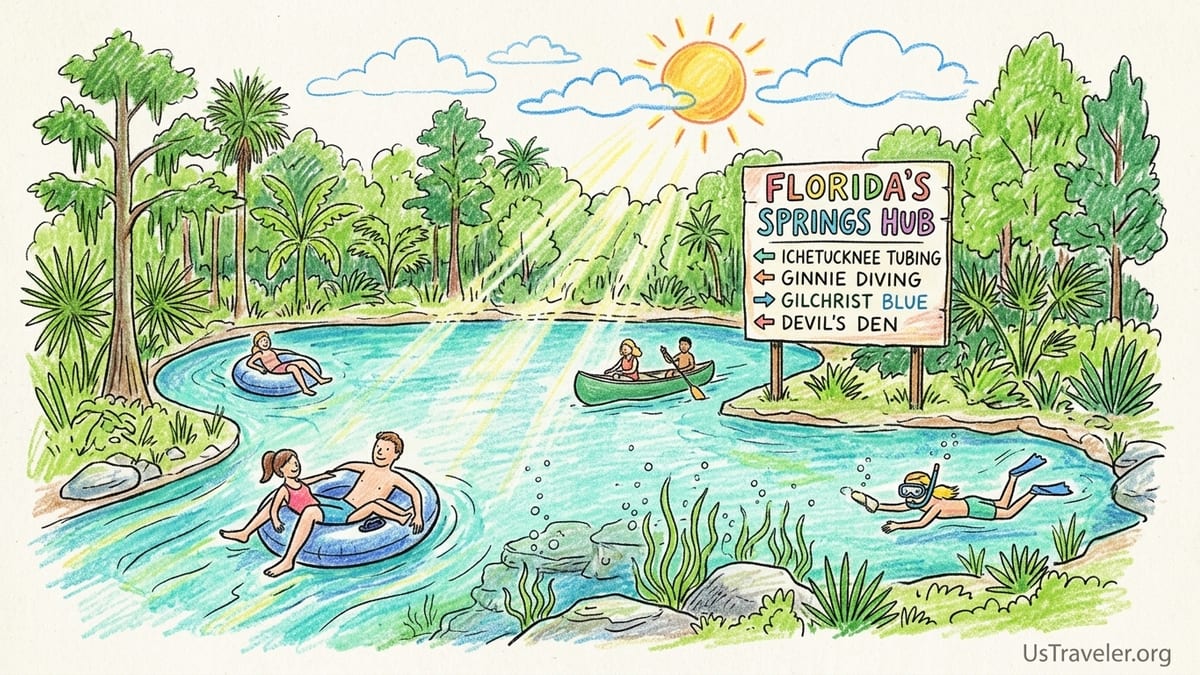
Why High Springs Has Become Florida’s Springs Hub
Base yourself in High Springs or Gainesville and you are within an easy drive of Ichetucknee Springs, Ginnie Springs, Gilchrist Blue Springs, Poe Springs, Troy Spring and Devil’s Den, plus a scattering of smaller county and private parks. For travelers, that concentration means you can plan a long weekend around tubing one day, snorkeling another, then finishing with a dive or quiet paddle on the Santa Fe or Suwannee Rivers without ever driving more than about an hour.
High Springs in particular has embraced its status as a springs town. You will find outfitters in town renting tubes and kayaks specifically for Ichetucknee and the Santa Fe, coffee shops opening early for people trying to beat the park caps at the state springs, and lodging that openly markets itself to paddlers and divers. Gainesville, a 30 to 40 minute drive away, adds more hotel choice, restaurants and nightlife while still keeping you close enough for easy day trips.
Because most of the area’s marquee springs flow at a steady 72 degrees Fahrenheit year round, the experience shifts more with season and crowds than with water temperature. Weekdays outside of summer and holiday periods are typically calm, with plenty of parking and space in the water. Holiday weekends at places like Ginnie Springs can feel more like a festival than a nature escape, while state parks such as Ichetucknee and Gilchrist Blue use daily capacity limits that reward early arrivals.
All of this makes planning especially important. The right spring on the wrong day can be frustrating, but pair your priorities with the right park and season and North Central Florida’s springs are as close as you can get to the classic “Old Florida” swimming-hole experience in a very modern, accessible package.
Ichetucknee Springs: Classic Tubing River With Wild Feel
Ichetucknee Springs State Park, northwest of Fort White, is the region’s benchmark tubing run and one of Florida’s most famous spring-fed rivers. The upper Ichetucknee, accessible from the park’s north entrance, is a clear, tree-lined ribbon of water that feels surprisingly wild despite the park’s popularity. Tubing is the headliner from roughly late spring through early fall, with outfitters in nearby Fort White and High Springs renting tubes and offering shuttle services if you do not want to manage your own logistics.
Swimming and snorkeling are centered around the headspring and at Blue Hole Spring, a deeper, spring-fed pool popular with freedivers and certified scuba divers. The park maintains designated swimming areas to protect the river banks, and you will see a clear difference in atmosphere between the relaxed family groups at the headspring and the more adventurous crowd paddling or diving at Blue Hole. Underwater visibility is usually excellent, so even casual snorkelers can watch fish and waving eelgrass drift by.
Ichetucknee is a state park, so admission is per vehicle and comparatively affordable. Parking and river access, rather than the fee itself, are often the pinch points. On summer weekends vehicles can be turned away before midday once capacity is reached, and tubing departures from the north entrance close well before the official park closing time so everyone is off the water before dark. Plan to arrive at opening time, especially in June and July, and consider a weekday visit if you want fewer crowds and easier parking.
Accommodation near Ichetucknee ranges from basic tent and RV campgrounds just outside the park to chain hotels along Interstate 75 in Lake City and Gainesville. A common strategy is to camp near the river for one or two nights if tubing is your trip’s focus, then shift to a hotel in Gainesville or High Springs to explore other springs and take advantage of restaurant options after long days on the water.
Ginnie Springs: Lively Private Playground for Tubing and Camping
Privately owned Ginnie Springs, northwest of High Springs, is famous for its exceptional water clarity, accessible cave systems for certified divers, and a social scene that ranges from lively to outright rowdy on big weekends. Day admission for adults is noticeably higher than the state parks and increases in peak season, but in return you get access to seven named springs, a long stretch of the Santa Fe River, and large riverside camping areas where you can pitch a tent almost at the water’s edge.
For swimmers and casual snorkelers, the main Ginnie Spring basin feels like a natural swimming pool framed by forest and sandy beach. You can float lazily in the basin itself, explore side springs such as Dogwood or Twin, or drift the Santa Fe on a tube, kayak or stand up paddleboard. Compared to the carefully regulated tubing on the Ichetucknee, the river at Ginnie feels looser. Alcohol is allowed for adults, loud music is common, and the mood can shift from family-friendly to college-party depending on the weekend. If you want quiet, target midweek or winter, when admission is lower and crowds thin dramatically.
Ginnie is also a top-tier site for scuba and cavern diving. Certified cavern and cave divers explore the extensive limestone systems that make the park famous in training circles. If you are a new diver, local shops in High Springs and Gainesville often run classes and guided dives to Ginnie, making it a straightforward place to log your first freshwater dives. Nondivers can still enjoy the sight of divers emerging from the cave entrance in the main spring, a unique bit of people-watching in addition to the natural scenery.
Because Ginnie is private, there is no daily cap on visitors, which means holiday weekends can feel extremely crowded, with packed campgrounds, river congestion and long lines at showers and rentals. On a random Tuesday in February, though, you might share a spring with only a few other people. If your priority is a quiet, nature-forward springs experience, consider using Ginnie as an early-morning or shoulder-season stop and leaning more on nearby state and county parks for your main swimming days.
Gilchrist Blue Springs: Turquoise Basin With a Relaxed State Park Vibe
Ruth B. Kirby Gilchrist Blue Springs State Park, commonly called Gilchrist Blue, sits a short drive west of High Springs and offers the kind of turquoise spring basin many people picture when they imagine Florida’s springs. The main pool is compact but remarkably clear, with a sandy bottom and limestone ledges that invite snorkeling. A shallow spring run flows a short distance to the Santa Fe River, giving paddlers an easy route to explore upstream and downstream springs.
Gilchrist Blue offers swimming, snorkeling and paddling in a more controlled environment than Ginnie. Alcohol is not allowed, amplified music is limited, and there are capacity limits that often mean the park closes to new entries once the parking lot fills on busy summer days. Families often appreciate this calmer tone, and the beachy shoreline around the basin makes it easy to supervise children or relax with a picnic while others swim.
The park has a small campground with tent and RV sites just a short walk from the water, plus basic facilities like restrooms and outdoor showers. Sites tend to book out quickly for weekends in spring and summer, especially when river levels are favorable for paddling. Because it is a state park, day-use admission is straightforward and relatively low compared with private options. Travelers often pair Gilchrist Blue with Ginnie on the same day, visiting Gilchrist early for quieter swimming, then shifting to Ginnie for a late-afternoon river float or dinner at camp.
If you plan to paddle, call ahead or check with local outfitters about current river levels, since very high or low water can change how easy it is to reach and exit the river from the spring run. When conditions are right, a popular route is to launch a kayak or canoe from Gilchrist Blue, explore neighboring springs along the Santa Fe, then return against a mild current before evening.
Poe Springs, Troy Spring and Quieter Alternatives
Not every day needs to be spent at the busiest parks. Poe Springs, about three miles west of High Springs, is a county park centered around a clear spring run that flows to the Santa Fe River. The swimming area is modest but refreshing, and its county-park status means it usually flies under the radar compared with Ichetucknee or Ginnie, especially on nonholiday weekdays. You will see local families, picnickers and paddlers using the park as both a swimming hole and a launch point.
Facilities at Poe are simpler than at the marquee state parks, but that is part of its appeal. Expect a short walk from the parking lot down to the water, basic restrooms, and seasonal concessions or rentals operated by outfitters who also serve the Santa Fe. If you want to practice snorkeling without crowds kicking up the bottom or simply want a shaded picnic followed by a swim, Poe is a practical alternative close to town.
Farther northwest along the Suwannee River, Troy Spring State Park offers a very different feel. Here the spring basin opens directly into the wide, tannin-stained Suwannee, and an old riverboat wreck sits visible beneath the clear water near the spring vent. Swimmers and snorkelers can explore the basin itself, while certified divers may be able to tour the wreck when conditions allow. The park is less about tubing and more about soaking in one dramatic spring basin, watching the blue spring water spill into the darker river.
Other worthwhile stops in the wider region include Rum Island Spring, a small county park on the Santa Fe with a short walk to the water and a laid-back mood, and several private campgrounds with spring or river access scattered around Gilchrist and Suwannee Counties. These quieter spots rarely have the infrastructure or marketing of bigger parks, but if your goal is a peaceful swim or a sunset paddle rather than amenities, they can be the highlight of a longer itinerary.
Devil’s Den: Underground Cavern for Snorkelers and Divers
Devil’s Den, near Williston roughly 45 minutes from Gainesville, is one of the most visually striking aquatic sites in Florida. Instead of an open basin, you access an underground spring by walking down a stone staircase into a sinkhole, emerging under a circular opening where daylight streams into a cavern filled with 72-degree water. For travelers who have already swum in several open-air springs, Devil’s Den feels like stepping into a different world.
The site operates entirely as a snorkel and scuba facility rather than a general swimming hole. You must either snorkel or dive to enter the water, using required flotation for snorkelers and meeting certification or training requirements for divers. That structure keeps numbers in the water somewhat controlled and gives the experience more of a guided-adventure feel than a casual afternoon swim. Snorkeling sessions are typically booked in set time windows, and it is wise to reserve in advance during weekends or holiday periods.
Devil’s Den is particularly popular with new divers completing training dives, as well as underwater photographers drawn to the light beams that angle through the roof opening on clear days. Snorkelers can float above submerged rock formations, watching bubbles from divers rise to the surface. Because the environment is enclosed and resonant, noise carries, so even a small group can feel lively. If you prefer silence and a contemplative swim, you may find one of the open-air springs more relaxing.
On land, Devil’s Den offers tent and RV camping plus a handful of basic cabins. Many visitors combine a day here with a visit to nearby Blue Grotto, another popular cavern-diving site, or plan a multi-day loop that includes Devil’s Den, Rainbow Springs near Dunnellon, and the High Springs cluster. For a North Central Florida itinerary focused on unique water experiences, Devil’s Den earns its reputation as a must-see.
Choosing Springs for Swimming, Tubing, Paddling and Diving
The best spring for you depends on exactly how you want to be in the water. For pure swimming in a scenic basin with a manageable walk and family-friendly facilities, Gilchrist Blue, Poe Springs and Ginnie’s main spring all work well. Gilchrist Blue leans calm and regulated, Poe leans local and low-key, and Ginnie offers more amenities and people-watching at the cost of higher fees and, on many weekends, louder crowds. Ichetucknee’s headspring area is also excellent for swimming, though many visitors are tempted to leave the basin and drift the river at least once.
If tubing is nonnegotiable, prioritize Ichetucknee and Ginnie. Ichetucknee offers a more natural, shaded, and regulated river float with set entry points and an emphasis on protecting the river banks. Gear rental is available both inside and outside the park, and shuttle systems handle most of the transportation. Ginnie’s tubing is looser and more social, with many visitors bringing their own elaborate inflatables, coolers and music for day-long floats on the Santa Fe. Families with younger kids or visitors sensitive to noise often prefer Ichetucknee or a short paddle trip from Gilchrist Blue instead.
For paddling, think of the Santa Fe and Suwannee Rivers as your highways. Launch from Ginnie or Gilchrist Blue to explore chains of springs along the Santa Fe, or head out from Troy Spring to see how the clear spring water blends into the darker Suwannee. Outfitters based in High Springs and Fort White can deliver kayaks or canoes, run shuttles so you do not have to backtrack, and advise on current water levels. A common one-day itinerary is to rent kayaks in High Springs, paddle a manageable stretch of the Santa Fe that includes stops at access-friendly springs, then exit at a prearranged takeout where your car is waiting.
Divers and serious snorkelers will naturally gravitate toward Ginnie Springs for cavern and cave training, Devil’s Den for the underground-sinkhole experience, and Ichetucknee or Troy Spring when river conditions are favorable. If you are new to freshwater or spring diving, strongly consider booking a guided dive through one of the local shops rather than trying to plan everything yourself. They can help you choose sites appropriate to your certification level, navigate park rules, and time entries to avoid the heaviest crowds.
Crowds, Parking, Costs and Where to Stay
One of the biggest practical differences between springs is how they handle crowds and vehicles. State parks like Ichetucknee and Gilchrist Blue have clear daily capacity limits tied to parking, and entry points may close when lots fill. That makes an early-morning arrival critical on sunny weekends, particularly between Memorial Day and Labor Day. County parks such as Poe and Rum Island tend to be more forgiving but still fill up during local holidays. Ginnie, as a private park without a firm admission cap, stays open but can feel extremely busy in and out of the water during major holiday weekends.
Costs also vary widely. State and county parks typically charge a modest per-vehicle or per-person entry fee that makes them good value for families spending the whole day swimming and picnicking. Private parks like Ginnie Springs and Devil’s Den charge higher per-person rates, often with separate pricing for campers and day visitors and additional costs for scuba or snorkel packages. When comparing, remember that a relatively low state-park entry fee, plus an outside tube rental, can still end up cheaper than a high day rate at a private facility if you are mostly interested in floating and swimming.
Parking dynamics influence comfort as much as cost. At Ichetucknee, you may park at one entrance for tubing and rely on shuttles or outfitters to return you to your vehicle, while at Gilchrist Blue and Poe the parking lots are a short walk from the water. At Ginnie, large, unpaved parking and camping areas spread along internal roads, so the exact distance from your tent or car to the springs varies. Devil’s Den has a smaller, more controlled parking area near the check-in building, with paths leading to cabins, campsites and the sinkhole entrance.
For accommodation, think in rings. In the inner ring around High Springs and Fort White, you will find basic motels, vacation rentals and campgrounds that cater directly to springs visitors. In the middle ring, Gainesville offers full-service hotels, chain properties and student-oriented rentals, which work well if you want nightlife or restaurant variety in the evening. The outer ring, including towns like Lake City and Chiefland, adds budget motels and RV parks that can anchor longer road trips looping several springs and rivers across the region.
The Takeaway
North Central Florida’s springs are remarkably varied for such a compact area. On one trip you can float quietly under cypress trees on the Ichetucknee, camp in the middle of the social scene at Ginnie, teach a child to snorkel in the turquoise basin of Gilchrist Blue, explore a sunken riverboat at Troy Spring, and descend into the otherworldly light of Devil’s Den. Each spot has its own personality, rules and tradeoffs, and the best experience comes from matching those to your priorities.
If you want a nature-first experience with modest costs, make the state and county parks your anchors and treat the private operations as optional extras. If you are traveling with a mixed group of divers, partiers and casual swimmers, Ginnie and Devil’s Den may deserve a bigger share of the schedule. Above all, plan around season and crowds: arrive early, avoid peak holiday weekends if you value quiet, and give yourself enough days to mix big-name rivers with smaller, more local springs.
Used thoughtfully, High Springs and Gainesville are ideal bases for this kind of trip. Both put you within easy reach of the water while still offering real-world conveniences once you have rinsed off the spring water and stored the snorkels. Whether you are planning a family vacation, a dive-focused long weekend or a slow tour of Old Florida, the springs of North Central Florida deliver a rare combination of accessibility and authentic freshwater adventure.
FAQ
Q1. What is the best time of year to visit the springs around High Springs and Gainesville?
The springs flow at about 72 degrees year round, but late spring and early fall usually offer the best combination of warm air temperatures and moderate crowds. July and early August can be very busy, especially at Ginnie Springs and Ichetucknee on weekends, while winter brings fewer people but cooler air that makes getting out of the water less comfortable.
Q2. Which spring is best for families with young children?
Gilchrist Blue Springs and Poe Springs are both excellent for younger kids thanks to their compact swimming areas, calmer atmosphere and clear sight lines for supervising adults. Ichetucknee’s headspring area can also work well if you stay in the designated swim zone and avoid the more advanced tubing sections of the river, while Ginnie Springs is better on quieter weekdays than on busy summer weekends.
Q3. Where should I go if tubing is my top priority?
Ichetucknee Springs State Park is the classic choice for a shaded, scenic tube float on a clear spring-fed river, with designated entry and exit points and shuttle options. Ginnie Springs offers a more free-form experience on the Santa Fe River, where many visitors bring their own large inflatables and coolers. If you prefer nature and tighter rules, choose Ichetucknee; if you want a louder, social day on the water, Ginnie may suit you better.
Q4. Do I need to be a certified diver to enjoy Devil’s Den?
No. While Devil’s Den is very popular with scuba divers, nondivers can book guided snorkel sessions that include the required gear and flotation. You will still access the underground spring via the stone staircase and float in the cavern, watching divers below. General swimming without snorkel or scuba equipment is not available, and advance reservations are strongly recommended on weekends.
Q5. How early should I arrive to avoid being turned away at state parks?
On sunny weekends and holidays from roughly late May through early September, aim to be at the entrance of Ichetucknee or Gilchrist Blue close to opening time. Once parking lots reach capacity, rangers may close gates to additional vehicles until enough people leave, and reentry is not guaranteed. Midweek and off-season visits are more forgiving, but arriving in the morning still gives you the best choice of parking and space around the water.
Q6. Can I bring my own kayak, paddleboard or tube?
Yes, at most springs you can bring your own nonmotorized gear, though you may need to carry it from the parking area to the water and follow specific put-in and take-out rules. Ichetucknee, Ginnie, Gilchrist Blue and Poe Springs all commonly see private tubes and boats alongside rented ones. Check each park’s guidelines for any restrictions on vessel size, glass containers, or anchoring in sensitive areas.
Q7. Are there options for visitors who want quiet rather than a party scene?
Absolutely. Focus on state and county parks such as Ichetucknee, Gilchrist Blue, Poe, Troy Spring and Rum Island, especially on weekdays or outside major holidays. Even at Ginnie Springs, crowds thin considerably on winter weekdays, turning what can be a loud summer hotspot into a surprisingly peaceful camping and snorkeling base. Early mornings generally offer the calmest conditions everywhere.
Q8. What should I wear and bring for a full day at the springs?
Plan on a swimsuit, water shoes or sandals that can get wet, and a lightweight cover-up or quick-dry clothes for when you are out of the water. A cooler with food and non-glass drinks, a shade tent or umbrella where allowed, reef-safe sunscreen, and a dry bag for keys and phones make the day more comfortable. In cooler months, a thin wetsuit or neoprene top helps you stay in the 72-degree water longer.
Q9. Is there public transportation to the springs from Gainesville?
Public transit options are very limited, so most visitors rely on a personal car or rental vehicle. Rideshare services may reach some parks near Gainesville or High Springs, but pickup can be unreliable in rural areas, especially at closing time. If you do not plan to drive, consider booking with an outfitter that includes transportation from town as part of a tubing or paddling package.
Q10. How many days do I need to experience the main springs in this region?
A long weekend of three to four days is enough to sample a mix of highlights, such as one tubing day at Ichetucknee, a camping and snorkeling night at Ginnie, a quieter swim at Gilchrist Blue or Poe, and a half-day at Devil’s Den or Troy Spring. If you have a full week, you can add side trips to more distant springs, schedule a guided dive or two, and build in rest time between long days on the water.