


I went up to the Catskills telling myself the same lie I always do about quick getaways: that I could “do” it in a weekend. In my head, the Catskills were a single cozy mountain town with one great hike, one great meal, and a late Sunday drive back to New York City.
What I actually found was a region that behaves like several different trips stitched together. Woodstock, Hunter and Windham, Phoenicia, Livingston Manor and Roscoe, and the broader sprawl of Sullivan County all look close on a map until you start doing the drives on two lane roads that curve, climb, and slow you down. My idea of a weekend changed hour by hour as I realized how far apart the Catskills really are, how dramatically the weather can shift with elevation, and how quickly parking and trail rules shape your day.
This guide is my attempt to save you from my biggest mistake: treating the Catskills like a single destination instead of a collection of pockets. I’m writing it the way I wish I’d had it, built around the exact transport approach I used, the actual bases I chose, the meals I ate, the hikes and river stops that worked, and the ones that cost me time I didn’t have.
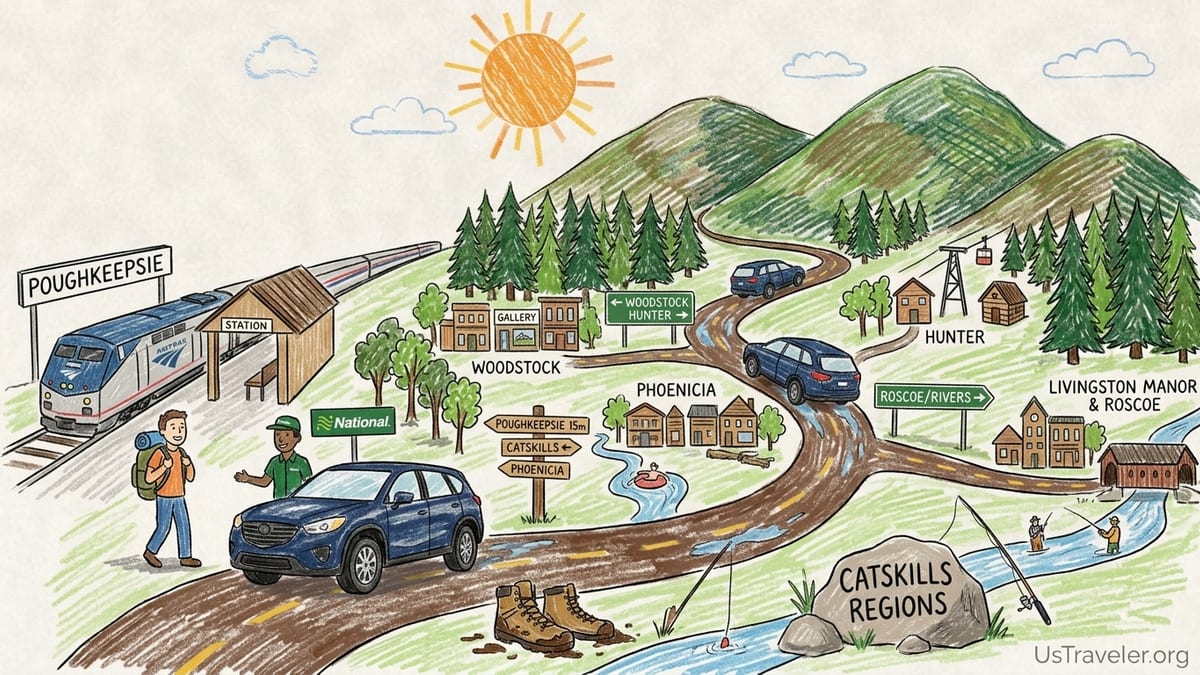
How I Got There: The “No Direct Rail” Reality, Plus My Exact Car Plan
I started with a simple constraint: I wanted to avoid driving the whole way from NYC if I could. Then I ran into the same blunt line I’d seen before from I LOVE NY, which notes that the Catskills are not directly accessible by major train lines. You can take Amtrak or Metro North into the Hudson Valley, but you still need a taxi or rental car to get into the region. That detail matters, because it turns “a weekend” into a logistics puzzle.
My exact combination was Metro North to Poughkeepsie, then a rental car. I picked up a midsize SUV from a national chain directly near the station area, mainly because I wanted something stable on wet mountain curves and because I knew I’d be hauling a cooler and muddy hiking shoes. This is not the cheapest way to do it, but it was the most time efficient for my plan of bouncing between towns. In hindsight, it was also the only reason my weekend stayed flexible when weather and parking got weird.
I briefly considered a bus to Kingston instead, because Kingston is one of the Catskills adjacent hubs with frequent NYC service. But for my specific itinerary, I wanted to start north toward Woodstock and Hunter first, then swing west to Livingston Manor and Roscoe. Doing that by bus would have forced me into ride shares and limited the early morning starts that make hiking and parking easier.
My first recalibration moment came almost immediately: even with a car, you do not glide between Catskills hotspots. Two lane roads, slow pockets through villages, deer heavy dusk driving, and steep stretches that get slick in rain all add minutes that pile up. I entered the weekend thinking I could casually “pop over” from Woodstock to Hunter. After my first set of curving climbs and a sudden fog bank, I stopped saying pop over and started saying commit.
My First Big Lesson: The Catskills Aren’t One Place, They’re Several Regions
Before I went, I had the classic NYC weekender mental map: Woodstock is “the Catskills,” plus maybe a ski mountain. On the ground, it felt more like hopping between separate mini regions. Woodstock and the surrounding Ulster County hamlets have their own vibe, with galleries, cafes, and a dense little center that can feel busy on peak weekends. Hunter and Windham feel more resort oriented and seasonal, shaped by mountain operations and event calendars.
Phoenicia, to me, read like a practical outdoor base. It’s the kind of place where you can grab a coffee, pull on wet boots without anyone looking twice, and pivot between a hike and a river afternoon. Livingston Manor and Roscoe, farther west, felt like a different trip entirely, with a wider sense of space and that fly fishing culture that gives the area a specific identity. By the time I crossed into Sullivan County, I understood why locals talk about the Catskills as plural.
The distance isn’t just miles. It’s also the fact that the terrain dictates how you move. A route that looks direct can still mean climbing through a notch where weather changes quickly, then dropping into a valley where everything is warmer and faster. That’s why I now plan the Catskills by clusters. Trying to stitch Woodstock, Hunter, Phoenicia, and Roscoe into one seamless weekend is how you end up eating dinner too late and arriving at trailheads when lots are already full.
If you only have two nights, pick one main base and one secondary zone. I tried to be ambitious, and that ambition is exactly what made the weekend feel bigger than expected. The Catskills won, gently but firmly.
Driving, Road Feel, And Parking: What Actually Slowed Me Down
The driving itself was beautiful and also the main time sink. My roads were mostly in good shape, but the Catskills are full of stretches where the pavement narrows, sight lines shrink, and your speed drops because you should not be taking curves like you’re on a highway. Wet conditions made that more obvious. After rain, I found myself braking earlier on downhill curves and giving extra space on shaded sections where moisture lingers.
Parking was the second reality check. In Woodstock, I treated parking like I treat a small city: I expected a quick loop, a spot, and then a walk. Instead, I found myself circling longer than I wanted, especially at peak times. The Town of Woodstock publishes clear guidance on where public parking is concentrated around the hamlet and notes that some lots charge by the day on summer weekends. I also paid attention to the town’s rules around municipal lots, because it’s not the kind of place where you want to gamble on what is allowed overnight.
Then there’s the Catskills version of parking drama: high use nature attractions where enforcement is tight and shoulders are not your friend. The Town of Hunter and NYS DEC have been explicit about parking restrictions on Route 23A and Platte Clove Road, and DEC recommends accessing Kaaterskill Falls from specific parking areas instead of trying to improvise. That’s not just bureaucratic language. It’s the difference between a relaxed morning and a stressful one where you’re worried about a tow.
My biggest parking mistake was thinking I could “swing by” a famous spot mid day. When I approached the Kaaterskill area at a popular time, it was immediately clear that the region is trying to balance access with safety. I didn’t lose hours, but I did lose my preferred timeline and had to adjust the rest of the day’s plan. If you’re short on time, this is where you either go early or you go somewhere else and come back off peak.
Where I Stayed: Choosing Bases That Match the Distances
I split my weekend into two bases on purpose, and I’m glad I did, even though it cost me an extra checkout and repack. Night one I stayed closer to the Woodstock side so I could arrive, park, walk the town, and keep my first evening simple. Night two I shifted west toward the Livingston Manor and Roscoe side to shorten my drives for river time and that Sullivan County pocket I didn’t want to rush.
The split base strategy solved one big problem: the Catskills look compact, but returning to the same bed each night can mean long drives after dark. Deer risk is real on rural roads, and I noticed myself becoming a more cautious driver as dusk hit. By relocating, I gave myself shorter end of day drives and more time for unplanned stops.
If I were doing it again, I’d choose one base based on what you want most. If your priority is the classic postcard Catskills, you can base nearer the Hunter and Tannersville corridor for access to high viewpoints, big waterfall energy, and mountain events. If your priority is river culture, quiet roads, and a slower feel, I would base farther west in the Livingston Manor and Roscoe orbit and treat Woodstock as a day trip, not a nightly anchor.
One thing I would not do again is underestimate check in timing. Some Catskills stays are small and personal, which I loved, but that can also mean front desks are not 24/7 in the way you expect in a city. On my second night, I built my afternoon to arrive earlier, because I didn’t want a late arrival to become another stress point.
My Meals And Roadside Stops: What Felt Worth The Detour
I learned quickly that the Catskills reward planning your meals around where you already are. The detours add up. In Woodstock, I made my first dinner an easy walkable meal because I didn’t want to get back in the car after a travel day. The next morning, I grabbed coffee and something portable, because I’d already decided my best chance at a calm hike was an early start.
My best food moments were the ones that matched the day. After a wet hike, I wanted warmth and speed, not a long wait. After a river afternoon, I wanted a real sit down meal. The Catskills deliver on that if you accept that some places will be packed at peak times and some will be surprisingly quiet even on weekends. I had one lunch that took longer than planned because I showed up at what I thought was an off hour and discovered it wasn’t off at all.
As for roadside stops, the Catskills are made for them, but only if you keep your expectations realistic. Pull offs can be limited and some roads don’t have the kind of wide shoulders you’d need for a casual photo stop. When I did stop, it was usually in town centers or at clearly defined lots. That kept me from creating my own problems.
The best detour I made was choosing a less famous stretch of river for a break rather than insisting on the most photographed spot. It bought me quiet. The busiest moment of the weekend was predictable: I wandered toward one of the marquee attractions at a peak hour and instantly felt the weekend crowd density that turns the Catskills into an extension of the city. I didn’t resent it. I just adjusted and promised myself I’d come back midweek.
Hikes, Rivers, And Rules I Had To Respect (Or Pay For)
The Catskills can feel like a choose your own adventure book until you hit special regulations. Two rules shaped my weekend planning the most. The first was Kaaterskill Falls area management: DEC and the Town of Hunter have pushed visitors toward specific access points and away from risky roadside parking. I treated that guidance as mandatory, not optional, because the whole corridor has a history of heavy use and safety concerns.
The second was the Peekamoose Blue Hole permit system. NYS DEC requires a paid permit for use of the Peekamoose Valley Riparian Corridor, including the Blue Hole, during the permit season, and it comes with strict rules. The corridor is open only from a half hour before sunrise to a half hour after sunset, and there are firm prohibitions including no alcohol, no glass containers, and no fires, with additional restrictions on cooler sizes. Permits are linked to a vehicle and must be obtained in advance. I did not try to force this into my weekend without planning, because it’s exactly the kind of place where “we’ll just see” turns into a dead end.
I spent my river time farther west, closer to the Livingston Manor and Roscoe side, where you can feel the fly fishing heartbeat of the Catskills. If you’re planning to fish, the Catskills are not a place to wing it. NYS DEC’s current regulations include special rules on some reaches, seasonal shifts, and even closures on specific stretches to protect stressed trout in summer. I’m not going to summarize all of that in a single line, because it’s the kind of detail you should confirm for the exact water you’re touching. But the takeaway from my weekend is simple: the rules here are real, and they change depending on the stream and the calendar.
My hiking weather was classic Catskills: a warm valley start, then cooler air and occasional wind as I gained elevation. I carried a light rain layer even when the forecast looked decent because mountain conditions don’t always match the town. I also learned not to judge mud by the parking lot. Trails can hold water long after roads dry.
If you want to keep your weekend low stress, pick hikes that match your timing. Famous short attractions can be crowded and feel chaotic. Longer, less hyped trails can be quieter but require more commitment and earlier starts. My best hike of the weekend wasn’t the one with the most dramatic photos. It was the one where I didn’t have to fight for a parking space and could hear the forest again.
Hunter, Windham, And The Resort Factor: Operations, Crowds, And Timing
I built one day around the Hunter and Windham zone because I wanted that northern Catskills mountain energy. Hunter Mountain’s operations calendar matters. In summer and fall, scenic lift rides and events can shape traffic and parking, and in winter, lift and terrain operations dictate everything from lodging prices to dinner crowds.
When I researched ahead, I noticed Hunter Mountain messaging that lift ticket sales can be limited on certain days to manage the on mountain experience. Even if you’re not skiing, it’s a reminder that the Catskills resort corridor doesn’t behave like an open ended public park. It behaves like an operation with capacity, hours, and event weekends. For fall, Hunter has promoted specific dates for “Colors in the Catskills” weekends, and that kind of programming can quickly turn a quiet mountain town drive into a line of brake lights.
Windham’s ski scene has also evolved. Windham Mountain Club has been explicit that capacity is managed and ticket availability can be limited, with policies around rescheduling and day specific products. The practical implication for a weekend planner is that you should not assume you can just show up last minute on a prime weekend in peak season and get the experience you imagined.
My on the ground takeaway: the resort corridor can feel overly busy at the wrong time, and surprisingly calm at the right time. If you want to see the area without the crush, I would aim for early mornings, shoulder seasons, or weekdays. If you want to come for an event, commit to that and plan your drives and meals accordingly. The worst itinerary mistake is pretending you can be spontaneous on a high demand weekend and still stay on schedule.
The Takeaway: How My “Weekend” Plan Changed And What I’d Do Next Time
My original plan was basically three destinations in a trench coat. I thought I’d do Woodstock, a big Catskills hike, and a quick swing through the western Catskills for river time, all without feeling rushed. The distances corrected me. The Catskills are wide, and the roads ask you to slow down.
If you want the weekend to feel restful, choose your anchor zone. If your anchor is Woodstock, stay there and treat Hunter and Windham as a deliberate day trip, ideally early. If your anchor is the western Catskills, base near Livingston Manor or Roscoe and let your itinerary be about rivers, small town meals, and fewer miles. If you try to stitch everything together, you can do it, but the weekend becomes a driving weekend.
I also learned that rules and operations shape the Catskills more than I expected. Parking restrictions around Kaaterskill Clove, permit rules at the Blue Hole, and managed capacity at resort areas all mean you need a plan that respects the reality on the ground. My best moments came when I accepted that reality and built around it instead of fighting it.
The Catskills ended up feeling bigger than I expected, and I mean that as a compliment. It isn’t one getaway. It’s many. Next time, I’ll go back for a longer stretch, or I’ll go back for a tighter focus. A weekend can work, but only if you choose what you’re not doing.
FAQ
Q1. Is there a direct train from NYC into the Catskills?
Not on major rail lines. Amtrak and Metro North can get you into the Hudson Valley, but you’ll still need a taxi or rental car to reach Catskills towns.
Q2. What transportation method did you actually use?
I used Metro North to Poughkeepsie and then rented a car for the rest of the weekend, which gave me the flexibility to move between Woodstock, Hunter, Phoenicia, and the western Catskills.
Q3. Is Woodstock really about two hours from NYC?
Roughly, yes by car in typical conditions, but weekend traffic and slow mountain roads can stretch that. I treated it as “about two hours, plus wiggle room.”
Q4. Where did the Catskills feel most spread out?
The jump from the Woodstock and Hunter corridor over to Livingston Manor and Roscoe is where I felt the region’s scale. It stopped feeling like one destination and started feeling like multiple trips.
Q5. What’s the biggest parking mistake to avoid?
Assuming you can arrive mid day at a famous spot and find easy parking. In high use corridors, follow official parking guidance and avoid shoulder parking where restrictions are enforced.
Q6. Do I need a permit for Peekamoose Blue Hole?
Yes during the permit season. NYS DEC requires a paid permit for the Peekamoose Valley Riparian Corridor during that period, and permits must be obtained in advance.
Q7. Are there strict rules at Peekamoose Blue Hole?
Yes. Rules include time of day limits and prohibitions such as no alcohol, no glass, and no fires, along with other restrictions that are enforced to protect the area.
Q8. Can I plan a Catskills weekend without a car?
You can reach gateway cities by bus or train, but once you’re there you’ll have limited access to trailheads and spread out towns. For the kind of multi town weekend I did, a car was essential.
Q9. How should I choose where to stay for two nights?
Pick one main base that matches your priorities. Woodstock works for arts and walkability. The Hunter and Windham zone works for mountain operations and events. Livingston Manor and Roscoe work for a quieter western Catskills feel.
Q10. What would you do differently next time?
I’d either extend the trip or narrow the focus to one cluster of towns. The Catskills reward depth, and the drives between zones can quietly consume a weekend.