


I thought Kaaterskill Falls would be the kind of Catskills stop where you roll up, stroll 10 minutes, snap the postcard photo, and move on. The waterfall delivered, but the part I underestimated was everything that comes before it: finding legal parking, understanding seasonal roadside restrictions, and choosing a route that matches the kind of visit you actually want (overlook only, or the steeper descent toward the lower area). If you’re arriving on a weekend between late spring and early fall, the access plan matters as much as your hiking plan.
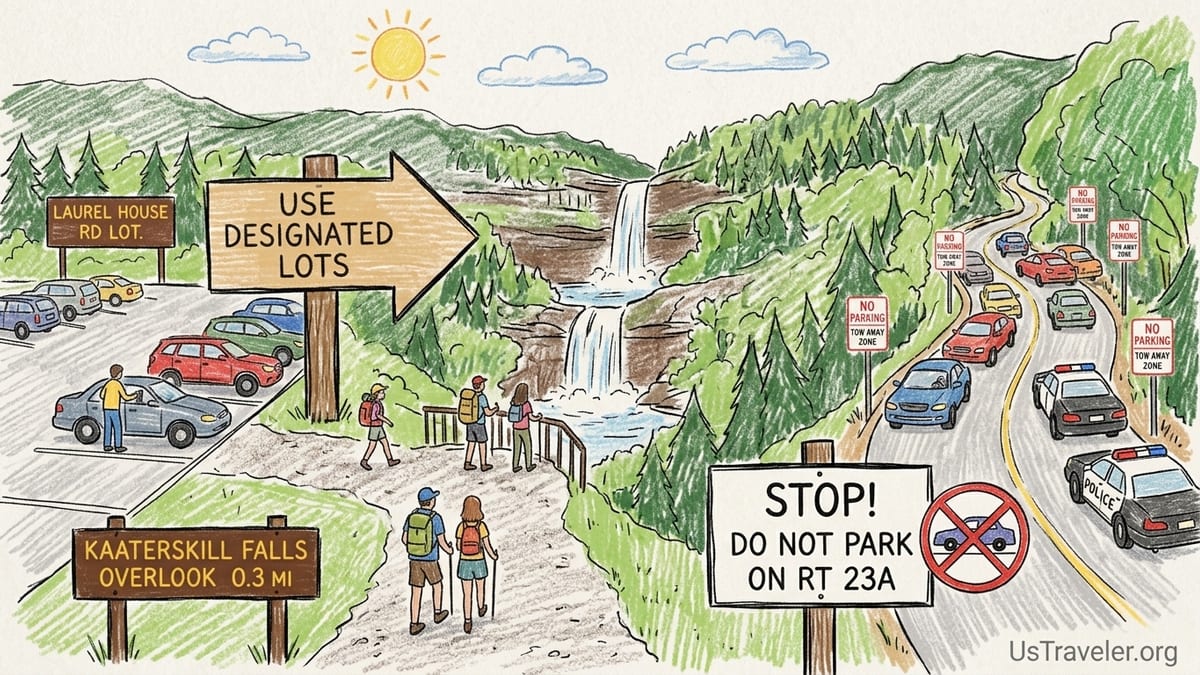
Before You Go: The New Reality of Access (And Why Route 23A Is a Trap)
Let’s start with the headline you need to internalize before you punch anything into your GPS: seasonal roadside parking restrictions are now a defining part of the Kaaterskill Falls experience. The New York State Department of Environmental Conservation (DEC) directs visitors away from Route 23A pull-offs in Kaaterskill Clove during peak season and recommends using designated lots such as Laurel House Road, Scutt Road, or South Lake instead. If you show up expecting to grab a random shoulder spot along 23A, you’re setting yourself up for a stressful start and, potentially, a tow.
The Town of Hunter has also published travel advisories for the Clove that reinforce the same message: do not park along Route 23A or in informal pull-offs. In practice, this means you should plan your day around a real parking lot with a real trailhead sign, not around “finding something along the road.” The entire corridor has become a safety and congestion problem in warm months, and enforcement has followed.
Even if you are visiting outside the busiest summer weekends, the old habit of “just pull over near the falls” is outdated. DEC has closed some former access points and redesigned the visitor flow around safer trailheads. The short version is simple: if parking feels like it should be easy, you are probably in the wrong place.
The Exact Parking Area I Used: Laurel House Road (And What It Was Like On Arrival)
For this hike, I used the DEC Laurel House Road parking area in Haines Falls, the one DEC specifically lists as a primary access point for the Kaaterskill Falls overlook. This is the lot you want if your priority is a straightforward, low-stress walk to the observation platform and you do not want to gamble with roadside restrictions.
Because parking drives the whole day here, I built the morning around it and arrived early. I pulled in shortly after 8:00 a.m. on a weekend morning in peak season, and the lot was already active. It was not full at that moment, but it was filling in a steady, predictable way: a few cars leaving, more cars arriving, and people regrouping at the trunk with water bottles and sneakers. The vibe was less “quiet trailhead” and more “organized tourist hike,” which is exactly what Kaaterskill Falls is most days.
What I noticed immediately was how much the experience changes when you start from a proper lot. You’re not stepping out into a narrow shoulder with traffic whipping by. You’re not doing that awkward roadside shuffle with kids and dogs. You’re starting on land that is designed for the volume Kaaterskill Falls attracts. If you only do one thing right here, make it this: park legally in a designated area and accept that it might add a few minutes of walking.
The Walk To The Overlook: Trail Surface, Shoes, And How It Actually Feels
From Laurel House Road, DEC describes the walk to the observation platform as about 0.3 miles one way on a firm crushed-stone surface with a relatively gentle grade. That matches how it feels underfoot: more like a wide, well-built path than a typical rooty Catskills singletrack. It’s not perfectly flat, but it is approachable for a wide range of visitors, including families and people in casual footwear.
That said, “approachable” doesn’t mean “no prep.” I wore low-cut hiking shoes with good tread, the kind you might wear for mixed gravel and wet stone, and I was glad I did. The crushed stone is forgiving, but the area near the viewpoint can be damp, and the human factor matters: you’re often stepping around groups, passing people who stop suddenly, and navigating the small pinch points where everyone wants the same photo angle.
If you’re deciding what to wear, here’s the practical distinction: sneakers are fine for the Laurel House to overlook walk in dry weather, but if you even think you might continue down toward the lower area, choose real hiking footwear. The surface changes quickly once you leave the easy approach. What starts as smooth and wide becomes steeper, rockier, and much less forgiving if it’s wet.
Overlook Versus Lower Area: My Decision, The Stairs, And The Part That Gets Serious
Kaaterskill Falls is one of those places where people arrive with different definitions of “doing the hike.” Some visitors mean “the overlook and back.” Others mean “go down toward the base for the roar and the mist.” DEC’s improvements have made the overlook experience safer and more accessible, but the steeper descent beyond the main platform is where the day can turn from casual walk into a real hike.
On my visit, I spent time at the observation platform first and treated it like the main event, not a quick stop. The viewpoint is excellent: you get a direct, dramatic look at the upper tier, and it’s the kind of scene that explains why Kaaterskill Falls has been famous for generations. It’s also where crowds concentrate, so if you want a calmer moment, your best lever is timing, not technique. Early arrivals get space. Late morning visitors get lines of people waiting for the same photo spots.
I did continue beyond the overlook toward the lower area, but I did it deliberately and slowly. The character of the route changes: steeper grade, more uneven footing, and sections where stone steps and slick rock demand attention. DEC has built significant infrastructure in this corridor over the years, including a large stone staircase as part of broader safety improvements. Even with that work, this is not a place to rush, especially if the rock is wet or if you’re navigating around other hikers on narrow sections.
If you are deciding whether to descend, my practical read is this: the overlook is the best “high reward, low risk” option. The lower area can be spectacular, but it’s where ankles get rolled, knees get punished on the climb back, and people make poor decisions near cliffs and water. If anyone in your group is unsure on steep stairs, this is the moment to say “we came for the view, and we got it.”
Safety Rules You Need To Treat As Non-Negotiable
Kaaterskill Falls is gorgeous, but it is also a place where safety rules exist because too many people ignored common sense. DEC regulations prohibit being within six feet of cliff edges except on marked trails, and they also prohibit entering the water within 150 feet upstream of the falls. Those details are not trivia. They are the bright line between a memorable day and an emergency response.
On the ground, the safest behavior is also the simplest behavior: stay on the built trail, stop where the fencing and signs tell you to stop, and treat wet rock as if it is ice. The viewing areas are designed to give you the drama without requiring you to inch toward an edge. If you see someone stepping past barriers for a better angle, don’t follow. Kaaterskill Falls is not the place to crowd the cliff line.
One more practical note: the trail feels very different depending on weather. After rain, the stones and stair sections can get slick, and the gorge holds moisture. In shoulder seasons, frost can linger in shaded sections. If conditions look even slightly questionable, slow down, use handrails where available, and accept that turning around early is a smart choice.
Crowds, Timing, And How Long I Actually Spent There
This is not a “quick, secret waterfall.” Kaaterskill Falls is one of the Catskills’ biggest draws, and it shows. On my visit, I spent roughly two hours total from the moment I parked to the moment I was back at the car, and only part of that was walking. A surprising amount of time was absorbed by normal crowd dynamics: waiting for a clear view at the platform, letting groups pass on narrower sections, and pausing because the person in front of you stopped to retie a shoe or take a video.
At the overlook itself, I genuinely lingered. I stayed around 30 to 40 minutes, long enough for the scene to change as different groups came and went. That time mattered because it let me enjoy the falls instead of just checking a box. It also gave me a chance to watch how people move through the space: the platform area is an “everybody funnels to the same spot” bottleneck, and patience is part of the cost of admission.
What would I change about my arrival timing? I would keep the early start and make it even earlier if I were traveling on a peak foliage weekend. Laurel House Road is the most convenient access point for the overlook, which also makes it a magnet. Arriving in the mid-morning window is when you risk circling for a spot or feeling pressured to rush because the crowd energy is high. If you can be parked before 9:00 a.m., you give yourself the best chance at a calmer walk and a more enjoyable viewpoint.
The last timing reality is this: your plan should include time to exit the area. The Clove corridor can feel tight and slow when lots fill up and drivers are hunting for illegal shoulder spots. The smoother your parking choice, the smoother your exit.
The Takeaway
Kaaterskill Falls is still one of the most impressive waterfalls in New York, but it’s no longer the kind of place where you can treat parking as an afterthought. The access rules have changed, the enforcement is real, and the most successful visits begin with choosing a designated lot like Laurel House Road, Scutt Road, or South Lake and building your timing around that decision.
If you want the best balance of payoff and simplicity, park at Laurel House Road and commit to the overlook as the main event. Bring footwear with traction, arrive early, and plan to spend enough time at the platform to actually enjoy it instead of competing with it. If you choose to descend toward the lower area, do it with the mindset of a hike, not a stroll: slower pace, more attention to footing, and zero tolerance for stepping near cliff edges or into restricted water zones.
In other words, Kaaterskill Falls is a waterfall you earn twice: once by showing up with a parking plan, and again by moving through the gorge with respect.
FAQ
Q1. Where should I park for Kaaterskill Falls if Route 23A pull-offs are prohibited?
Use designated access points recommended by DEC, including Laurel House Road, Scutt Road, or South Lake, rather than roadside pull-offs in Kaaterskill Clove.
Q2. How far is the walk from Laurel House Road to the Kaaterskill Falls overlook?
DEC lists the overlook as about 0.3 miles one way from the Laurel House Road parking area on a firm crushed-stone trail.
Q3. Is the Laurel House Road route difficult?
The overlook route is generally easy with a gentle grade and wide tread, but it can feel busy and can be slick near viewpoint areas in wet weather.
Q4. Do I need hiking boots for Kaaterskill Falls?
For the overlook-only walk, sturdy sneakers can work in dry conditions, but hiking shoes with good traction are a better choice, especially if you plan to descend beyond the overlook.
Q5. Can I go down to the base of Kaaterskill Falls?
You can hike beyond the overlook toward lower areas, but it becomes steeper and more demanding. Conditions and safety signage should guide your decision on the day you visit.
Q6. What safety rules should I know at Kaaterskill Falls?
DEC rules include staying at least six feet from cliff edges except on marked trails and prohibiting entry into the water within 150 feet upstream of the falls.
Q7. How early should I arrive to get parking at Laurel House Road?
On weekends in peak season, arriving early in the morning gives you the best chance at a spot and a less crowded walk to the platform.
Q8. How long should I plan to spend at Kaaterskill Falls?
Even though the overlook is close to the parking lot, crowds and time at the viewpoint add up. Planning for 1.5 to 2.5 hours makes the visit feel unhurried.
Q9. Is swimming allowed at Kaaterskill Falls?
Swimming and wading restrictions apply in the immediate falls area, and DEC specifically prohibits entering the water within 150 feet upstream of the falls.
Q10. What is the biggest mistake first-time visitors make at Kaaterskill Falls?
Underestimating access and parking, arriving without a legal lot in mind, and then feeling pressured to park illegally or rush the hike because of congestion.