


I pulled off Hurd Road in Bethel, New York, and the landscape immediately did something the documentaries never quite manage: it got quiet. Not silent, exactly. There were cars in the lot, families arranging strollers, and a couple in tie-dye debating whether they should do the grounds experience first or save it for after lunch. But the Catskills air felt spacious, and the rolling green beyond the buildings looked like it had been waiting a long time for people to stop calling this place “Woodstock” and actually see where Woodstock happened.
Arrival Day Logistics: Parking, Timing, And What A Ticket Actually Gets You
Bethel Woods Center for the Arts sits at 200 Hurd Road, and arriving feels more like pulling into a rural fairground than a traditional museum campus. The road narrows into the kind of two-lane approach where you can imagine 1969 traffic backing up for miles, except now it is orderly. For a regular museum day, I followed staff signage to the main lot across from the museum buildings, parked without a fee, and walked in with the kind of ease that feels almost suspicious when you know the site’s history.
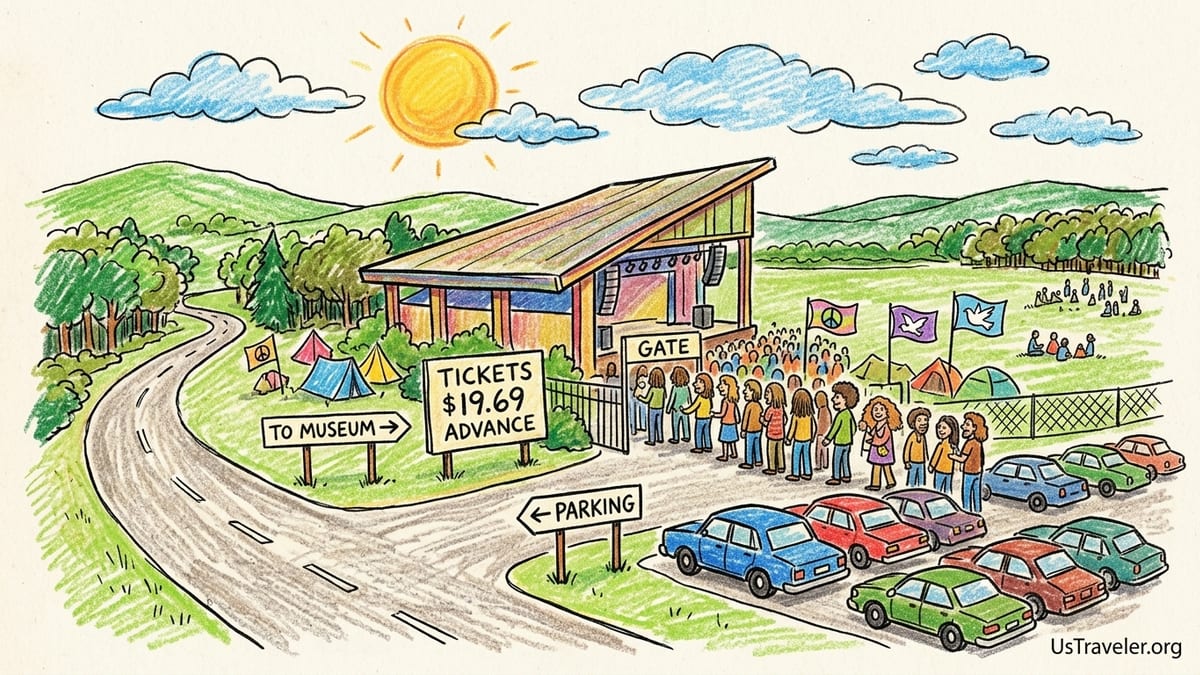
I had bought an advance adult ticket online, partly to lock in the lower price and partly because I wanted the day to feel planned. Adult museum admission is listed at $19.69 in advance and $22.69 for walk-up purchase. Those numbers are not a typo, and they are not subtle. The decimal points are part of the storytelling, a nod to 1969 that sets the tone before you even scan your ticket.
Hours matter here. For 2026, the museum is open daily from April 1 through December 31, normally 10 a.m. to 5 p.m., and the museum notes extended hours on show days. That show-day detail is important, because Bethel Woods is not just a museum. It is a working concert venue, and the campus breathes differently when a pavilion concert is on the calendar. If you are visiting on a concert day, plan to confirm the museum’s hours and last entry time before you set out, because traffic patterns, security posture, and evening crowd volume can change the feel of the visit.
One more detail that I appreciated in practice: Bethel Woods runs cashless for food and beverage purchases on site, and while museum tickets and the gift shop may still accept cash, I found it easier to assume I would be tapping a card for anything from coffee to a sandwich. If you are the kind of traveler who still likes to carry a little emergency cash for rural day trips, bring it, but do not depend on it.
First Steps Inside: The Entrance, The Flow, And The “Not-Just-Woodstock” Feeling
The entrance experience is part welcome center, part checkpoint, and part time machine. Once inside, the museum’s energy is immediate: the lighting drops, the colors change, and the sound design starts doing the work of an opening scene. I am careful about hyperbole, but here it is fair to say that the museum is engineered to move you emotionally as well as informationally.
It is also easier to navigate than I expected. The main exhibit is designed for self-guided movement, and I never felt trapped in a single linear path. On a busy day that matters. You can linger at an artifact case, step aside for a family to pass, and then drift toward the next gallery without breaking the story.
Bethel Woods bills this as a museum of the 1960s with Woodstock as the centerpiece, and that framing comes through in the early sections. Rather than dropping you straight into three muddy days in August, the exhibits spend time on the decade’s pressure points: political assassinations, civil rights battles, generational conflict, and the way music became both a soundtrack and a tool. I left that opening stretch feeling like Woodstock was being treated as a culmination, not an isolated miracle.
It is a smart curatorial choice, because it shifts the question from “How did this festival happen?” to “Why did this moment need to happen?” That distinction kept the visit from becoming nostalgia tourism. It felt closer to cultural history.
The Exhibits That Actually Stuck With Me: Films, Artifacts, And The Museum’s Best Details
Every museum has the artifacts you expect and the artifacts you do not realize you want until you are standing in front of them. Here, the objects are less about celebrity worship and more about human scale. The museum leans heavily into the idea that Woodstock was experienced by people who were not famous, and that choice changes what feels precious behind glass.
Several exhibit elements genuinely stood out. One was the use of film, not as background wallpaper but as a narrative engine. Screens are placed where you cannot help but pause, and the footage is curated to match the room you are in. In the sections dealing with the build-up and the on-the-ground reality, the films do not just show performances. They show logistics, tension, and the strange calm that comes when normal systems stop working and the crowd becomes its own temporary city.
I also gravitated toward the smaller, more intimate artifacts: printed materials that look like they survived a backpack, personal items that feel like they could have belonged to someone you know, and signage that clarifies how quickly a planned event turned into something else. I found myself reading more closely than I usually do in interactive-heavy museums, because the text panels were not trying to be cute. They were trying to be clear.
One of the museum’s signature touches is its immersive approach. Bethel Woods has long described the experience as multimedia, and that is accurate. You are not simply walking past glass cases. You are walking through a carefully layered mix of sound, light, projection, and objects that are meant to suggest not just “what happened,” but what it felt like in the moment.
How Long It Really Takes: My Actual Time In The Galleries (And Why Rushing Is A Mistake)
Before I arrived, I kept trying to guess how long the museum would require. Museums tied to a single event can sometimes be quick, especially if you already know the broad story. This is not that kind of museum. I moved at a normal pace, not racing but not lingering at every single panel, and I still needed roughly two hours in the main exhibit to feel like I had done it justice.
The museum itself notes that its guided docent tour runs about 45 minutes to one hour, depending on group size and the tour guide, which offers a good clue: if a guided overview takes close to an hour, a self-guided visit with stops for film segments and artifact reading will almost always run longer. If you are a detail person, budget more time.
The biggest time variable is film. You can do the “glance and move on” version of this museum in under an hour, but you will leave without the emotional arc that the filmmakers and curators clearly want you to absorb. I watched more than one film segment through to the end, and those minutes added up. They were also the moments where the museum stopped being information and became atmosphere.
If you are building a day trip itinerary, I would treat the museum like a half-day anchor. Give it a real block of time, then decide what else fits around it. That approach made the rest of my visit feel earned rather than squeezed.
Concert Days And Restrictions: What Changes When Bethel Woods Is Also A Venue
Bethel Woods is a museum campus and a live concert operation, which means the rules you encounter can depend on what else is happening that day. The museum explicitly notes extended hours on show days, and the broader venue policies emphasize security screening, a clear bag policy for many events, and a no re-entry approach for pavilion shows. Even if you are only visiting the museum, it is wise to anticipate a more security-forward environment on show days.
One practical constraint to understand is parking access. For museum visits, parking is typically in the main lot across from the museum. For major concerts, parking operations can change, and venue policies state that patrons who do not have a ticket for an event may not be allowed to park on site during certain event operations. In other words, if you are trying to visit the museum on the same day as a big show you are not attending, you should confirm whether general museum parking is being limited.
If you are pairing a museum visit with a concert you are attending, that is a different story. Bethel Woods advertises museum discounts tied to valid concert tickets, and it also promotes museum hours that can run later on show days. I met one group in the lobby who treated it like a pre-show ritual: museum first, late lunch, then the pavilion. It looked like a good rhythm, especially if you want to avoid the feeling of arriving only when the gates open and the crowd shifts into concert mode.
On any day, I recommend packing as though you might be passing through security screening at least once. Keep your bag minimal. Bring water within the venue’s stated guidelines when applicable. And if you have any doubt about what is permitted, plan to leave extra items in the car. The easiest day at Bethel Woods is the day you do not have to turn around at an entry point.
The Augmented-Reality Grounds Tour And The Separate Historic-Field Experience: Worth It, If Available
After I finished the main exhibit, I faced the question everyone seems to face here: do you head straight for the field, or do you add the layers first? Bethel Woods treats the historic grounds as a separate part of the experience, and in 2026 the site notes that the Bethel Woods Grounds and the Meet Me at Woodstock augmented-reality tour reopen on May 1, 2026. That date matters if you are traveling early in the season, because the museum itself opens April 1, but the full outdoor interpretive layer may not be operating until May.
There is also a separate self-guided historic-field experience listed at $10 when available. That phrasing is important. Availability can change based on calendar, staffing, weather, and campus operations. I approached it the same way I would approach timed entry at a popular historic site: I did not assume it would be offered just because I wanted it. I confirmed at the welcome desk and then made my decision.
When I did use the augmented-reality component, it felt less like a gimmick and more like a respectful overlay. The best AR experiences do not try to replace what is in front of you. They help you see what is missing. On an open hillside that looks peaceful today, the tour helps you imagine density, sound, and scale. It also changes your posture. You stop walking like it is a park and start walking like it is a site.
If you have limited time, I would still prioritize the main museum first, because it gives you context. But if you have the space in your schedule, the grounds layer is the bridge between learning and feeling. And at Bethel Woods, feeling is part of why you drove out here in the first place.
Woodstock The Town Vs. Woodstock The Festival Site: Why Bethel Is The Place That Matters
It is one of America’s most persistent travel misunderstandings: people hear “Woodstock” and picture the town of Woodstock, New York, with its artsy downtown and iconic name. The reality is more complicated, and Bethel Woods makes that clear without making a fuss. The 1969 Woodstock Music and Art Fair did not take place in the town of Woodstock. It took place here, in Bethel, on Max Yasgur’s farm.
This distinction matters culturally and logistically. Culturally, it changes the mythology from a bohemian village hosting a festival to a rural community absorbing a seismic influx of people. Logistically, it changes your trip planning. If you book lodging in the town of Woodstock because you assume you are staying “near the festival site,” you may find yourself facing a much longer drive than expected, especially on summer weekends when roads are busy.
Standing on this property, the name confusion starts to feel like part of the story. Woodstock became shorthand for an idea: youth culture, music as movement, a national mood. Bethel is the geography of the idea. The museum does not demand that you correct people. It simply demonstrates, through maps and narrative, that place is not a footnote. Place is a character.
For travelers, the takeaway is simple: if your goal is to stand where Woodstock happened, you want Bethel Woods in Bethel, New York. You can still visit the town of Woodstock on the same trip for its own history and culture, but they are not the same destination, and treating them as interchangeable will flatten your experience.
The Takeaway
I expected a good museum. I did not expect a recalibration of my mental map. Bethel Woods Museum is not just a place to revisit a famous weekend. It is a place that insists you understand the decade that produced it, the rural landscape that held it, and the human-scale choices that turned disorder into something like community.
By the time I walked out of the museum and aimed myself toward the open land, I felt like I had been handed a new set of lenses. The field was no longer an abstract backdrop from album photos. It was a specific slope and a specific horizon and a specific distance between points, which meant the scale of the gathering finally made physical sense.
And then I reached the festival field. The grass was neat, the air was calm, and the hillside looked almost too serene to be the setting for anything chaotic. I stood there longer than I planned, because it was the first time “Woodstock” stopped being a cultural slogan in my head and became a place under my feet. That shift, from story to site, is what changed the visit.
FAQ
Q1. What are The Museum at Bethel Woods hours in 2026?
For 2026, the museum is open daily April 1 through December 31, normally 10 a.m. to 5 p.m., with extended hours on show days.
Q2. How much are Bethel Woods Museum tickets for adults?
Adult admission is $19.69 when purchased in advance and $22.69 for walk-up purchase.
Q3. Is there a separate ticket for the historic festival field experience?
Yes. A separate self-guided historic-field experience is listed at $10 when available.
Q4. When does the augmented-reality experience operate in 2026?
The Meet Me at Woodstock augmented-reality tour is listed as reopening May 1, 2026, along with the Bethel Woods Grounds.
Q5. How long should I budget for the museum itself?
Many visitors can see the main exhibit in about two hours at a comfortable pace, especially if they stop to watch films and read artifact labels.
Q6. Are museum hours different on concert days?
They can be. The museum notes extended hours on show days, and hours may vary depending on the event schedule.
Q7. Can I visit the museum if I am not attending a concert that day?
Often yes, but concert operations can affect parking and campus access, so it is smart to confirm hours and access rules for that specific date.
Q8. Is the Woodstock festival site in the town of Woodstock, New York?
No. The 1969 festival took place in Bethel, New York, on Max Yasgur’s farm, which is where Bethel Woods is located.
Q9. Is parking free at Bethel Woods for museum visits?
On typical museum days, parking is available in the main lot across from the museum, and venue policies indicate no charge for parking in their general lots.
Q10. What is the biggest mistake first-time visitors make at Bethel Woods?
Rushing. The films, artifacts, and the walk to the festival field work best when you give the museum enough time before stepping onto the grounds.